Study of the Relationship Between Logical and Ethical-Emotional Abilities
Study of the Relationship Between Logical and Ethical-Emotional Abilities
V. L. Talanov
St. Petersburg, March 2017
Problem Statement
In socionics (one of the branches of the psychology of individual differences), disputes continue to this day over whether logical and emotional abilities form a dichotomy in the human population, that is, whether they are negatively correlated with one another. The prevailing view is that a substantial negative correlation is present, just as it is present between sensory and intuitive abilities.
Several years ago, the author already published experimental data collected on a limited sample that supported this hypothesis. In the present work, this hypothesis is tested on substantially larger experimental material.
Methodology
To test the hypothesis, data obtained previously using the author’s MOLTI-4 socionic diagnostic questionnaire for 1729 respondents (437 men, 1292 women) were used. The composition of the items in this socionic diagnostic questionnaire, originally intended to diagnose the proximity of subjects to each of the 16 standard psychotypes, also makes it possible to construct special scales for diagnosing the properties of interest to us: pure logical abilities (without admixture of indicators denying emotional abilities) – see Table 1, pure ethical-emotional abilities (without indicators denying logical abilities) - see Table 2, and an additional scale whose items deny the presence of ethical-emotional abilities in the subjects (see Table 3). The composition of the items in these scales fully corresponds to the current conceptions in socionics and in the Keirsey and MBTI typologies regarding abilities selectively associated with the logical and ethical-emotional poles. The items of the emotional scales are well balanced with respect to the contributions of white and black ethics, while the composition of the experimental logical scale is approximately balanced by functions and has a slight predominance of black-logic items over white-logic items, which was immaterial for the purposes of the present work.
The subjects’ raw responses to each questionnaire item were cleared of the influence of their differing individual levels of social dissimulation and differing response-style characteristics (that is, tendencies to answer yes or no more often and to give ratings with a narrow or wide spread). The responses were then normalized to achieve a sample mean of zero and a sample standard deviation of one for each individual questionnaire item. The raw value of each scale for each subject was calculated by summing that subject’s processed responses across all items of the scale (taking the sign into account for the last item of the logical-abilities scale). The raw values of the resulting scales were then, in turn, normalized to a standard deviation of one (over the entire sample) for each scale. Linear correlations between the scale scores were then calculated over the array of results from all subjects, and graphs were constructed (using the capabilities of the licensed MS EXCEL program).
The correlations were calculated twice, for two data arrays. The first time – on the array of subjects’ results (for the three scales of interest to us), which was not corrected for the “lopsidedness of the sample” (that is, for the unequal representation of representatives of different psychotypes in it). The second time – for data arrays that had already been corrected for the unequal representation of psychotypes in the sample. In this case, the correction is performed by dividing all results of each subject by the square root of the proportion of that subject’s psychotype in the sample. This mathematical operation, performed before calculating the correlations, makes it possible to completely eliminate any influence whatsoever of the “lopsidedness of the sample” (the unequal proportion of different psychotypes in it) on the resulting correlations.
To construct Table 6 (the values of the three experimental scales averaged by psychotype), the results of diagnosing the subjects’ psychotypes with the questionnaire were used (the methodology for diagnosing psychotypes with questionnaires of this series is described in greater detail in the methodological sections of the author’s other works, links to which are provided at the end of the article).
| Table 1. “Pure Logic” Scale (Logical Abilities) |
|---|
| In other people’s logical arguments and in the arguments offered in support of them, I often recognize something well known and old that I had forgotten. |
| If I go to a café with friends, I always estimate how much money each person should have with them. |
| I like all kinds of structural diagrams and enjoy examining them. |
| I like devising complex problems for myself that require comparing many facts. |
| I instantly see a regular structural connection among facts and events that at first glance are disparate, where others perceive no connection between them at all. |
| I can repeat without error a fairly long phrase that I have just read or that another person has just spoken aloud (test yourself by repeating aloud the wording of the question you have just read - no peeking). |
| If something is bothering me, I immediately begin analyzing all the separate aspects of the situation. |
| I am always very fascinated by ideas for increasing the efficiency of various enterprises, - for this purpose I often propose technical innovations and unconventional approaches and willingly take business risks. |
| I quickly perform arithmetic operations mentally on any integers (I believe my brain is fairly well trained for this, and the process itself is familiar and gives me some pleasure). |
| I read very quickly. |
| I often think in terms of gain, efficiency, and utility. |
| I can explain the essence of any phenomenon clearly in a few phrases. |
| I easily absorb all kinds of news and analytical information by ear. |
| Better than others, I sense and quickly grasp subtle nuances when comparing matters in terms of their profitability. |
| I have a strained relationship with complex household appliances. |
| Table 2. “Pure Ethics” Scale (Ethical-Emotional Abilities) |
|---|
| I experience anxious agitation and become very upset if I see animals suffering. |
| Sometimes I amuse myself by flattering someone - without any particular purpose, simply to observe how the person’s mood changes for the better. |
| I am a very emotionally sensitive and benevolent person; I subtly sense nuances in relationships. |
| I always quickly sense what another person will “fall for.” |
| It is difficult for me to remain unruffled when everyone is happy about something - as a rule, I automatically become happy along with them. |
| First and foremost, I am oriented toward my inner ethical world, the world of feelings and experiences. |
| I always know who in a group likes me and who does not. |
| When I watch a good film, I can easily put myself in the place of the main character and find myself caught up with that character in the tension of the unfolding events, almost as if I were on the other side of the screen. |
| I instantly distinguish by ear a sarcastic “thank you,” a grateful “thank you,” and an angry “thank you.” |
| In books, I am interested not so much in the plot as in the relationships between people. |
| In many situations, my emotions instantly “wind themselves up” to a high degree. |
| I usually anticipate other people’s angry outbursts in advance. |
| I usually see immediately whether another person is cheerful. |
| I usually understand immediately that my friend is beginning to get angry. |
| If someone close to me cries, tears come to my own eyes as well. |
| I read people like an open book. |
| I always notice and remember who knows whom and what their closeness is based on. |
| If my friends are frightened, I usually understand it immediately, although I do not share their fear. |
| Other people’s laughter is almost always contagious for me. |
| I easily determine whether another person’s smile is sincere or deliberately “made.” |
| Watching certain scenes in films is quite capable of “knocking” a tear out of me. |
| I am highly observant of people’s ethical behavior and always pay attention to improper acts among my acquaintances and friends. |
| I know how to inflame passions, making a mountain out of a molehill. |
| I usually see and understand what a person is feeling even before that person says anything about it. |
| I immediately see whether my friend is sad or not, although I myself remain in my own mood. |
| I have a good feel for other people’s intonations, gestures, and looks. |
| I can manipulate the mood of the person I am speaking with during a conversation at will. |
| I easily become “infected” by another person’s anxiety. |
| I have a good feel for relationships between people and am perceptive about the intrigues and schemes of ill-wishers. |
| I quickly notice anxiety in another person’s voice. |
| I practically always develop an involuntary answering smile when I communicate with a person who is in a very good, elevated mood. |
| From another person’s behavior, facial expressions, and voice, I quickly recognize that person’s mood. |
| If someone close to me is in a good mood, I see it instantly. |
| Another person’s fear is easily transmitted to me. |
| I am a good mediator in relationships because I am gentle, affectionate, and soothing; I never push myself into the front ranks and never initiate conflicts myself. |
| I easily and quickly notice hostility directed at me in a person’s behavior. |
| I know how and like to establish good relations between people in a group. |
| I quickly notice signs of dissatisfaction in a person’s behavior. |
| If I see something very horrifying and frightening - I will not be able to restrain my feelings; with high probability I will become hysterical. |
| From another person’s eyes and face, I easily read that person’s intentions. |
| I am sensitive and observant to sudden small shifts toward a more negative and “cold,” minor-key, or dissatisfied mood in my partner or interlocutor. |
| I find it unpleasant to watch another person grimace in pain - I immediately begin to feel something similar to that person’s suffering myself. |
| I always experience a strong feeling of joy and inspiration from the successes of a close family member. |
| I usually determine quickly how and with what one can “approach” a new person. |
| I often influence another person in order to raise that person’s mood, make that person more self-confident and less minor-key or anxious. |
| I always quickly sense changes in the mood of the person I am speaking with. |
| I usually find it easy to understand whether another person is telling the truth or lying. |
| I always have a good sense of the moment when a person ceases to be my enemy. |
| I almost always feel the pain of a close family member as my own. |
| I possess a gift for empathy and am excellent at calming another person and relieving that person’s emotional tension. |
| I easily detect whether an “attack” on a person had an effect and whether it worsened that person’s mood. |
| I often pay attention to changes in the relationships of people I know. |
| I can express my feelings beautifully: from elevated intonations to subtle irony. |
| I have always taken great pleasure in choosing and giving gifts to people whom I liked or to whom I owed something. |
| I am sensitive and observant to sudden small shifts toward a more positive and “warm” mood in my partner or interlocutor. |
| I experience a feeling of genuine suffering if my favorite team loses or if someone close to me comes home dejected after failing an examination. |
| I quickly see and understand what can be used to interest a specific interlocutor. |
| I have a large, flexible, and varied set of techniques for starting an acquaintance. |
| I like situations with increasing emotional tension. |
| Feelings, passions, emotional memories, and experiences occupy more time in my thoughts than logical reasoning or business calculations. |
| There have been occasions in my life when I had “eyes wet with tears” solely because of my joy for others. |
| I easily detect whether praise or flattery had an effect on a person and whether it improved that person’s mood. |
| I can flexibly manipulate my relationships with other people, decreasing or increasing the distance according to the situation, as well as according to how “needed” a business partner is and that person’s status in society. |
| I always quickly sense if a person has become tired of talking with me and is trying to leave. |
| I often intrude into other people’s emotions and experiences with my own feelings. |
| I like, as it were, to create “emotional whirlwinds” around myself so as to be at the focus of human emotions and passions. |
| I easily catch anxiety or distress in another person’s voice. |
| A person nearby with a sad, dejected face generally spoils my mood as well. |
| My mood improves when someone passes along warm, sincere greetings to me from another person. |
| I quickly see all the psychological weaknesses of a new person. |
| Table 3. Scale of Denial of Ethical-Emotional Abilities |
|---|
| The misfortunes of my friends do not make me feel anything special. |
| My friends’ joy is their own personal joy; as a rule, it does not affect me and cannot “infect” me. |
| I always control my behavior easily and completely. |
| I am usually indifferent to everything and am not prone to any anxiety. |
| In relations with people, I often lack sensitivity and tact. |
| I can catch and crush flies or wasps with my hands without disgust. |
| If the mood of the person I am speaking with changes during a conversation, I usually find it difficult to understand where it came from. |
| I do not always understand what offended the person I am speaking with during a conversation. |
| I have always had difficulties in knowing and understanding other people. |
| I rarely worry and almost never feel anxious about the consequences or about other people’s possible reaction to my actions. |
| The anger of the person I am speaking with usually does not affect me and does not change my mood. |
| I find it difficult to guess whether my friends are happy. |
| I am usually poorly informed about my friends’ feelings. |
| I admit that I do not understand people’s feelings well, and therefore I am cautious in communication and try to keep my distance from people. |
| Quite often, for some reason, people take offense at my words, although I did not intend to offend them at all. |
| I am a cool-headed person and rarely become attached to anyone. |
| I do not need any leaders or chiefs; I am on my own. |
| I remember people’s voices poorly and recognize them poorly over the telephone. |
| I have little insight into other people’s experiences. |
| In response to some personal success and joy of a close person, I can politely say that I am happy too, but inwardly, as a rule, I remain calm and unruffled. |
| I am emotionally “short-sighted” and usually discern in others only very vivid and strong experiences. |
| I am a very self-sufficient person - I am usually comfortable even by myself; in any case, I generally do not need anyone’s help or support. |
| I find it difficult to read another person’s mood from that person’s eyes and facial expressions. |
| I am not at all a shy person, but at the same time I am helpless in building my relationships with people - here I am easy to hook. |
| I am worse than others at recognizing people’s moods from their faces. |
| I very much dislike scandals - because I have absolutely no idea what to do in such a situation. |
| I know how to restrain and conceal my emotions. |
| I am not very susceptible to other people’s pain or fear, and therefore I could quite well work as a dentist or surgeon. |
| I find it difficult to “feel” another person’s joy. |
| I am not very observant of other people’s ill health and poor physical condition, rarely notice them, and therefore more often learn that someone close to me is ill only when that person says so. |
| I rarely notice in advance that another person’s mood is elevated, and therefore I more often learn of the successes of people close to me only from their own words. |
| I usually find it difficult to think of how to approach and where to begin if I need to strike up an acquaintance with a new person whom I do not know. |
Results
The results are presented in Tables 4, 5, and 6 and in Figures 1 and 2.
Table 4. Linear correlations between the scores of the 3 experimental scales in the sample of 1729 people (without corrections).
| N=1729 respondents (437 men, 1292 women) | pure logic | pure ethics | denial of pure ethics |
|---|---|---|---|
| pure logic (scale of 16 items) | 1 | ||
| pure ethics (scale of 71 items) | -0,58 | 1 | |
| denial of pure ethics (scale of 34 items) | 0,46 | -0,89 | 1 |
Table 5. Linear correlations between the scores of the 3 experimental scales in the sample of 1729 people. Before the correlations in this table were calculated, the data were fully corrected for the unequal representation of psychotypes in the sample by dividing each subject’s results by the square root of the proportion of that subject’s psychotype in the sample.
| N=1729 respondents (437 men, 1292 women) | pure logic | pure ethics | denial of pure ethics |
|---|---|---|---|
| pure logic (scale of 16 items) | 1 | ||
| pure ethics (scale of 71 items) | -0,57 | 1 | |
| denial of pure ethics (scale of 34 items) | 0,43 | -0,89 | 1 |
Table 6. Mean values by psychotype of the normalized scores of the three scales.
| ILE | LII | SEI | ESE | SLE | LSI | IEI | EIE | SEE | ESI | ILI | LIE | IEE | EII | SLI | LSE | |
|---|---|---|---|---|---|---|---|---|---|---|---|---|---|---|---|---|
| N (number of people in the sample with the indicated type diagnosed by the questionnaire) | 89 | 123 | 94 | 88 | 87 | 138 | 196 | 182 | 107 | 86 | 105 | 35 | 146 | 162 | 71 | 21 |
| pure logic (scale of 16 items normalized to unit standard deviation) - type-mean value | 0,50 | 0,57 | -0,97 | -0,43 | 0,67 | 0,65 | -1,06 | -0,48 | -0,53 | -0,51 | 0,57 | 1,03 | -0,81 | -0,69 | 0,14 | 1,00 |
| pure ethics (scale of 71 items normalized to unit standard deviation) - type-mean value | -0,67 | -0,87 | 0,66 | 0,76 | -0,81 | -1,05 | 1,06 | 1,10 | 0,81 | 0,64 | -0,93 | -0,71 | 1,10 | 0,75 | -0,76 | -0,65 |
| denial of pure ethics (scale of 34 items normalized to unit standard deviation) - type-mean value | 0,42 | 0,80 | -0,48 | -0,87 | 0,79 | 1,20 | -0,95 | -1,22 | -0,77 | -0,35 | 0,88 | 0,46 | -1,07 | -0,67 | 0,89 | 0,32 |
Fig. 1
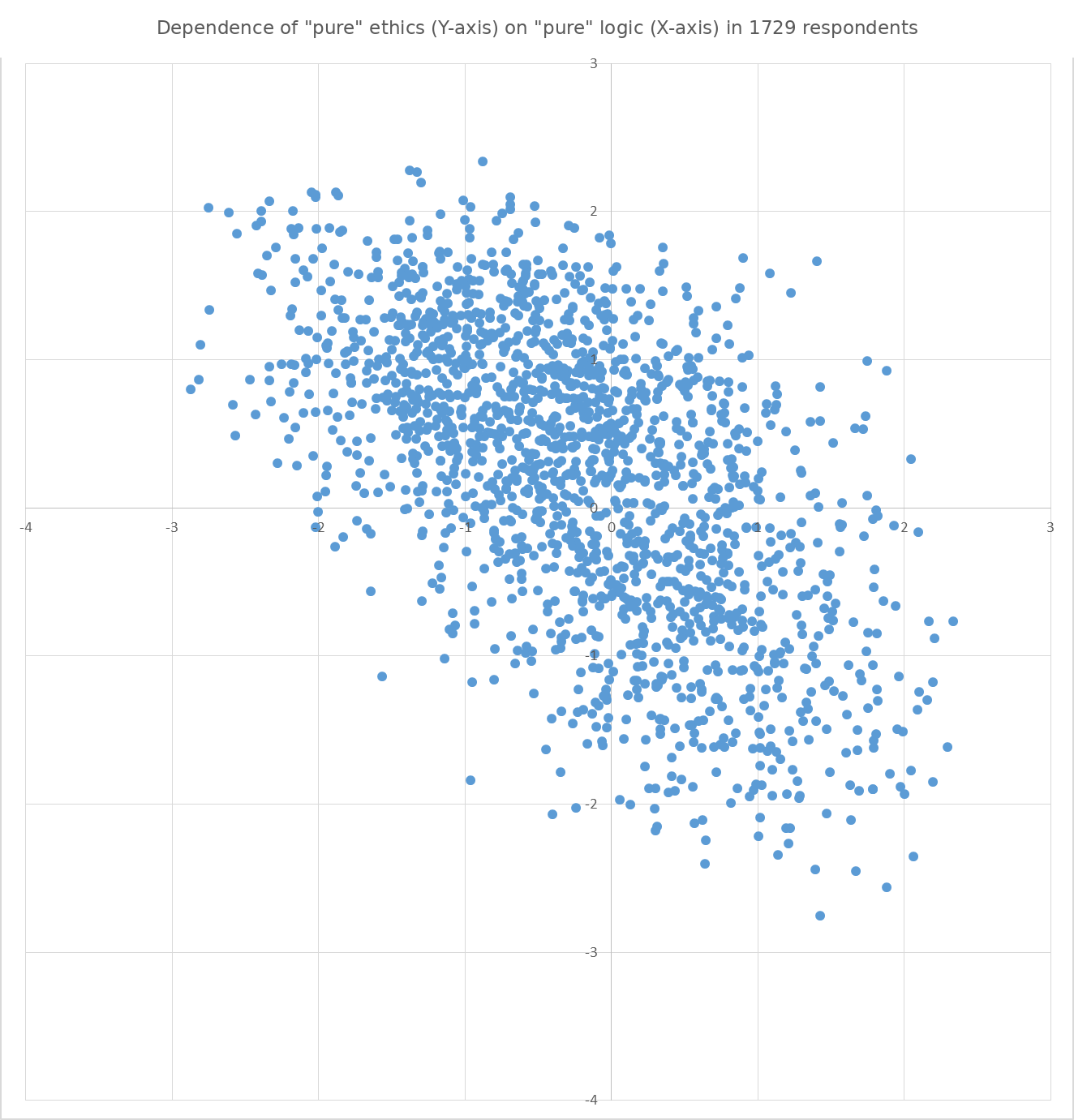
Fig. 2
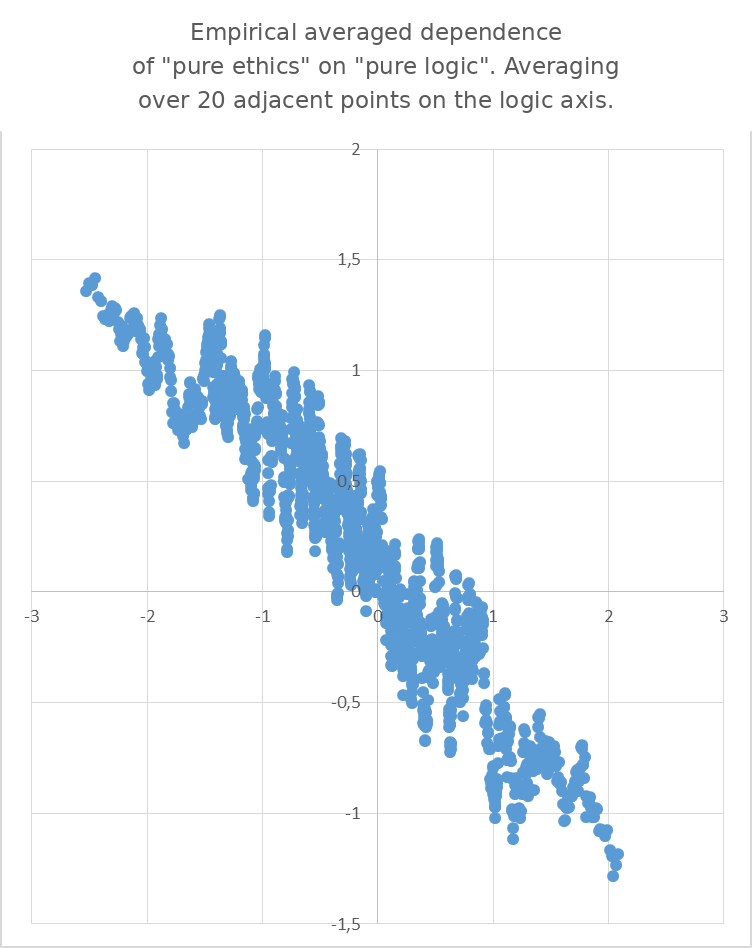
The scales of the X and Y axes in Figs. 1 and 2 are expressed in fractions of the standard deviation of the corresponding scores (that is, logical and ethical abilities) in the experimental sample. No correction of the data arrays for heterogeneity in the proportions of psychotypes was performed for constructing the figures. A quite clear inverse relationship between purely ethical and purely logical abilities is readily visible. Among people with logical-ability scores above +2, absolutely all but one have ethical-emotional-ability scores below the population mean. Similarly, among the examined people with logical-ability scores below -2, absolutely all (also with the exception of one person) have ethical-emotional-ability scores above the population mean.
Conclusions:
The hypothesis of a negative correlational relationship between logical and ethical-emotional abilities was fully confirmed. At the same time, however, logical and ethical-emotional abilities also have a certain degree of independence from one another. This is clearly seen by comparing, on the one hand, the correlation between the pure-ethics scale and the scale of denial of ethical abilities (R=-0,89) and, on the other hand, the correlation between the pure-ethics and pure-logic scales (R=-0,59). The first correlation is close to minus one (which is understandable – ideally, if these scales were longer and therefore more accurate, the correlation between self-assessment of one’s ethical abilities and self-assessment of the degree to which they are absent in oneself should generally tend toward minus one). However, the second correlation, between ethical and logical abilities, already differs substantially from one in absolute magnitude, and this cannot be explained solely by the shorter logical scale in this experiment (16 items) compared with the scale of absence of ethical abilities (34 items). Thus, it is evident that although a person’s logical and ethical abilities are connected to one another by a “spring,” this spring can to some extent be compressed or stretched. For example, this may occur due to differing levels of training (development) of the abilities of the opposite pole, but not only for this reason. Neurobiological factors may also be a cause, and from the outset they do not determine the negative correlation between logic and emotional abilities too rigidly. Nevertheless, for approximately half or slightly more than half of the variance, neurobiological factors provide a negative, inverse relationship between logical and ethical abilities.
The partial independence of logical abilities from ethical abilities (approximately half of their variance or somewhat less, based on the magnitudes of the negative correlation coefficients between them that we found) is well known in socionics and also in the Keirsey and MBTI typological systems. The point is that it is precisely because of this partial independence of logic from ethics, and of intuition from sensing, that the balance between the sum of all intuitive and sensing functions, on the one hand, and the sum of all logical and ethical functions, on the other, can differ among different people. And it is precisely this balance, which differs among people, that forms the psychological trait which in socionics is called the balance of irrational and rational traits (the nality trait), in MBTI is called the balance of perceiving and judging abilities, and in the Five-Factor Model of personality coincides with the personality factor of Competence. Were there no certain degree of freedom of logic from ethics, and of intuition from sensing, and were the correlation in these pairs negative and strictly equal to one in absolute magnitude, then the nality trait would not exist at all and would be completely degenerate.
Other Recent Works by the Author
- V. L. Talanov. Everything Unknown and Little-Known About the Eight Functions of the Psyche. Part I: Calculation of Functions, Quantitative Value of All Functions in the Psychotype, Content of Functions: http://sociotoday.narod.ru/funkcii1.html
- V. L. Talanov. Everything Unknown and Little-Known About the Eight Functions of the Psyche. Part II: On the Semantics of Functions in Program and Creative Positions: http://sociotoday.narod.ru/funkcii2.html
- V. L. Talanov. Detailed Study of Black Sensorics Clusters (2016): http://sociotoday.narod.ru/funkc_bs.html
- V. L. Talanov. Detailed Study of White Sensorics Clusters (2016): http://sociotoday.narod.ru/funkc_ws.html
- V. L. Talanov. Are Psychological Types Quantized? Testing the Density of the Population Distribution at the Boundaries Between the 16 “Standard” Psychotypes. Introduction of 4 New Functions of the Psyche. (2016): http://sociotoday.narod.ru/funkc_3.html
- V. L. Talanov. Experimental Study of the Validity of Socionic Diagnostic Methods (Including the Convergence of Socionic Diagnoses) – December 2013. http://sociotoday.narod.ru/validnost.htm
© Talanov V. L. 2017
The author permits copying and free reproduction of this article on the Internet on the mandatory condition that a hyperlink to the original source is provided: http://sociotoday.narod.ru/corFT.docx
Go to the site’s table of contents and list of all its articles: http://sociotoday.narod.ru/index1.html
Earlier works by V. L. Talanov (before 2011) can also be found at: http://www.newsocionicsmodel.narod.ru