Analysis of the Socionic Causes of Xenophobia
Analysis of the Socionic Causes of Xenophobia
V. L. Talanov, July 2011
Before proceeding to a detailed analysis of the causes of racism and xenophobia, we present the results of our experimental study of the socionic profiles of two behavioral clusters most closely related to xenophobia (all socionic designations are the same as in our more general work on the properties of the authoritarian personality: http://sociotoday.narod2.ru/avtoritaryperson.htm )
Cluster No. 30: “Dividing people into ‘us’ and ‘them,’ adherence to team factionalism and to the principle ‘whoever is not with us is against us’”
The cluster consists of 5 rated statements, with an average of 790 respondents participating in the rating of each. The diagram was constructed using 3,950 responses from more than 2,000 respondents.
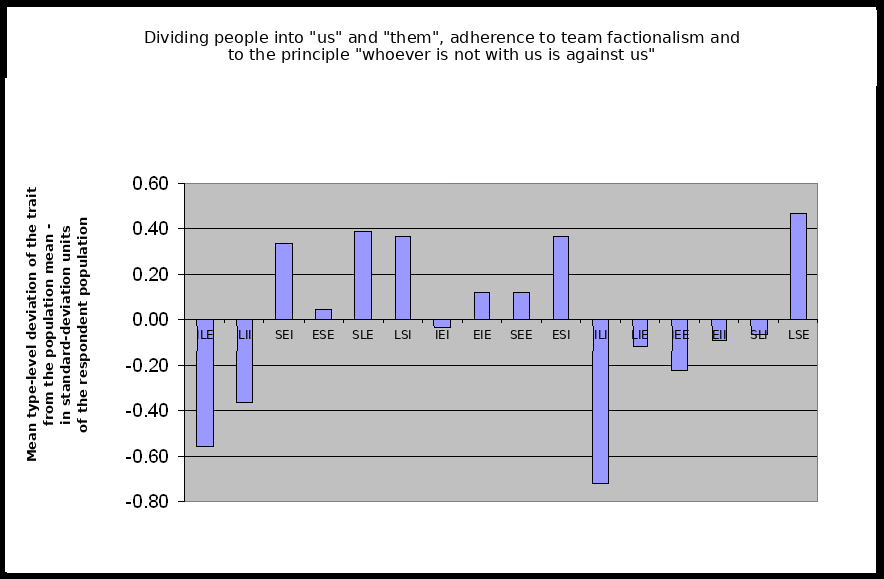
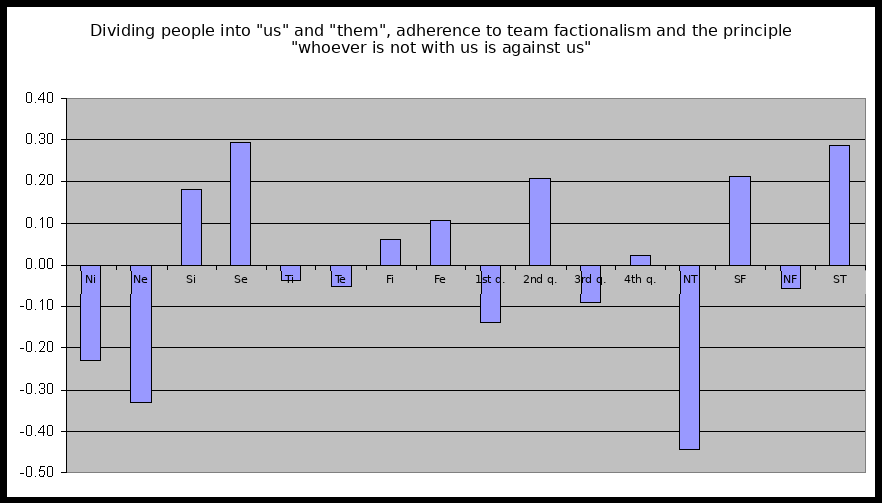
The cluster took into account AGREEMENT with the following opinions:
- Whoever is not with us is against us;
- I am surprised by those who try to live on friendly terms “with both sides” - no, you should make up your mind, and if you are with them — then you are against us;
- Personal loyalty is more important than talents and convictions;
- I am a team person — for me there are always those who are one of us, and those who are outsiders;
- If you do not belong to a group of people bound together by common loyalty to a leader, you will achieve nothing in life.
Cluster No. 31: “Nationalism, xenophobia and its extension as far as racism and chauvinism”
The cluster consists of 26 rated statements, with an average of 470 respondents participating in the rating of each. The diagram was constructed using 12,220 responses from more than 4,500 respondents.
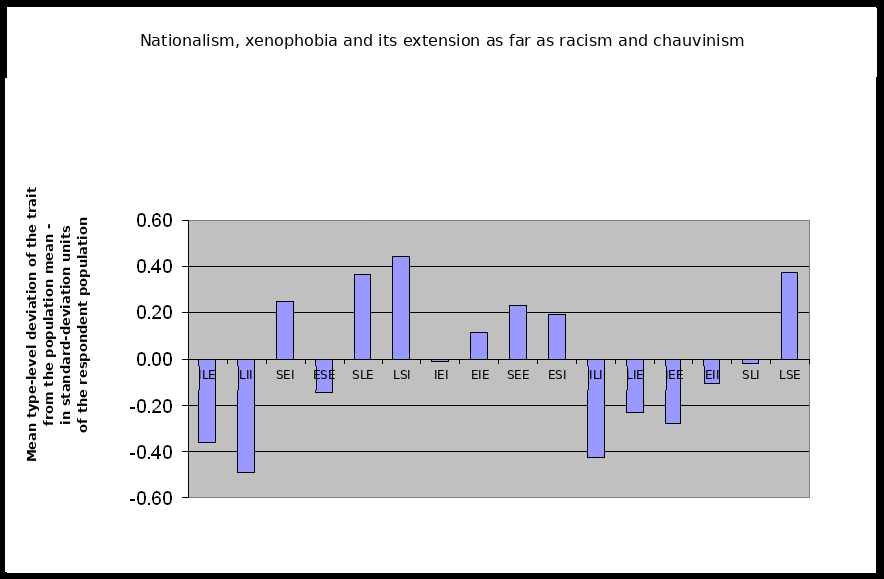
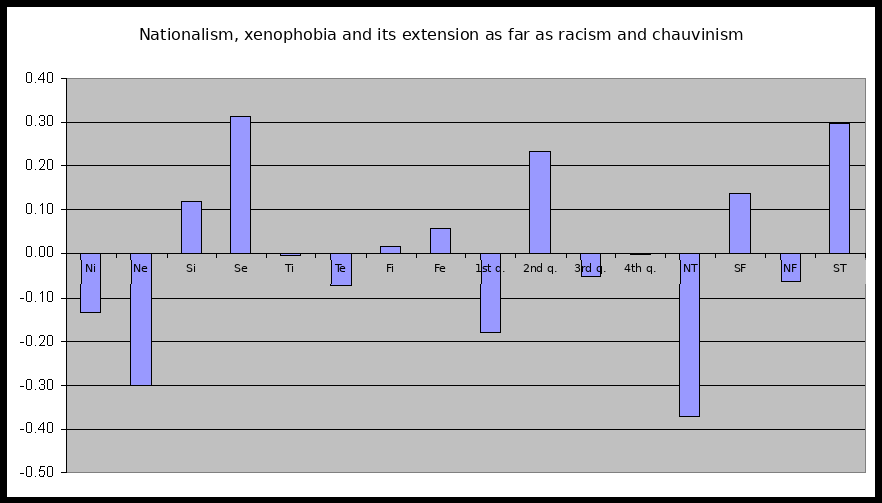
The cluster took into account AGREEMENT with the following opinions:
- Most people of foreign ethnic origin ought to live in their own historical homeland, not here among us;
- The most dangerous people for the state are those who contaminate the national soil with the weeds of cosmopolitanism;
- Immigrants cannot and should not have equal social rights with native residents;
- Internationalism — it is always either deception or stupidity;
- A person who does not think about his nationality — is always a dangerous degenerate;
- Foreigners must not be allowed to criticize one’s own state;
- Sympathy for a country that competes with my homeland — is already betrayal;
- To be a patriot — means defending one’s country from any critical attacks;
- There are peoples who wish evil upon my nation;
- Representatives of small non-titular peoples should not be represented in culture, science, and politics beyond their percentage share of the country’s total population;
- It is better to be a nationalist than an internationalist;
- Some nationalities are deeply unpleasant to me;
- I would prefer to live exclusively among people of my nationality;
- Outside his own people, any person — is nothing;
- Stateless persons should not have the right to scholarships at our higher-education institutions;
- There exists a dangerous conspiracy by the intellectual elite of one small nationality against all humanity;
- Residents of other countries are for the most part worse than we are;
- We have very little to learn from other peoples;
etc.
Let us analyze the socionic causes contributing to the emergence of xenophobia. First of all, the illustrations above clearly show that Cluster No. 30: “Dividing people into ‘us’ and ‘them,’ adherence to team factionalism and to the principle ‘whoever is not with us is against us’” and Cluster No. 31 (xenophobia and nationalism proper) have very similar socionic profiles, which also indicates substantial commonality in the causes underlying them. Of all socionic functions, xenophobia is promoted first and foremost by high Se, followed by Si and Fe. By contrast, high Ne inhibits xenophobia. How can this be explained? The phenomenon of xenophobia has, in our view, five or six principal causal components. Let us characterize them in the expected order of decreasing importance.
The first factor influencing the degree of xenophobia is the width of the range of variation in the characteristics being compared within which a person becomes prepared to identify himself with other people. As is known, the width of the range within which a subject places an equality sign between any two perceived objects, including when comparing himself with other people, is much greater in intuitive types than in sensing types (see our work http://www.newsocionicsmodel.narod.ru/structure_intuit.html ). The greatest contribution to the width of this range, which is equivalent to a low quality factor in the tuning of the comparison and identification apparatus, is made by the intuition of possibilities (Ne). People with high Ne perceive as similar and close even objects with very remote resemblance, which leads them to perceive a much broader circle of other people as “their own” than sensing types do.
The second factor is associated with a different hierarchy of the set of attributes by which other people are identified with oneself. In sensing types, because of the characteristics of their concrete-visual perception, external similarity between people turns out to be more important for establishing an equality sign between them, whereas intuitive types, when making comparisons and identifications, pay much more attention to another person’s inner spiritual world. Besides the obvious connection with the Intuition-Sensing dichotomy, this difference is also partly determined by the subject’s intellectual background, his extra-socionic cultural and educational status. Therefore, intuitive types and, to some extent, logical types and any people with higher intellectual status are more inclined to recognize other people as equal to themselves when they have the same spiritual interests and values, regardless of their language and facial features, whereas sensing types and, to some extent, ethical types and people with low intellectual and cultural status are much more oriented toward formal external similarity: that is, facial features, skin color, language, the nationality entry in a passport, formally declared membership in some organization or religious denomination.
The third factor is associated with the strength of the “basic instinct,” which strives for the maximum propagation of one’s own genes and suppression of the propagation of others’ genes. One side of the “basic instinct” is personal sexual aggression, while the other side of the same coin — is a covertly intensified drive toward the genocide of everything alien and competing. It is well known that this factor, which contributes substantially to xenophobia and racism, is usually more pronounced the more pronounced the subject’s force sensing (Se) is (the magnitude of libido is equally associated with Se and Fe, but Se is the most aggressive component of the sexual instinct). It is no accident that the tendency in childhood fights to immediately strike an opponent in the genitals is most pronounced in the two types of the socion with program Se. The “basic instinct” factor is not the only factor forming xenophobia — otherwise SEE (on average for the type) would show a greater tendency toward racism than LSI, which, as we can see, is not the case. In addition, the third factor under consideration can very often also manifest extra-socionically, outside a direct relationship with force sensing (Se) — for example, it was presumably elevated to a considerable degree in Hitler (EIE), primarily because of sexual complexes and, for this reason, a distorted hypercompensated sexual instinct, pathologically sharpened within conceptual personal attitudes and directed in his case exclusively toward the collective gene of the nation rather than toward the expression of his own genes. Of course, Hitler’s high Fe and Se elevated above type norms also potentially contributed in themselves to xenophobia caused by the “basic instinct,” but another circumstance played the principal role in its manifestation. A normally developed sexual instinct proceeds rather by way of propagating one’s own genes than by aggression against alien genes. In Hitler, the routes for the direct realization of the sexual instinct were blocked — as is known, he did not sleep with women and, from a certain point onward, considered himself the “bridegroom of the entire nation.” In this case, precisely the route of aggression against alien genes remained open for the realization of the basic instinct. Apparently, in persons with high Se and Fe, the greater the subject’s sexual complexes and dissatisfaction, the more xenophobia should also be expected in him (as a realization of the sexual instinct through hatred of the genes of “outsiders”). Stalin’s xenophobia and antisemitism became most pronounced after he lost his wife. An example of a distinctive “ideological xenophobe” is apparently the well-known V. Novodvorskaya, EIE by type. In our opinion, in this woman with a potentially high “basic instinct,” who on the one hand was without a family and undoubtedly had complexes, and on the other hand had long been sadistically persecuted by Russian KGB operatives, who diligently cultivated in her hatred of everything Russian and socialist, a distinctive xenophobia eventually developed in the form of a combination of Russophobia and intolerance toward any “left-wing” ideological manifestations. Another example may be the ideological xenophobia of Ignatius of Loyola, founder of the Jesuit order (at the beginning of his career merely an ordinary secular dandy, soldier, and alpha male). His xenophobia clearly progressed after Loyola suffered a severe leg injury in war and could no longer remain a secular conqueror of women’s hearts. We suppose that if one delves into the biography of Alfred Rosenberg (SLE), the founder of Hitler’s racial theory, strong sexual complexes will inevitably be found there as well (after all, not every SLE calls for the killing and castration of persons of other nationalities). Thus, high levels of Se and Fe form a strong “basic instinct,” which in itself creates potential prerequisites for xenophobia, but its full flourishing (by virtue of the factor associated with libido) occurs only in those cases where the normal routes for realizing the sexual instinct are blocked, while the route of its distorted realization through hatred of manifestations of “alien genes” remains open. The predicted values of V. Putin’s potential xenophobia (based on the predicted profile of his functions, with high Se and Fe among his values, taking type and subtype into account) are comparatively low, although still 0.4 standard deviations above the population mean. Above we saw that moderate potential values of xenophobia can increase sharply if, within the “basic instinct” factor, the emphasis shifts from its first component to its second. The intelligentsia ought to pray that everything is in order with V. Putin’s sex life. Otherwise, all those whom he regards as “outsiders” may suffer still more (in the author’s opinion, the Russian intelligentsia is in the front rank among them).
The fourth factor of predisposition to xenophobia is associated with a developed group pack instinct. The socionic function most strongly coupled with this instinct is Fe (Fe originally arose from the exchange of alarming emotional signals indicating danger between individuals of the same group). Te, by contrast, is the function least associated with the group instinct; in addition, it is opportunistic with respect to Fe. In fact, this factor raises xenophobia as such comparatively little; rather, it is associated with the manifestation of the group instinct in its pure form, that is, with the division of people into “us” and “them,” adherence to team factionalism and to the principle “whoever is not with us is against us.” It affects the formation of xenophobia only to the extent that the “pack instinct” also participates in it. But Hitler’s xenophobia, for example, was to a substantial extent caused precisely by this factor (and partly also by the distortedly elevated third, fifth, and sixth factors discussed below).
Finally, the fifth factor of xenophobia is value-motivational and is caused by the division of the socion into clubs bound together by common values, which, in descending order of their average level of xenophobia, are arranged as follows: ST-SF-NF-NT. Because the difference between ST and NT is the greatest, this generally leads to the level of xenophobia among the “Aristocrats” of the socion being somewhat higher overall than among the “Democrats.” The causal essence of this factor is that the higher a person’s “managerial” motivations are in comparison with “scientific,” research-oriented motivations, the higher the potential for xenophobia. This should be understandable: science knows no nationalities or borders, whereas management, on the contrary, requires the erection of additional boundaries. Science and cognition unite; management is interested in dividing people and, especially, in “marking” the contingent under its control, separating it from the rest of the world’s population. The more strongly a given socionic type’s lust for power is expressed, the more intensively this factor also operates. It is primarily because of this factor that xenophobia is substantially expressed in the LSE type. But because motives of genocide are not built into this factor, in the LSE sociotype xenophobia manifests rather as patriotism and a great-power mentality, sometimes as a tendency toward national insularity, but not as interethnic hatred (which in its tendency is most strongly coupled with the level of Se). Although closely associated with socionic clubs, this factor can nevertheless also manifest independently of them, individually, in connection with a person’s profession. For example, in Hitler personally (because of the specific nature of the managerial tasks he set himself), it was likewise elevated considerably above average, although in the Humanitarian club to which Hitler belonged it remains overall slightly below the population-average level.
One could add to the five factors listed above one more, a sixth factor — bearing in mind that it is much weaker than the preceding ones and has only a small influence on the level of xenophobia. This factor is associated with Rationality-Irrationality. Among rationals (on average and all else being equal), xenophobia tends to be slightly higher, because rationals, by virtue of their tendency to fix judgments, are also more inclined to “apply labels,” including national ones.
Taken together, all these factors produce the specific socionic profile of a certain averaged “xenophobia,” shown in the third and fourth images.
Copyleft V. L. Talanov 2011
The author permits free reproduction of the work on Internet sites, provided that a hyperlink to the source is included: http://sociotoday.narod2.ru/ksenofob.htm