Frequently Asked Questions
Do you have questions about Socionics? Welcome to the FAQ!
To jump to a specific section, click its title in the table of contents.
To read the answer to a question, click the question.
Table of Contents
- A. Fundamentals of Socionics
- B. Dichotomies
- C. Functions
- D. Subtypes
- E. Relations
- F. Socionics and MBTI
- G. Type Diagnosis
- H. Tests
- K. Criticism (addressing common claims made by critics of Socionics)
Section A. Fundamentals of Socionics
1) What is Socionics?
Socionics is a personality typology popular in the post-Soviet region and related to the MBTI typology, which is more widespread in the West. The advantage of Socionics over other typologies is the universally symmetrical structure of traits underlying it, originating in the research of C. G. Jung (and later supplemented by the so-called Reinin dichotomies), as well as its developed theory of intertype relations (which, for example, MBTI does not have). Unlike most other typologies, Socionics also claims the role of a link between sciences of different kinds and profiles: sociology, neurophysiology, ethology and communication theory, and general systems theory.
2) Is Socionics Model A?
Model A was created by Aušra Augustinavičiūtė to describe the particularities of information processing by the human psyche.
Model A consists of 8 positions or cells (in A.A.’s terminology, “functions”: program, creative, etc.) and 8 informational “aspects” (Ne, Se, etc.), which can occupy these cells in 16 different ways (corresponding to the 16 Socionic types). Model A was subsequently criticized as excessively simplified and as describing information processing reasonably well only for some people. A number of other models were created, for example, Model T (Talanov’s model), but Model A remains the best known to this day.
Over time, another approach also became widespread in Socionics, based on diagnosing type from a holistic set of psychological properties without dividing them by informational aspects. Supporters of identifying Socionics with Model A often consider this approach a step backward and even a repudiation of the very essence of Socionics. This is not so. Any personality property used in type diagnosis has some relation to the Socionic coordinate system. There are almost no properties that involve only one informational aspect; most involve all of them, but to different degrees. Therefore, using Model A alone, on the contrary, impoverishes Socionics in terms of the tools available for studying personality characteristics.
3) What is the subject matter of Socionics?
The subject matter of Socionics, like that of any other psychological typology, is human diversity. This includes differences in life values, motivations, behavior, communication and information-processing styles, neurobiological and physiognomic characteristics, and features of personality ontogenesis. Some deliberately narrow the subject matter of Socionics to the study of the characteristics of “information metabolism” (IM), calling Socionics the “science of the socion.” In the author’s view, such an approach not only artificially impoverishes Socionics but is also openly anti-scientific. By avoiding the search for relationships between IM characteristics and other known approaches to understanding personality, its supporters effectively detach Socionics from the rest of science. This situation is typical of a number of pseudosciences. To avoid exposure, their adherents avoid intersecting with the mainstream scientific community and instead invent their own jargon, turning their activity into a meaningless thing-in-itself.
3a) What approaches currently exist in Socionics?
On this topic, I recommend V. Lytov’s short review article.
The author of this website considers the “biopsychological approach” among those discussed in the article to be the most scientific and generally the most productive, whereas the “informational” and “linguistic” approaches often indulge in overtly pseudoscientific assumptions. Nevertheless, in the author’s view, the biopsychological approach by itself cannot answer the question of the nature of Socionics as an integrated coordinate system in the space of psychological diversity, because it is confined to the biological nature of the human being. The sociotype as a phenomenon, by contrast, is most likely a projection onto the biosocial level of more general properties of the structure of the Universe that are characteristic of all universal systems, regardless of their nature.
3b) How can I recognize pseudoscientific approaches in Socionics?
At present, Socionics contains many approaches and communities - clubs and “schools.” Some do not even claim to be scientific, using Socionics purely for entertainment while greatly simplifying and distorting the knowledge embodied in it. Some rely on outdated or unscientific (pseudoscientific) ideas and hypotheses. For example, the following views are still common in a number of schools:
- that the space of Socionic types is strictly quantized, and that personalities representing transitional forms between different sociotypes do not exist (or, if they do exist, they are merely distortions or “masks” of one “correct” type - see below);
- that the manifestations of personality accessible in direct contact reflect only a person’s “masks,” which supposedly merely resemble a Socionic type externally but are not that type; while the “true” type lies deeper and can be understood only by a small number of initiated “gurus”;
- that all traits, including the so-called Reinin dichotomies, must necessarily and equally be present in all representatives of the same type;
- that tests are in principle incapable of determining a person’s type (i.e. supposedly the person is incapable of forming a correct understanding of themselves);
- conversely, that Socionic type can be determined literally from a couple of signs, for example from a person’s reaction to a single situation, often taken out of context, or from nuances of their appearance.
The presence of even one of these features makes it possible to confidently classify a given Socionic school as unscientific. The same applies to resorting to astrology, so-called Psyche Yoga, and similar systems in attempts to explain characteristics of a particular personality that do not fit the typical picture of their sociotype.
The works of V. L. Talanov, representing the results of statistical analysis of questionnaire data from thousands of respondents, fully meet scientific standards - almost uniquely among the work currently available in Socionics. This is precisely why, in his own work, the author prefers to proceed from conclusions obtained by V. L. Talanov regarding the association of specific psychological properties with Socionic dichotomies, functions, and sociotypes.
4) What is a Socionic type?
A sociotype is a complex phenomenon: a set of personality properties spanning the broadest range, from behavioral to physiological, that shift a personality away from the population mean in one direction or another.
From an evolutionary perspective, the presence of sociotypes in a population reflects the variability inherent in all living systems and is necessary to increase population survival under changing environmental conditions. Modern human society is, in essence, a universal system in which there is a place for every possible form of specialization.
4a) - from the perspective of neurophysiology?
According to V. L. Talanov’s hypothesis, each sociotype corresponds to some structural characteristic of the central nervous system involving increased sensitivity to particular neurohormones. The neurohormonal background is also important, but because it is more changeable, it influences not so much the sociotype itself as situational fluctuations in the type profile. Features of bodily structure may also be associated with sociotype. Among them may be both characteristics that functionally complement a particular kind of neurohormonal balance (for example, high muscle mass complementing elevated testosterone levels - a marker of the Se and Ti functions), and characteristics that occur together due to accidental local factors (for example, dark eye color and increased emotional disinhibition - a marker of the Fe function - may be associated in a particular population if both are more typical of one of its subpopulations).
4b) - from the perspective of the systems approach?
According to the author’s theory of social energy, any universal system, in order to ensure its survival, masters the control of all forms of energy existing in its environment. The theory argues that there are 16 forms of systemic energy in the Universe, manifesting at all levels of self-organization - from the physical (material bodies and particles) to the social (the psychic reality of individuals). Projected onto the social level, we observe 16 forms of the energy of society as a system composed of interacting personalities, and 16 Socionic types as functions of society for managing its own energy.
Although the author’s approach is not fully scientific and represents only a metaphorical analogy between complex phenomena of different natures, the author believes that there is no other way to explain the selection of the psychological coordinate system considered in Socionics as a basic system for classifying psychological diversity.
5) Are Socionic type and information metabolism type (IM type) the same thing?
A foundational hypothesis of early Socionics is the concept of “information metabolism,” proposed by its founder Aušra Augustinavičiūtė. According to this concept, differences between representatives of different sociotypes are determined by the way information is perceived, processed, and produced. According to A.A., the reality confronting people can be represented through the prism of 8 basic concepts - “aspects”. Every person is capable of processing information across all 8 aspects, but does so more effectively for some than for others. All 8 aspects occupy 8 positions in “Model A”, and their order depends only on the sociotype - there are 16 possible arrangements in total.
It was discovered almost immediately that differences in information-processing style can influence personality behavior, increasing or decreasing the probability of particular reactions in particular situations; increasing or decreasing aptitude for particular kinds of work; changing the probability of particular preferences, habits, interests, beliefs, and even worldviews. Subsequently, various researchers hypothesized that sociotypes are also associated with a person’s physical characteristics - appearance, facial expressions, reaction speed, and other physiological characteristics. V. L. Talanov’s research was a natural development of this line of thought: it made it possible to systematize and formalize the full range of personality properties by relating them to the system of 16 sociotypes, and to express numerically the probability that a particular person possesses a given property.
Thus, it can now be stated with confidence that Socionic type is a broader phenomenon than IM type.
6) Why are there exactly 16 Socionic types?
In C. G. Jung’s original typology, presented in the book “Psychological Types” (Part X. General Description of the Types), 4 basic psychological functions were considered - sensation and intuition (perceiving functions), and thinking and feeling (judging functions), each of which could be extraverted or introverted. If the second function is taken as auxiliary according to the following scheme:
{if the first function is extraverted, the second must be introverted, and vice versa; if the first is a judging function, the second must be a perceiving function, and vice versa}, then 16 combinations - 16 types - can be obtained.
Later, with the introduction of the Reinin dichotomies in Socionics, each type acquired 11 additional degrees of freedom. But because considering 2^15 = more than 32 thousand variants would be practically meaningless, the number of combinations considered remained the same. When a Socionic diagnosis is provided not as a single leading type but as a profile of 16 numbers corresponding to a person’s similarity to each of the 16 types, this additional information is not lost.
7) Is it true that some sociotypes are much more common than others?
If Socionic type is regarded as a deviation of personality properties from the population mean (which is correct), there are no grounds for making such a claim. Some unevenness in prevalence is possible because of correlations between the axes of strong dichotomies, if these are not compensated by other correlations. For example, the global population share of types from Aristocratic quadras is probably somewhat greater than that of Democratic types because logical and sensory personality traits are correlated, but this disproportion is not large.
I should also note the problem of the reference point, since the population mean may differ substantially from one society to another. Obviously, if we are examining a narrowly defined professional group within a larger population, the normative parameters should not be adjusted to that group’s mean. But if we are considering two large countries with different cultural mentalities and genetic heritage, the question arises whether the norm should be calculated separately for each or jointly for both. Are there any criteria that allow us to establish objectively the coordinates of a “pan-human” normative point, or should the coordinates of this point be established separately for each relatively isolated (genetically and functionally) population? This question does not yet have an answer.
Nevertheless, all of these issues are specialized and far removed from everyday practice. Type diagnosticians who claim that some sociotypes are several times more numerous in the global (not narrowly professional!) population than others are, in effect, using a coordinate system with a “shifted center of gravity.” Why and for what purpose is this done? The author suspects that the answers lie not in the domain of “subtle” scientific research but in ordinary human psychology. People have a desire to distinguish themselves from the crowd, and Socionists are no exception. Claims that supposedly over 90% of the population are extraverts / representatives of the “Serious” quadras / EIE / ILE, etc., often conceal either a desire to become a “guru who alone knows the truth,” or (sometimes simultaneously) a “representative of a rare type.” The author readily allows that some Socionists reach such conclusions quite sincerely, simply by falling into a well-known cognitive trap. Namely, if you personally deviate sharply from the norm on some personality property, the population as a whole begins to seem to you as though it deviates on the same property in the opposite direction. All that remains is to shift the center of gravity of your coordinate system to the desired position and revel in your exceptional status.
8) Are all sociotypes equally dissimilar from one another, or are some more or less similar?
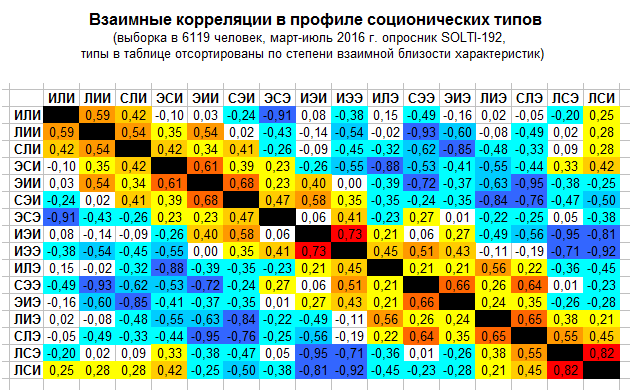
Any two sociotypes share 7 dichotomies and differ on 8. The dichotomies are not equal in strength (the volume of personality properties associated with them). The more “strong” dichotomies fall into the matching group, the greater the similarity, and vice versa. The similarity between average type images can be estimated using this table. the data are heavily outdated [author’s note, 07.2026] Positive numbers in it correspond to pairs of sociotypes such that two randomly selected people belonging to those types will, with greater probability, resemble each other more than two randomly selected people from society as a whole. Negative numbers correspond to pairs for which they will more likely be less similar. On average, sociotypes in quasi-identical, kindred, business, mirror, contrary, and benefit relations are more similar. Conflict types are the least similar.
9) Where can I find descriptions of Socionic types?
Descriptions of sociotypes:
- for beginners and others - here for those interested in details - on V. L. Talanov’s website.
or, better still (newer descriptions, from 2020) - here [author’s note, 07.2026]:
Psychological portraits of sociotypes:
ILE part 1; part 2; LII part 1; part 2; SEI part 1; part 2; ESE part 1; part 2;
SLE part 1; part 2; LSI part 1; part 2; IEI part 1; part 2; EIE part 1; part 2;
SEE part 1; part 2; ESI part 1; part 2; ILI part 1; part 2; LIE part 1; part 2;
IEE part 1; part 2; EII part 1; part 2; part 3; SLI part 1; part 2; LSE part 1; part 2.
English translation of the lists above: part 1. The pages linked above contain lists of personality properties that are exclusively associated with one or another of the 16 sociotypes.
(Important: “exclusivity” does not mean that every person of type N will find all of these properties in themselves, or, conversely, that every person with another leading type will lack them. All relationships between sociotype membership and the presence of particular properties are probabilistic. It should also be remembered that some properties may be very rare, so even among people of the type in which they are most common, they may occur in fewer than 50% of cases.)
10) Where can I read about the Socionic types of specific people?
The author recommends descriptions by V. L. Talanov: on his website; some additional material is also available in the VKontakte group (but there you will have to browse through the general list of posts).
Section B. Dichotomies
1) What is a Socionic trait, or “dichotomy”?
A Socionic dichotomy (literally, a pair of traits) is a fundamental concept of Socionic classification. Each dichotomy consists of two mutually exclusive sets of personality properties - two poles. In everyday speech, the dichotomy itself is sometimes called a “trait,” although terminologically this is not entirely correct.
The socion as a set of 16 sociotypes can, as a first approximation, be generated by four dichotomies, provided that each is independent of the other three. The four dichotomies first considered by C. G. Jung (the so-called “Jungian basis”) are usually taken as the basic set:
- Extraversion - Introversion Logic (thinking) - Ethics (feeling) Intuition - Sensing (sensation) Irrationality (perceiving) - Rationality (judging)
Sometimes, instead of the dichotomy “Irrationality - Rationality,” one of the so-called Reinin dichotomies, Static - Dynamic, is used; it plays a major role in the construction of Model A. In principle, however, the socion can be constructed from any other set of four mutually independent Reinin dichotomies.
Read the author’s definitions of the main dichotomies on this page. Requires updating. [author’s note, 07.2026]
2) What are the Reinin dichotomies?
The Reinin dichotomies are additional dichotomies obtained from the basic ones, and from one another, by Boolean multiplication of the conventional signs of their poles. In theory, the values of the Reinin dichotomies depend nonlinearly on the values of their parent dichotomies, but in practice they are largely independent of them.
More about the Reinin dichotomies.
3) Can descriptions of the Reinin dichotomies found online be trusted?
The semantic content of the Reinin dichotomies was first proposed by A. Augustinavičiūtė and was subsequently almost never re-examined. Because the range of most of these dichotomies is small, their meaning is difficult to detect and study through ordinary interaction; it is often overlaid by similar meanings of stronger dichotomies and “drowns” in them. In addition, “folk” Socionics often interprets the Reinin dichotomies literally, searching for their meaning in the names originally assigned by A.A. Analysis of V. L. Talanov’s questionnaire statistics has shown that these names are, in a number of cases, quite distant from the “core” meaning of the relevant dichotomy, often selecting a single property (not necessarily the most important one) from a set of properties gravitating toward that dichotomy while ignoring the rest.
Conclusion: the author does not recommend using commonly circulated descriptions of the Reinin dichotomies. Links to the most reliable descriptions are provided now here and here. [author’s note, 07.2026]
4) Can Socionic type be determined without accounting for the influence of the Reinin dichotomies?
No. In that case, we obtain an MBTI type, not a Socionic type. Statistics from Talanov’s questionnaires show that failing to account for the Reinin dichotomies in type diagnosis, especially Judiciousness-Decisiveness, Merry-Serious, and Positivism-Negativism, reduces the reliability of correctly determining sociotype by 25%. [learn more]
Because diagnoses from Talanov’s questionnaires are based on mass self-typing, it can be stated with confidence that the semantics of at least some Reinin dichotomies are present in collective understanding. However, they are not always interpreted correctly by individual type diagnosticians.
5) Are all Socionic dichotomies equally important for determining sociotype?
The importance of correctly identifying a dichotomy pole in type diagnosis is determined by the strength of that dichotomy - that is, by the volume of personality properties associated with its poles. As the statistics show, only 5 dichotomies are sufficiently strong to determine the main personality properties of most people: the 4 dichotomies of the “Jungian basis” and Judiciousness-Decisiveness. The remaining 10 dichotomies can in some cases have a meaningful influence on the personality portrait, but only as additional factors rather than primary ones.
Here are approximate shares of the contribution of different dichotomies to the overall diversity of psychological traits. [author’s note, 07.2026]
6) Must a person of a particular sociotype display all 15 Reinin dichotomy poles corresponding to that sociotype?
The values of the Reinin dichotomies are strictly tied to a person’s leading sociotype only in theory; in practice, they are largely independent of it and of one another. Because sociotype is determined mainly by the poles of the strong dichotomies, inversion of these dichotomies (i.e. a person’s tendency toward the opposite pole from the one theoretically expected for their leading type) is a rarer event. Nevertheless, even with this taken into account, in half of people at least one dichotomy of the “Jungian basis” does not correspond to the theoretical expectation for their leading type. Inversion of weak dichotomies is much more frequent. Overall, there are virtually no people in the population for whom every Reinin dichotomy gravitates toward the pole predicted by theory.
Moreover, because of mutual correlations among different Reinin dichotomies, for some types an inverted state of a particular dichotomy is even more common than the “correct” one. The overall situation is presented in this article. [author’s note, 07.2026]
Therefore, the author categorically does not recommend determining sociotype from the values of only 4 arbitrarily selected Reinin dichotomies, especially weak ones.
6a) How should one type correctly using dichotomies?
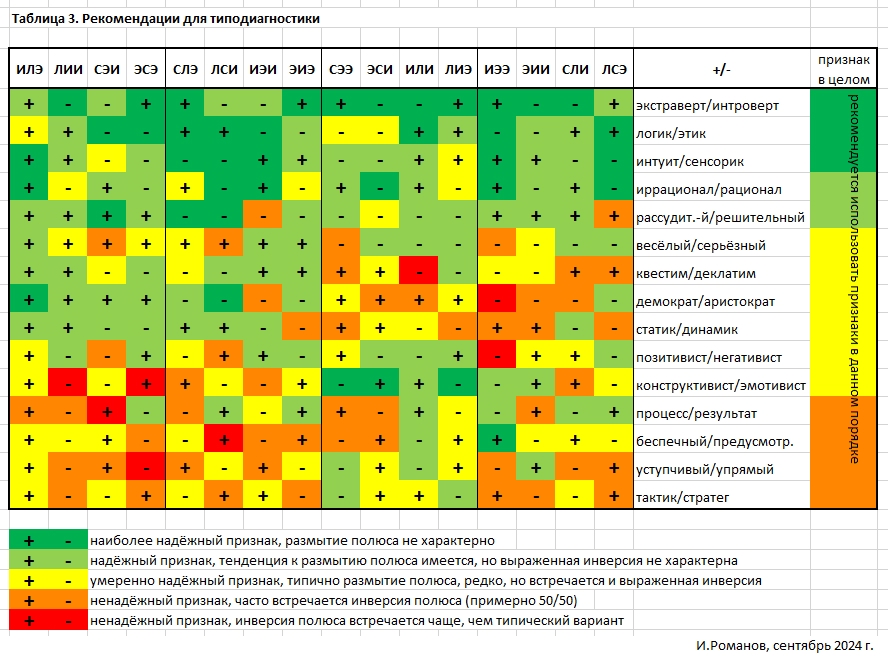
When diagnosing type by dichotomies, the author recommends proceeding in the following order: first determine the poles of Extraversion-Introversion, Logic-Ethics, and Sensing-Intuition; then, when choosing between two quasi-identical types, take into account Irrationality-Rationality and Judiciousness-Decisiveness (when contradictions arise, following this scheme); if doubts remain, examine the weak dichotomies, remembering that their values often contradict the theoretical model.
7) What are “small groups” in Socionics?
A “small group” in Socionics is a division of the socion into 4 subgroups of 4 sociotypes each, such that within each subgroup all sociotypes theoretically share 3 Reinin dichotomy poles. Depending on how “strong” the three dichotomies forming the group are, the distinctive semantic content of the subgroups can range from very substantial to vanishingly small.
Combinatorics permits exactly 35 possible partitions of the socion - 35 “small groups.”
Learn more about specific small groups.
8) What are quadra values?
Quadras are not the strongest small group, but they are the most important in terms of shared life values.
Quadra values are the 3 Reinin dichotomies (Judiciousness-Decisiveness, Merry-Serious, and Aristocracy-Democracy) that form this small group. The Judiciousness-Decisiveness pole determines which functions are valued within the irrational block of functions - Si and Ne or Se and Ni, respectively. The Merry-Serious pole determines which rational functions are valued - Ti and Fe or Te and Fi; the Aristocracy-Democracy pole determines Di and Qe or Qi and De (what is this?)
Section C. Functions
1) What is a Socionic function?
A Socionic function is an apparatus by means of which a personality manages one or another aspect of surrounding reality. The original version of Socionics considers 8 aspects and 8 functions.
Brief descriptions of the aspects and functions by the author. Requires updating [author’s note, 07.2026]; the author’s latest and most up-to-date descriptions of the functions.
A distinctive feature of the 8-function model is that the functions reflect the contribution of only 7 of the 15 Reinin dichotomies. Other methods of calculating functions were later developed, including V. L. Talanov’s expanded model, which contains 24 functions reflecting the variance of all 15 Reinin dichotomies.
1a) How is function strength calculated?
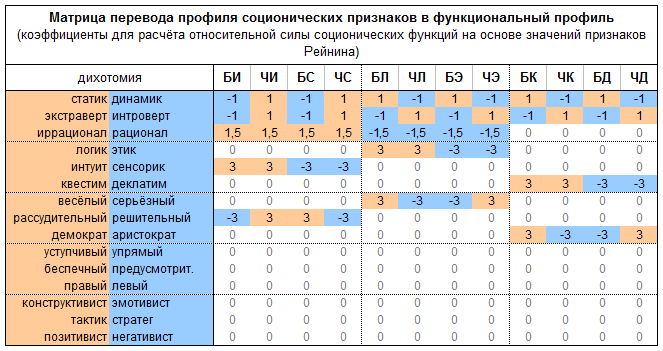
Each Socionic function corresponds to a set of dichotomies. For example, for Ne (intuition of possibilities), these are Extraversion, Irrationality, Static, Intuition, and Peripherality. The value of any function is mathematically calculated as the sum of the products of the corresponding dichotomy values and additional coefficients indicating the contribution of each dichotomy to the semantic content of the function.
1b) Why are the coefficients used to calculate functions from dichotomy values set as they are?
Each Socionic function is expressed most strongly in the sociotypes in which it occupies an extreme, maximally distant-from-the-norm, inert position. Therefore, to calculate the properties associated with a function, the most natural approach is to consider the difference between the average sets of properties of the two sociotypes in which that function occupies the program position (inert in strength). For example, the value of Ne in this case will be proportional to the summed content of the 7 dichotomies shared by ILE and IEE.
However, although the 24-function system makes it possible to account for the contribution of all dichotomies, this is impossible in the “classical” set of 8 functions. In the 8(12)-function system, weak dichotomies associated not with the strength but only with the inertness of a particular function are ignored when calculating function strength (first, because with this number of functions they would inevitably become coupled with other dichotomies; and second, because they increase the contribution to the function’s content of properties of types in which the function is vulnerable, i.e. also inert, but inert in weakness rather than strength - which is not always justified). At the same time, the contribution of Static-Dynamic - a dichotomy also associated with function inertness/contactness, but affecting all functions rather than only some four - is traditionally taken into account.
The coefficients for all dichotomies used in calculating the functions are selected so that the sums of their absolute values, calculated across all 12 functions, are equal - that is, so that the variance of each dichotomy is represented in the function profile to an equal extent.
The resulting coefficient system is not the only possible one, but it is the one currently used in Talanov’s questionnaires. Somewhat different calculation systems are presented in V. L. Talanov’s work: the old version of the model, 8 functions, and the new version, 24 functions.
2) What is the difference between the concepts of “aspect” and “function” in Socionics?
The founder of “classical” Socionics, A. Augustinavičiūtė, understood an “aspect” as information of a particular type, and a “function” as the role of that information in a person’s “information metabolism” - the position of that aspect in Model A of their information metabolism type. For example: “in ILE, the program function processes the Ne aspect.” This terminology was subsequently retained in a number of Socionic schools using the so-called “informational approach” (which reduces sociotype to characteristics of the personality’s “information metabolism”).
In V. L. Talanov’s Socionics, the concept of an “aspect” is not used, while a “function” is understood as a complex of personality traits (neurophysiological, behavioral, and motivational-value traits) associated with activity of a particular kind. Accordingly, here it is more correct to say: “in ILE, the Ne function occupies the program position.”
The author considers V. L. Talanov’s approach more scientific and generally correct, but still uses the concept of an “aspect” - not in A.A.’s sense, but as a description of objectively existing phenomena in reality, the evaluation of which constitutes the main task of a given function. For example: “the Si aspect is the internal dynamics of matter in the organism, metabolism; the Si function is responsible for managing this dynamics, perceiving its characteristics by reading bodily sensations; in ILE, the Si function occupies the suggestive position.”
For those interested in the history of the issue and terminological nuances, I recommend Kanonik’s article On Differences in Terminology in “Old” and “New” Socionics (the article is written from the standpoint of V. L. Talanov’s views).
3) Is the following correspondence regarding Socionic aspects correct: Ethics = energy, Logic = matter, Sensing = space, Intuition = time? In other words, is the function of Ethics to manage energy, Logic to manage matter, and so on?
This model is widely used in so-called “aspectonics” (a quasi-scientific philosophical current within Socionics focused on finding parallels between individual psychology and general laws of existence). In the author’s view, this model conflates everyday and scientific meanings of the terms being used and presents what is desired as though it were fact. In searching for the deeper nature of the phenomena studied by Socionics, the author developed the theory of social energy. It considers a possible nature of sociotypes as an abstract-metaphorical repetition of fundamental phenomena of the objective physical world at a new level of systemic complexity.
4) Which dichotomies affect the determination of functions? Can we say, for example, that Ne is extraverted intuition, Fi is introverted ethics, and so on?
The semantic content of Socionic functions depends on which types’ properties we include (and with what weights) when calculating the value of a given function. The current compromise model is as follows: the largest contribution to the content of any function comes from properties of the types in which it occupies the program position; types in which it is creative also contribute positively; and types for which it is vulnerable contribute strongly negatively. When translated into the language of dichotomies, the following coefficient system is used.
For example, according to it, Ni = 3Intuition + 3Decisiveness + 1.5*Irrationality + Introversion + Dynamic. Thus, the largest contribution comes from the function’s primary dichotomy (in the example above: Intuition) and the dichotomy determining whether the function is valued (here: Decisiveness). The contribution of the temperament-group dichotomies (including vertness) is smaller; their variance is distributed evenly across all functions. Nevertheless, because the range of vertness values in the population is greater, its actual contribution is often more important than the contribution of value dichotomies when determining the relative strength of functions of the same nature but opposite vertness.
5) Does the same function differ in the program and creative positions, and if so, how?
Yes. A function in the program and creative positions (in Model A) differs substantially. For example, program Fe in EIE and creative Fe in IEI are both Dynamic, Merry, Ethical functions; however, program Fe additionally carries properties associated with Extraversion and Rationality, while creative Fe, conversely, carries properties associated with Introversion and Irrationality. As a result, the differences between these two versions of any function are so numerous that it is more appropriate to speak of 16 rather than 8 functions. In the system first proposed by A. Khizhnyak the link is broken - because of a system failure on socioforum.su, all of A. Khizhnyak’s posts were later deleted [author’s note, 07.2026], the 16 functions are named according to the nature of the function (ethical, logical, sensory, intuitive) and the temperament group formed by the intersection of the corresponding vertness and nality dichotomies. For example, in this system EIE has two strongest functions - Linear-Assertive Ethics, LA-E (the classical Fe), and Linear-Assertive Intuition, LA-I (most of whose properties are associated with Si deficit). An Ethical subtype of EIE corresponds to predominance of LA-E over LA-I in the personality structure, while an Intuitive subtype corresponds, conversely, to LA-I exceeding LA-E. The same principle applies to the other sociotypes.
6) Which function is strongest and which is weakest in representatives of a particular Socionic type?
Most often, the strongest function is the one occupying the program position in Model A, while the weakest occupies the vulnerable position. With corresponding accents, the program function may be surpassed in strength by functions occupying the demonstrative or creative positions (one of them or both), and much more rarely by the ignoring or activating function (in this case one usually speaks of a “mixed” type). The function occupying the vulnerable position can also become strengthened, in which case the weakest function will instead be the suggestive, role, ignoring, or activating function.
There is a strong relationship between which functions are relatively strengthened in a given person and the presence of additional accents toward other types alongside their leading type[see].
The results of a study of the frequency of the strongest and weakest functions depending on sociotype are published here.
7) Can a person “train” their weak functions until they become stronger than another person’s strong functions?
Unfortunately, the very formulation of this question reflects a misunderstanding of the nature of Socionic functions. None of the parameters used in Socionics can serve as an equivalent of the quantity of skills a personality possesses; they are always only estimates of the direction of that person’s personality accentuation. Mathematically, the sum of all functions is strictly equal to zero, so if strengthening one function is possible, it can occur only at the expense of weakening others. Even in such a situation, this would not constitute personality development in itself, but only a change in the principal direction of development and in the accompanying motivational system. The latter, however, is entirely possible and occurs in cases of:
- use of psychoactive substances (pharmacological substances and, to some extent, ordinary foods of particular kinds); mood fluctuations associated with purely psychological factors; changes in hormonal background caused by age or other physiological factors.
8) What are function inertness and contactness?
A function’s contactness is determined by its proximity to the population norm (zero on the function-profile diagram), while inertness is determined by the magnitude of its deviation from that norm. The properties of inertness/contactness are expressed more strongly for functions of the so-called “mental ring” - that is, the program and vulnerable functions are usually the most inert, while the creative and role functions are the most contact.


9) What are valued functions?
In theory, a function is valued if it occupies a position in the “Ego” or “Super-Id” blocks of Model A for its sociotype. In practice, because Model A does not work for all people, and also for the sake of general clarity, the following definition is more appropriate: a function is valued if, together with its complementary function, it is stronger than the sum of the antagonist functions (or, equivalently, if the pole of the quadra-value dichotomy contributing to its content (see above) coincides with the pole of that dichotomy predominating in the personality). For example:
- Ne (and also Si) is valued if Ne+Si > Ni+Se (i.e. if the personality is closer to the “Judicious” pole of personality properties than to the “Decisive” pole); Ti (and also Fe) is valued if Ti+Fe > Fi+Te (i.e. if the personality is closer to the “Merry” pole of personality properties than to the “Serious” pole)
10) Why are Logic and Ethics rational functions, while Intuition and Sensing are irrational functions?
This is a Socionic tradition originating in C. G. Jung’s theory. Jung proposed that all people can be divided into those who perceive the external world as it is (irrationals) and those who form judgments about it (rationals). He divided the former into those who favor sensation (Sensing) in perception and those who perceive the world intuitively. He divided the latter into those who rely on thinking and those who rely on feeling when forming judgments (Logic and Ethics in modern Socionics).
In reality, the question of whether this assumption should continue to be made remains open. In one of his works, the author attempts to construct the traditional Socionic model using an alternative set of functions - namely, by taking 8 functions in their creative positions as the basic set (Flexible-Adaptive Intuition, Flexible-Adaptive Sensing, Linear-Assertive Intuition, Linear-Assertive Sensing, Receptive-Adaptive Ethics, Receptive-Adaptive Logic, Balanced-Stable Ethics, Balanced-Stable Logic). In this model, all logical and ethical functions are irrational, while sensory and intuitive functions are rational; changes also occur in the structure of relations - in particular, the so-called “rings of benefit and supervision” run in the opposite direction.
11) Is it true that Se is associated with aggressiveness, while Ne is not? Does that mean all people with strong Ne are good and all people with strong Se are bad?
Se is assumed to perceive the external world as a collection of material objects whose vivid images produce a desire to bring them closer, appropriate them, possess and use them, exploit them, and consume them.
Thus, one can say that the social role of force sensing is the concentration of material resources under the subject’s control (ownership). Under conditions of limited material resources, Se inevitably encounters the need to displace competitors; that is, its subject manifests aggression in one form or another, up to and including physical violence. This also inevitably occurs when the desired resource is itself a subject that does not wish to become someone else’s resource (for example, this occurs in the natural environment in predator-prey relations).
And the stronger Se is in a particular subject, the more strongly these properties are expressed and the less amenable they are to rational control.
For comparison, the intuition-of-possibilities function (Ne) is also responsible for concentrating potential - but not material potential (property), rather informational potential (knowledge). Here it is useful to recall a statement attributed to Bernard Shaw: “If you have an apple and I have an apple and we exchange these apples, then you and I will each still have one apple. But if you have an idea and I have an idea and we exchange these ideas, then each of us will have two ideas.” This phrase makes especially clear the difference between the basic egoism of Se (there are not enough real resources for everyone, so they must be fought over) and the relative altruism of Ne (information about potential resources is never superfluous, which encourages the exchange of ideas).
The author of this website, as a structural logician, would prefer not to address ethical evaluations of the social role of Se - after all, as is well known, they can be diametrically opposed depending on which side the evaluator is on. From an objective perspective, both Ne and Se are demanded by evolution, but in different situations. Ne, as a peripheral function, is more valuable under conditions of insufficient population density, when survival and life success depend more on the ability to move forward rapidly and develop new territories and fields of activity that are not yet occupied, and to create new alliances. Se, as a central function, is more useful under conditions of overpopulation or, which is practically the same thing, resource scarcity - where one cannot manage without the ability to “elbow one’s way through” and defend one’s territory and property.
You can also read about the semantic content of the Decisiveness dichotomy (as valued Se) here.
12) Is it true that Ni is associated with a good sense of time and a lack of tendency to be late?
A good sense of time is most strongly associated with the Te and Ni functions. By contrast, a lack of tendency to be late is associated with belonging to the Rationality pole and, above all, with a deficit of Ne - on average, representatives of the LSI, ESI, and LSE sociotypes are the least likely to be late. This property also has a negative correlation with Ni strength, but it is not as pronounced.
In the author’s view, Ni as a function is primarily responsible for the instinct of self-preservation and is associated with the subject’s desire to preserve the free time of their life from encroachment by other subjects and circumstances of the external world. - this is not entirely correct; I recommend my newer work on the Ni function [author’s note, 07.2026]
13) Where can I read about Socionic functions?
- what functions represent in theory (what they are in the most general sense) link removed because the information there is outdated. A new article is planned. [author’s note, 07.2026]
- how they manifest in practice (by which properties they can be recognized as strong) link replaced with a more up-to-date one [author’s note, 07.2026]
14) What are Questim and Declatim functions (Qi, Qe, Di, De)? Why are they needed?
The links were removed because the articles are outdated. Now read here. [author’s note, 07.2026]
Section D. Subtypes
1) My personality has a lot in common with two (three, four…) Socionic types, and it is difficult to identify one main type. Is this normal?
Yes, this is normal.
In Socionics, a person’s personality is described most fully not by a single type but by a type profile - a set of 16 numbers indicating how close the person is, in their qualities, to each of the 16 types. If only the leading type is determined and everything else is ignored, a substantial amount of information about personality properties is lost. This is acceptable only for people with a relatively “pure” type (one high peak in the type profile), who are a minority. Most people have mixed types, and artificially forcing oneself into just one of them in such a situation leads not to better self-understanding but to worse self-understanding.
1a) Where can I read descriptions of people with mixed types?
Examples of psychological portraits of accentuated types:
- frequently occurring accentuations intermediate between two types (by V. L. Talanov);
- all additional accents of the LSI sociotype (by kanonik);
- all additional accents of the LII and ESE sociotypes (the author’s work).
2) From a Socionic perspective, are two people of the same Socionic type always more similar than two people of different types?
No. Within-type human diversity is very large.
When additional “accents” toward other types are present (that is, individual strengthening of personality traits associated with other types), a person who has the same leading type as you may be less similar to you than a person of another type.
This will happen especially often, for an obvious reason, if you also have strong accents relative to your leading type. For example, an ILE with a strong accent toward ILI will be much more similar to an ILI with a strong accent toward ILE than to an ILE with a strong accent toward ESE.
Incidentally, it also follows from this that not every dual is necessarily a better Socionic match for you than every non-dual (especially if you have a mixed type).
3) Are types quantized? (i.e. is it always possible to draw a clear line separating people of one type from people of another?)
As V. L. Talanov’s research has shown[read], the space of Socionic dichotomies is continuous and is not quantized. The distributions of people by the values of each Socionic dichotomy are close to the bell-shaped curve of the normal distribution[download the study result] - the link is already broken [author’s note, 07.2026], meaning that ambiverts on a given dichotomy are numerically more common than people in whom one pole is strongly expressed. Under such conditions, assuming the existence of 16 independent and relatively isolated poles formed at the intersections of dichotomies is practically impossible.
4) What are subtypes?
Subtype theory is an extension of the Socionic model intended to explain diversity among people assigned to the same sociotype. There is no single universal way to divide people into subtypes (and, in principle, there cannot be one). Different subtype systems speak of strengthening (or strengthening and weakening) a particular function, pair of functions, dichotomy or set of dichotomies, or a holistic set of properties corresponding to another sociotype or sociotypes.
5) What is the best way to divide sociotypes into subtypes?
The accent method provides the greatest detail; under this method, personality can be represented as a “profile of 16 types.”
A type profile is a set of 16 numbers, each showing how similar the personality is, across the totality of its qualities, to the generalized portrait of one or another “pure” sociotype (similarity is measured in standard deviations from the set of qualities of the average personality).
For a representative of sociotype X, the value for that sociotype should be the maximum in the profile, while the other values can be distributed almost arbitrarily, reflecting individual personality characteristics. However, because different dichotomies have different ranges of possible values (different “strengths”), positions 2-3 in the profile are most often occupied by types that match the leading type on 3-4 of the 5 most important dichotomies, while the lowest value is usually obtained by the type that differs from the leading type on all 5 strong dichotomies - the conflict type.
6) What is an “accent toward a type”? How can it be determined from a type profile?
Reference values (i.e. values typical of a “pure type”) in tests created using V. L. Talanov’s methodology are usually shown with a dashed line. However, the type profile of a real person may differ substantially from this ideal variant. If the real value for a particular type differs especially strongly from the reference value in the positive direction, one should speak of an accent toward that type.
In addition to accents toward types, one can also speak of accents toward a particular function or toward the strengthening/weakening of a particular dichotomy. For this, one should examine the personality’s functional and dichotomy profiles and identify, respectively, the functions and dichotomies with the largest deviations from the reference value for the given leading type.
7) It is said that a person’s subtype is immediately visible, while their type is not, and that distinguishing the manifestations of the former from the latter is very difficult. Is this true?
No, generally speaking, this is not true. Nevertheless, two arguments are often offered in defense of this view:
- many people supposedly, consciously or unconsciously, “wear masks” in society, concealing their true essence;
- people differ greatly even within the same type; therefore, in addition to the “type” layer there must be another “layer” of personality that can also be classified somehow.
What can be said in response? Regarding the first: one can suspect others of insincerity. But extending such suspicions to all situations and all people is an unhealthy mental practice akin to conspiracy theory. If the situation is an initial acquaintance, a job search, or a public speech, then yes, observing a person under such circumstances may make it difficult to judge their sociotype. But if we are speaking about self-knowledge, answering test questions at home in a relaxed setting where there is no need to prove anything to anyone… there is probably a small proportion of people who tend to enact patterns of thought and behavior that are not characteristic of them even in such circumstances. But I think this is still a very, very small proportion.
As for the second point: most people, including “Socionics experts,” find it psychologically easier and more comfortable to work not with a continuous space of psychological diversity but with quantized, clear, and unambiguous concepts. Yet because people within the same type objectively differ, and ignoring this today would make one look completely inadequate to clients, some Socionists invented the hypothesis that there are several quantized “layers” (two or even more) in understanding sociotype: the upper one is supposedly accessible to everyone but of little value, while the lower one supposedly contains the real value and can be reached and correctly combined with the upper one only by true “gurus.” (Another version of the same misconception is the use of external typologies to refine sociotype. For example, invoking so-called Psychosophy type to explain personality characteristics that do not fit the standard description of a sociotype.)
There are no arguments supporting the existence within a human personality of several independent logical circuits that direct behavior under different circumstances. All typologies essentially examine the same personality qualities, with minor differences.
In this connection, the author considers it important to state the following. True knowledge is usually formulated simply and does not require assorted “crutches” and supports in the form of repeatedly duplicating basic principles. Those who continue to use such “crutches” in Socionics - subtypes unrelated to type, Psychosophy, or anything else that splits a unified system of knowledge into disconnected fragments - should recognize that they are playing on the side of pseudoscience and Socionic charlatans who seek to confuse the public as much as possible in order to extract more money from clients amid the resulting chaos of misunderstanding.
Section E. Relations
1) Is duality the best type of relation for family life?
As is well known, to increase the viability of offspring, a population’s gene pool must be mixed, and individuals with closely related genes should avoid mating with one another. From a biological perspective, duality, together with conflict relations, connects people who are maximally distant from each other in the space of psychological diversity. If one takes into account that phenotypic (behavioral) characteristics largely reflect differences in genotype, one may hypothesize that dual psychological attraction has a natural explanation rooted in evolutionary expediency. In addition, unlike conflict relations, duals share views on how one should treat the heritage of ancestors and raise offspring (these views are determined mainly by the 3 quadra values and the Irrationality-Rationality pole). The link has been updated and now leads to the current version of the theory [author’s note, 07.2026]
Studies by E. S. Filatova (1999)[link] and V. L. Talanov (2019)[link], independently of each other, showed that duality is the most common type of relation among opposite-sex married couples (in samples of people who came for type diagnosis), which indicates greater stability of such relationships and/or a better ability of partners in them to coordinate their actions.
2) Is Socionic type inherited from parents by their children?
Because all traits considered in Socionics have polygenic inheritance, no clear relationship between the types of parents and children is observed. Nevertheless, the inheritance of the poles of at least the strongest dichotomies should not be entirely random. Otherwise, for example, the well-known differences in the “mentalities” of different peoples and large populations within humanity could not have arisen under the influence of natural selection.
Section F. Socionics and MBTI
1) Are personality type in Socionics and personality type in MBTI the same thing?
They are related but not completely identical categories. Whereas personality types in MBTI are defined by a simple mechanical combination of the poles of the 4 dichotomies of the Jungian basis, Socionics was originally constructed around definitions of 8 psychic functions. In addition, sociotypes are themselves holistic constructs whose images developed naturally through prolonged discussion in popular Socionic culture.
In addition to the Jungian basis, Socionics considers 11 alternative partitions of the socion, orthogonal to one another and to the Jungian dichotomies - the so-called Reinin dichotomies. At least 6 of these dichotomies have independent substantive content, including one (Judiciousness-Decisiveness, i.e. Se- or Si-valuing) whose significance is comparable to the dichotomies of the Jungian basis.
As practice has shown, the Reinin dichotomies can manifest independently of one another and of the values of the Jungian-basis dichotomies (that is, essentially, independently of MBTI type), and their poles are often mutually inconsistent. Because of this, MBTI type and sociotype differ in approximately 45% of people (or, equivalently, at least one dichotomy of the Jungian basis is inverted)[link].
All Reinin dichotomies contribute to the commonly recognized properties of Socionic types and functions. This makes Socionics much richer in semantic content than MBTI. Thus, if MBTI is well suited only as a tool for finding an optimal sphere of employment (knowledge of one’s poles on the 4 classical dichotomies is entirely sufficient for this), Socionic knowledge can also be useful for more fundamental tasks - understanding one’s basic personality values, finding a life partner close in spirit, and even global social design.
Also on this topic: On how and why the paths of MBTI and Socionics diverged, and why this made Socionics a much more advanced and substantively rich scientific direction.
2) Is it true that the MBTI J/P dichotomy corresponds to Socionic Static-Dynamic?
No. This is a myth sustained by two circumstances:
- in some branches of MBTI, the relationship considered optimal for living together is one in which complementarity occurs not on 3 dichotomies of the Jungian basis, as in Socionics, but on all 4, including J/P. In other words, MBTI ends up advocating conflict relations instead of duality.
- Socionic LII (but only this type!) is indeed closer in its properties to the description of the MBTI type INTP, an irrational type, than to INTJ, a rational type. This is due to an absurd accident whereby the INTJ description became excessively loaded with meanings of the Socionic Decisiveness dichotomy - ignored in MBTI but no less real for that reason.
As a result, in an attempt to satisfy everyone, some Socionists proposed treating the MBTI J/P dichotomy as analogous not to Socionic Irrationality-Rationality but to Static-Dynamic (despite the fact that, in its semantic content, J/P corresponds precisely to Irrationality-Rationality). The author categorically does not recommend this kind of adjustment of meanings and proposes honestly acknowledging that MBTI made an error in its recommendations. It was much easier for MBTI theorists to make this mistake than for Socionists, because J/P in MBTI is understood one-sidedly and is strongly correlated with the S/N dichotomy (much more strongly than in Socionics). It is therefore unsurprising that such confusion became entrenched there and continues to exist even contrary to common sense.
Section G. Type Diagnosis
1) What is the most accurate way to determine my sociotype?
The most accurate method of type diagnosis is to take professionally constructed tests (questionnaires). With sufficient questionnaire quality and length, reliability of 80-85% is entirely achievable. Higher reliability after a single administration of a questionnaire (regardless of how long and accurate it is) is impossible in principle, because people’s psychological state changes over time, and in some cases this can objectively lead to changes in the leading type.
There are also several categories of people for whom this method of type diagnosis works worse than average. These include:
- highly suggestible people who are unable independently to distinguish what they want to be true about themselves from what is actually true;
- people with strong mood fluctuations;
- people already familiar with Socionics who are invested in a particular testing outcome (consciously or unconsciously enacting a particular type);
- mediocre and constitutionally unintelligent people (with a low level of personality accentuation).
For the highest accuracy, the questionnaire should be taken in one’s typical psychological state and preferably at least twice, with several weeks between administrations.
Among other methods, expert diagnosis (through live interaction or an interview) yields an average reliability of about 40% for determining the leading type (from 6.25% to 70-75%, depending on the expert’s adequacy and knowledge). Manually constructed tests of the 4 dichotomies have an upper reliability limit of 65% (usually much lower), while self-typing reaches 70%[link].
A serious disadvantage of all these methods compared with typing using questionnaires created according to Talanov’s methodology is that they determine only the leading type, ignoring and discarding the other information contained in the type profile. In some cases, this leads to unjustified simplification and distortion of the overall personality image.
2) Is expert typing the most reliable method?
Type diagnosis through live interaction or an interview (whether written or video-based) has a major vulnerability: all people, including “experts,” are subject to numerous cognitive biases that they are unable to correct for, and often unable even to recognize. The situation is aggravated by the absence of quality control in Socionics, which allows outright fantasists and simply unscrupulous psychology entrepreneurs to enter diagnostic practice.
Overall, if an expert does not use questionnaires to independently verify the quality of their work, they will almost certainly determine your type with lower reliability than you could achieve yourself by studying a broad range of materials available online.
3) Can Socionic type be determined from a person’s appearance?
Associations between a person’s appearance and sociotype do exist, but almost all of them are statistically weak. Type diagnosis based exclusively on appearance is unreliable, and given that most “experts” who use it are frankly mistaken about many type markers, it usually amounts to a profanation.
Download V. L. Talanov’s 2018 study on this topic (Excel file)
4) Can Socionic type be determined from how frequently a person uses particular words and expressions in speech?
At present, the author is not aware of a single study of speech-frequency content in which reliability above 20% was demonstrated for determining the leading sociotype. The problem with all programs of this kind is that they operate too simplistically and directly, whereas memes (semantic constructs) characteristic of different sociotypes can evidently take different forms and receive different verbal expression depending on the characteristics of the particular person and the particular situation in which they express their thoughts.
5) Many personality characteristics that do not fit the classical image of a sociotype can supposedly be explained if Psychosophy type is determined alongside sociotype. Is this true?
As Talanov’s 2018 study showed, Socionics and Psychosophy as typologies examine the same universal set of personality qualities (only the position of so-called Psychosophical Will is additionally influenced by a range of non-Socionic factors, such as personal ambition). Thus, combining the two typologies produces a redundancy. Why, then, do people do it?
In the author’s view, the desire to refine Socionic type using Psychosophy is a sign not of high but, on the contrary, low skill in type diagnosis. Normally, a substantial portion of personality characteristics that do not fit the “reference” image of the leading type can be explained by the presence of additional accents toward other types in that particular person, or equivalently by strengthening/weakening of individual dichotomies and functions. But most people find such a system too complex (and type diagnosticians are people too), so instead of understanding the “shades” of accentuated types they simply stack one system on top of another. The result is a classic pseudoscientific approach: instead of resolving contradictions within a single logical system, several systems are created, and by balancing among them one can always “explain” anything.
6) Does Socionic type influence a person’s political beliefs?
This question was examined in detail by V. L. Talanov in his work Ideological Differences and Psychological Types of People (2008). Talanov’s VK group also contains more recent work; on this website you can read, for example, this author’s material, which summarizes it [author’s note, 07.2026] Overall, yes: fairly strong associations have been found between sociotype and a person’s inclination toward particular ideas about how a “normal” society should be organized. Importantly, in a number of cases the Reinin dichotomies belonging to the quadra values were especially prominent.
7) Does Socionic type influence intellectual abilities?
As V. L. Talanov’s 2018 study showed, there is an association between IQ and Socionic dichotomies (belonging to the Logical-Intuitive club increases the probability of high intelligence, while belonging to the Ethical-Sensory club decreases it), but the association is weak. By contrast, the difference between, for example, IQ level and the ability to recognize emotions from facial expressions depends almost entirely on Socionic factors (because the contribution of intelligence itself is effectively controlled out in this comparison, unlike its orientation - Logical-Intuitive versus Ethical-Sensory).
8) Does Socionic type influence a person’s sexual preferences?
Yes, it does. Socionics contains both older works on this topic, which in the author’s view are filled more with conjecture than fact, and newer work based on reliable statistics. Among the former, the author particularly highlights V. Gulenko’s now “classic” work “Life Scenarios. From Ethical Feelings to Sensory Drives” (1992). Among the latter are, for example, these notes by V. Talanov: “Characteristics of Sociotypes in Sex and Marriage”; “On the Mysteries of Sadism, Masochism, and Sadomasochism”.
Section H. Tests
1) Can Socionic type be determined using tests that ask questions only about the 4 dichotomies of the Jungian basis?
Only approximately. The reason is that the Reinin-dichotomy poles of a particular person do not have to be mutually consistent in exactly the way prescribed by Socionic theory. The 11 additional dichotomies contain approximately 25% of the total variance of psychological properties considered in Socionics, and failing to account for this substantially reduces the reliability of determining the leading sociotype - by 25…45% according to different estimates.
2) How is the accuracy of tests/questionnaires determined?
The accuracy (reliability, percentage of correct diagnoses) of any diagnostic method can be determined by measuring its agreement with another method that is independent of it and whose accuracy is known. The general formula is as follows: accuracy of method 1 * accuracy of method 2 = agreement of correct diagnoses of methods 1 and 2 = total agreement of methods 1 and 2 - agreement of incorrect diagnoses. More details.
In the general case, one can take two different tests created according to the same methodology, with similar structure and length but different sets of questions, and determine the accuracy of the methodology by calculating the agreement of their diagnoses with one another.
I should emphasize that for these formulas to work, the questions in tests 1 and 2 must cover the full diversity of personality properties evenly. Otherwise, methods 1 and 2 cannot be called fully independent, and their agreement will be higher than the calculated value.
3) What is the accuracy of Talanov’s large questionnaires?
About 84%[link]
4) Why do questionnaires created according to V. L. Talanov’s methodology normalize the height of the type profile (visually “stretching” or “compressing” it until standard variance is reached)? Does this not discard information about the depth of personality accentuation? Why is it necessary?
The type profile is normalized because Talanov’s questionnaires measure not the depth of a person’s accentuation but its direction in the space of psychological diversity. In mathematical terms, they measure not the length of a vector (drawn from the point of the population mean) in this space, but its angles in the Socionic coordinate system. 16 types - 16 angles.
5) What are the S and K parameters in Talanov’s questionnaires?
These are indicators of data quality. S - profile sigma - indicates the overall consistency of a person’s responses to questionnaire items with one another. The mean S value is about 0.22; with S below 0.20, result reliability is reduced, and with S below 0.12, the data are of low reliability. K is the correlation between type profiles obtained from two independent halves of the test. The mean K value is about 0.86, the maximum is 1; with K below 0.60, reliability is reduced.
6) Why do Talanov’s questionnaires contain so many questions? It seems to me that 50-100, or even fewer, should be more than enough.
A large number of questions is necessary to minimize the influence of random factors on the result. A person’s response to any question is partly determined by stable type-related characteristics (hereafter, signal) and partly by personal experience, random associations, perceptual errors, and so on (hereafter, noise). In the variance (spread) of people’s responses to different questions, the proportion of signal may differ greatly, but noise is always present. To separate signal from noise, many questions must be asked. In that case, random factors, being multidirectional, cancel one another out, the proportion of noise decreases, and diagnostic reliability increases.
As practice shows, to achieve high reliability of type diagnosis, the test should contain at least 200 questions. This number can be reduced somewhat if questions are specifically selected in which the proportion of noise in response variance is minimal (so-called questions with high diagnostic value). But this is not always justified. In particular, a substantial number of diverse questions may also be required:
- to create an optimal test architecture;
- for data-quality control;
- for research purposes.
7) Why do Talanov’s questionnaires contain questions that obviously seem unrelated to Socionics - for example, liking green peas in food, eyebrow thickness, mouth width, having siblings, susceptibility to various illnesses, and so on?
EVERY personality property has its own Socionic profile; some have a high profile (the property is strongly correlated with particular Socionic dichotomies), while others have a low profile (the relationship is very weak). Any properties can be used for diagnostic purposes; if properties with low profiles are used, more of them are simply required to achieve the same reliability.
I should note that many of these “specific” properties are included in questionnaires exclusively for research purposes (they are not used in diagnosis).
8) Someone claims to have created a test based on sociotype descriptions from Talanov’s website, and it does not work. Does this mean V. L. Talanov’s sociotype descriptions are incorrect?
Before making such a claim, check that this person understands:
- that every personality property has its own unique population-average level of agreement with that property, which can differ greatly from 50/50 (that is, from 3 on a 5-point scale) in either direction;
- that the choice of specific wording strongly affects the average response, and often also the Socionic profile of the resulting property (because every wording carries its own unique semantic nuances). Tables on Talanov’s website mainly contain not “pure” questionnaire items but cluster properties summarizing many questionnaire items. Therefore, the author does not recommend directly using the property wordings from those tables to construct one’s own questionnaires.
Section K. Criticism
1) “I know that some perfectly reasonable and intelligent people have said that Socionics is a pseudoscience”
Modern Socionics as a field of knowledge is still quite “loose”; it lacks a single, universally recognized system of standards and quality control for type diagnosis. In such a situation, it would be naive to expect the most adequate paradigms and methods to be the ones most visible to outsiders. Genuine scientific researchers are usually not successful at self-promotion: the ability to judge complex phenomena correctly and the ability to persistently and brazenly advertise oneself (offering the public simple, vivid bait-images) do not combine well in the same people. At present, Socionics as a field of knowledge is surrounded by many people who parasitize on it, varying in unscrupulousness, inadequacy, and dilettantism, and unfortunately opinions about Socionics are often formed after encounters with precisely such people.
Socionics is also often accused of pseudoscience because it grew out of an essentially non-scientific sphere of psychological knowledge. The people at its origins often resorted to dubious references to quasi-scientific or even openly pseudoscientific theories, mysticism, and natural philosophy. The hypothesis of “information metabolism” itself, adopted by A. Augustinavičiūtė from Kępiński, is at minimum highly questionable and controversial; beyond that, modern Socionics contains many untested hypotheses (and their number is constantly growing).
However, while not denying the problems identified above, the author urges against hasty conclusions. In his view, all these problems are inevitable and even quite normal for a young theory in the process of formation. It advances by feel, trying not to ignore anything potentially useful along the way so as not to overlook it. What will happen later is difficult to say. It is reasonable to expect that the accumulated body of knowledge will sooner or later be consolidated, during which most hypotheses will be discarded (including some that were typical of “classical” early Socionics). Obviously, this consolidation will proceed in close interaction with other human sciences - those studying neurophysiology, genetics, and social behavior.
See also:
- Relations between Socionic dichotomies and factors of modern personality models (from V. L. Talanov’s research) - BIG5
- Why Socionics is needed and could be highly useful to modern neuroscience
2) “Sociotypes do not exist, and the fact that people supposedly observe them is a consequence of the Barnum effect”
All living systems exhibit variability, including variability in individual psychological qualities; this variability is necessary to improve survival of the population as a whole. In humans, the existence of stable personality accentuations over time was known long before and independently of Socionics. The association of some of these accentuations with a stable neurohormonal balance of personality is now indisputable. A number of valid tests have been developed and are widely used to classify psychological diversity - the MMPI, Cattell’s PF, and others.
Socionics differs in this situation only in introducing a universally symmetrical coordinate system for classifying the diversity of accentuated personalities, thereby giving this classification a completed form.
It is a fact that some amateurish sociotype descriptions suffer from excessive “political correctness” and socially desirable wording, which is what prompts discussions of the Barnum effect. However, in the scientific part of Socionics this problem has long been recognized and successfully addressed; a wide range of personality traits has been classified with corrections for social desirability and the fashionability of particular qualities and formulations.
There is no need to exaggerate. Socionic descriptions, even when made unprofessionally and containing many stereotypes, still make it quite possible to perceive and understand the differences between different sociotypes, functions, and major dichotomies. But only if a person genuinely wishes to perceive and understand them. Unscrupulous critics of Socionics who invoke the Barnum effect unthinkingly are, in essence, claiming that a personality is in principle incapable of evaluating itself correctly :-)
Unfortunately, unwillingness to understand a subject combined with a desire for fame as a “debunker of pseudoscience” is often a consequence of the same mentality found among pseudoscientists themselves, who similarly attack mainstream science. To people who wish to form a correct view of the nature of things, I advise not being taken in by cheap arguments from either side, but thinking for themselves. In the end, this is the only path to understanding.
3) “The values of all Socionic dichotomies in the population are normally distributed, therefore sociotypes do not exist”
The values of all Socionic dichotomies do indeed have normal or approximately normal distributions. The reason is that almost every personality property has polygenic inheritance, and Socionic dichotomies, being complex aggregates of personality properties, even more so. Under such conditions, the emergence of quantized poles of Socionic dichotomies and likewise quantized sociotypes (that is, sociotypes stably separated from one another in the space of psychological diversity) is impossible. The continuity of the space of Socionic dichotomies, and the absence in it of regions of relative concentration, have been demonstrated in V. L. Talanov’s research.
But the same can be said about any other psychological accentuation. For example, we call people schizoid when a complex of certain “schizoid” character traits extends beyond the population norm - people who, in the expression of that complex, gravitate toward the positive tail of its distribution curve in the population. Note: a normal distribution. The boundary between schizoids and non-schizoids is gradual; in essence, there is no boundary. There are many mixed accentuations: schizoid + paranoid, schizoid + psychasthenic, and so on. Does all this imply that schizoidness as an accentuation does not exist? Of course not. Socionics is the same. Any sociotype is, in essence, a personality accentuation of the same kind. The leading sociotype of a particular personality is the one, among the 16 considered in Socionics, whose traits are expressed most strongly in that person (the largest positive deviation from the population norm).
4) “I see a Socionic type - someone else’s, or possibly my own - changing frequently, therefore sociotype does not exist and Socionics does not work.”
A person’s Socionic profile is closely tied to the balance of neurohormones in the central nervous system. Its stable features are apparently explained by structural characteristics of the CNS itself, including the proportion of receptors for different neurohormones. This is determined largely at the very beginning of ontogenesis - during prenatal development and early childhood[link]. Severe brain injuries can shift this balance and lead to a change of type, but under normal conditions it is stable because, in essence, it is “encoded” at the material level.
A person’s Socionic profile in most people slowly drifts with age toward stronger Rational, Sensory, and probably also Judicious traits[link].
In addition, chemical influences (food, pharmacology) and purely psychological factors can cause short-term changes in mood and neurohormonal levels and, correspondingly, fluctuations of the type profile around its equilibrium point. The magnitude of these fluctuations differs between personalities (it is usually greater with strong Fe than with strong Ti). If a personality is initially close in its properties to the boundary between two or more types, even small changes of this kind can lead to a temporary change in the leading type, which will also be recorded during type diagnosis. (Long-term drift under the influence of age-related factors may likewise produce such a change, but it will occur 1) more slowly, 2) in a non-random direction, and 3) irreversibly.)
Thus, frequent changes of the leading type can occur even in a person whose Socionic personality traits are otherwise fairly stable. If, however, the person has an unstable psyche and experiences problems with self-reflection or personal self-identification, the profile of personality traits may “float” even more actively. But how many such people are there? Because they are more likely than others, owing to their personal psychological problems, to take an interest in psychology and type diagnosis, and because objections of this kind are more likely to be voiced by those to whom they apply, it may seem that there are many. In reality, as type-diagnostic practice shows, they constitute only a few percent of the population.
5) “Socionic tests are invalid because, by asking people about themselves, we learn only their self-image and not what they are actually like. If test results have not been verified in practice, they are worthless”
In reality, this statement is equivalent to the following: people filling out tests either deliberately conceal information about themselves in order to mislead others (i.e. everyone invents and lies, nobody can be trusted), or they are incapable of forming a correct understanding of themselves (i.e. a person is unknowable to themselves, one cannot trust oneself). Both are very productive approaches, are they not? ;-)
Obviously, among people completing tests there is a small proportion of both kinds. Moreover, every person’s responses contain some degree of misunderstanding of themselves and some invention or embellishment. But one can deny the value of tests only if one is certain that this proportion is 100%. In every other case, tests necessarily retain some value.
If I have not convinced you, consider what evidence you would need in order to believe in the reliability of a result. Ultimately, everything will still come down to trust in other people - those doing the checking, those checking the checkers, and so on. How deep is your trust or distrust in this world? Think about it.