Hormonal, Neural, and Social Mechanisms of Social Status and Dominance (Literature Review)
HORMONAL, NEURAL, AND SOCIAL MECHANISMS OF SOCIAL STATUS AND DOMINANCE (Literature Review)
V. L. Talanov, 2021
Part 1 - SEROTONIN, HORMONES, AND SOCIAL STATUS
Serotonin is a neurotransmitter and is found in all bilaterally symmetrical animals, where it acts as a so-called mediator of intestinal movements and of the animal’s perception of the availability of the resources it needs. In less “complex” animals, such as some invertebrates, resources are understood only as the availability of food. In more “complex” animals, such as arthropods and vertebrates, resources also include social dominance. In response to an excess or deficit of resources, an animal’s growth, reproductive capacities, or mood may increase or decrease. Here too, the regulator - in accordance with the evolutionary “tradition” that has already developed - is serotonin itself. The effectiveness and direction of regulation may, to some extent, depend on how much serotonin is available to the organism.
Coila, Bridgett. “Effects of Serotonin on the Body.” LiveStrong. n.p., 20 June. 2010. Web. 11 Aug. 2013.
When serotonin levels fall, we may experience a feeling as though something in the world is going wrong. After receiving a sign of recognition, things seem to improve… but only for a short time. It seems that you will be happy for the rest of your life if your poems are published in a newspaper, but if this happens, the brain will begin searching for some new symbols of recognition. The brain becomes accustomed to the feeling of its own significance and constantly seeks confirmation of it.
A widespread method of stimulating serotonin production is winning the love of a partner with high status or social standing. However, once you obtain the trophy, the increase in serotonin content stops. Subsequently, its level may fall when the resources attained become familiar and begin to seem ordinary. A new surge of serotonin will occur when you win an object of love with an even higher status.
Oliya Taskaeva © https://www.livemaster.ru/topic/3265074-blog-sobstvennaya-vazhnost-sotsialnaya-znachimost-serotonin
Dominant adult male monkeys have whole-blood serotonin concentrations approximately twice as high as subordinate adult males. The effects of spontaneous and induced changes in social status, temporary isolation from the social group, and membership in all-male groups on whole-blood serotonin concentrations were investigated. It was found that in male vervet monkeys (pygmy green monkeys - a favored model organism in the work of biologists because most of their physiological and even social characteristics resemble those of humans), elevated blood serotonin concentration is a state-dependent consequence of a male occupying a dominant social position. The authors believe that the results lead to a reconsideration of the significance of hyperserotonemia in humans as well.
Raleigh MJ, McGuire MT, Brammer GL, Yuwiler A. Social and environmental influences on blood serotonin concentrations in monkeys. Arch Gen Psychiatry. 1984 Apr;41(4):405-10. doi: 10.1001/archpsyc.1984.01790150095013. PMID: 6703857.
McGuire and Raleigh first showed as early as 1975 that serotonin levels in male vervet monkeys (green monkeys) change simultaneously with status. Moreover, artificially increasing serotonin levels in subordinate vervets with fluoxetine (“Prozac”) led to an increase in their status, in a number of cases - up to “alpha” (Raleigh, 1991). Dominant animals exude an aura of calm self-confidence, self-control, and purposefulness. Subordinates, by contrast, appear anxious and readily excitable; their behavior is influenced more by external stimuli than by internal purposefulness. In addition, subordinates display impulsivity (including outbursts of aggression). A higher serotonin level (and therefore - greater motor activity) in dominant individuals gives them advantages in obtaining resources. In subordinates, reduced serotonin levels are adaptive, because reduced motor activity makes it possible to conserve energy in connection with limited access to food. Moreover, this inhibition helps reduce the frequency of potential conflicts with “higher-ranking” individuals. Finally, a low level is accompanied by a state of heightened vigilance, which allows subordinates to monitor the behavior of potentially dangerous high-ranking conspecifics.
In their 1991 work, McGuire and Raleigh showed that not only does an increase in status lead to an increase in serotonin in male primates (vervets), but serotonergic mechanisms themselves also contribute to the acquisition of dominance by adult male vervets.
In a balanced crossover study, they investigated the contribution of serotonergic systems to the acquisition of social dominance in adult male vervets. The subjects were members of 12 social groups, each consisting of 3 adult males, at least 3 adult females, and their offspring. The animals were observed over 5 intervals, including a first baseline (no treatment), first experimental, second baseline, second experimental, and third baseline period. At the end of the first baseline period, the dominant male was removed from each group. In each group, one of the two remaining subordinate males was randomly selected for drug treatment, and during the first experimental period 6 of the 12 treated males received drugs that enhanced serotonergic activity (3 received tryptophan 40 mg / kg / day and 3 fluoxetine. 2 mg / kg / day). The remaining 6 males, by contrast, received drugs that reduced serotonergic function (3 received fenfluramine 2 mg / kg / day and 3 cyproheptadine 60 µg / kg / day). At the end of the first experimental period, the original dominant male was returned to his group, and the second baseline period began. In all cases, the dominant male re-established his dominant position. The second experimental period began with the dominant male again being removed, and the 12 treated males received the treatment they had not received during the first experimental period. At the beginning of the third 12-week baseline period, the original dominant male was returned to his group and restored his dominant status. When the 12 treated subjects received tryptophan or fluoxetine, they became dominant in every case. When they received fenfluramine or cyproheptadine (serotonin-lowering agents), their cagemates treated with a serotonin-enhancing agent became dominant. The sequence of behavioral changes displayed by the treated males as they acquired dominant status corresponded to those observed under natural conditions. These observations support the distinction between dominance and aggression and strongly suggest that, when hierarchical relationships are uncertain, serotonergic mechanisms may mediate behavior that allows a male to attain high dominance status.
Raleigh, M. J. , McGuire, M. T. , Brammer, G. L. , Pollack, D. B. , & Yuwiler, A. (1991). Serotonergic mechanisms promote dominance acquisition in adult male vervet monkeys. Brain Research, 559(2), 181–190. 10.1016/0006-8993(91)90001-C - https://doi.org/10.1016/0006-8993(91)90001-c - https://pubmed.ncbi.nlm.nih.gov/1794096/
In macaques, brain serotonin levels in alpha males are twice as high as in subordinate males and females (measured by the concentration of 5-HIAA in cerebrospinal fluid (CSF)). Dominance status and serotonin levels in cerebrospinal fluid appear to be positively correlated. When dominant males are removed from such groups, subordinate males begin competing for dominance. Once new dominance hierarchies have been established, serotonin levels in the new dominant individuals also increase twofold compared with subordinate males and females. The reason serotonin levels are high only in dominant males, but not in dominant females, has not yet been established.
McGuire, Michael (2013) “Believing, the neuroscience of fantasies, fears, and confictions” (Prometius Books)
Dominant social status facilitates the behavioral effects of serotonergic agonists. Since dominant males initially have higher serotonergic activity, it follows that “serotonin specialists” are also more sensitive to pharmacological manipulations aimed at increasing it. Alternatively, the results can be explained by the subordinate position of males preventing an increase in their serotonin as a result of pharmacological manipulations, or preventing the manifestation of the corresponding behavioral effects of increased serotonin (leading to the behavioral pattern characteristic of dominants).
Specifically, the effect of dominance rank on behavioral responses to drugs that enhance central serotonergic function was studied in 45 adult male vervets living in 15 stable social groups. Each group contained 3 adult males, 3 adult females, and their immature offspring. Dominance rank was assessed by measuring success in agonistic encounters between males. In each group, one male was clearly dominant, or the alpha male, and the other two males were subordinate. Males from the first 5 groups received 3 different doses of the serotonin reuptake inhibitor fluoxetine (0,5, 1,0, and 2,0 mg / kg / day); males from the second five groups received 3 different doses of the serotonin receptor agonist hipazine (0,25, 0,50, and 1,0 mg / kg / day); members of the third set of five groups received tryptophan, a serotonin precursor (10, 20, and 40 mg / kg / day). The three types of drugs produced strikingly similar behavioral effects. Each caused dose-dependent increases in approach behavior, grooming, resting, and eating and decreases in locomotion, avoidance, vigilance, and solitude. Dominant males were significantly more behaviorally responsive to all 3 drugs than subordinate males: the increase or decrease in every behavioral measure was greater in dominant males than in subordinate males. Taken together with previous studies, these data suggest that dominant and subordinate males differ in the drug sensitivity of their serotonergic systems.
Raleigh MJ, Brammer GL, McGuire MT, Yuwiler A. Dominant social status facilitates the behavioral effects of serotonergic agonists. Brain Res. 1985 Dec 2;348(2):274-82. doi: 10.1016/0006-8993(85)90445-7. PMID: 3878181.
“6. Social Dominance and Serotonin Receptor Genes in Crayfish”
Gene expression influences social behavior only through changes in the excitability of neural circuits that control the initiation of the corresponding motor programs. In turn, social behavior influences gene expression only through patterns of sensory stimulation that cause substantial activation of the corresponding parts of the nervous system. In crayfish, social interactions between pairs of animals lead to changes in behavior that mark the formation of a dominance hierarchy. These changes in behavior result from changes in the excitability of specific neural circuits. In a newly subordinate animal, aggressive-behavior circuits become less excitable, whereas defensive-behavior circuits become more excitable. In crayfish, the dominant individual runs rapidly while backing up, whereas the subordinate tends to remain immobile. Serotonin, which is involved in mechanisms of social dominance in many animals, modulates escape circuits and avoidance responses in crayfish. It has been found that the modulatory effects of serotonin on escape circuits themselves change with social dominance, becoming excitatory in dominant crayfish and inhibitory in subordinates. These changes in the influence of serotonin on escape affect the synaptic response to sensory input of a single cell, the lateral giant (LG), a command neuron for escape. Moreover, these changes occur over a 2-week period and, in subordinates, are reversible at any time after a change in the animal’s status. The results indicate that a persistent change in social status leads to a gradual change in serotonin-receptor expression toward a pattern more appropriate for the new status. To test this hypothesis, serotonin-receptor expression patterns in dominant and subordinate crayfish must be compared. Two of the five possible serotonin receptors in crayfish have been cloned, sequenced, and pharmacologically characterized. Measurements of receptor expression throughout the CNS of dominant and subordinate crayfish yielded inconclusive results, probably because each receptor is widely distributed throughout the nervous system and is likely to undergo opposing changes in expression in different regions of the CNS. Both receptors have recently been found in identified neurons that mediate avoidance responses, and therefore the next step will be to measure their expression in these identified cells in dominant and subordinate animals.
Edwards DH, Spitzer N. 6. Social dominance and serotonin receptor genes in crayfish. Curr Top Dev Biol. 2006;74:177-99. doi: 10.1016/S0070-2153(06)74006-6. PMID: 16860668.
If a lobster was administered serotonin, it behaved as though it were an alpha, whereas administration of octopamine (a serotonin antagonist) produced subordinate behavior.
Kravitz EA (1988). “Hormonal control of behavior: amines and the biasing of behavioral output in lobsters”. Science 241 (4874): 1775–81. Bibcode:1988Sci…241.1775K. doi:10.1126/science.2902685. PMID 2902685.
A crayfish (lobster), when in a state of fear, may flick its tail, and the influence of serotonin on such behavior depends greatly on the animal’s social status. Serotonin inhibits the escape response in subordinate animals (crayfish), but enhances the same response in dominant or isolated individuals. The reason for this behavior is that social experience changes the proportion between serotonin receptors (5-HT receptors), which leads to opposite effects within the “fight or flight” response. The effect of 5-HT1 receptors predominates in subordinate animals, whereas 5-HT2 receptors predominate in dominant animals.
Yeh SR, Fricke RA, Edwards DH; Fricke; Edwards (1996). “The effect of social experience on serotonergic modulation of the escape circuit of crayfish”. Science 271 (5247): 366–9. Bibcode:1996Sci…271..366Y. doi:10.1126/science.271.5247.366. PMID 8553075
Psychiatrist Russell Gardner described a female patient who succeeded in advancing in her career, presumably because of treatment with Prozac (Gardner, 1998).
Although such cases occur, Gardner emphasized that in humans (as a species) there is no automatic increase in status when SSRIs (serotonin reuptake inhibitors that increase its level in synapses) are used. In vervets in the Raleigh and McGuire experiment, rank increased with such pharmaceutical intervention, but relationships among humans are much more complex. Changes in social status are influenced by many biochemical factors (numerous neurotransmitters, sex hormones, and stress hormones). Among them, serotonin is probably the principal one with respect to rank behavior. However, it is doubtful that manipulating serotonin would affect status even in great apes. For example, the cognitive complexity of chimpanzees apparently reaches a level that prevents a change in hierarchical position through the simple administration of a neurotransmitter.
- Palmer D. A., Palmer L. K. Evolutionary Psychology. The Secrets of Homo sapiens Behavior (1999) http://www.koob.ru/palmer/evolutionary_psychology
- Gardner, R. (1998). The Biology of leadership. Presented at the NLU Psi Chi Distinguished Speaker Series, Northeast Louisiana University, Monroe, LA.
Dominant Individuals Share More Readily with Others. “Impact of Internal and External Factors on Prosocial Choices in Rhesus Macaques”
(Dominant individuals share more readily with others, as though from the height of their position distributing life’s benefits from their table to subordinates. Subordinate individuals do not like sharing with their conspecifics.)
Whereas traditional economic models assume that agents are primarily concerned with their own self-interest, humans and most nonhuman primates are social species. Consequently, many of the decisions they make require integrating information about other social agents. This study asks to what extent information about social status and the social context in which decisions are made influences reward-based decisions in rhesus macaques. The authors tested 12 monkeys with different dominance statuses in several experimental versions of a two-option choice task in which a reward could be delivered only to oneself, only to another monkey, to both oneself and another monkey, or to neither. The results showed that dominant animals were more inclined toward prosocial choices than subordinates, but only when the choice was between a reward only for oneself and a reward for both oneself and others. If the choice was between a reward only for oneself and a reward only for others, no animal displayed altruistic behavior. Finally, prosocial choices were genuinely social decisions because they decreased sharply when the social partner was replaced with a nonsocial object. These results showed that, as in humans, rhesus macaques’ social decisions are adaptive and depend on social status and the costs associated with prosociality.
Sallet J, Emberton A, Wood J, Rushworth M. Impact of internal and external factors on prosocial choices in rhesus macaques. Philos Trans R Soc Lond B Biol Sci. 2021 Mar;376(1819):20190678. doi: 10.1098/rstb.2019.0678. Epub 2021 Jan 11. PMID: 33423628; PMCID: PMC7815427.
The results of the following work largely explain why elevated serotonin and responsible social dominance within a group are interrelated.
“Serotonin and Social Norms: Tryptophan Depletion Impairs Social Comparison and Leads to Resource Depletion in a Multiplayer Harvesting Game”
How do people conserve resources for the benefit of individuals and communities and avoid the tragedy of the commons when shared resources are depleted? In the present study, we investigated the role of serotonergic activity and social norms in managing depletable resources. Healthy adults, together with social partners, completed a multiplayer resource-dilemma game in which they repeatedly obtained profits from a partially replenishing monetary resource. Dietary tryptophan depletion, leading to reduced serotonergic activity, was associated with aggressive harvesting strategies and violations of social norms defined by the harvesting distribution of other players. Participants with tryptophan depletion were more likely to completely exhaust the resource and also accumulated fewer rewards than participants without tryptophan depletion.
Bilderbeck AC, Brown GD, Read J, Woolrich M, Cowen PJ, Behrens TE, Rogers RD. Serotonin and social norms: tryptophan depletion impairs social comparison and leads to resource depletion in a multiplayer harvesting game. Psychol Sci. 2014 Jul;25(7):1303-13. doi: 10.1177/0956797614527830. Epub 2014 May 8. PMID: 24815611; PMCID: PMC4230382.
“A Biochemical Property Relating to Power Seeking in Humans”
In this study, the disposition toward seeking power in the social sphere was found to be positively related to a biochemical marker - whole-blood serotonin. This finding represents the first systematic evidence of any human biochemical property that distinguishes power seekers from others. The disposition itself is given empirical content using measures of three components of the Type A behavior model - aggressiveness, competitiveness, and drive, as well as distrust and self-confidence. The statistical compatibility with serotonin is very good. This finding echoes similar findings made in primates.
Madsen, D. (1985). A Biochemical Property Relating to Power Seeking in Humans. American Political Science Review, 79(2), 448-457. doi:10.2307/1956659
Aggressiveness associated with causing psychological or physical harm to another person is regarded in contemporary research as one of the traits of a person oriented toward competition and dominance, attaining or maintaining high status. Unlike animals, people in everyday life usually resort not to physical aggression (although this also occurs), but achieve a similar effect through criticism, discrimination, covert manipulation, verbal insults, etc. The association of social aggression with high testosterone and low serotonin is investigated and confirmed in most studies (e.g., [Montoya, 2012]).
Montoya E. R., Terburg D., Bos P. A., van Honk J. (2012) Testosterone, cortisol, and serotonin as key regulators of social aggression: A review and theoretical perspective. Motivation and Emotion. Vol. 36: 65–73.
Behavior oriented toward dominant status is regulated by the hormonal systems of serotonin and testosterone (see, e.g., [Eisengger et al., 2011; Mazur, 2005]). Thus, experimental data have been obtained according to which testosterone levels change before and after competition for status. Testosterone rises shortly before a competitive event in anticipation of the challenge and immediately afterward in winners compared with losers. For example, testosterone levels rise after a promotion and fall after a demotion. This effect is observed against a background of mood changes – elation or dejection – accompanying an increase or decrease in status, respectively. The patterns have been identified predominantly in men [Mazur, 2005].
Eisenegger C., Haushofer J., Fehr E. (2011) The role of testosterone in social interaction. Trends in Cognitive Sciences. Vol. 15 (6): 263–271.
Mazur A. (2005) Biosociology of Dominance and Deference. Rowman & Litilefield Publishers.
Gender inequality also has its origins in primary differences in reproductive biology between men and women, and in the greater biological predetermination of women’s behavior with respect to children – gestation, nursing, and prolonged care. This presupposes a close mother-child bond, which is regulated to a considerable extent by the nanopeptide hormone oxytocin (an increase in its level promotes the formation of maternal attachment). It is therefore no coincidence that oxytocin also stimulates parochial altruism (altruism toward one’s own group) and, in a situation of fear – defensive aggression toward “outsiders” [De Dreu et al., 2010].
De Dreu C. K. W. et al. (2010) The Neuropeptide Oxytocin Regulates Parochial Altruism in Intergroup Conflict Among Humans. Science. Vol. 328: 1408–1411.
Social Status Increases Testosterone Levels in Men
The journal Human Nature published the results of a study by scientists at the University of Cambridge. The work shows how men’s perception of their social status affects testosterone levels and sexuality.
The target group of the study consisted of 38 men over twenty years of age, in whom the following were measured:
- hormonal profile;
- self-esteem and inclination toward competition;
- readiness for reproduction before and after physical exertion.
Saliva samples were taken from the subjects to test hormone levels before and after physical activity. They were also asked to complete questionnaires to identify their psychological state, determine self-esteem, and sexuality. The participants in the experiment then competed in canoe rowing.
According to the study:
- In men who showed average results, testosterone increased by an average of 4,92%.
- In the losers, the hormone fell by 7,24%.
- In the winners, testosterone levels increased by 14,46%.
- Analysis of self-confidence in the losers showed no difference, whereas the winners scored 6,53% more points than their rivals.
Results
The study’s author, Danny Longman, states that as men’s perception of their social status increases, physiological changes occur and the desire to realize personal reproductive functions more fully in order to transmit the winner’s genes increases.
The indicators obtained correspond to relationships that occur in populations of animal communities. Males occupying the upper levels of the hierarchy are the most active representatives of reproduction in packs and prides.
The only thing that remained outside the scope of the study — the drive to compete. Leadership qualities are determined by instincts. However, the extent to which instincts depend on testosterone and the role of intelligence in competition remain unknown.
Longman, DP, Surbey, MK, Stock, JT et al. Tandem androgenic and psychological shifts in men’s reproductive effort following manipulation of “win” or “loss” in a sporting competition. Hum Nat 29, 283–310 (2018). https://doi.org/10.1007/s12110-018-9323-5
It has been established that the male sex hormone testosterone is also closely associated with dominant rank (Mazur & Lamb, 1980; Pusey, Williams & Goodall, 1997). Artificially increasing testosterone levels in hens led to an increase in their status (Allee, Collias & Lutherman, 1939). In primates, human-induced changes in testosterone levels did not affect rank, despite a direct correlation between the level of this hormone and position in the hierarchy. In the experiment by Gordon, Rose, Grady, and Bersrein (Gordon, Rose, Grady & Bersrein, 1979), testosterone injections in rhesus macaques did not lead to a change in the subjects’ initial rank. After these injections, overall activity increased. Thus, individuals that frequently engaged in fights fought more often, those that frequently engaged in grooming (combing conspecifics) groomed conspecifics more often, and sexually active individuals mated more often. The relationship between dominance and testosterone is less direct than that with serotonin discussed earlier. Upon attaining high status, an individual has more opportunities for mating, which in turn increases testosterone production. Observations of primates support the idea that increases in testosterone are situational and have only an indirect relationship with position in the hierarchy. One of the primary functions of testosterone is to increase spermatogenesis, which is necessary for successful mating and reproduction. Secondary effects of testosterone include increased muscle mass and, possibly, preparation of an adult male for an aggressive encounter.
Studies of primates have established that aggressive clashes usually increase testosterone levels. Analysis of the relationship between testosterone and aggression showed that this relationship is highly indirect.
Ehrenkranz, Bliss, and Sheard (Ehrenkranz, Bliss & Sheard, 1974) measured testosterone levels in a group of prisoners. Although prisoners convicted of violent crimes were found to have high testosterone levels, comparable levels were observed in a group of offenders who were not violent but were socially dominant. The lowest testosterone levels were found in prisoners who were neither violent nor socially dominant. Studies of blood testosterone levels in humans before and after athletic competition (tennis matches and intercollegiate wrestling tournaments) found that even those who were defeated experienced a sharp rise in testosterone before the match. After the competition, testosterone levels fell in the loser and rose sharply in the winner (Elias, 1981; Mazur & Lamb, 1980). If the margin of victory was small and the participants did not have a sense of a clear victory, their blood testosterone levels decreased. The same effects occur in sports fans watching a competition involving their favorite team. If their team wins, the fans’ testosterone levels rise; if the team loses, the level of this hormone in their blood falls (Ellis, 1993). A rise in testosterone was also observed in a group of medical-school students who had passed their final examination. A simple adaptationist explanation of these results is that testosterone favors aggressive physical inclinations necessary for fighting for higher status or defending that status from encroachment. Another significance of testosterone is stimulation of reproductive behavior associated with more favorable mating opportunities in dominant males.
The role of testosterone in women has not been studied as well. Although young women have a lower percentage of testosterone in blood plasma than their male peers, women are proportionally more sensitive to the action of this hormone (Hoyenga, 1993). Most likely, testosterone performs the same functions in women as in men. Testosterone may prepare an individual for upward movement on the social ladder. Studies of both humans and other primates have established that female dominance hierarchies show substantially greater cooperation among their members and much less conflict and rivalry than male hierarchies (Cronin, 1980).
Palmer D. A., Palmer L. K. Evolutionary Psychology. The Secrets of Homo sapiens Behavior (1999) https://www.phantastike.com/human/evolutionary_psychology/doc/
Social status is also directly related to levels of stress hormones. In primates, there is a clear pattern: individuals with low status have elevated levels of stress hormones (adrenocorticotropic hormone (ACTH) and cortisol) compared with higher-ranking individuals (Botchin, Kaplan, Manuck, Mann, 1994; Suomi, Scanlan, Rasmussen, Davidson, Boinski, Higley, Mariott, 1989). The work of Gust, Gordon, Hambright, and Wilson (Gust, Gordon, Hambright & Wilson, 1993) demonstrated an inverse relationship between stress-hormone levels and instances of cooperative behavior.
The function of stress hormones — the mobilization of the body’s energy reserves in case of fight or flight. In response to their release, heart rate increases, blood pressure rises, and blood begins to flow selectively to the large muscles. At the same time, blood supply to the genitals, digestive tract, and other organs of the torso that are insignificant (from the standpoint of fight or flight) decreases. Although the digestive and reproductive systems are important for the survival of the organism and its genes, they are “switched off” until the dangerous situation has passed. Organisms that continued to expend energy on digestion during a critical situation survived less often than those in which energy was selectively expended on overcoming physical danger. From this perspective, it becomes clear why chronic stress has such an unfavorable effect. The sole function of the stress response — to help you overcome a physical threat. Natural selection — a very narrow process. An animal unable to fight successfully or flee leaves no offspring.
One of the systems “switched off” by the fight-or-flight response — the immune system. There is nothing alarming about this if critical situations are few and rare. But, as Selye (Selye, 1956) noted, if stress is chronic and persistent, the results can be fatal. Bower (Bower, 1997) found that low-ranking rhesus macaques exhibit loss of body mass, increased stress hormones, and substantial deterioration in immune-cell function.
Sapolsky (Sapolsky, 1997) identified similar patterns in wild olive baboons. Many negative effects of chronic stress are caused by the hormone cortisol. In brief, cortisol mobilizes energy reserves into available “fuel,” but a prolonged increase in production of this hormone leads to muscle atrophy, hypertension, and disturbances in the immune and reproductive systems. For maximum effectiveness of the fight-or-flight response, cortisol secretion should be low except in extremely dangerous situations. Sapolsky established that this is true for dominant male baboons. Their baseline cortisol level is lower than that of subordinates; but in a stressful situation it rises faster and to a greater extent. In addition, Sapolsky found that dominant position itself leads to these physiological differences. While an individual remains at the top of the hierarchy, it displays healthy, efficient patterns of physiological responses. However, if the rank of the same animal falls substantially, its psychological profile acquires the unhealthy features characteristic of low-status baboons.
Higher-ranking individuals (including humans) generally cope with stressful situations better than low-ranking individuals. In the experiment by Rejeski, Gagn, Parker, and Koritnik (Rejeski, Gagn, Parker & Koritnik, 1989), people’s position in the hierarchy was assessed, after which a specially trained technician modeled a stressor for them. It was found that subordinates had a higher heart rate and a testosterone level — lower than those whose status was regarded as higher.
Palmer D. A., Palmer L. K. Evolutionary Psychology. The Secrets of Homo sapiens Behavior (1999) https://www.phantastike.com/human/evolutionary_psychology/doc/
Hormones and Social Rank
Which hormones determine an individual’s position in a hierarchy? This is unknown. In all likelihood, the hormonal profile does not determine, but only reflects, an individual’s position in the social structure of the community.
Populations can be composed solely of rats of behavioral Type A, and in all of them the sympathoadrenal type of stress response will predominate over the glucocorticoid type (Type B), i.e. preferential activation of the adrenal medulla rather than the cortex. After we place them in one cage, a population forms and a hierarchy gradually develops. One of the males becomes dominant. He will be found to have elevated testosterone and certain other hormones, and changes will also be identified in various CNS neurotransmitter systems. Mice often form a despotic hierarchy – with one dominant individual, all the others occupy an equally subordinate position. None of these subordinates will show substantial differences from one another in hormonal and neurotransmitter systems.
Hormonal responses reflect an individual’s social rank. There is no direct, unambiguous influence of hormones on an animal’s social rank.
Thus, dominant status is associated with elevated testosterone and a number of features of neurotransmitter metabolism, particularly serotonin. But this does not mean that this particular neurohumoral profile determined the individual’s social position. It merely reflects it, as can be revealed by subsequent developments.
If the dominant individual is removed from the population, the dominant position will be taken by one of the previously subordinate individuals. After some time, examination of the biochemical indicators of the new dominant’s organism will show that its biochemical and hormonal profile resembles that of the previous dominant. This confirms that status is associated with specific endocrine characteristics of the organism. But before occupying a dominant position in the hierarchy, this individual differed little from the other subordinates. The succession of dominants can be continued by removing this one as well. Again, on the basis of hormonal-secretion indicators and other biochemical analyses, it will be impossible to predict which subordinate individual will occupy the dominant position in the community.
Hormones only reflect an individual’s social status, but do not influence it. Although, of course, they to some extent support this status. In addition to influencing the social characteristics of psychological Types A and B (with Type A having an advantage in attaining a dominant position), the supporting function of hormones is revealed by castration. Without a certain (sufficiently high) level of androgen secretion, an individual will not occupy a dominant position in the community.
Zhukov D. A. Stop, Who Is Leading? The Biology of the Behavior of Humans and Other Beasts. In 2 vols. Moscow: Alpina Non-Fiction, 2014.
Neural Mechanisms of Social Dominance (Review)
Neurotransmitters involved in social dominance and hierarchy formation. The article summarizes the influence of neurotransmitters involved in the perception of social dominance and in the formation of social hierarchy. The 5-HT and dopamine systems project across broad regions of the brain and regulate many functions during the formation of a social hierarchy. Likewise, oxytocin levels in the brain are influenced by a person’s status in the hierarchy. By contrast, the recently discovered neuropeptide B / W and its receptor NPBWR1 also participate in the perception of social dominance, but have a very restricted distribution in the brain.
5-HT System
Several studies have shown that the 5-HT (serotonin) system contributes to the formation of a social hierarchy. Using 5-HT measurements obtained from peripheral blood drawn from the femoral veins of adult male vervets housed in groups, Raleigh et al. (1984) found that 5-HT levels depend on the monkey’s social status, such that dominant males have approximately twice the 5-HT concentration of subordinate males. However, 5-HT levels in dominant monkeys were highly sensitive to the presence of subordinates. When a dominant monkey was temporarily isolated, its 5-HT levels fell to approximately the same level as those of subordinate monkeys within 1 day. When these dominant monkeys were returned to group housing, their 5-HT levels increased. Conversely, the transition from a subordinate to a dominant position in the social hierarchy was accompanied by increased 5-HT levels. Unfortunately, this study was limited to measuring serotonin levels in blood plasma and did not directly measure 5-HT levels in the brain,
Raleigh et al. (1991) also investigated whether 5-HT levels contribute to the acquisition of dominance in adult male vervets by observing changes in the group hierarchy. After the most dominant monkey was removed from the group, certain subordinate monkeys were administered either tryptophan, a precursor of 5-HT (Young and Teff, 1989), to increase blood 5-HT levels, or fluoxetine, a selective 5-HT reuptake inhibitor (Gonzalez-Heydrich and Peroutka, 1990; Wong et al., 1990), to increase synaptic 5-HT concentrations, for 4 weeks. Compared with untreated control animals in their group, subordinate monkeys treated with tryptophan or fluoxetine exhibited a higher level of dominance over the 4 weeks. Conversely, when subordinate monkeys were administered fenfluramine, which disrupts 5-HT vesicle function with chronic administration (Appel et al., 1990), or cyproheptadine, a 5-HT2A-receptor antagonist (Peroutka, 1988), the treated monkeys lost the dominant position and shifted into the untreated control within the group. These results show that social dominance modulates (increases) internal 5-HT levels, and that 5-HT levels can in turn modulate the vervet hierarchy. Interestingly, Noonan et al. (2014) reported that the size of the raphe nucleus, which is the source of 5-HT projection neurons (Hensler, 2006), is larger in dominant rhesus macaques than in subordinate monkeys. Although the study did not directly measure brain 5-HT levels, this observation is consistent with the idea that the 5-HT system positively influences the formation and maintenance of social hierarchy.
Administration of 5-HT to humans has a similar influence on social dominance (Moskowitz et al., 2001). Healthy human participants received a dose of tryptophan (3 g / day) with meals for 12 days, which raised their serotonin, and were asked to verbally describe their frequency of communication, agreeableness, and dominance. Participants who were administered tryptophan exhibited increased dominant behavior and reduced quarrelsome behavior (that is, critical comments directed at others decreased).
Dopaminergic System
Stress leads to increased levels of synaptic dopamine in the midbrain, whereas chronic stress causes downregulation of dopamine D2 receptors (D2Rs; Cabib and Puglisi-Allegra, 1996). In a study of social hierarchy using positron emission tomography (PET), dominant cynomolgus macaques showed greater binding of the D2R ligand [18F] fluoroclebopride ([18F] FCP), which has high affinity for D2R in the basal ganglia, than subordinate monkeys (Grant et al., 1998). Because ligand-binding affinity is usually directly proportional to the number of D2R binding sites (Mach et al., 1996), these data indicate that chronic stress experienced by subordinate monkeys causes downregulation of D2R expression. However, this study did not directly determine whether this difference resulted from a reduction in the number of D2Rs in subordinate monkeys or an increase in the number of D2Rs in dominant monkeys. Moreover, it also remained unclear whether differential D2R expression reflects a neurobiological predisposition that predetermines hierarchical rank or a neurobiological change caused by attaining a particular hierarchical rank.
A comparison of D2R levels among cynomolgus macaques housed individually and in groups showed that, rather than D2R levels predetermining social rank, the formation of a social hierarchy produces a D2R gradient (Morgan et al., 2002). In addition, compared with prior individual housing, [18F] FCP binding increased in all monkeys after they were housed together, such that the most dominant monkey displayed a greater degree of binding than subordinate monkeys. Thus, although Grant et al. (1998) concluded that rank-dependent differences in FCP binding resulted from D2R downregulation in subordinate monkeys experiencing chronic stress, it is more likely that these differences result from increased D2R binding in dominant monkeys (Morgan et al., 2002).
Similar effects were reported in a human study that used the Barratt Simplified Measure of Social Status (BSMSS) to assess social status and PET scanning with [11C] raclopride to assess D2R and D3R binding in the striatum (Martinez et al., 2010). BSMSS scores were positively correlated with the level of [11C] raclopride binding, confirming previous findings showing that social dominance is closely associated with the dopaminergic reward system.
Thus, the 5-HT and dopamine systems are modulated by a person’s hierarchical position. Conversely, the level of 5-HT in the blood also affects social status. Although dopamine has been shown to act in the striatum, it is unclear whether a similar change is observed in other brain regions that express D2R and are reportedly involved in the perception of dominance. In addition, these studies did not identify the primary site of 5-HT action.
Oxytocin System
In mammals, including humans, oxytocin plays an important role in regulating complex social cognition and social behavior, such as attachment, social recognition, social investigation, aggression, and anxiety (for reviews, see Meyer-Lindenberg et al., 2011; Kumsta, Heinrichs, 2013). Several nonhuman studies have demonstrated an influence of oxytocin on the formation and maintenance of social hierarchy. In accordance with their social hierarchy, dominant female rhesus macaques had higher serum oxytocin levels than subordinate monkeys (Michopoulos et al., 2011). Likewise, mRNA expression of genes associated with the oxytocin receptor in the medial amygdala of subordinate rats was lower than in dominant rats (Timmer et al., 2011). However, the precise functional role of oxytocin in the perception and learning of social dominance remains unclear.
NPBWR1 (GPR7) System
Unlike the monoaminergic system and oxytocin, which are distributed across broad areas of the brain, the neuropeptide B (NPB) and neuropeptide W (NPW) system has restricted localization (O’Dowd et al., 1995; Lee et al., 1999; Brezillon et al., 2003; Tanaka et al., 2003). NPBWR1 (or GPR7) is a G i-protein-coupled receptor and is highly conserved in a particular brain region of humans and rodents. NPBWR1 mRNA was localized in discrete brain regions, including the hypothalamus, hippocampus, ventral tegmental area, and central nucleus of the amygdala in rodents (Lee et al., 1999; Tanaka et al., 2003), as well as the amygdala and hippocampus in humans (Brezillon et al., 2003). In behavioral tests, Npbwr1 - / - mice exhibited a shorter latency to initial physical contact and longer contact and pursuit times with an intruder during the resident-intruder test compared with Npbwr1 + / + mice, indicating reduced social fear (Nagata-Kuroiwa et al., 2011). However, because there were no significant differences between Npbwr1 - / - and Npbwr1 + / + mice in the open-field test or elevated plus-maze test, this type of compulsive behavior toward the intruder apparently does not indicate increased general anxiety. On the contrary, it suggests that these changes were specific to fear or anxiety experienced in a social context.
Watanabe et al. (2012) investigated behavioral differences during human social interactions and their relationship to variants of the NPBWR1 gene. In humans, the NPBWR1 gene can express a single-nucleotide polymorphism (SNP), 404AA or 404AT, at the site where this molecule binds to adenylyl cyclase and subsequently regulates the function of this receptor. When the human 404A or 404T genes were transfected into the HEK293A cell line, the 404T gene was associated with lower levels of cAMP release than the 404A gene, indicating impaired receptor function by the 404T gene. Because Npbwr1 - / - mice displayed abnormal behavior during social interactions (Nagata-Kuroiwa et al., 2011), it was hypothesized that a person with the 404AT gene would be less sensitive to social-context cues such as facial expressions.
Watanabe et al. (2012) presented participants with images of four types of facial expression and asked them to evaluate their emotions during the presentation (see the section “Facial Expression and Dominance”). During the dominance rating, a significant difference was observed between genotypes, such that the 404AT group felt less submissive during the presentation of an angry face than the 404AA group. This suggests that individual differences in the NPBWR1 SNP affect the perception of dominance, especially when participants observe overpowering stimuli such as angry faces. Because NPBWR1 mRNA expression occurs in restricted regions, especially in the amygdala in humans (Brezillon et al., 2003), this finding also supports the involvement of the amygdala in the perception of dominance during human interactions. However, the role of the B / W neuropeptide system in the formation and maintenance of social hierarchies has not yet been directly confirmed.
Watanabe N, Yamamoto M. Neural mechanisms of social dominance. Front Neurosci. 2015 Jun 17;9:154. doi: 10.3389/fnins.2015.00154. PMID: 26136644; PMCID: PMC4469834.
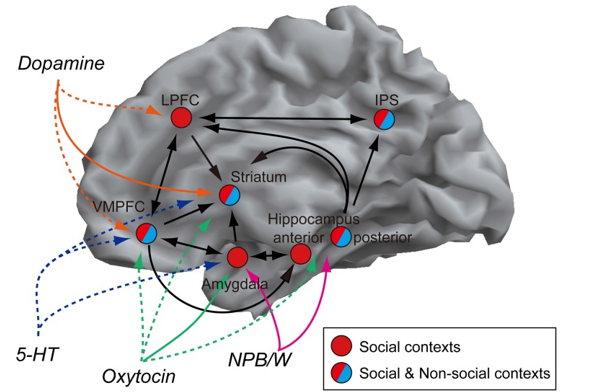
Figure 2. Network model of social dominance. Regions reportedly involved in the perception of social dominance are shown. Black lines and arrows indicate possible direct connections between regions based on anatomical studies (Clover et al., 2001; Freese and Amaral, 2009; Haber and Knutson, 2010; Yeterian et al., 2012). With respect to transmitters, colored solid lines indicate target regions for which scientific reports concerning hierarchy are available (Grant et al., 1998; Morgan et al., 2002; Brezillon et al., 2003; Timmer et al., 2011). Colored dashed lines indicate possible areas in which these transmitters may exert an influence (Passchier et al., 2000; Landgraf and Neumann, 2004; Hurd and Hall, 2005), but there is no scientific report from the perspective of social dominance and hierarchy.
- Figure from Watanabe N, Yamamoto M. “Neural mechanisms of social dominance”.
The Secret Ingredient for Social Success of Young Males: A Functional Polymorphism in the 5HT2A Serotonin Receptor Gene
During adolescence, social success depends to a considerable extent on popularity among peers. Although some young people have everything needed to become popular, this does not happen, whereas others seem to have a secret ingredient that simply matters. In this study, the G allele of a functional polymorphism in the promoter region of the 5HT2A serotonin receptor gene (-G1438A) was identified as the secret ingredient of peer popularity. These results are based on and extend previous work by Burt (2008, 2009). Taking the limitations of previous studies into account, the role of the 5HT2A serotonin receptor gene was studied in adolescent males (N = 285; mean age 13 years) using a unique sample from the TRAILS study. The presence of the G allele strengthens the association between aggression and popularity, especially for boys who have many female friends. This appears to be an “amplifying” effect of the G allele, through which characteristics related to popularity become more salient. There is, however, no “popularity gene,” because the G allele by itself does not affect popularity.
Dijkstra JK, Lindenberg S, Zijlstra L, Bouma E, Veenstra R. The secret ingredient for social success of young males: a functional polymorphism in the 5HT2A serotonin receptor gene. PLoS One. 2013;8(2):e54821. doi: 10.1371/journal.pone.0054821. Epub 2013 Feb 14. PMID: 23457454; PMCID: PMC3573014.
Serotonergic Contribution to Boys’ Behavioral Regulation
Objectives: Studies in animals and adult humans have identified a contribution of serotonin to behavioral regulation. Whether these findings apply to children is unclear. In the present study, serotonergic functioning was examined in boys with a history of difficulties in behavioral regulation using a double-blind acute tryptophan-administration procedure.
Method: Participants were 23 boys (age 10 years) with a history of elevated physical aggression, selected from a community sample. Eleven received a chocolate milkshake supplemented with 500 mg of tryptophan, and 12 received a chocolate milkshake without tryptophan. The boys participated in a competitive timed reaction game against a fictitious opponent in which responses to provocation, impulsivity, perspective taking, and exchange of views were assessed. Impulsivity was then assessed using a “go / no-go” paradigm. A computerized emotion-recognition task and a staged instrumental-helping task were also performed.
Results: The boys, regardless of group, responded similarly to strong provocation from the fictitious opponent. However, boys in the tryptophan group optimally adjusted their response level according to the level of provocation, whereas boys in the control group significantly reduced their response level by the end of the competition. Boys in the tryptophan group generally showed better perspective taking, better discrimination of fearful and happy facial expressions, and provided more instrumental help to the experimenter.
Conclusions. The present study provides preliminary evidence for the feasibility of acute tryptophan supplementation in children and for some effect of tryptophan supplementation on children’s behavior. Further research is needed to investigate the potential effects of increased serotonergic function on boys’ dominant and affiliative behavior.
Nantel-Vivier A, Pihl RO, Young SN, Parent S, Bélanger SA, Sutton R, Dubois ME, Tremblay RE, Séguin JR. Serotonergic contribution to boys’ behavioral regulation. PLoS One. 2011;6(6):e20304. doi: 10.1371/journal.pone.0020304. Epub 2011 Jun 1. PMID: 21673801; PMCID: PMC3105989.
Part 2 - DOMINANCE AND THE NEURAL ORGANIZATION OF THE BRAIN
In humans, a role has been identified for allelic variants of the dopamine and serotonin transporters, the vasopressin 1A receptor, and the transcription regulator MECP2 in the expression of social dominance [Kooij, Sandi, 2015]. Neural networks associated with recognition of social ranks have been identified - the inferior parietal lobule, dorsolateral prefrontal and ventrolateral prefrontal cortex, and medial occipitotemporal gyrus [Chiao, 2010]; data have been obtained on differences in neural activity of the brain in situations involving awareness of belonging to high or low status (e.g., [Krendl et al., 2008]).
- Van der Kooij A., Sandi C. (2015) The genetics of social hierarchies. Current Opinion in Behavioral Sciences. Vol. 2: 52–57.
- Chiao J. Y. (2010) Neural basis of social status hierarchy across species. Current Opinion in Neurobiology. Vol. 20: 803–809.
- Krendl A., Richeson J. A., Kelley W., Heatherton T. F. (2008) The negative consequences of threat: an fMRI investigation of the neural mechanisms underlying women’s underperformance in math. Psychological Science. Vol. 19: 168–175.
- Yulia Shkurko. Development of Evolutionary Neurosociology: Behavioral Biograms and Biological Predisposition to Social Inequality. Sociological Studies No. 9, 2018. https://www.researchgate.net/publication/329446233_Development_of_Evolutionary_Neurosociology_Behavioral_Biograms_and_Biological_Predisposition_to_Social_Inequality_in_Russ
Social Status and Modern-Type Depression: A Review
Social hierarchy is one of the most influential social structures used by social species. Whereas dominant individuals in such hierarchies may preferentially gain access to rich resources, subordinates are forced to shift to a lower social status and a lifestyle with fewer resources. Previous studies have shown that social rank regulates social behavior and emotions in many species, resulting in individual organisms living within their ranks. However, in human societies, people, especially young people who cannot accept their social status, may display behavior of withdrawal from society, such as hikikomori, in order to avoid confronting their circumstances.
The article examines the neural mechanisms underlying social status that have been identified in animal studies with rodents and primates and assesses how social rank influences animals’ social behavior and emotions that may be relevant to modern-type depression.
Results. Certain brain regions, such as the medial prefrontal cortex, are involved in establishing animals’ social status, resulting in differences in vulnerability and resilience to social stress.
Komori T, Makinodan M, Kishimoto T. Social status and modern-type depression: A review. Brain Behav. 2019 Dec;9(12):e01464. doi: 10.1002/brb3.1464. Epub 2019 Nov 19. PMID: 31743626; PMCID: PMC6908884.
Neural Mechanisms of Social Dominance (Review)
The principal brain regions whose activity both reflects one’s own social status and participates in the perception and processing of another person’s social status are the amygdala, hippocampus, striatum, IPS, VMPFC, DLPFC, and VLPFC. The review examines in detail the results of a number of studies on the participation of these structures in reflecting one’s own social status and processing that of others. The results show that these regions can be divided into two groups: one group that encodes only social ranking and includes the LPFC, amygdala, and anterior hippocampus, and a second group that encodes both social and nonsocial ranking and includes the VMPFC, IPS, striatum, and posterior hippocampus. It has been suggested that the amygdala plays an important role in the perception of social ranking. The striatum appears to process information about both social and nonsocial ranking in relation to the value and reward system. The IPS apparently encodes both types of ranking in relation to “magnitude,” while the LPFC may encode social ranking as part of a social norm. However, these concepts are only beginning to be studied, and future experiments will clarify the role of each brain region in the perception of dominance.
Watanabe N, Yamamoto M. Neural mechanisms of social dominance. Front Neurosci. 2015 Jun 17;9:154. doi: 10.3389/fnins.2015.00154. PMID: 26136644; PMCID: PMC4469834.
Understanding Social Hierarchies: The Neural and Psychological Foundations of Status Perception (Review)
Social groups of different species rapidly self-organize into hierarchies whose members differ in their level of power, influence, skill, or dominance. In this review, we examine the nature of social hierarchies and traits associated with status in both humans and nonhuman primates, as well as how status changes with development in humans. Our review shows that we can rapidly determine social status on the basis of a broad range of cues. Like monkeys, we tend to use certain cues, such as physical strength, to make judgments about status, although sociocultural status cues, such as job titles and level of education, are superimposed on these more primitive perceptual cues. A person’s relative status has a profound influence on attention, memory, and social interactions, as well as on health and well-being. These effects may be particularly detrimental for children and adolescents. Studies devoted to the development of peer groups and social exclusion show that adolescents may be especially sensitive to information about social status, but research specifically addressing status processing and the brain regions associated with it is very limited. Recent evidence from neuroscience suggests that there may be a basic neural network, including regions involved in executive, emotional, and reward processing, that is sensitive to status information. In conclusion, questions for future research are posed, and the need to extend social-neuroscience research on status processing to adolescents is emphasized.
Keywords: adolescence; Dominance; Neural; Popularity; Status.
Koski JE, Xie H, Olson IR. Understanding social hierarchies: The neural and psychological foundations of status perception. Soc Neurosci. 2015;10(5):527-50. doi: 10.1080/17470919.2015.1013223. Epub 2015 Feb 20. PMID: 25697184; PMCID: PMC5494206.
Status and the Brain
Social hierarchy is a fact of life for many animals. Navigating a social hierarchy requires understanding one’s own status relative to others and behaving accordingly, whereas attaining higher status may require cunning and strategic thinking. The neural mechanisms mediating social status are becoming increasingly well understood in invertebrates and model organisms such as fish and mice, but until recently remained more opaque in humans and other primates. In a new study devoted to this issue, Noonan and colleagues investigate the neural correlates of social rank in macaques. Using both structural and functional brain imaging, they found neural changes associated with the social status of individual monkeys, including changes in the amygdala, hypothalamus, etc. and the brainstem - regions previously implicated in dominance-related behavior in other vertebrates. A separate but interconnected network in the temporal and prefrontal cortex appears to mediate more cognitive aspects of strategic social behavior. These discoveries begin to outline the neural circuits that allow us to navigate our own social worlds. An important remaining problem is to determine how these networks functionally contribute to our social lives, which may open new opportunities for developing innovative treatments for social disorders.
The authors identified a network of regions in which gray-matter measures varied according to social status; these regions included the bilateral central amygdala, bilateral brainstem (between the medulla and midbrain, including parts of the raphe nuclei), and hypothalamus, which varied positively with dominance, and regions in the basal ganglia, which varied negatively with social status. These regions have been implicated in social-rank functions across a number of species [28] - [32]. Importantly, these relationships were unique to social status. There was no relationship between gray matter in these subcortical regions and social-network size, supporting a specific role in behavior related to social dominance. Nevertheless, gray matter in the bilateral middle STS and rPFC varied both with social status and with social-network size, as previously reported. These results show that certain brain regions uniquely mediate functions related to social hierarchy, whereas others may serve more general social-cognitive processes.
Noonan and colleagues then investigated spontaneous coactivation using fMRI to determine whether functional connectivity among any of these regions varies as a function of social status. They found that the more subordinate the animal, the stronger the functional connectivity among several dominance-related regions. These results suggest that individual differences in social status are functionally observable in the brain even when the animal is at rest and not engaged in social behavior. These results suggest that structural changes associated with individual differences in social status alter baseline brain function, consistent with the idea that the brain is social by default [33] and that the sense of self and perhaps even awareness arise from inwardly directed social reasoning [34].
These findings echo previous studies of the neural bases of social dominance in other vertebrates. In humans, for example, activity in the amygdala tracks knowledge of social hierarchy [28], [35] and, in addition, displays patterns of activity that uniquely encode social rank and predict corresponding behavior [28]. Moreover, recent studies have identified a specific region in the mouse hypothalamus aptly named the “hypothalamic attack zone” [36], [37]. Stimulation of neurons in this region immediately induces attacks on other mice and even on an inflated rubber glove, whereas inactivation of these neurons suppresses aggression [38]. In the African cichlid Haplochromis burtoni, a change in the social status of an individual male causes a reversible change in the number of specialized neurons in the hypothalamus that interact hormonally with the pituitary gland and gonads [39]. Injections of this hormone into male birds after an aggressive territorial encounter enhance the normal subsequent rise in testosterone [40]. Serotonergic neurons in the raphe region of the brainstem also contribute to dominance-related behavior in fish [29], [31] and aggression in monkeys [41].
Utevsky AV, Platt ML. Status and the brain. PLoS Biol. 2014 Sep 2;12(9):e1001941. doi: 10.1371/journal.pbio.1001941. PMID: 25181006; PMCID: PMC4151965.
A Neural Circuit Covarying with Social Hierarchy in Macaques
Despite widespread interest in social dominance, little is known about its neural correlates in primates. We hypothesized that primate social status might be related to individual differences in subcortical brain regions involved in other aspects of social and emotional behavior in other mammals. To investigate this possibility, we used magnetic resonance imaging (MRI), which permits noninvasive quantitative measurements of both brain structure and brain function in many regions simultaneously. We performed a series of tests of structural and functional MRI (fMRI) data in 25 macaques living in groups. First, a deformation-based morphometric (DBM) approach was used to show that gray matter in the amygdala, brainstem near the raphe nucleus and reticular formation, hypothalamus, and septum / striatum of the left hemisphere correlated with social status. Second, similar correlations were found in the same regions in the other hemisphere. Third, similar correlations were found in a second dataset obtained several months later from a subset of the same animals. Fourth, the strength of connectivity between activity measured by fMRI in the same regions correlated with social status. The network of subcortical regions, however, had no relation to the sizes of individuals’ social networks, suggesting that the regions had a simple and direct relationship with social status. By contrast, a second cortical circuit, including the middle superior temporal sulcus as well as the anterior and dorsal prefrontal cortex, depended on both individuals’ social status and the sizes of the social networks they encountered.
Noonan MP, Sallet J, Mars RB, Neubert FX, O’Reilly JX, Andersson JL, Mitchell AS, Bell AH, Miller KL, Rushworth MF. A neural circuit covarying with social hierarchy in macaques. PLoS Biol. 2014 Sep 2;12(9):e1001940. doi: 10.1371/journal.pbio.1001940. PMID: 25180883; PMCID: PMC4151964.
Raphe GABAergic Neurons Mediate the Acquisition of Avoidance after Social Defeat
Serotonin (5-HT) modulates neural responses to socioaffective signals and may influence approach or avoidance in behavioral decisions, but the cellular mechanisms underlying its contribution to the regulation of social experience remain poorly understood. The authors hypothesized that GABAergic neurons in the dorsal raphe nucleus (DRN) may participate in socioaffective regulation by controlling serotonergic tone during social interaction. The authors tested this hypothesis using whole-cell recording methods in genetically identified DRN GABA and 5-HT neurons in mice exposed to social defeat, a model that induces prolonged avoidance behavior in a subset of mice responsive to serotonergic antidepressants. Our results showed that social defeat affects DRN GABA neurons and causes GABAergic sensitization that enhances inhibition of 5-HT neurons in mice that were susceptible, but not resilient, to social defeat. In addition, optogenetic silencing of DRN GABA neurons disinhibited neighboring 5-HT neurons and prevented acquisition of social avoidance in mice exposed to social threat, but did not affect a previously acquired avoidance phenotype. We provide the first characterization of GABA neurons in the DRN that monosynaptically inhibit 5-HT neurons and reveal their key role in the neuroplastic processes underlying the development of social avoidance.
Challis C, Boulden J, Veerakumar A, Espallergues J, Vassoler FM, Pierce RC, Beck SG, Berton O. Raphe GABAergic neurons mediate the acquisition of avoidance after social defeat. J Neurosci. 2013 Aug 28;33(35):13978-88, 13988a. doi: 10.1523/JNEUROSCI.2383-13.2013. PMID: 23986235; PMCID: PMC3756748.
Stress-Induced Changes in Social Dominance Are Scaled by AMPA-Type Glutamate Receptor Phosphorylation in the Medial Prefrontal Cortex
Establishing and maintaining social dominance are crucial for social stability, survival, and the health of individual animals. Stress leads to depression, and reduced social status in depressed people is a risk factor for suicide. We therefore investigated mechanistic and behavioral relationships among stress, depression, and social dominance and found that mice exposed to chronic restraint stress (CRS), an animal model of stress-induced depression, exhibited reduced social dominance according to the dominance tube test. Importantly, this submissive behavior was suppressed by the antidepressant fluoxetine, a selective serotonin reuptake inhibitor. Social dominance is known to be controlled by synaptic efficacy in the medial prefrontal cortex (mPFC), and the AMPA-type glutamate receptor (AMPA-R) is a key molecule for synaptic efficacy. We found that AMPA-R phosphorylation was bidirectionally altered by CRS and fluoxetine in the mPFC of CRS mice. Moreover, we found a strong correlation between social dominance and AMPA-R phosphorylation, which regulates synaptic efficacy by modulating synaptic targeting of AMPA-R. Our correlational analysis of behavior and biochemistry in the CRS model suggests that AMPA-R phosphorylation in the mPFC may serve as a biomarker of stress-related social dominance.
Park MJ, Seo BA, Lee B, Shin HS, Kang MG. Stress-induced changes in social dominance are scaled by AMPA-type glutamate receptor phosphorylation in the medial prefrontal cortex. Sci Rep. 2018 Oct 9;8(1):15008. doi: 10.1038/s41598-018-33410-1. PMID: 30301947; PMCID: PMC6177388.
Neural Mechanisms Supporting Successful Social Decisions in Monkeys
Vervet monkeys are a suitable species for modeling aspects of the neurobiology of human social decision-making. Vervets are phylogenetically closely related to humans and possess a large brain that undergoes substantial postnatal maturation, exhibit a rich behavioral repertoire, and establish strong and complex social relationships. This chapter describes two types of studies that examined relationships among monoaminergic neurotransmitter systems, frontal-lobe function, and effective social decision-making in vervets. One set examined indices of serotonergic function, while the other used positron emission tomography (PET) to assess glucose metabolism in the brain.
Serotonergic systems are involved in mediating social-behavior decisions necessary for attaining high social status among adult animals. In vervets, under appropriate social conditions, pharmacological enhancement of serotonergic function sharply increased the probability of dominance. Adult male monkeys treated with fluoxetine or tryptophan displayed enhanced abilities to assess and act more effectively than their vehicle-treated rivals. Treated subjects displayed more effective aggression, formed and maintained more reciprocal alliances, and were more likely to initiate a sequence of behavior that led both to attacks and to ostracism of members of a rival group. Pharmacologically reduced serotonergic function produced behavioral changes in the opposite direction. In addition,max ) serotonin-2A receptors (S 2A ) in the posterior orbitofrontal cortex, amygdala, and temporal pole.
In the second series of studies, positron emission tomography (PET) was used to examine the acute and persistent effects of early cognitive enrichment on brain metabolism and behavior. While in their social group, young animals were systematically exposed to cognitive tasks for 30 consecutive days. Compared with a control group of the same age and sex that did not undergo cognitive enrichment, these subjects showed an increased rate of glucose metabolism in selected neocortical regions, especially the dorsolateral and orbital frontal cortex. Other regions, such as the brainstem and cerebellum, did not show a similar increase in glucose metabolism. This region-specific increased metabolic rate persisted for 15 months after cognitive enrichment ended. Furthermore, enriched subjects continued to outperform control subjects not only on cognitive tasks but also on social problems. They were less anxious about novelty, assessed complex social situations more effectively, and were more likely to make the kinds of social decisions that allow individuals to attain high social status. These observations suggest that neural systems may possess substantial plasticity required for effective social decision-making.
These two sets of studies support and extend observations made in normal humans and humans with neurological disorders. They suggest that serotonergic systems, especially those terminating in the frontal cortex, may underlie stable individual differences in the ability to make effective social decisions. They also imply that early cognitive enrichment may affect social decision-making processes in addition to having a long-term influence on neural function.
Raleigh M., McGuire M., Melega W., Cherry S., Huang SC., Phelps M. (1996) Neural Mechanisms Supporting Successful Social Decisions in Simians. In: Damasio A.R., Damasio H., Christen Y. (eds) Neurobiology of Decision-Making. Research and Perspectives in Neurosciences. Springer, Berlin, Heidelberg. https://doi.org/10.1007/978-3-642-79928-0_4
Part 3 - SOCIAL STATUS AND THE STRUCTURE OF SOCIETY
Although dominance hierarchy is a ubiquitous social phenomenon, there are differences in its perception that are associated with the allelic frequency of the serotonin transporter. In cultures in which the value of social hierarchy prevails over egalitarianism, individuals carrying at least one copy of the short allele of the serotonin transporter 5-HTTLPR predominate compared with nations that prefer egalitarian social norms. At the same time, it is known that the short allele of the serotonin transporter 5-HTTLPR is associated with an increase in negative emotions, including increased anxiety and fears; individuals possessing at least one short allele are at risk of developing depression. One possible explanation is that people in such cultures (with a predominance of individuals with short alleles) may prefer hierarchical social structures in order to increase predictability in social relationships and, consequently, reduce the probability of life risk associated with unstable social hierarchies that emerge in more egalitarian societies [Chiao, 2010]. It has also been found that in collectivist cultures (according to G. Hofstede’s model, Russia, in particular, is one such culture), people with short alleles of the serotonin transporter 5-HTTLPR predominate in the population [Chiao, Blizinsky, 2010].
- Chiao J. Y. and Blizinsky K. D. (2010) Culture–Gene Coevolution of Individualism–Collectivism and the Serotonin Transporter Gene. Proceedings of the Royal Society B: Biological Sciences. Vol. 277: 529–537.
- Chiao J. Y. (2010) Neural basis of social status hierarchy across species. Current Opinion in Neurobiology. Vol. 20: 803–809.
It is known that in any social group, because of the need to solve coordination problems, a leader necessarily emerges, while some people are biologically more predisposed than others to follow a leader rather than to be one (a substantial role of genetic factors has been identified in general personality traits predisposing to leadership – extraversion, intelligence, empathy, ambition) [van Vugt, 2006; van Vugt, Ahuja, 2012]. There are, of course, differences in the evolutionary strategies for attaining and retaining a status position between leadership as a “process of influence for achieving common goals” and dominance based on coercive force [van Vugt, 2006]. Nevertheless, the emergence in a group of a leader, someone who plays a central role in decision-making, provides strong grounds for the emergence specifically of a dominance hierarchy (rather than merely status differences), in which only those followers who are more important than others for maintaining the existing leadership system are at its top.
- Van Vugt M. (2006) Evolutionary Origins of Leadership and Followership. Personality and Social Psychology Review. Vol. 10 (4): 354–371.
- Van Vugt M., Ahuja A. Selected Works. Evolutionary Psychology of Leadership. Moscow: Kar’era Press, 2012. [van Vugt M., Ahuja A. (2012) Selected Works. The Psychology Science of Leadership. Moscow: Kar’era Press. (In Russ.)]
Adaptations accompanying and making hierarchical social organizations possible are being studied. Thus, the emotions of “pride” and “shame” emerged as adaptations to high and low status in a social-dominance hierarchy; they are caused by emotionally oppositely colored experiences of social relations of power ranking (anger and fear) and mutual support (joy and sadness). Pride makes it possible to demonstrate one’s dominant position and superiority to others (expansive posture and movements, direct gaze, raised head, bodily relaxation). This generally positive emotion combines anger (increasing the probability of success in achieving the desired goal of social superiority) and joy (at what has been achieved). In hierarchical relationships, shame developed from the primary emotions of fear (of failure) and sadness (because of others’ disapproval, “loss” of self) and became associated with a subdominant position. The expression of shame (constricted posture, restrained movements, avoidance of direct gaze, muscular tension) allows subdominants to avoid punishment and negative evaluation and to obtain necessary resources. Ultimately, the ability to transmit, express, and recognize emotions that signal a dominant or subordinate position is useful for everyone, regardless of position in the social hierarchy [TenHouten, 2017].
TenHouten W.D. (2017) Social dominance hierarchy and the pride–shame system. Journal of Political Power. doi: 10.1080/2158379X.2017.1285154
Existing sex differences at the hormonal level apparently give women advantages in child-rearing [Huber, 2008]. Evolutionary sociologists suggest that such predispositions influence the contemporary choices of men and women toward work and family, respectively, which affects socioeconomic status. Evolutionary logic also explains why women’s status increases after they pass childbearing age [Hopcroft, 2009].
- Huber J. (2008) Reproductive Biology, Technology, and Gender Inequality: An Autobiographical Essay. Annual Review of Sociology. Vol. 34: 1–13.
- Hopcroft R. (2009) Gender Inequality in Interaction – An Evolutionary Account. Social Forces. Vol. 87(4): 1–27.
Dominance and social power are always associated with a particular territory. Moreover, there is nothing remarkable about the human relationship to territory. More than 100 species of nonhuman primates, for example, live in social groups that have persistent hostile intergroup interactions. Such relationships include territorial defense, nonterritorial dominance over rival groups, and competition for females [Wrangham, 2004: 241]. Humans differ little from them in this respect. For example, behavioral similarity is observed between youth gangs and chimpanzee communities – males attain status through struggle, including fights; in turn, status attained in this way requires the creation of alliances for protection against rivals, generally within a particular territory [Wrangham, 2004]. Such behavioral processes are regulated by the neuropeptide vasopressin, known for its role in defending territorial boundaries and intergroup communication [Ferguson, Young, Insel, 2002].
Wrangham R. V., Wilson M. L. (2004) Collective Violence. Comparisons between Youths and Chimpanzees. Ann. N. Y. Acad. Sci. Vol. 1036: 233–256
Ferguson J. N., Young L. J., Insel T. R. (2002) The Neuroendocrine Basis of Social Recognition. Frontiers in Neuroendocrinology. Vol. 23: 200–224.
Social Dominance Theory (SDT) is a theory of intergroup relations that focuses on maintaining and ensuring the stability of hierarchy in social groups. According to the theory, inequality in groups is maintained by three primary types of intragroup behavior: discrimination, aggregated individual discrimination, and behavioral asymmetry. SDT proposes that widespread cultural ideologies (so-called legitimizing myths) provide moral and intellectual justification for these types of intergroup behavior. There are two functional types of legitimizing myths: (1) hierarchy-enhancing and (2) hierarchy-attenuating. Ideologies that enhance hierarchy (for example, racism or meritocracy) contribute to establishing a higher degree of inequality in the group. Hierarchy-attenuating ideologies (for example, anarchism and feminism) correspond to a higher level of intergroup equality. People provide living confirmation of these forms of ideology on the basis of their psychological orientation toward dominance and their desire for unequal group relations (i.e. their social dominance orientation; SDO). People who are more oriented toward social dominance tend to endorse hierarchy-enhancing ideologies, whereas people who prefer submission tend to adhere to ideologies that attenuate it. Finally, SDT proposes that the relative balancing of these two functional types stabilizes intergroup inequality.
Sidanius, Jim; Pratto, Felicia (1999). Social Dominance: An Intergroup Theory of Social Hierarchy and Oppression. Cambridge University Press
As dominance hierarchies evolved, natural selection made the “rich — richer, and the poor — poorer.” Dominant individuals are happier, healthier, and live longer than subordinates. In other primates, not only genes that promote attainment of dominant status are inherited, but status itself as well (because they live in leaders’ families). In rhesus macaques, the “alpha” male is often the son of the first-ranking female in the female hierarchy. In humans, direct inheritance of status is even more likely. Noble titles, land, and other material property were for a long time part of legal systems. People not only received high status by birthright, they also inherited many traits conducive to attaining high position. In addition, early childhood experience (ontogenesis) adjusted their behavior to correspond to high position. When ancient humans ceased living by gathering and hunting, they simultaneously abandoned exchange in kind and balance that had prevented the concentration of great power in the hands of one person. As soon as the accumulation of resources (land, livestock) became possible, a unique feature of human culture emerged — inheritance of material property. Wealth and power were no longer limited to what one person could acquire in a lifetime, but, passing by inheritance to sons, grew like a snowball. In the absence of external control, despotic rulers spontaneously emerge in human communities and cause the people much suffering. Examples include the first six civilizations (Betzig, 1993) and many subsequent ones. Fortunately, evolution in the social context also produced many opposing tendencies. These formed the foundation for some of the highest and noblest human ideals.
Dominance hierarchies arise in groups of living organisms in order to minimize aggression among individuals competing for limited resources. Because high social rank automatically provides access to all available resources, natural selection favored tendencies to struggle for higher social status. In primates, a high level of social intelligence also emerged over the course of evolution, facilitating this upward movement.
Human evolution is complicated by the fact that our extinct ancestors lived in dominance hierarchies, but during the Pleistocene the social structure was egalitarian, which is necessary for the life of gatherers and hunters. With the emergence of agriculture, individual persons gained the ability to monopolize resources and centralize power. Thus, a new type of dominance hierarchy emerged.
At the level of physiological responses, behavior in a dominance hierarchy is determined by the neurotransmitter serotonin. When a primate’s social rank rises, its serotonergic activity increases, resulting in greater motor activity and a good mood. When status is lowered, serotonergic activity falls, and motor activity falls with it, which conserves energy. Selective serotonin reuptake inhibitors (SSRIs) increase serotonin levels and are used to treat depressive states.
The level of the male sex hormone testosterone also fluctuates with changes in social status. High-ranking individuals require a higher testosterone level in order to take advantage of favorable mating opportunities and to be prepared to defend their social position against rivals.
Stress hormones mediating the fight-or-flight response are also involved in the physiology of life within a dominance hierarchy. In high-status individuals, the release of stress hormones in a critical situation generally helps. Conversely, in subordinate individuals, chronic stress impairs the physiological efficiency of stress responses and entails health problems and reduced life expectancy. In human communities, cultural factors (for example, inheritance of material goods) often make upward movement more difficult for people of low social standing.
In vertebrates, helping conspecifics derives from patterns of parental care. Kin-selection theory maintains that altruism shown by parents toward children could readily have been extended to other conspecifics. Once a group of living organisms reached a certain level of complexity, altruistic actions could also become directed toward nonrelatives, because it was understood that the recipient of help would reciprocate. Gratitude, sympathy, trust, and guilt can be regarded as adaptive mechanisms that facilitate the functioning of a highly developed system of reciprocal altruism in humans.
Palmer D. A., Palmer L. K. Evolutionary Psychology. The Secrets of Homo sapiens Behavior (1999) https://www.phantastike.com/human/evolutionary_psychology/doc/
Neural Mechanisms of Social Dominance (Review)
Social hierarchy is a form of expression of dominance that is observed in various animal species that develop communal systems, from fish to primates (Paz-Y-Mino et al., 2004; Grosenick et al., 2007; Byrne and Bates, 2010). Certain aspects of behavior, including obtaining food and reproduction, are influenced by social hierarchy, and in fact some species exhibit morphological changes in accordance with their hierarchical rank in society. For example, flanges (cheek pads) appear on the face of a male orangutan only when that individual is physically strong and dominant in society (Mackinnon, 1974; Kuze et al., 2005). However, changes induced by social rank are not limited to appearance, and a number of social signals associated with dominance affect the activity of brain systems (Sapolsky, 2005).
Human social systems also developed on the basis of social hierarchy, which arose to increase the probability of survival in dangerous situations. If a group functions as well as a single organic system, then that group can achieve much more than an isolated individual. For this to occur, people generally must work under the direction of a single control center and a component of hierarchical information processing. In animal societies, physical strength tends to determine social rank, but in human societies not only physical strength but also cognitive factors such as intelligence and emotional stability determine his / her social ranking (Hall et al., 2005). In humans, a recent study (Cook et al., 2014) reported that there are two types of dominant personalities; one they called social dominance and the other aggressive dominance. The former rely on persuading others through reasoning, whereas the latter use aggression, threats, deception, and flattery. Although the strategies differ, both types are motivated to control others and to understand their hierarchical relationships for purposes of control.
Facial Expression and Dominance
During direct (face-to-face) communication, a person can perceive the social status or hierarchical rank of other people in a social group using various cues. A person tends to change his or her behavior depending on the relative social rank of the other person compared with his / her own rank. One cue that can help in assessing another person’s social rank is facial expression.
Wiggins proposed an interpersonal circumplex model with a two-axis concept of valence and dominance / power for assessing interpersonal behavior (Wiggins, 1979; Wiggins et al., 1989). The results of Oosterhof and Todorov (2008) supported Wiggins’s model. They studied participants’ impressions while viewing a large number of human faces. To avoid the emotional component inherent in facial expressions, they used photographs of neutral faces without a clear emotional expression. Participants were asked to describe their impressions of the neutral faces on a scale from 1 to 9 using 15 adjective ratings, including terms such as “attractive,” “strange,” “average,” and “trustworthy,” and they identified independent face functions using principal component analysis. Two orthogonal (independent) axes were extracted: valence and dominance / power. Oosterhof and Todorov concluded that people generally evaluate others’ faces according to whether they appear favorable (valence axis: high scores for trustworthiness, emotional stability, and responsible) or whether the person dominates (surpasses) the participant (dominance / power axis: high scores for dominant, confident, and aggressive). Thus, they proposed that one of the factors determining interpersonal relationships is Dominance / Power.
Watanabe N, Yamamoto M. Neural mechanisms of social dominance. Front Neurosci. 2015 Jun 17;9:154. doi: 10.3389/fnins.2015.00154. PMID: 26136644; PMCID: PMC4469834.
CONCLUSIONS on the Role of Serotonin in Social Status
High social-group status in male lower primates, but only in males (and partly – in humans, whose social organization is more complex), is indeed accompanied by a tendency toward increased serotonergic activity in the CNS, including increased concentrations in blood and cerebrospinal fluid.
The relationship between serotonin and social status is bidirectional, reciprocal: high serotonin contributes to the acquisition of higher social status; in turn, acquired high group status increases serotonin in the individual.
Serotonin is far from the only hormonal agent influencing an individual’s social status. The acquisition of higher dominance ranks is also facilitated by elevated testosterone (which maintains aggressiveness at the proper level), vasopressin, in women – also oxytocin, and in both sexes – a lower cortisol status. Group status is also influenced by (or reflected in) CNS concentrations of a number of recently discovered specific neuropeptides. Thus, a direct unambiguous relationship between serotonin levels and social status cannot be established, although a positive correlation between them does exist.
It should be remembered that, whereas in animals the concept of social status within a group is fairly universal, in humans at least two different forms of social dominance should be distinguished. One of them is based on authority in a small group where everyone knows one another by sight. Here, apparently, the role of high serotonin is maximal, because it gives a person’s behavior confidence, optimism, equanimity, and affiliativeness (that is, the capacity to create warm, trusting, emotionally meaningful relationships with other people), increases readiness to care for others and to share (moreover - from the position of a self-confident strong person), and increases the business-logic and introverted-ethics components of behavior (that is – the “Serious” components in the socionic sense). All of these factors can undoubtedly contribute to increasing a person’s authority in the group within intergroup interaction, that is, they lead to an increase in his or her intragroup status. The second form of social dominance is more common in large human communities (from large corporations to states); it is despotic and based on instilling fear among subordinates. Within such a strategy, the dominant individual requires strength and cruelty rather than affiliativeness, ambition and egocentric lust for power rather than responsibility for others, and the role of, for example, a high testosterone level in this case is much more necessary and important.
Even within the interaction of serotonin alone with social-group status, it must be remembered that this concerns not only a formal increase or decrease in the activity of the serotonergic system as a whole, but primarily a restructuring of the relationships among its components, when a change in status is accompanied by changes in the balance of expression of different types of serotonin receptors (of which there are about two dozen). The serotonin system serves as an intermediary between environmental resources and the state of the organism. It regulates the state of the organism in such a direction as to adapt it optimally to the state of the available environmental resources. As a result, its effect on the organism is not single-factor but multifactorial – through changes in the balance of expression of numerous types of serotonin receptors on neurons and other cells of the organism that differ greatly in their functions.
In humans overall, “a lot of serotonin” (the principal factor of its action) produces not only a subjective feeling of well-being and confidence, but also a more general subjective sense of the availability and even abundance of existing resources (which, in general, is the reason for the feeling of serene well-being). Elevated serotonin as a whole leads to some reduction in exploratory activity, to a conservative orientation toward preservation rather than search and acquisition, improves mood and reduces anxiety, improves posture and straightens the back, makes the gaze more direct, makes a person more good-natured, creates a feeling of confidence, reduces fears, increases approach behavior and reduces avoidance behavior, reduces envy, increases the social motivation to share resources with those close to oneself, and also increases motivation to occupy higher status levels in society (because “why not,” since resources are available and “everything is now accessible”). At the same time, “serotonergic lust for power” looks not so much like aggression and greedy conflictual lust for power (that is – more a matter of testosterone), but rather like confidence in one’s entitlement and a constant readiness to decide other people’s fates while taking responsibility for others, and to “sit on the presidium.” In turn, the current serotonin level also depends on the current availability of resources. Specifically, after successful achievements it rises, while after failures and setbacks – it falls (not counting its circadian rhythms). If there is a lot of serotonin – there will also be greater claims to higher status and authority in the group. And the higher the status attained, signaling to the organism its success and the availability of broader resources, the higher serotonin in turn becomes (until a run of successes is replaced by a prolonged run of failures).
In the course of gaining power, a person’s behavior may contain a great deal of aggression and adventurism, but after power has been attained, their level declines simultaneously with the rise in serotonin (which registers the success of the victory and conquest), while readiness to distribute benefits to those nearby from one’s bounty – increases. This, in fact, is the basis, not entirely without reason, for the very common popular opinion that “it is better for the current bosses to remain rather than new ones; these ones have at least already eaten their fill, and at least something trickles down to us from them.” The corresponding forecast usually runs aground on rational Beta psychotypes, especially EIE. The point is that EIE is often characterized by such a profound serotonin deficit that no increase in social status succeeds in compensating for it. For this reason, in particular, in the 1930s the many German and European politicians and political scientists who expected that, after Hitler had acquired and consolidated power, “everything would settle down” and his international and domestic policy would become much more amenable to agreement, compromise-oriented, and peaceable were badly mistaken in their forecasts.