Self-Confidence in One´s Actions, or Doubts and Hesitation When Making a Decision? Socionic Projections.
Self-Confidence in One’s Actions, or Doubts and Hesitation When Making a Decision? Socionic Projections.
V. L. Talanov, August 2011
Based on extensive experimental material, the article analyzes in detail which socionic types, functions, and traits are associated with a person’s habitual self-confidence or, conversely, their persistent tendency toward doubts and hesitation when choosing and making decisions.
The following conventional designations are used in the article, including in its diagrams:
For designating sociotypes (and labels for the mean type values of the psychological trait for the given sociotype) -
ILE — intuitive-logical extravert, “Seeker”, “Don Quixote”
LII — logical-intuitive introvert, “Scientist”, “Analyst”, “Descartes”
SEI — sensory-ethical introvert, “Mediator”, “Hedonist”, “Dumas”
ESE — ethical-sensory extravert, “Enthusiast”, “Trader”, “Hugo”
SLE — sensory-logical extravert, “Marshal”, “Zhukov”
LSI — logical-sensory introvert, “Inspector”, “Maxim”
IEI — intuitive-ethical introvert, “Lyricist”, “Yesenin”, “Tutankhamun”
EIE — ethical-intuitive extravert, “Artist”, “Mentor”, “Hamlet”
SEE — sensory-ethical extravert, “Politician”, “Caesar”
ESI — ethical-sensory introvert, “Guardian”, “Dreiser”
ILI — intuitive-logical introvert, “Critic”, “Balzac”
LIE — logical-intuitive extravert, “Entrepreneur”, “Inventor”, “Jack”
IEE — intuitive-ethical extravert, “Journalist”, “Adviser”, “Huxley”
EII — ethical-intuitive introvert, “Humanist”, “Dostoevsky”
SLI — sensory-logical introvert, “Craftsman”, “Gabin”
LSE — logical-sensory extravert, “Administrator”, “Stirlitz”, “Sherlock Holmes”
For designating socionic functions or mean values of the psychological trait associated with a given function. (For the purposes of the present article, averaging by functions was performed using weighting coefficients assigned to sociotypes — sociotypes in which the function is the program function and has the highest dimensionality were assigned a coefficient of 1.0; all other sociotypes, including those in which the function is creative, were assigned a coefficient of 0) -
Ni - “white intuition”, introverted intuition, “intuition of time”
Ne - “black intuition”, extraverted intuition, “intuition of possibilities”
Si - “white sensing”, introverted sensing, “sensing of sensations”
Se - “black sensing”, extraverted sensing, “force sensing”
Ti - “white logic”, introverted logic, “structural logic”
Te - “black logic”, extraverted logic, “business logic”
Fi - “white ethics”, introverted ethics, “ethics of relations” - provides perception of other people’s feelings
Fe - “black ethics”, extraverted ethics, “ethics of emotions” - provides export and transmission of one’s own feelings
For designating groups of sociotypes linked by shared values - socionic quadras and clubs (including labels for values of the psychological trait averaged across the types in these groups) -
1st q. - the first socionic quadra of types, “Alpha”, (ILE, LII, SEI, ESE)
2nd q. - the second socionic quadra of types, “Beta”, (SLE, LSI, IEI, EIE)
3rd q. - the third socionic quadra of types, “Gamma”, (SEE, ESI, ILI, LIE)
4th q. - the fourth socionic quadra of types, “Delta”, (IEE, EII, SLI, LSE)
NT — the “Scientists” club, uniting four types with simultaneous predominance of logic and intuition (ILE, LII, ILI, LIE)
SF — the “Socials” club, uniting four types with simultaneous predominance of ethics and sensing (SEI, ESE, SEE, ESI)
NF — the “Humanitarians” club, uniting four types with simultaneous predominance of ethics and intuition (IEI, EIE, IEE, EII)
ST — the “Managers” club, uniting four types with simultaneous predominance of logic and sensing (SLE, LSI, SLI, LSE)
For the socionic analysis of selected psychological properties, individual questions and statements from questionnaires and interviews were grouped by their meaning and content into semantic clusters. Each cluster therefore generally combines several primary questionnaire psychological indicators — selected with the aim and in such a way that, in their combined set, the properties of the cluster are revealed as fully as possible. The resulting socionic profiles constructed for the clusters are averages of the profiles of all individual questionnaire questions and statements included in the cluster.
Type diagnosis was carried out using special, well-validated, high-accuracy diagnostic questionnaires, with reliability of type determination (including “borderline” cases) no worse than 90%.
Cluster: “Self-confidence and decisiveness predominate over indecisiveness, doubts, and hesitation in actions and when making a decision”
The cluster consists of 18 assessed statements; on average, 617 respondents participated in the assessment of each. The diagram was constructed using 11106 responses from more than 3500 respondents.
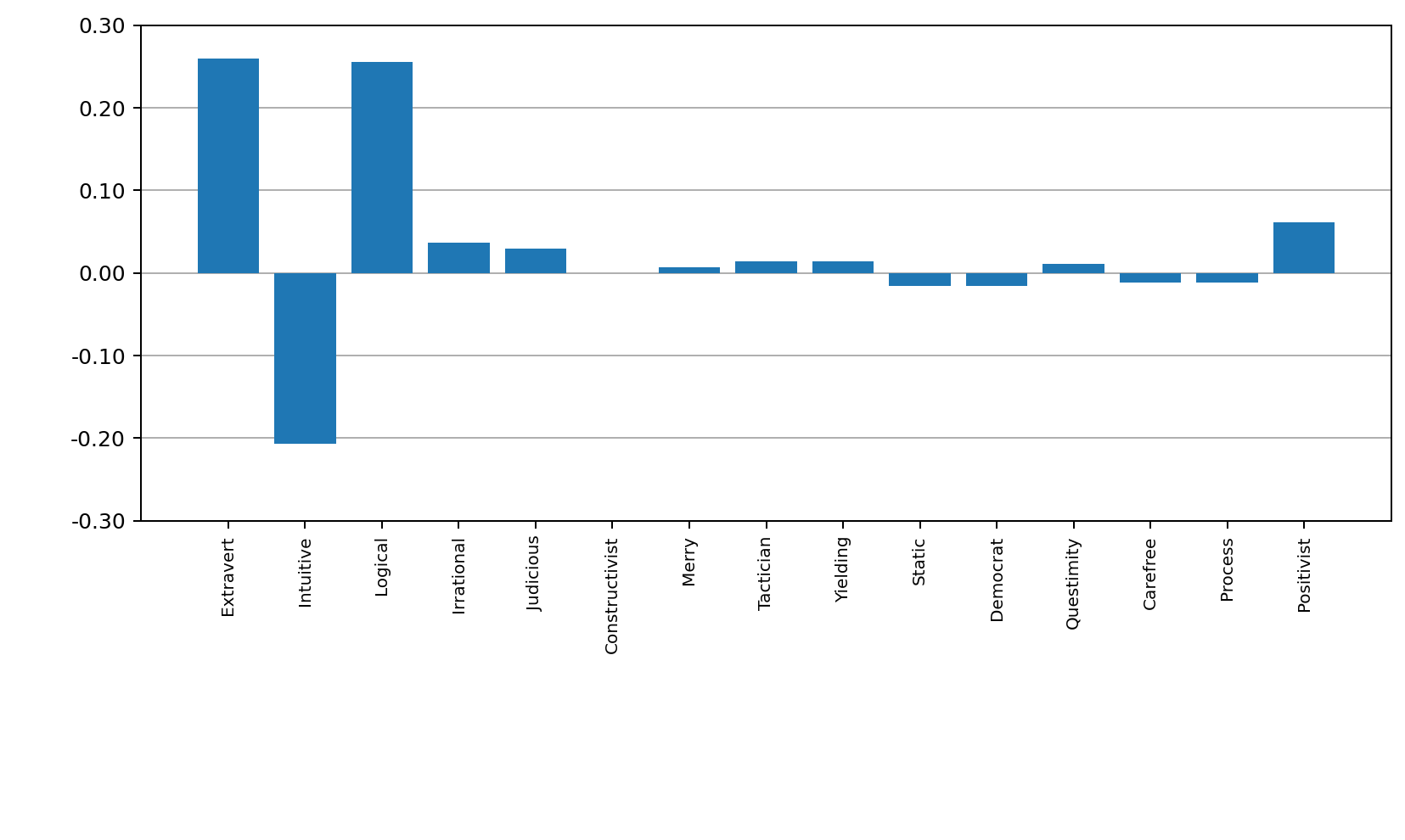
In the diagram showing the expression of the 15 socionic traits, the positive value of a pole is used as the name of the trait. If a diagram bar extends not upward but downward into the negative range of values, then the pole of the trait corresponding to the predominance of decisive and self-confident character properties will accordingly be not Intuitive but Sensor, and so on. All trait names, including Constructivism-Emotivism, are given in Aušra Augustinavičiūtė’s original terminological tradition (that is, all positive poles used as trait names correspond to the poles of the ILE type).
The cluster took into account AGREEMENT with the following opinions (in parentheses is the coefficient of linear correlation between the type profile of the item and the averaged type profile of the cluster as a whole):
- I am almost always quite self-confident, without a shadow of doubt, hesitation, or reflection (0.94);
- My confidence allows me to prevail even in seemingly hopeless situations (0.90);
- I am always confident in my competence and in my abilities (0.89);
- I never question the correctness of what I am doing (0.87);
- I always make decisions independently, and if I do consult others, it is only for form’s sake (0.77);
- All day, from morning to evening, my mood is most often colored by a certain calm self-satisfaction (0.69);
- My assessments of events are unambiguous and leave no room for doubt (0.64);
- I am usually characterized by an optimistic, calm, evenly self-confident mood (0.60).
The cluster took into account DISAGREEMENT with the following opinions (in parentheses is the coefficient of linear correlation between the type profile of the item and the averaged type profile of the cluster as a whole):
- I am internally contradictory, am often unsure of myself, and am prone to frequent doubts and hesitation when making a decision (-0.95);
- Restless doubts often “wash over” me (-0.92);
- I am often tormented by doubts about the correctness of my decisions and actions (-0.90);
- I often hesitate for a long time when making a decision (-0.89);
- I am often characterized by indecisiveness and also lack an immediate reaction to changes in the situation (-0.85);
- When I need to evaluate some step and make a business decision, I am usually indecisive and prone to hesitation (-0.82);
- After solving some problems at school or university, I would always subsequently doubt whether I had solved them correctly or not (-0.65);
- Being a skeptic by nature, I am prone to frequent doubts and hesitation and notice all the contradictions and imperfections of the surrounding world (-0.50);
- I often doubt the correctness of my perception and try to clarify it (-0.43).
Discussion and Conclusions:
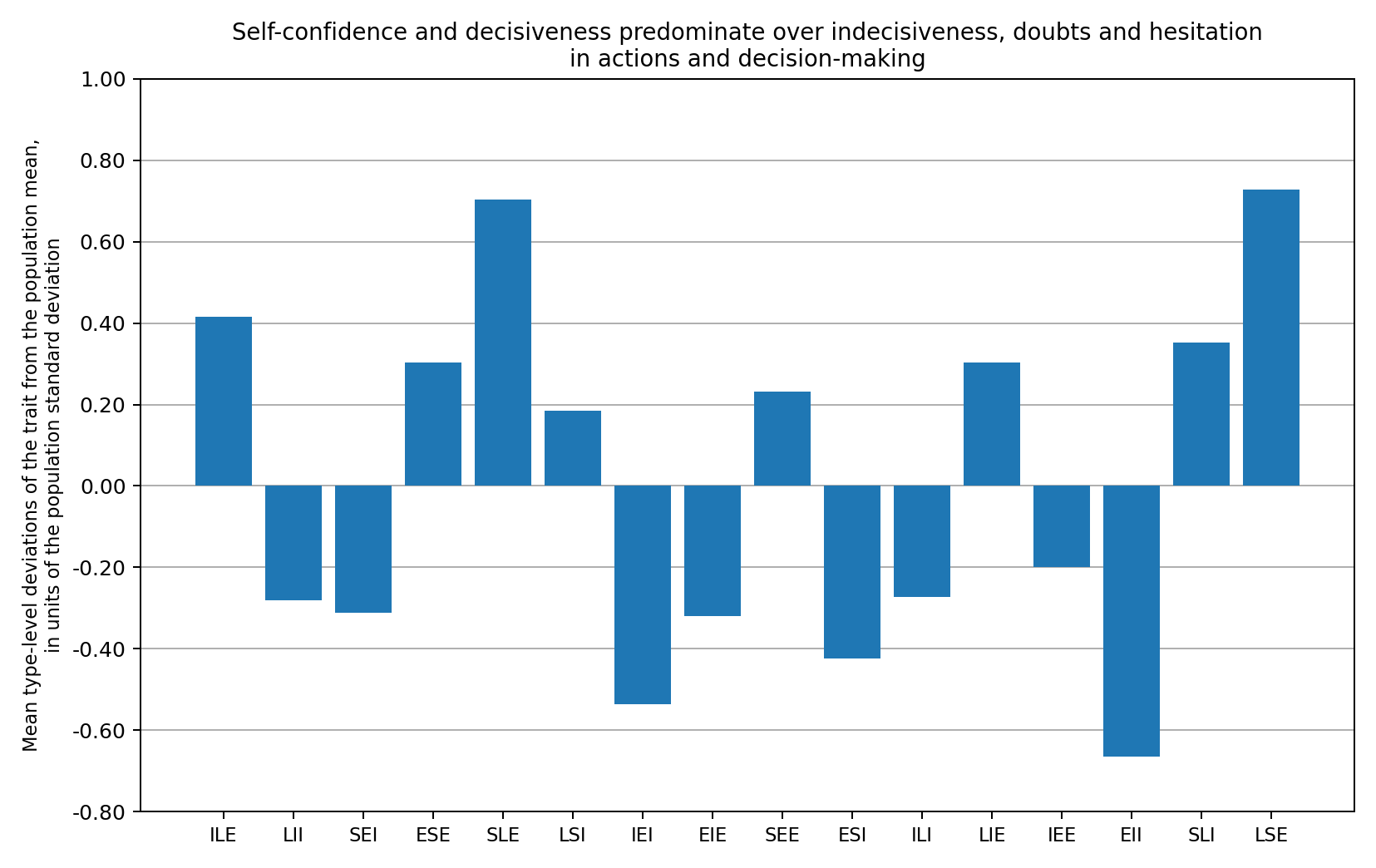
The record-holders for self-confidence and decisiveness in actions are, to an equal degree, two TIMs: LSE and SLE. ILE and SLI are also self-confident, although they lag behind the leaders. The least self-confident types, most prone to doubts and hesitation when making a decision, are EII and IEI. ESI follows close behind. The self-confidence of all other types differs little from the population-average level (this also applies to LSI; its self-confidence is more of a legend — recall that even Stalin was prone to doubts and hesitation: he made decisions only after weighing them for a long time, first “airing them out” at the Politburo and invariably listening to many other opinions). ESI, despite its Se orientation, is also among the three TIMs least confident and decisive in their actions. The indecisiveness (in the non-socionic sense of the term) of the average “Dreiser” and the tendency to take a long pause when making a decision are due to introversion and high Fi. However, one qualification should be made immediately: the diagram shows mean TIM-level values of the psychological trait of self-confidence. Within each TIM group, the interindividual dispersion in the magnitude of the trait is approximately 0.8-0.9 standard deviations of the population. Such substantial dispersion is due mainly to the presence within a type of subtypes close to the boundaries with other TIMs of the socion. Within-type dispersion of even 0.8 standard deviations means that even among LSEs and SLEs, more than 10 percent of representatives of the type will be found whose self-confidence when making decisions is, for one reason or another, below the population-average level. As for the LSI type, for example, its group indicator corresponds to approximately 54% of representatives of the type having self-confidence above the average and 46% having self-confidence below the average level. Therefore, for example, claims that Emperor Nicholas II could not have been a representative of the LSI type because of his well-known indecisiveness and tendency toward doubts and hesitation are based on absolutely nothing. It turns out that almost half of all LSIs have this shortcoming, primarily those “Maxim” subtypes in which Se is somewhat reduced and Fi somewhat elevated relative to the type norm (Nikolai Romanov was such a case). Conversely, extraverted “Maxim” subtypes with strengthened Se and Te are inclined neither to doubt nor to consult anyone when making decisions. Possible examples of the latter are Nikita Mikhalkov and Vladimir Putin, representatives of substantially different LSI subtypes, but both - with strengthened Se and Te.
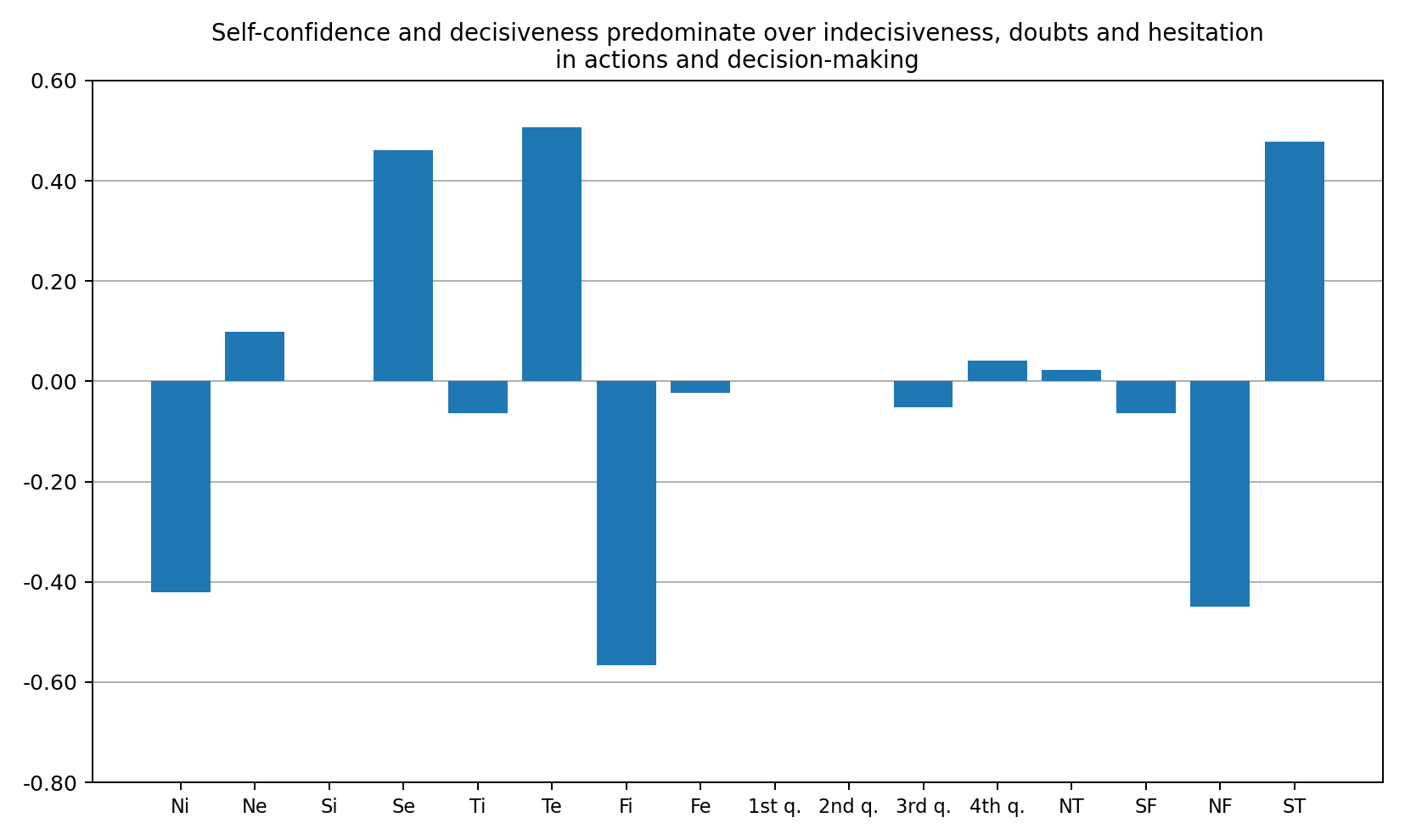
Among the functions of the psyche, Te and Se are responsible for self-confidence in decision-making; those responsible for indecisiveness, doubts, and hesitation — Fi and Ni. All other functions are indifferent to this psychological trait. Three socionic traits are clearly associated with self-confidence: extraversion, logic, and sensing. No other traits influence self-confidence (or, conversely, the tendency toward doubts and hesitation when making a decision). In particular, the socionic trait “Judicious-Decisive” HAS NO relation whatsoever to the psychological trait of self-confidence.
© V. L. Talanov 2011
The author permits quotation of the work on Internet sites, provided that a hyperlink to the present source is included: http://sociotoday.narod2.ru/samouverennost.htm