Political Troubles and Merits of Our Time in Their Projection onto Socionics
Political Troubles and Merits of Our Time in Their Projection onto Socionics
V. L. Talanov, 2011
The article selectively analyzes, from a socionic perspective, 45 clusters of personality psychological properties that have some relation to political views and ideological values. Among them are clusters whose meaning is commonly associated with the phenomenon of the “authoritarian personality.”
For the socionic analysis in the present article, material in the form of socionic interviews, questionnaires, and surveys collected by the author over 9 years of work was used. For the purposes of the socionic analysis, respondents’ sociotypes were diagnosed in all cases with an average reliability of no worse than 90%.
The fact that any of the properties considered below turns out, for some particular type, to be expressed on average above the population level does not mean that it will necessarily be expressed above the population mean in every representative of that sociotype without exception. All socionic profiles presented below are probabilistic in nature and express only a statistical tendency. Within each type, the within-group dispersion of its representatives in the magnitude of a property (namely, the standard deviation characterizing this dispersion) amounts to 0.75 to 0.9 of the standard deviation of the entire general population; therefore, even when the type-average values of a property are substantially elevated or reduced, some representatives of the type will still have the sign of that property opposite to the type average. More precise data on the expected percentage of representatives of a sociotype whose level of development of the property under consideration is either above or below the population mean are contained in Table 1 at the end of the article. Why is there no absolutely rigid linkage of particular characteristic value-related and behavioral manifestations to psychotypes and functions, but only statistical tendencies, even though these are often very strong? The issue is not only nonsocionic factors, for example, family upbringing and the individual’s acquired stereotypes associated with the chosen profession. The author believes that the biological multifactoriality underlying the formation of any mental function also plays a considerable role in the variability of manifestations of particular psychological properties. For example, the level of Sensing is higher the more strongly developed the serotonergic and cholinergic neurotransmitter systems of the brain are (on the basis of the available material, the author is currently inclined to believe that this is so). A small deficit in the first system may be compensated by an excess of the second, or vice versa. The level of Sensing may turn out to be the same in both cases, but the overall socionic profiles (in their polynomial decomposition by types) — will be different, and the levels of manifestation of particular psychological properties ultimately turn out to be different as well.
The following symbols are used in the diagrams:
For designating sociotypes (and labels for the type-average values of a psychological property for the given sociotype) -
ILE — Intuitive Logical Extravert, “Seeker,” “Don Quixote”
LII — Logical Intuitive Introvert, “Scientist,” “Analyst,” “Descartes”
SEI — Sensing Ethical Introvert, “Mediator,” “Hedonist,” “Dumas”
ESE — Ethical Sensing Extravert, “Enthusiast,” “Merchant,” “Hugo”
SLE — Sensing Logical Extravert, “Marshal,” “Zhukov”
LSI — Logical Sensing Introvert, “Inspector,” “Maxim”
IEI — Intuitive Ethical Introvert, “Lyricist,” “Yesenin,” “Tutankhamun”
EIE — Ethical Intuitive Extravert, “Artist,” “Mentor,” “Hamlet”
SEE — Sensing Ethical Extravert, “Politician,” “Caesar”
ESI — Ethical Sensing Introvert, “Guardian,” “Dreiser”
ILI — Intuitive Logical Introvert, “Critic,” “Balzac”
LIE — Logical Intuitive Extravert, “Entrepreneur,” “Inventor,” “Jack”
IEE — Intuitive Ethical Extravert, “Journalist,” “Adviser,” “Huxley”
EII — Ethical Intuitive Introvert, “Humanist,” “Dostoevsky”
SLI — Sensing Logical Introvert, “Craftsman,” “Gabin”
LSE — Logical Sensing Extravert, “Administrator,” “Stirlitz,” “Sherlock Holmes”
For designating socionic functions or the average values of a psychological property associated with the given function. (For the purposes of the present article, averaging by functions was carried out taking into account weight coefficients assigned to sociotypes — sociotypes in which the function is the program function and has the highest dimensionality were taken with a coefficient of 1.0; sociotypes in which the function is creative, with somewhat lower dimensionality, were taken with a coefficient of 0.65. For all other sociotypes, the weight coefficient in the averaging procedure was taken as zero. The coefficients were selected in precisely this way in order to maximize the shared variance between the set of functions and the set of Reinin traits associated with them) -
Ni - “white intuition,” introverted intuition, “intuition of time”
Ne - “black intuition,” extraverted intuition, “intuition of possibilities”
Si - “white sensing,” introverted sensing, “sensing of sensations”
Se - “black sensing,” extraverted sensing, “force sensing”
Ti - “white logic,” introverted logic, “structural logic”
Te - “black logic,” extraverted logic, “business logic”
Fi - “white ethics,” introverted ethics, “ethics of relations” - provides perception of other people’s feelings
Fe - “black ethics,” extraverted ethics, “ethics of emotions” - provides export and transmission of one’s own feelings
For designating groups of sociotypes connected by shared values - socionic quadras and clubs (including for designating values of a psychological property averaged across the types in these groups) -
1st q. - the first socionic quadra of types, “Alpha,” (ILE, LII, SEI, ESE)
2nd q. - the second socionic quadra of types, “Beta,” (SLE, LSI, IEI, EIE)
3rd q. - the third socionic quadra of types, “Gamma,” (SEE, ESI, ILI, LIE)
4th q. - the fourth socionic quadra of types, “Delta,” (IEE, EII, SLI, LSE)
NT — the “Scientists club,” combining four types with simultaneous predominance of Logic and Intuition (ILE, LII, ILI, LIE)
SF — the “Socials club,” combining four types with simultaneous predominance of Ethics and Sensing (SEI, ESE, SEE, ESI)
NF — the “Humanitarians club,” combining four types with simultaneous predominance of Ethics and Intuition (IEI, EIE, IEE, EII)
ST — the “Managers club,” combining four types with simultaneous predominance of Logic and Sensing (SLE, LSI, SLI, LSE)
For the socionic analysis of the selected psychological properties, individual questions and statements from questionnaires and interviews were grouped by meaning and content into semantic clusters. Each cluster therefore generally combines several primary questionnaire psychological traits — selected with the aim, and in such a way, that in their aggregate set the properties of the cluster are revealed as fully as possible. The resulting socionic profiles constructed for the clusters are averages of the profiles of all individual questionnaire questions and statements included in the cluster.
Cluster No. 1 “Striving to Establish a Prison-Like Order in Society”
The cluster is, in a certain sense, integral and heterogeneous in the semantic composition of its statements, although they all turn out to be closely correlated with one another, which provides grounds for combining them into a single cluster. The semantic composition of the cluster is disclosed below. The cluster consists of 33 rated statements; on average, 320 respondents participated in the rating of each one, and when different statements in the cluster were rated, the respondents most often changed and were not repeated. Thus, in total, more than 10,000 responses from more than 3,000 respondents were used to construct the diagram.
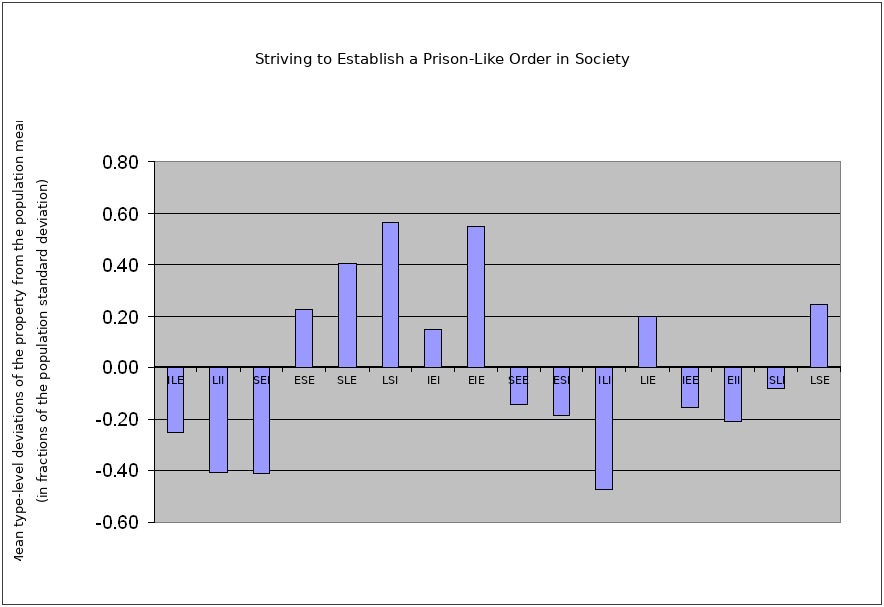
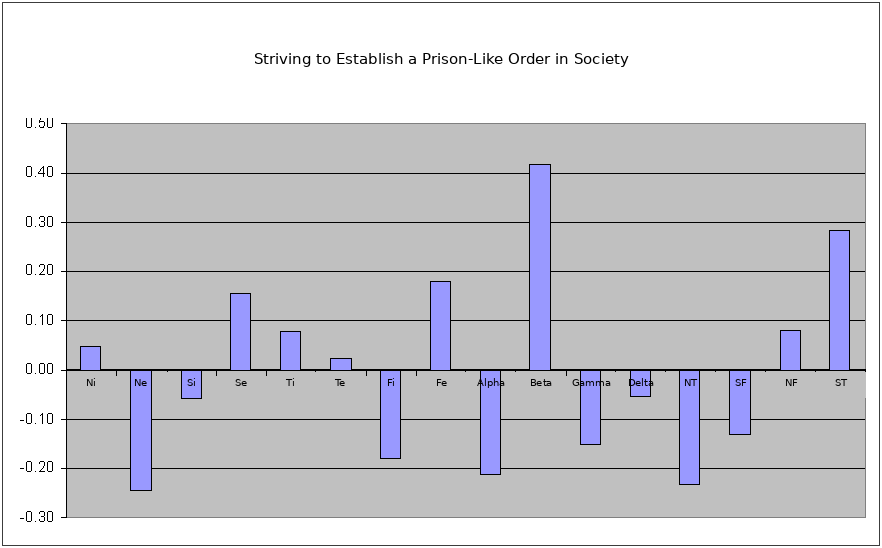
What individual opinions, which respondents apply to themselves, make up this semantic cluster? First, agreement with the following opinions:
The respondent likes strong-handed rule, even if under such rule the dissatisfied “howl” about violations of the constitution and human rights abuses.
The respondent dislikes the fact that, in their view, there is too much equality between people in modern society.
The respondent supports censorship and strict state control over publications on the Internet.
In disputes, the respondent is interested not in the exchange of information or the establishment of truth, but in who will win.
The respondent is interested in observing other people’s physical pain.
The respondent believes that all television channels should be strictly controlled by the state or directly owned by it under equally strict ideological control.
The respondent believes that the harsher and firmer the regime, the better it is.
The respondent believes that it is best for society if it is ruled by a secret elite.
The respondent regards a career as an employee in a large state apparatus as the ideal career.
The respondent regards a rigid, hierarchically constructed vertical of power, unaffected by the passage of time and bound from bottom to top by military discipline, as the best way to govern a state.
The respondent evaluates other people not by their knowledge and talents, but primarily by their force-related characteristics — how they carry themselves, whether they know how to demand respect and obtain it.
The respondent believes that if the state imposed a ban on discussing certain topics, then that is how it should be; in any case, they personally would adapt to this easily and quickly.
The respondent believes that at some point they will definitely take revenge, at least in some small way, on a person to whom they lose a game today.
The respondent often or constantly fears being undermined by someone and continually thinks through and undertakes countermeasures.
The respondent believes that different nations differ from one another much more strongly than people within a single nation differ from one another.
The respondent would prefer to hold a managerial position in a large, established state or monopolistic system rather than run their own business.
The respondent often likes to say things to people that are obviously unpleasant for them.
The respondent feels sincere dislike toward people who support a different sports team.
The respondent would gladly prohibit all motorists, under threat of large monetary fines or criminal prosecution, from engaging in private passenger transport without licenses.
Second, the cluster additionally takes into account and sums the respondents’ REJECTION of the following opinions:
The respondent treats other people’s rights with exactly the same respect as their own.
The respondent believes that through its intervention the state should somewhat limit income inequality in society.
The respondent believes that every person should be completely free in their political views.
The respondent’s principle of life: do not interfere with other people’s lives.
If the respondent found someone else’s wallet containing money and documents, they would try to find its owner.
Great wealth seems more desirable to the respondent than great power.
The respondent believes that the state should devote more attention to the welfare of the majority of the population than to the welfare of the upper classes of society.
The respondent dislikes being shouted at.
The personal qualities of another person are more important to the respondent than that person’s nationality or affiliation with some group.
The respondent believes that the state is not a supreme independent value, but merely a social contract among citizens, and nothing more.
The respondent is irritated by those who are forever “marching in formation” or insist on “keeping in step.”
The respondent hates manifestations of domineering rudeness and violent coercion.
Why did opinions with precisely the listed content enter the cluster? The primary selection was made on semantic grounds in order to encompass some manifestations of the authoritarian personality recognized in science, associated with a preference for a hierarchical society based on a rigid vertical of power. This was followed by screening with rejection of items — ultimately, the items included in the cluster were those whose resulting socionic profile was sufficiently closely correlated with the averaged socionic profile of the cluster as a whole. Items with a correlation with the cluster below 0.4 were excluded.
Cluster No. 2 “Other People’s Fear Gives Pleasure and Is Regarded as a Universal Means of Managing Society”
The cluster consists of 17 rated statements; on average, 530 respondents participated in the rating of each one, and when different statements in the cluster were rated, the respondents most often changed and were not repeated. In total, more than 9,000 responses from more than 3,000 respondents were used to construct the diagram.
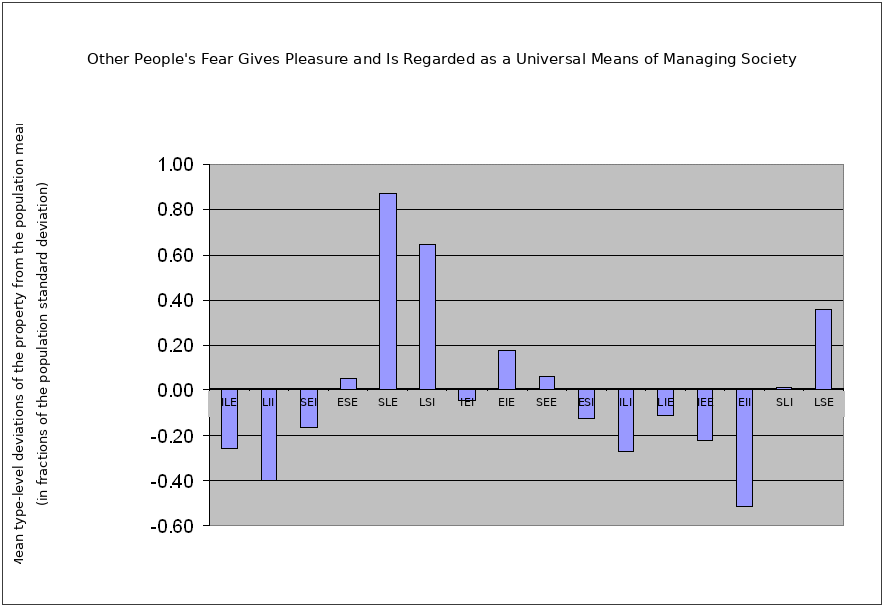
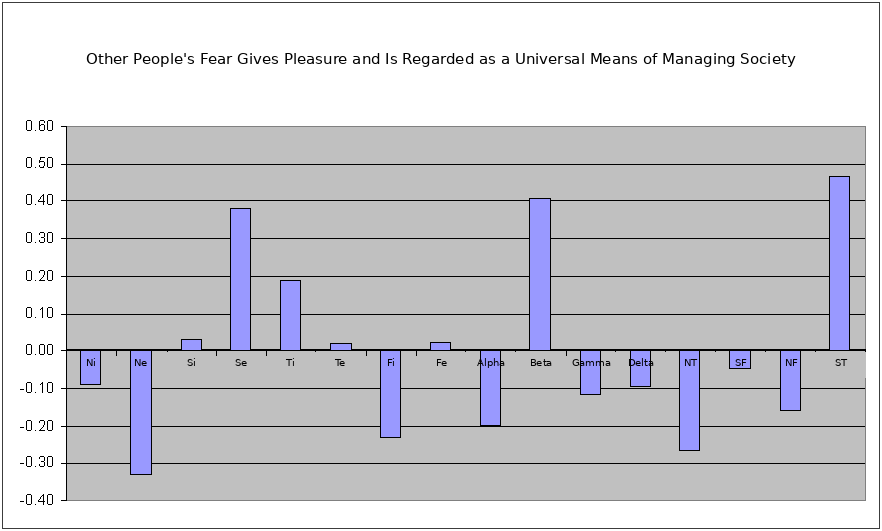
The cluster took into account AGREEMENT with the following opinions:
Society needs strict and fierce leaders;
Other people’s fear is pleasant and gives satisfaction;
You are respected only if you are feared;
It is pleasant to rebuke and punish those who violate order or “stick their necks out”;
A decent person cannot live without enemies; enemies exist and must always exist;
It is pleasant to demonstrate to other people their insignificance and their dependent position in relation to me;
Without fear, there would have been no civilization with its progress;
I know how to use fear to influence people so as to make them do things my way;
I like to give disciplinary offenders a dressing-down;
With my gaze I can, as it were, “strip” a person, testing their toughness;
I like to solve problems with people by means of threats;
Without fear of severe punishment, people inevitably turn into unrestrained animals;
Most people are prepared to work only under compulsion;
Under threat of punishment or a fine, people learn faster than when motivated by rewards and praise;
A good state is necessarily built on fear of authority and on spreading hostility toward a potential enemy among the population.
Only items whose socionic profile had a correlation exceeding +0.70 with the profile of the cluster as a whole were included in the cluster.
Cluster No. 3: “Support for (Apologetics of) Stalin and His Regime”
The cluster consists of 2 rated statements that are closely correlated with one another; the cluster was constructed from only 400 responses.
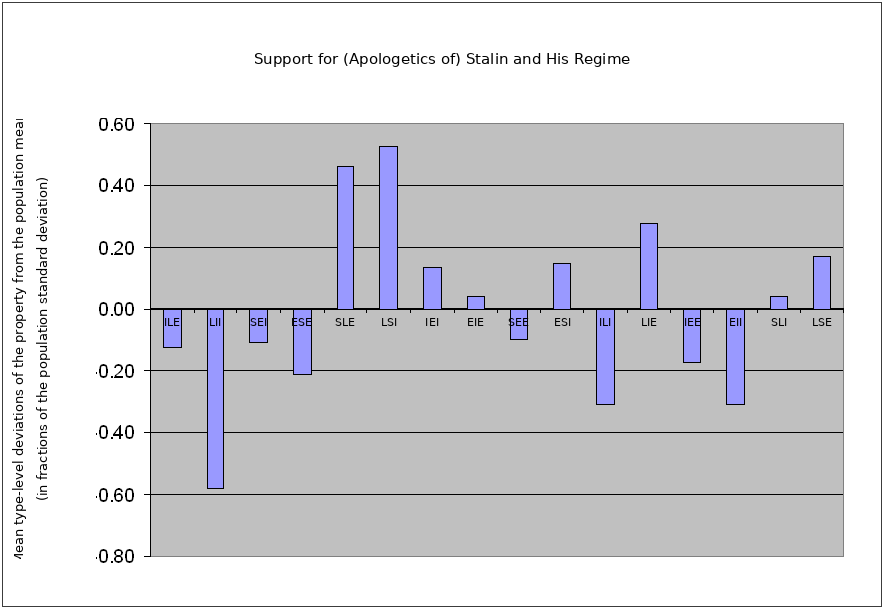
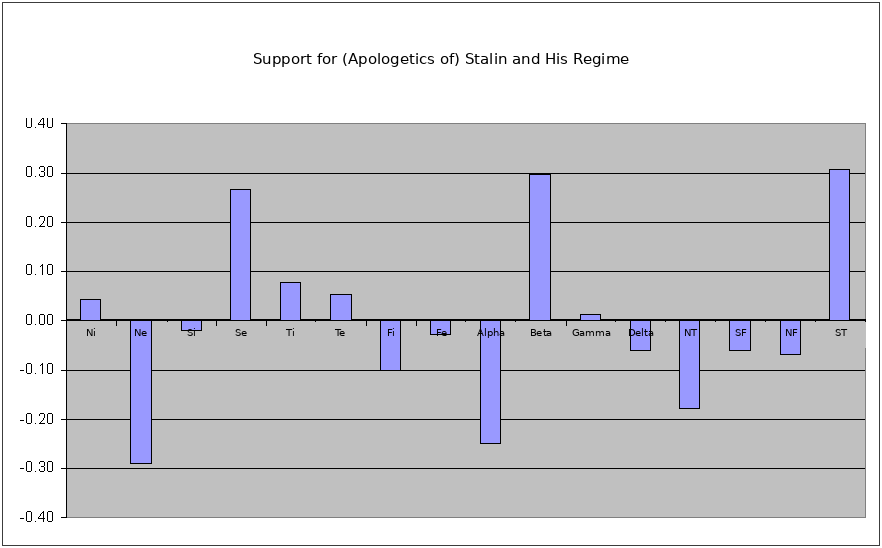
The cluster assessed agreement with the opinions that Stalin, on the whole, brought more benefit than harm, and that for the history of his country he was better than Lenin.
Cluster No. 4: “Antipluralism (For Uniformity of Opinions and Unification of All Orders, Against Pluralism of Opinions and Lifestyles, and Against a Multiparty System)”
The cluster consists of 8 rated statements; on average, 330 respondents participated in the rating of each one. A total of 2,640 responses from approximately 1,500 respondents were used to construct the diagram.
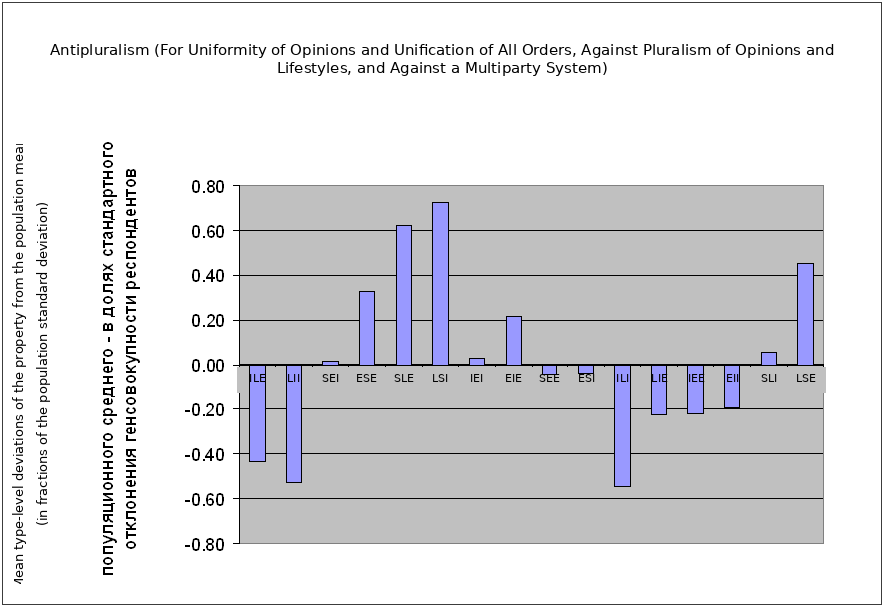
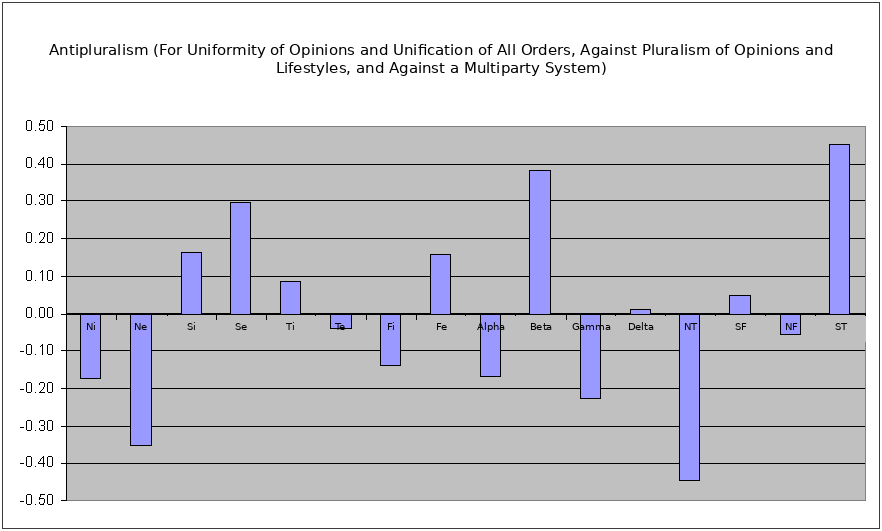
The cluster took into account AGREEMENT with the following opinions:
One common order is always better than many different ones, and unification is better than diversity;
The people do not need a multiparty system at all; only politickers need it;
There should be no diversity of orders and lifestyles in society; people should observe an established universal order rather than live however they please;
A country will not be strong and respected if freedom is granted to dissent.
The cluster took into account DISAGREEMENT with the following opinions:
I am irritated by those who forever like to “keep in step” and “march in formation”;
Every person should be free in their views, including political views;
I consider it necessary to live in such a way as not to interfere with other people’s lives.
Cluster No. 5: “Dictatorship and a Rigid Vertical of Power Are Better than Democracy and an Open Society with Developed Horizontal Ties”
The cluster consists of 10 rated statements; on average, 440 respondents participated in the rating of each one. A total of 4,400 responses from approximately 2,000 respondents were used to construct the diagram.
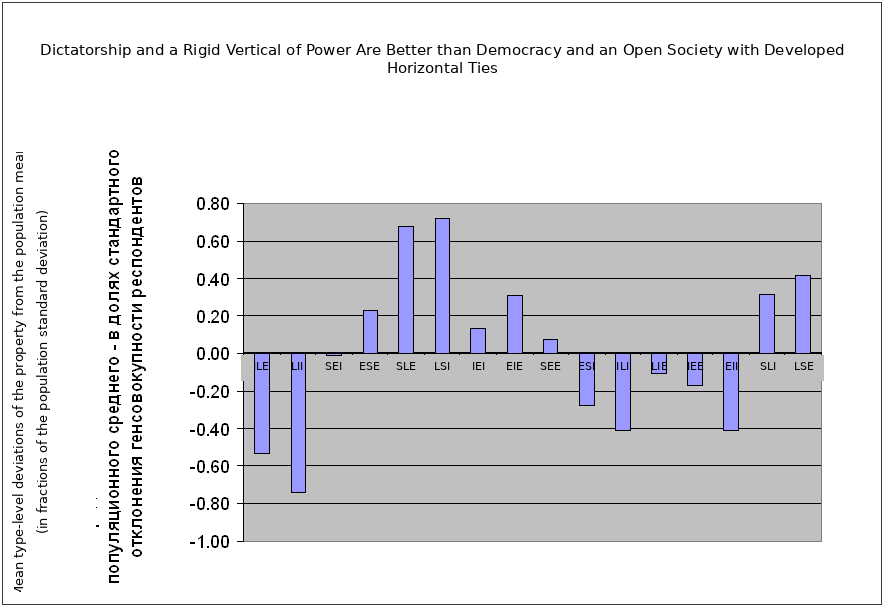
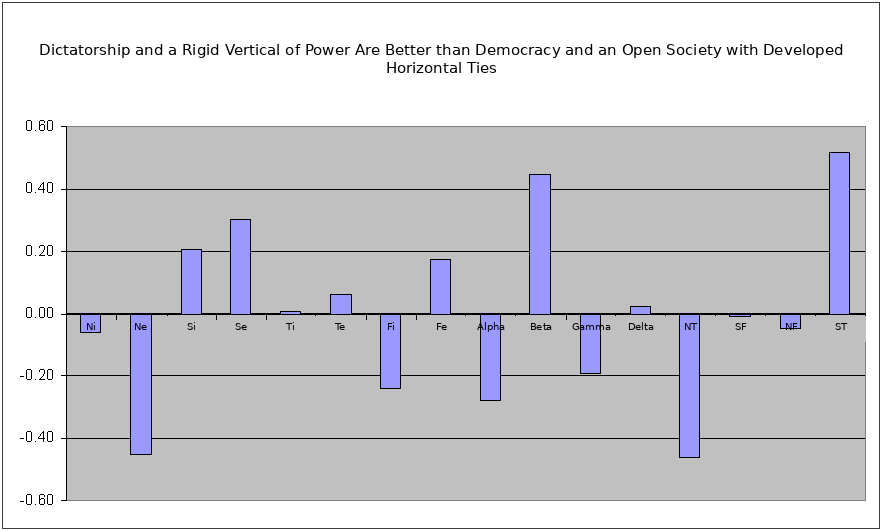
The cluster took into account AGREEMENT with the following opinions:
Authority must necessarily be “strong-handed” authority;
I would not want to live in a society where everyone is genuinely equal and there is no social hierarchy or vertical of power;
Every human collective must necessarily have a commander;
Proper authority should be built from the top down, not from the bottom up — all talk about democracy was invented for the wretched;
The people will never be able to live without tsars, leaders, and masters;
Authority that is built from the bottom up, according to the canons of democracy, rather than from the top down, imposed downward by a master-dictator — such authority is unviable;
I like strong-handed rule, even if under such rule the dissatisfied “howl” about violations of the constitution and human rights abuses;
The firmest and harshest regime is the best one;
Order must be built from the top down and must be immutable, resistant to the passage of time;
Society should be governed by a secret elite.
Cluster No. 6: “The Interests of the State Should Rank Far Above the Interests of the Individual; People Are Merely Cogs in a Large Machine”
The cluster consists of 7 rated statements; on average, 440 respondents participated in the rating of each one. A total of 3,080 responses from approximately 1,500 respondents were used to construct the diagram.
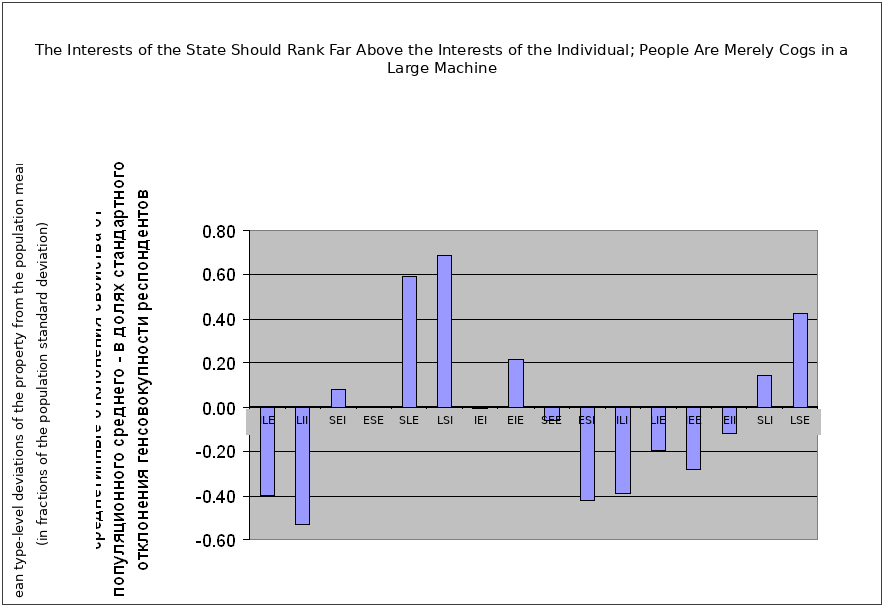
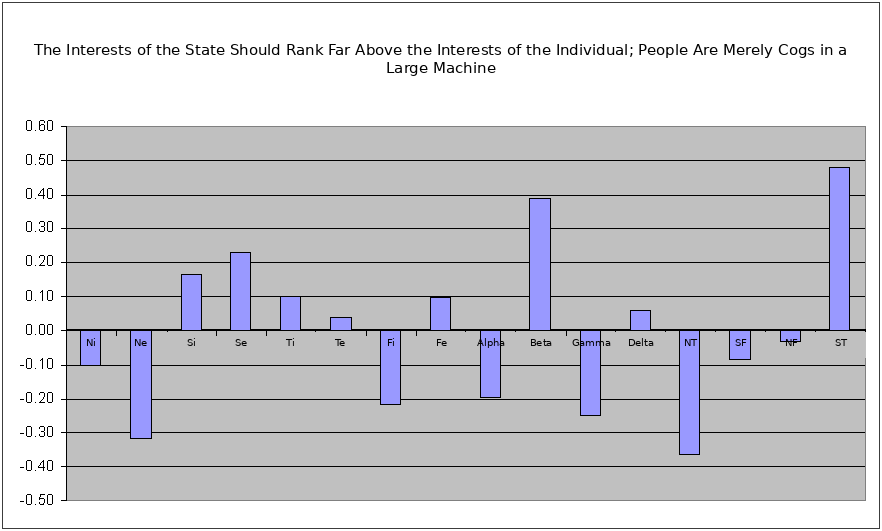
The cluster took into account AGREEMENT with the following opinions:
Ideally, citizens should be subordinate elements of their state, cogs in its large, smoothly functioning machine;
It is preferable to hold a position in the state system, or in a large, established major company occupying a monopolistic position and effectively forming part of the state system, rather than run one’s own business;
I would like to feel like a “cog” in a large machine;
State interests should take priority both over existing laws and over citizens’ rights;
State interests are more important than people’s right to their individual lives and freedom.
The cluster took into account DISAGREEMENT with the following opinion:
- The state is merely a social contract among its citizens, and nothing more.
Cluster No. 7: “The Country’s Territorial Expansion and Imperial Might Above All Else”
The cluster consists of 3 rated statements; on average, 560 respondents participated in the rating of each one. A total of 1,680 responses from more than 1,000 respondents were used to construct the diagram.
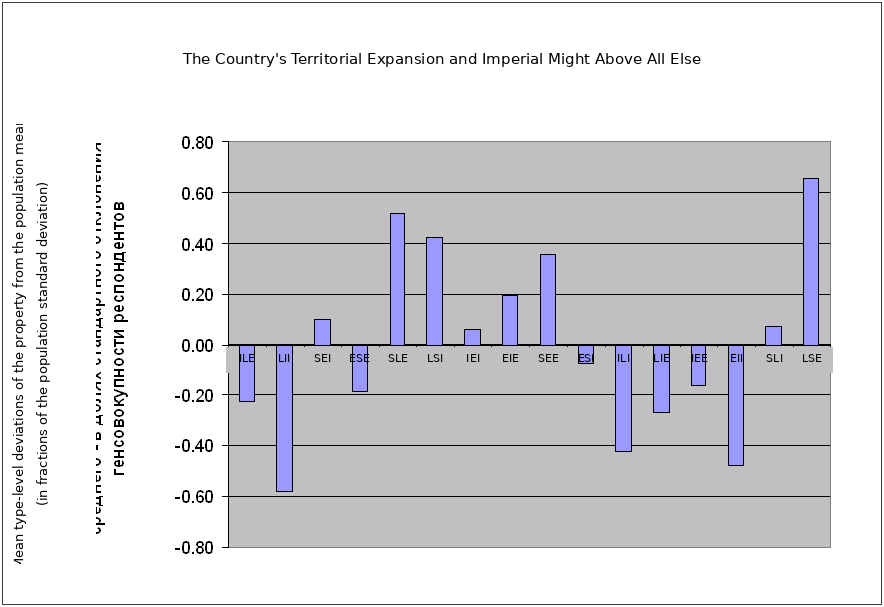
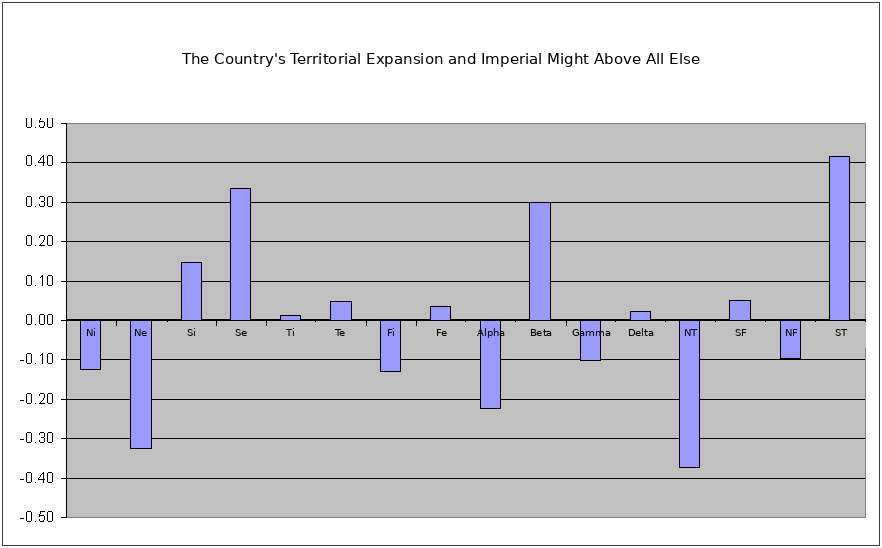
The cluster took into account AGREEMENT with the following opinions:
The country’s territorial expansion is more important than any democracy;
The ideal form of state is represented by the great empires of the past;
The country’s imperial might is more important than democracy, social equality, and human rights alike.
Cluster No. 8: “There Should Be Information Censorship in the State So That the Work of the Mass Media Does Not Interfere with State Interests”
The cluster consists of 8 rated statements; on average, 600 respondents participated in the rating of each one. A total of 4,800 responses from more than 2,000 respondents were used to construct the diagram.
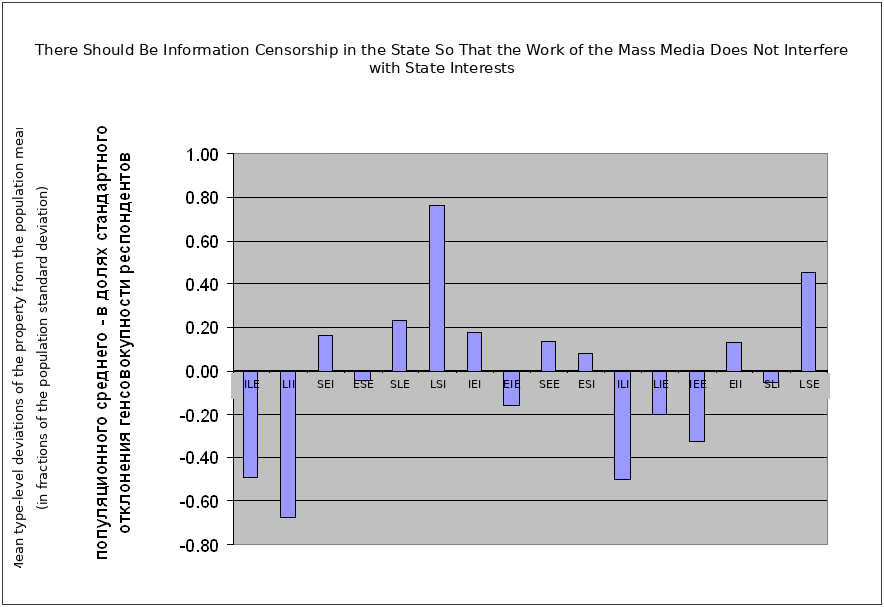
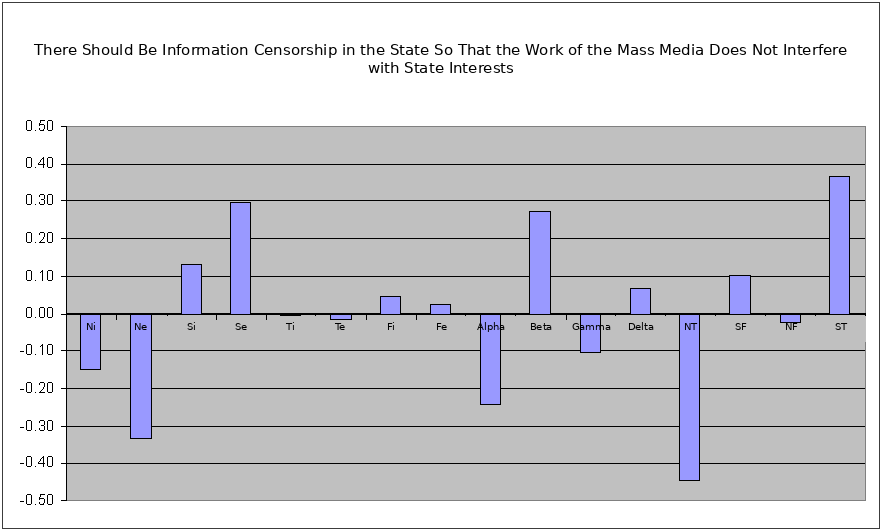
The cluster took into account AGREEMENT with the following opinions:
People should receive strictly rationed information depending on their position in society;
Censorship is justified if the work of the press begins to interfere with state interests;
Prior censorship of the mass media should be introduced;
People with erroneous views must not be allowed on television;
State control over publications on the Internet should be strengthened;
All television channels should be strictly controlled by the state;
Attempts to restrict the freedom to disseminate information do not bother me, or are even rather welcomed by me;
Society has the right to prohibit discussion of certain topics; I would adapt to this easily.
Cluster No. 9: “Hobbesian, Contemptuous and Misanthropic Views of the People”
The cluster consists of 8 rated statements; on average, 470 respondents participated in the rating of each one. A total of 3,750 responses from more than 2,000 respondents were used to construct the diagram.
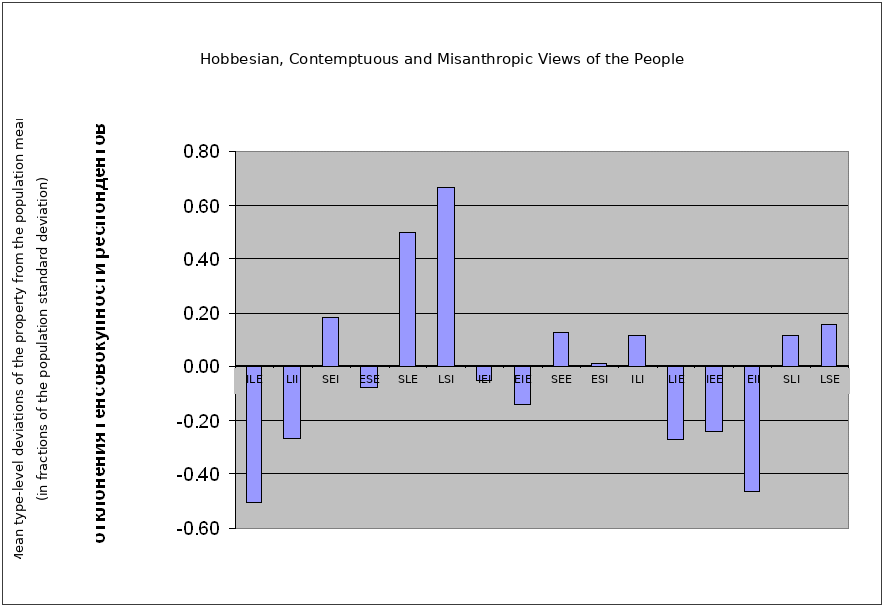
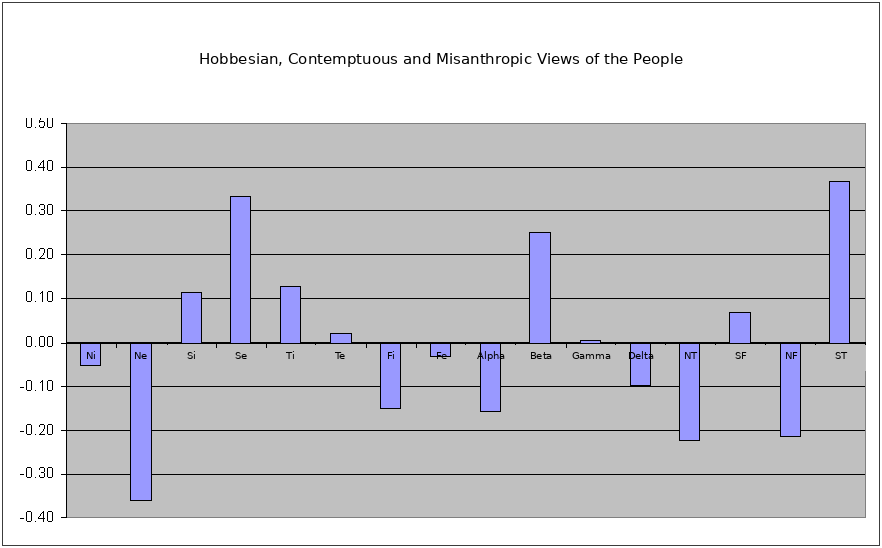
The cluster took into account AGREEMENT with the following opinions:
Most people are restrained from crime and idleness only by fear;
People inevitably turn into unrestrained animals if their fear of severe punishment disappears;
Everyone will steal if they believe they will not be caught red-handed;
Without coercion by the stick, no one will work;
Without punishments, people will never follow moral norms;
It is useless to educate and cultivate the people through enlightenment, culture, and goodness; the overwhelming majority will still remain a stupid, lazy, thieving herd.
Cluster No. 10: “Preference for a Class Society with Stark Social Inequality; the Right of the Lower Classes to Struggle for Their Rights Is Denied; the Strong Are Always Right and This Is Just; the State and Its Ruling Class Should Care for Their Own Interests Rather than for the Majority of the Population”
The cluster consists of 20 rated statements; on average, 430 respondents participated in the rating of each one. A total of 8,600 responses from more than 3,000 respondents were used to construct the diagram.
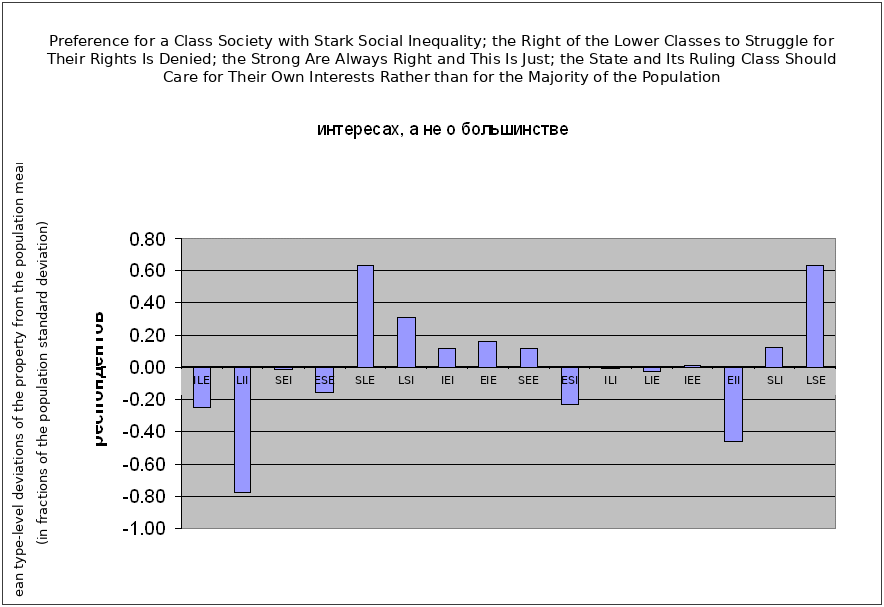
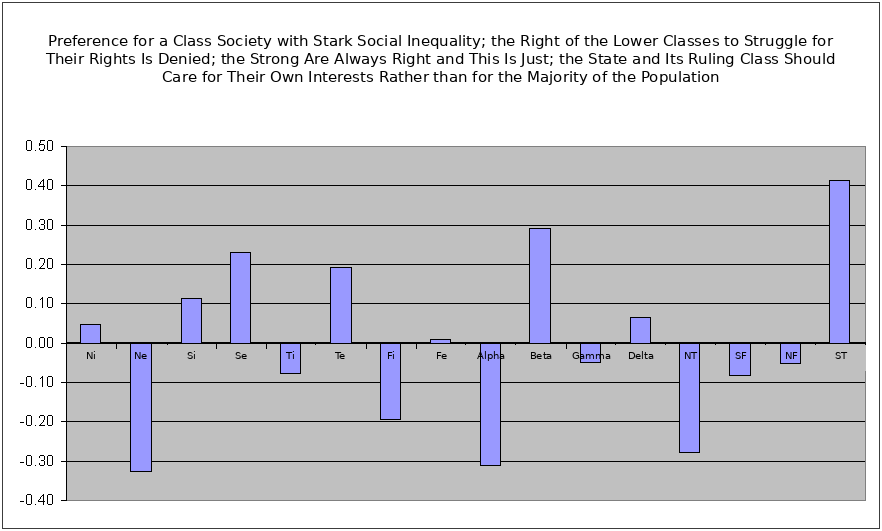
The cluster took into account AGREEMENT with the following opinions:
Society has always been divided and will always be divided into plebeians and aristocrats, and this is right;
The best society is one that is not ashamed of its division into masters and disenfranchised plebeians;
The dreams of certain eccentrics about universal equality of opportunity seem repugnant to me;
There is too much equality in modern society;
State-monopoly capitalism is better than any form of socialism;
The monopolization of retail networks in cities is better than a situation in which cities contain many small proprietors and many small shops;
The cluster took into account DISAGREEMENT with the following opinions:
Any manifestations of inequality between people are unpleasant to me;
Clashes between trade-union demonstrators and the police during workers’ struggles for their rights deserve respect and sympathy;
The person at the top should be the servant of everyone else;
I prefer to live in a society where there is no obvious division into masters and slaves, aristocrats and plebeians, superiors and subordinates;
I support the sacred slogans of liberty, equality, and fraternity;
I would feel sick living in luxury at the expense of others while creating nothing independently;
I react painfully to inequality, injustice, and someone being deprived;
In politics, the “left” appeal to me more than the “right”;
I sincerely respect “little” people;
I am a supporter of a classless society based on social equality;
The state should regulate and limit income inequality in society;
The government should devote more attention to the situation and condition of the numerous lower classes of society than to the interests of its upper classes.
Cluster No. 11: “There Is Nothing Wrong with a Slaveholding or Serf-Based Social Order”
The cluster consists of 2 rated statements; on average, 400 respondents participated in the rating of each one. A total of 800 responses from approximately 800 respondents were used to construct the diagram.
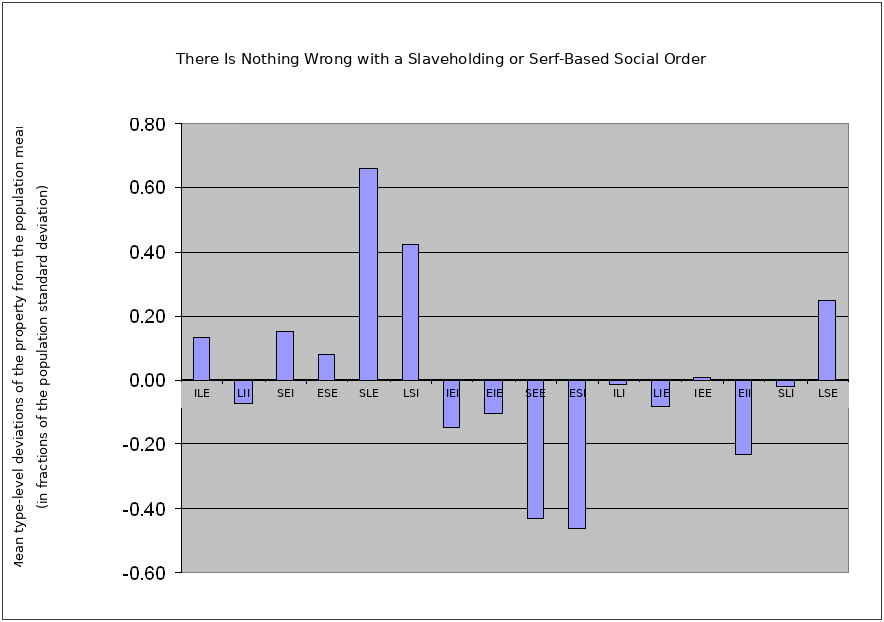
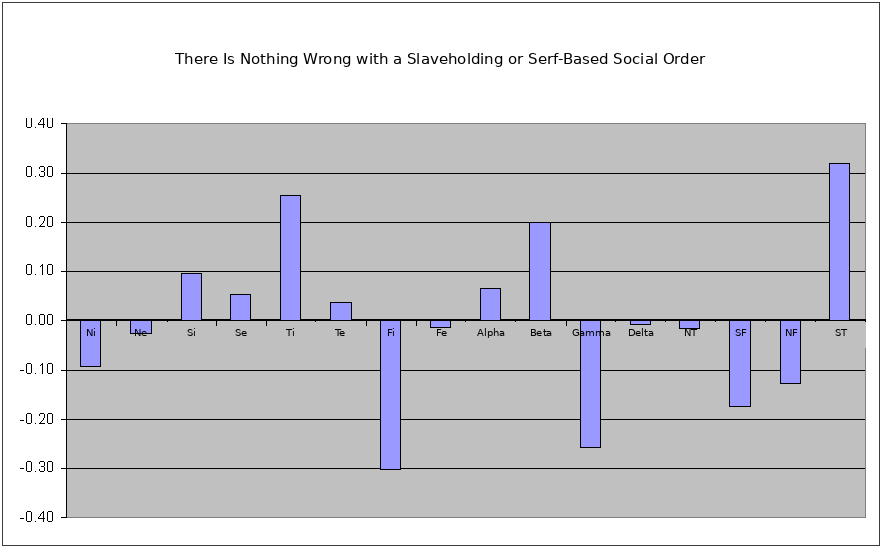
The cluster took into account AGREEMENT with the following opinions:
There was more good than bad in Russian serfdom;
The condition of slaves in the slaveholding states of antiquity was much better than historians describe it.
Cluster No. 12: “Autocracy Is Better than Parliamentarism, Whether in the Form of a Constitutional Monarchy or a Republic”
The cluster consists of 5 rated statements; on average, 380 respondents participated in the rating of each one. A total of 1,900 responses from more than 1,000 respondents were used to construct the diagram.
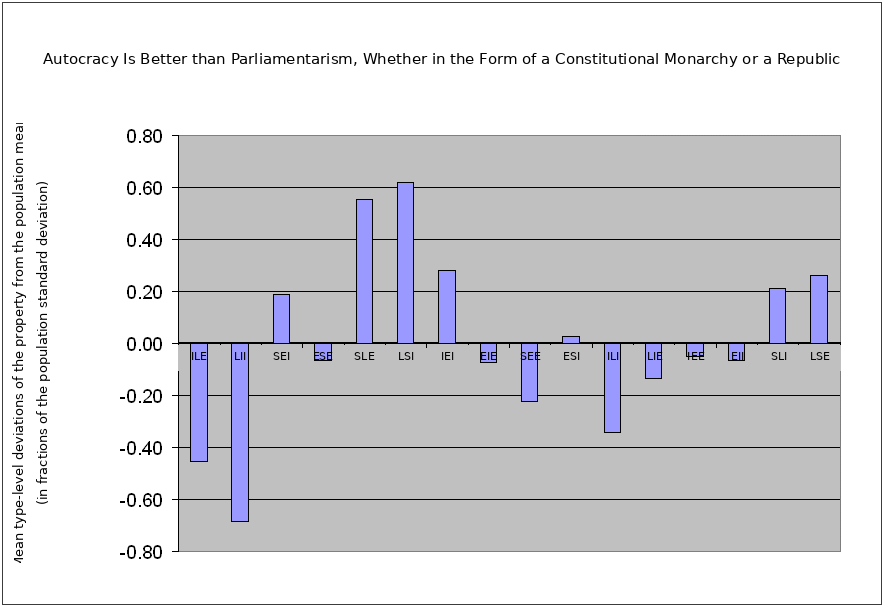
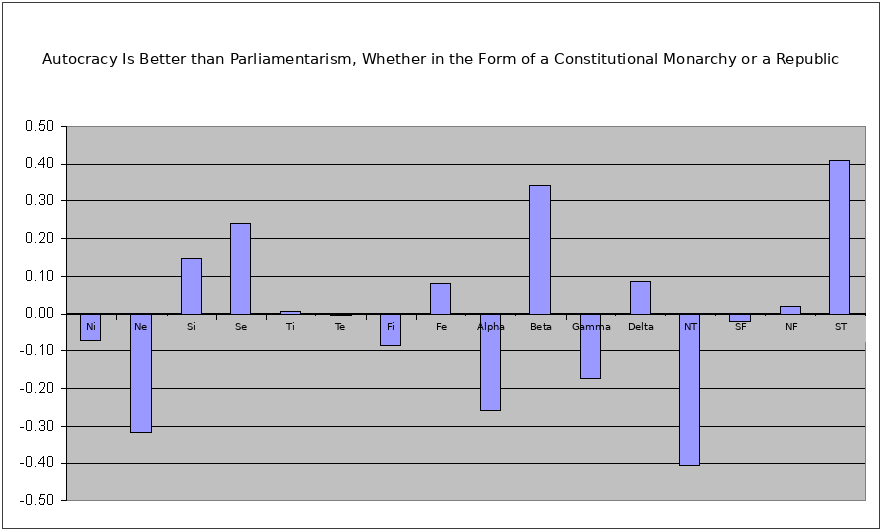
The cluster took into account AGREEMENT with the following opinions:
Autocracy is better than any democracy;
Absolute monarchy is better than constitutional monarchy;
Autocracy is better than parliamentary monarchy;
The best republic is worse than a monarchy.
Cluster No. 13: “A Person Should Always and Necessarily Have Enemies”
The cluster consists of 7 rated statements; on average, 490 respondents participated in the rating of each one. A total of 3,430 responses from more than 2,000 respondents were used to construct the diagram.
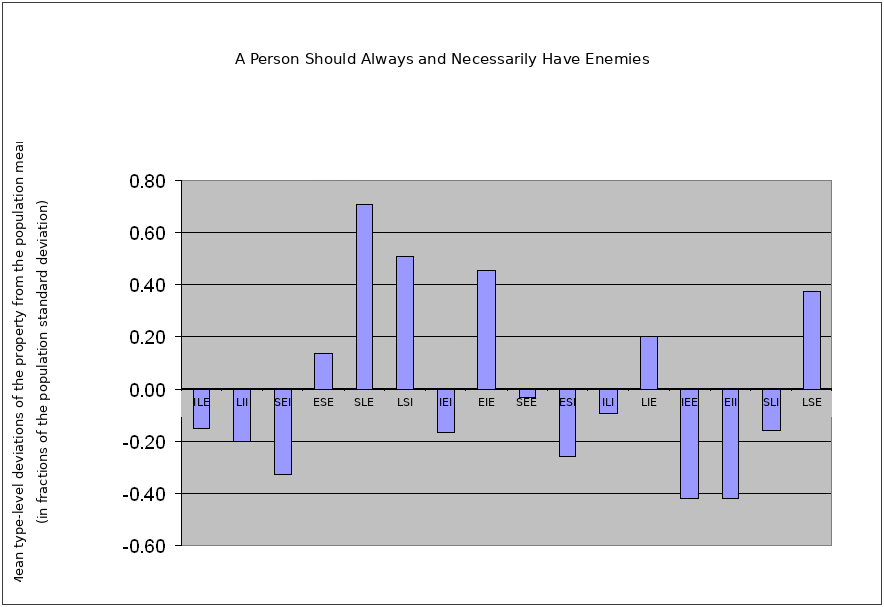
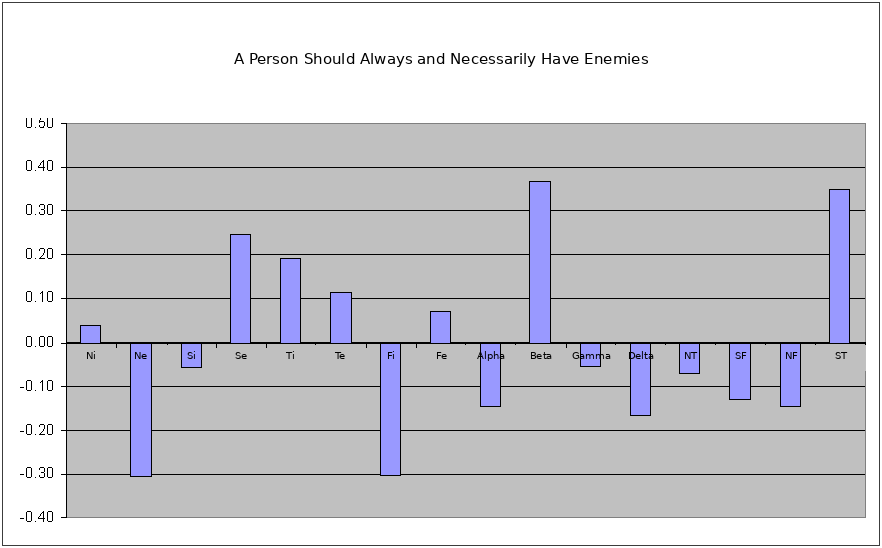
The cluster took into account AGREEMENT with the following opinions:
Enemies exist and should always exist, in any company and any circumstances;
Spreading hostility toward a potential external enemy among the population is an obligatory measure for the continual strengthening of the state;
Without hatred of enemies, there would have been no progress;
I know how to seek out and find enemies for myself so that I can then persecute and punish them;
I always think about my possible enemies, even when none of them can be seen nearby at that moment;
I often fear being undermined by enemies and constantly try to take preventive measures against it;
It is more pleasant to do something bad to an enemy than something good for a friend.
Cluster No. 14: “Command-and-Administrative Management Style, a Tendency Toward Unquestioning Subordination, and Strict Personal Control over Everything Happening Around Oneself”
The cluster consists of 13 rated statements; on average, 450 respondents participated in the rating of each one. A total of 5,850 responses from more than 2,000 respondents were used to construct the diagram.
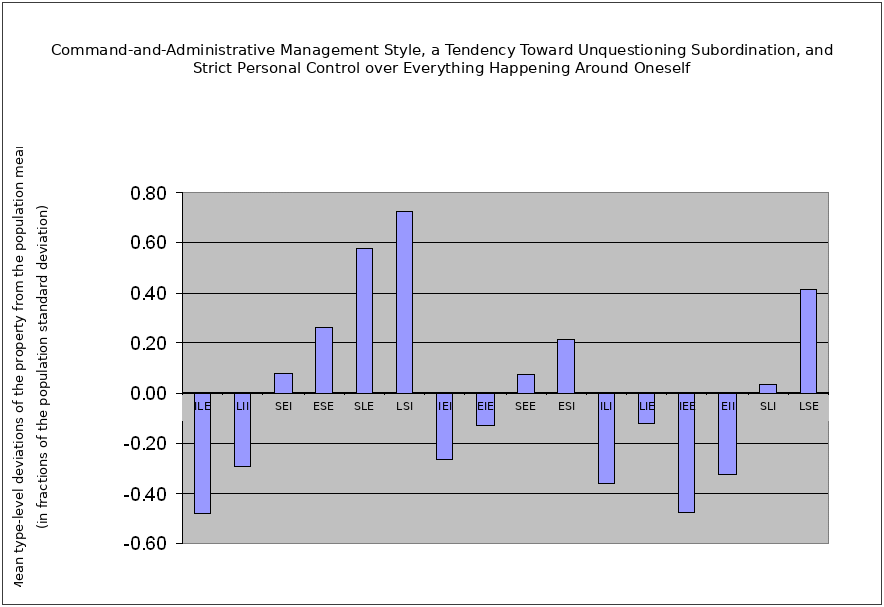
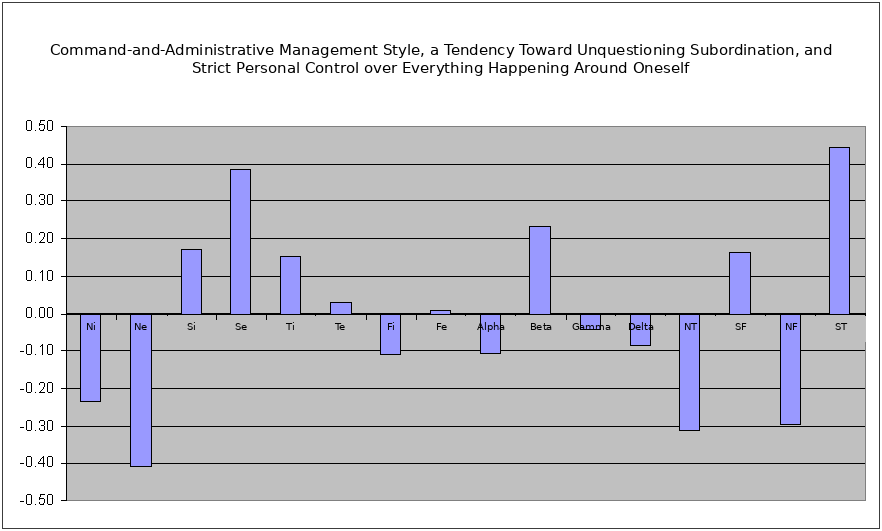
The cluster took into account AGREEMENT with the following opinions:
I like to create an orderly system of subordination;
I like to personally control any situation;
Always personally, meticulously, and closely controls the execution of tasks assigned to other people;
Tries to live so that nothing escapes personal control;
I would like to work as an inspector-controller;
More often it is not the system that is at fault, but the people who do not want to follow its rules;
I carry out orders without questioning them;
In the role of a minister, a general is always better than a scientist;
Employees in institutions should wear uniforms;
Wherever I am the boss, there is always order and a strict routine;
The discipline of subordinates is far more useful and necessary than their initiative;
I treat any formal subordination with respect and never tire even of strict discipline;
A command-and-administrative management style is better than a democratic one.
Cluster No. 15: “Conservatism of Views and Habits”
The cluster consists of 16 rated statements; on average, 500 respondents participated in the rating of each one. A total of 8,000 responses from more than 2,500 respondents were used to construct the diagram.
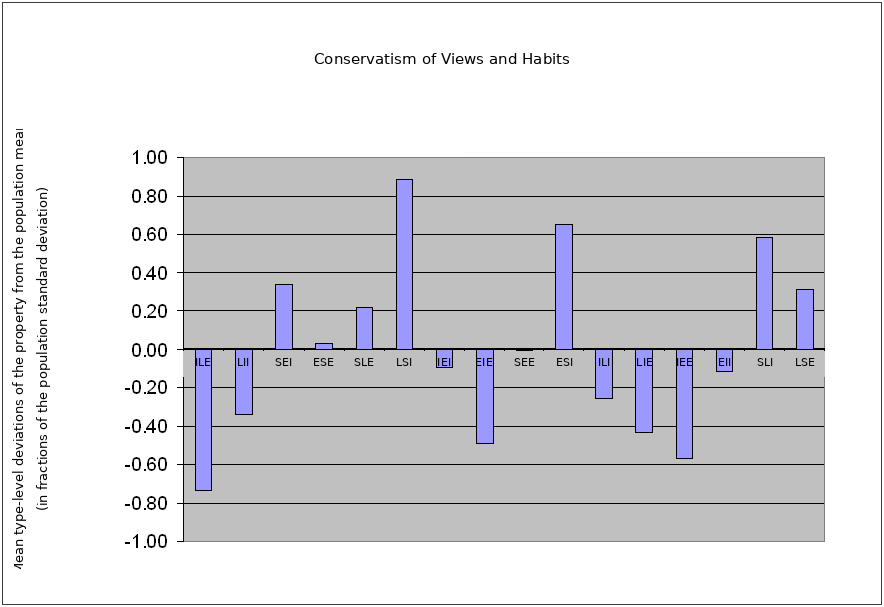
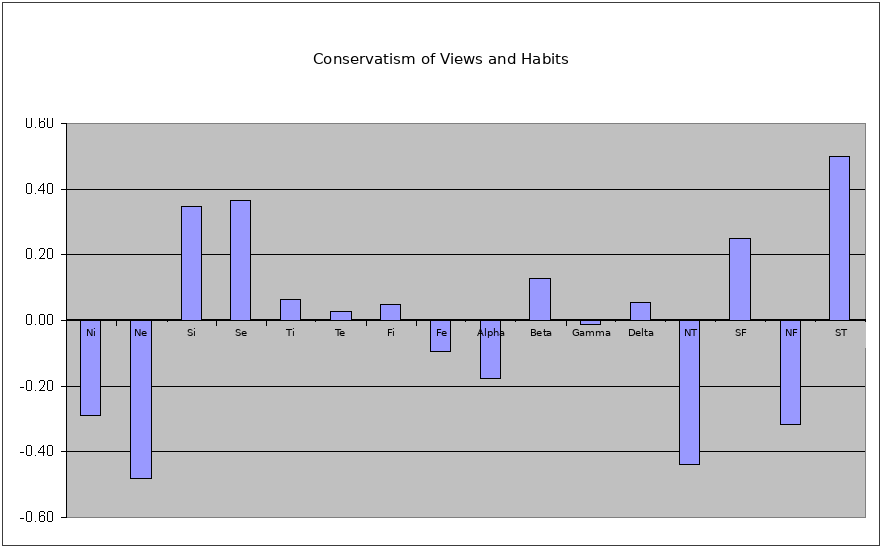
The cluster took into account AGREEMENT with the following opinions:
Conservatism, reliability, order, memory for good and evil, and the inevitability of punishment are key traits of my character;
I am a distrustful conservative, not an enthusiast for the new;
In my worldview, views, and habits, I am a consistent conservative;
I am wary of all new ideas and innovative projects;
I treat clever people and enthusiasts with irony and rely on common sense and conservatism;
My key concepts are administration, strictness, benefit, quality, thorough preparation, consistency, order, stability, conservatism;
I am sometimes reproached for excessive conservatism and excessive commitment to order and subordination;
It is better to suppress something innovative than to permit turmoil and disorder;
I am very conservative in my interests; it is difficult to interest me in any novelty;
I am conservative in sex and food;
I am a person of conservative rather than liberal views;
I am more of a skeptic than an innovator;
All kinds of fantasists, dreamers, and innovators much more often evoke skepticism than respect in me;
I often find it difficult to abandon what is mistaken without stubbornness; it is difficult for me to compromise.
Cluster No. 16: “Tendency to Narrow the Sphere of What Is Socially Permissible, Escalate Legislative Prohibitions, and Toughen Punitive Norms, Including Support for Tougher Criminal Laws and the Death Penalty”
The cluster consists of 5 rated statements; on average, 350 respondents participated in the rating of each one. A total of 1,750 responses from more than 1,000 respondents were used to construct the diagram.
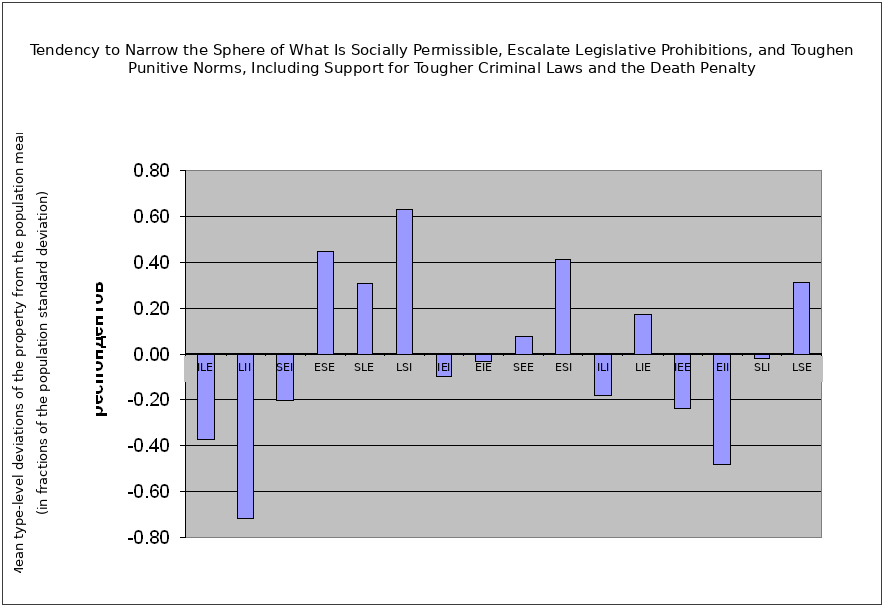
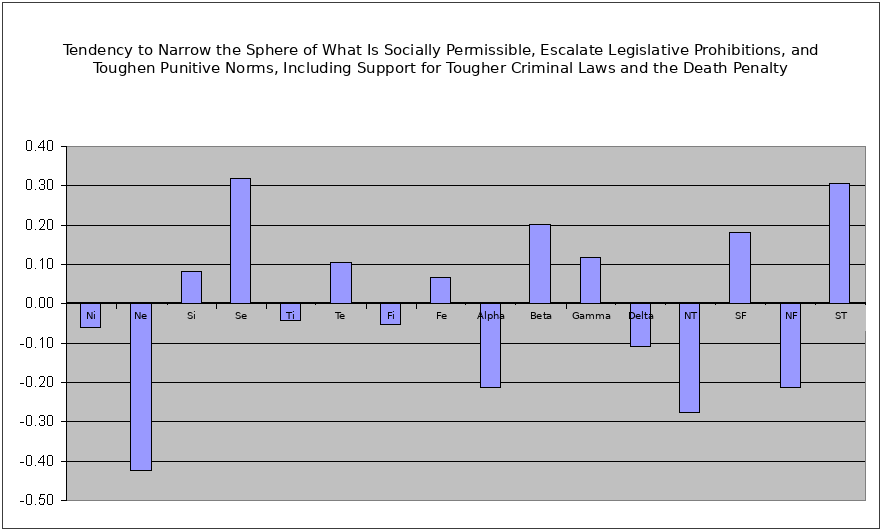
The cluster took into account AGREEMENT with the following opinions:
Supporter of the death penalty;
More in favor of increasing prison terms under criminal statutes than reducing them;
Believes that punishments prescribed by law should be made harsher rather than more lenient;
Supports a strict prohibition on motorists engaging in private passenger transport without licenses, under threat of large fines and punishments;
Supports harsher punishments for persons downloading pirated products from the Internet.
Cluster No. 17: “Aggression, Violence, Threats, and Humiliation of Others as Important Life Values”
The cluster consists of 39 rated statements; on average, 500 respondents participated in the rating of each one. A total of 19,500 responses from more than 4,500 respondents were used to construct the diagram.
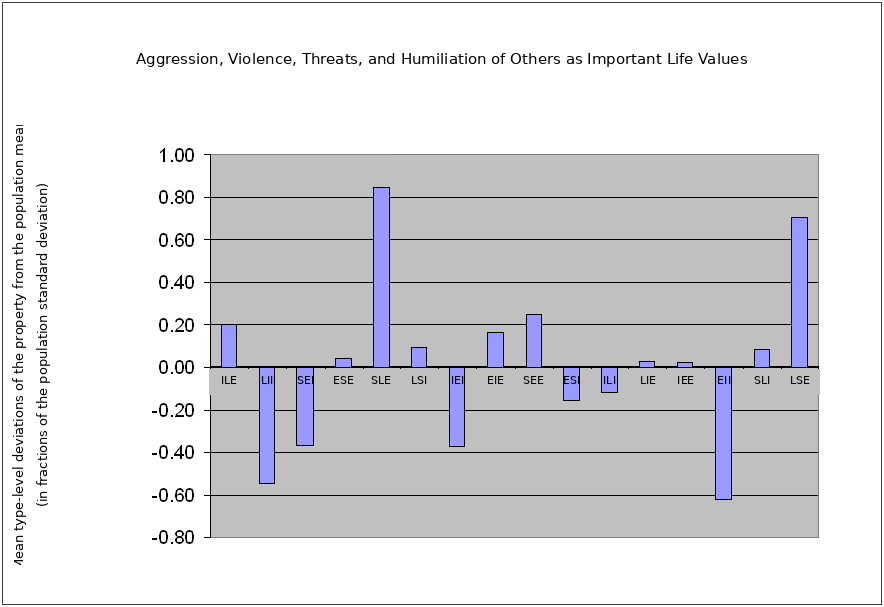
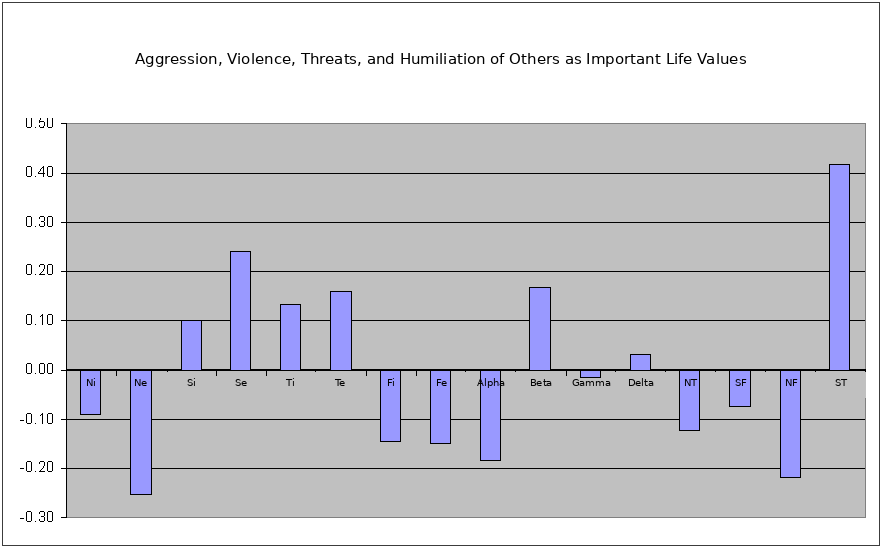
The cluster took into account AGREEMENT with the following opinions:
I will always try to show those around me my superiority;
I submit only to those who are much stronger than I am;
I can easily hit someone who has offended me;
I always respond to another person’s impudence with threefold aggression;
I like to press on an opponent’s weak points;
I can be very vicious;
I increase the pressure if I encounter another person’s submissiveness;
I do not respect people who avoid bold aggressive action;
I often behave without restraint and aggressively;
I like to act through force and threat;
It is always pleasant to get something from a person by applying forceful pressure to them;
Only a warrior is a real man;
I like watching force-based forms of combat;
War is better than a bad peace;
I often fought as a child;
All pacifists are simply cowards;
Sometimes I feel the desire to beat someone up;
I respect domineeringness, assertiveness, and strength in people;
I know how to choose the moment for an attack;
Violence neither frightens nor repels me;
I know how to suppress an interlocutor’s will with an intent, motionless, heavy gaze;
An opponent will yield only if you instill fear in them;
etc.
Cluster No. 18: “Aggression Toward the Weak (It Is Pleasant to Kick, Finish Off, Humiliate, Destroy, Degrade, Turn into a Slave, and Exploit Someone Weak and Defenseless”
The cluster consists of 14 rated statements; on average, 380 respondents participated in the rating of each one. A total of 5,320 responses from more than 2,000 respondents were used to construct the diagram.
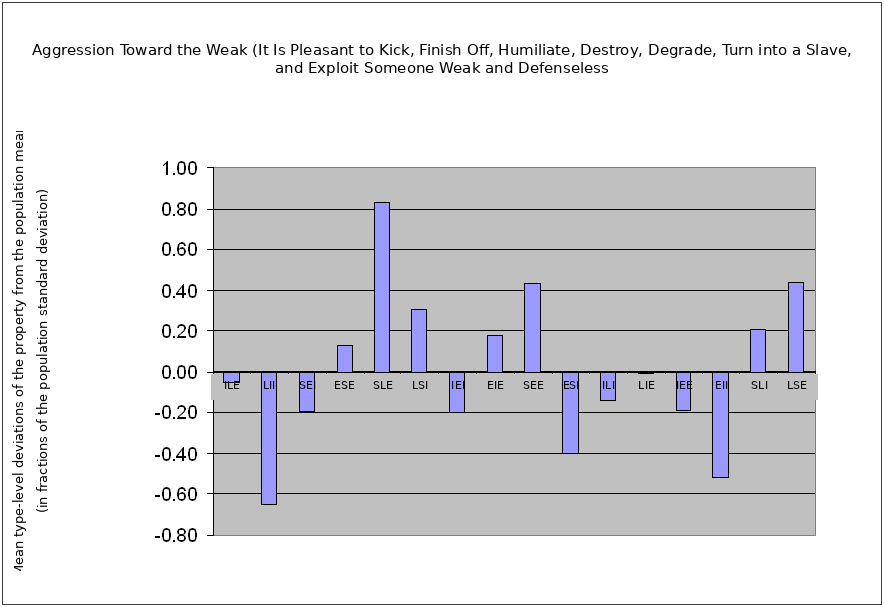
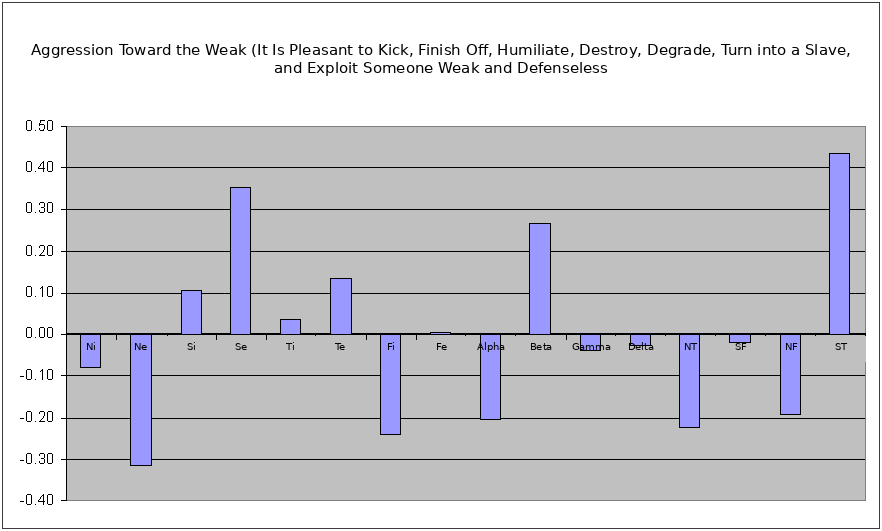
The cluster took into account AGREEMENT with the following opinions:
The triumph of the strong over the weak is the normal basis of life;
Any weakling immediately makes me want to kick and degrade them;
I despise and hate weaklings;
Hazing in the army is normal;
Let all the weak and ugly die;
I know how to put all worthless and weak people in their place;
The place of the weak is by the prison toilet;
Taking a weak and trusting person’s business away from them is normal;
Everything unfit for the struggle of life should be ruthlessly eradicated.
The cluster took into account DISAGREEMENT with the following opinions:
I have more sense of justice than pushiness;
I respect the intrinsic worth of every person;
I despise cultures in which offending the weak is considered a virtue;
The broad masses of people should be educated to respect other people’s rights.
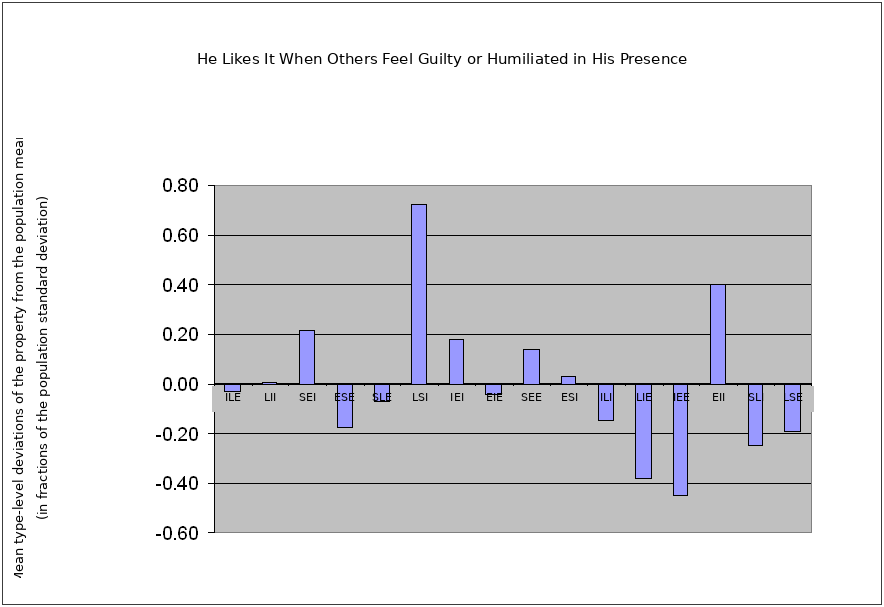
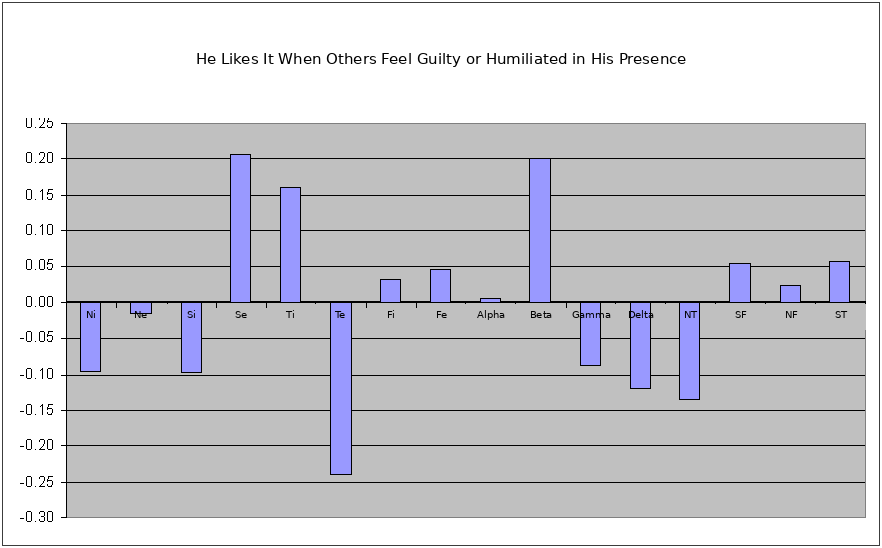
Cluster No. 19: “He Likes It When Others Feel Guilty or Humiliated in His Presence”
The cluster consists of 1 rated statement, in the rating of which 370 respondents participated.
Cluster No. 20: “Tendency Toward Sadism”
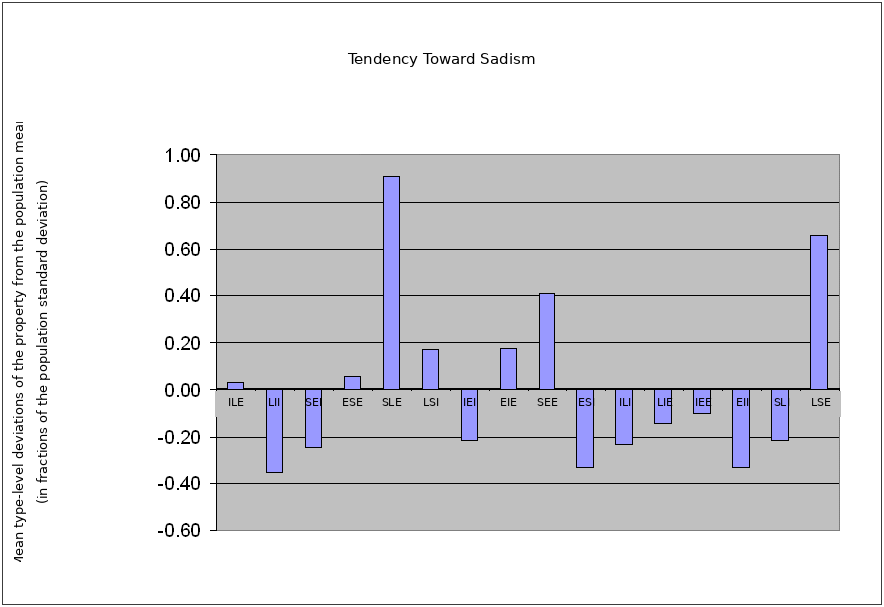
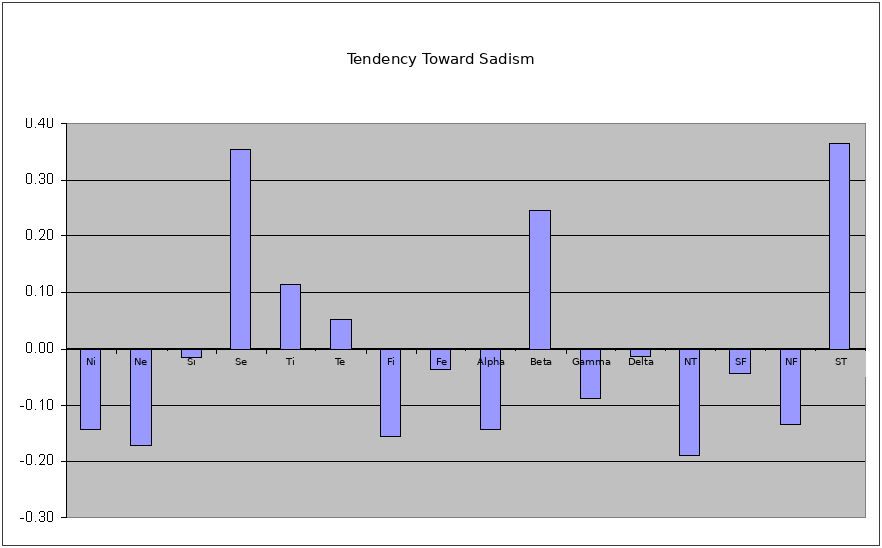
The cluster consists of 8 rated statements; on average, 420 respondents participated in the rating of each one. A total of 3,360 responses from more than 1,600 respondents were used to construct the diagram.
The cluster took into account AGREEMENT with the following opinions:
I like to hurt certain people, bringing them to emotional distress and tears;
I like to feel my flexible power over people’s health and lives;
I get pleasure from tormenting certain people;
I like seeing other people’s fear;
I like causing another person pain;
I feel pleasure if I manage to do minor harm to certain people — break or damage something in their home;
I am a vindictive person;
I experience enjoyment from power over others.
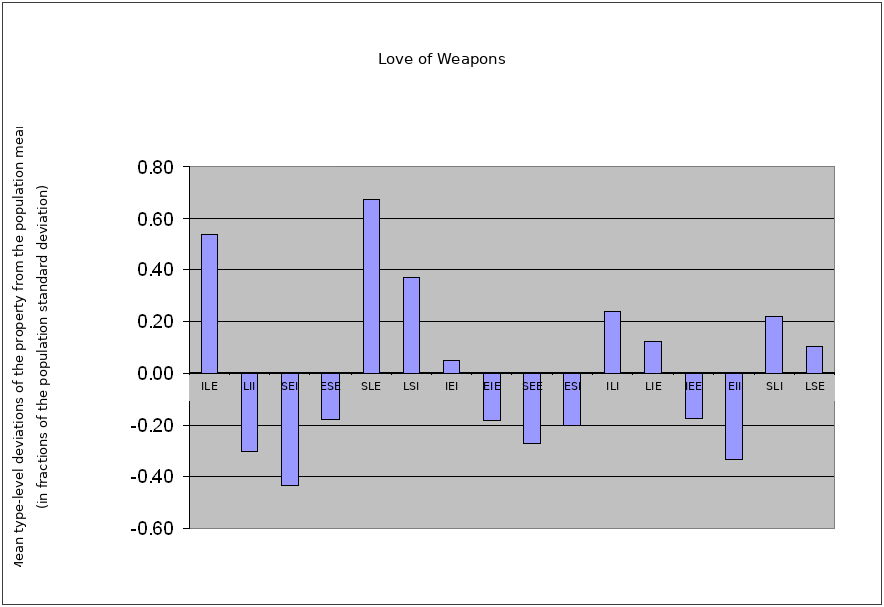
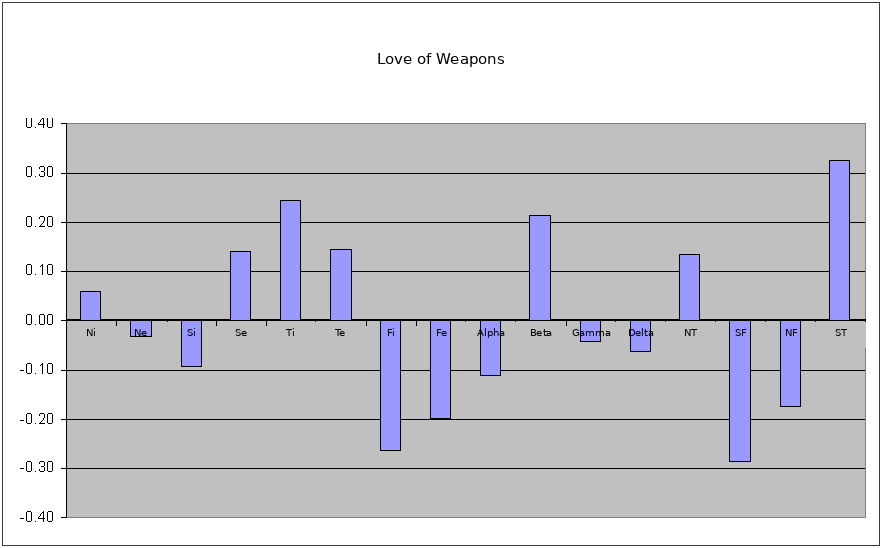
Cluster No. 21: “Love of Weapons”
The cluster consists of 2 rated statements; on average, 690 respondents participated in the rating of each one. A total of 1,380 responses from more than 1,000 respondents were used to construct the diagram.
The cluster took into account AGREEMENT with the following opinions:
Likes weapons and everything connected with them;
I would collect firearms and bladed weapons with pleasure if it were permitted.
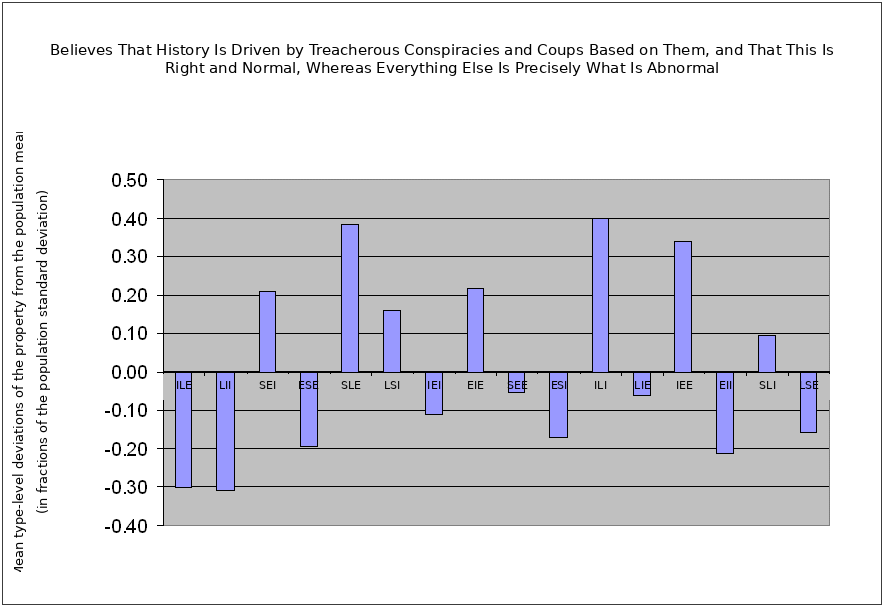
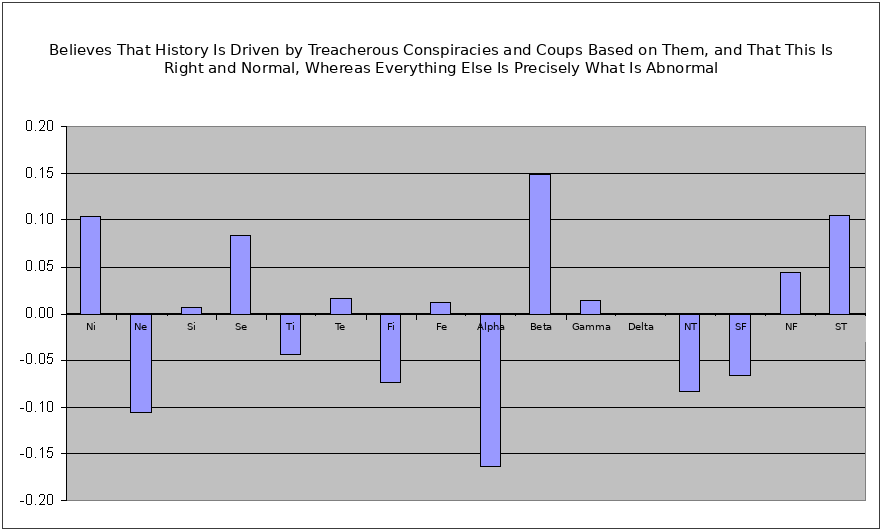
Cluster No. 22: “Believes That History Is Driven by Treacherous Conspiracies and Coups Based on Them, and That This Is Right and Normal, Whereas Everything Else Is Precisely What Is Abnormal”
The cluster consists of 1 rated statement, in the rating of which 420 respondents participated.
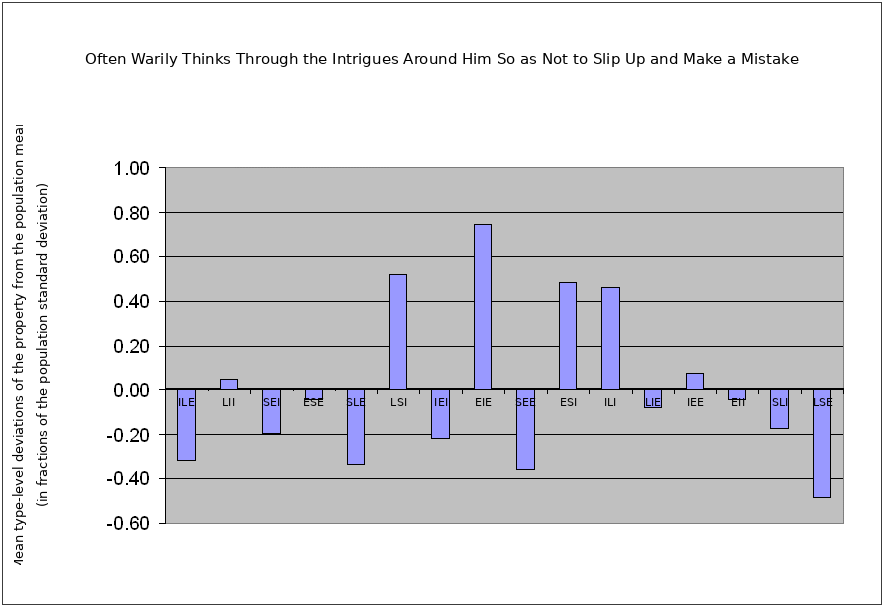
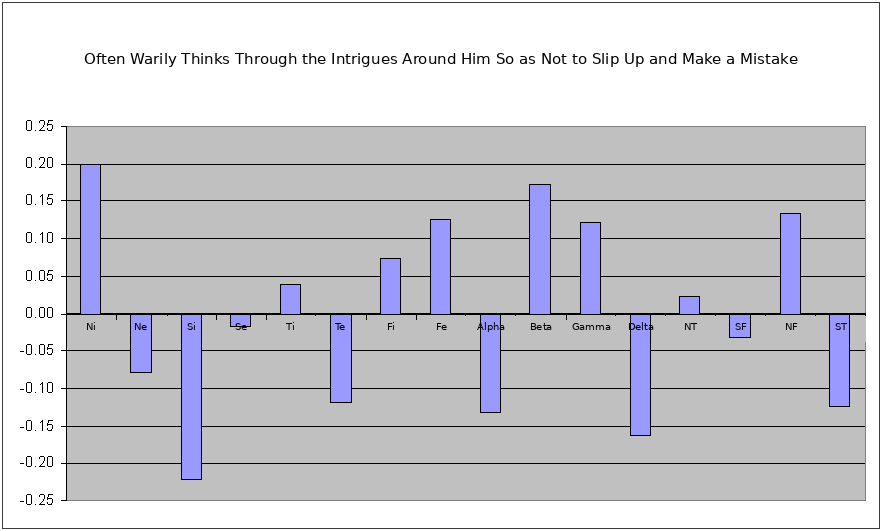
Cluster No. 23: “Often Warily Thinks Through the Intrigues Around Him So as Not to Slip Up and Make a Mistake”
The cluster consists of 2 rated statements; on average, 460 respondents participated in the rating of each one. A total of 920 responses from more than 800 respondents were used to construct the diagram.
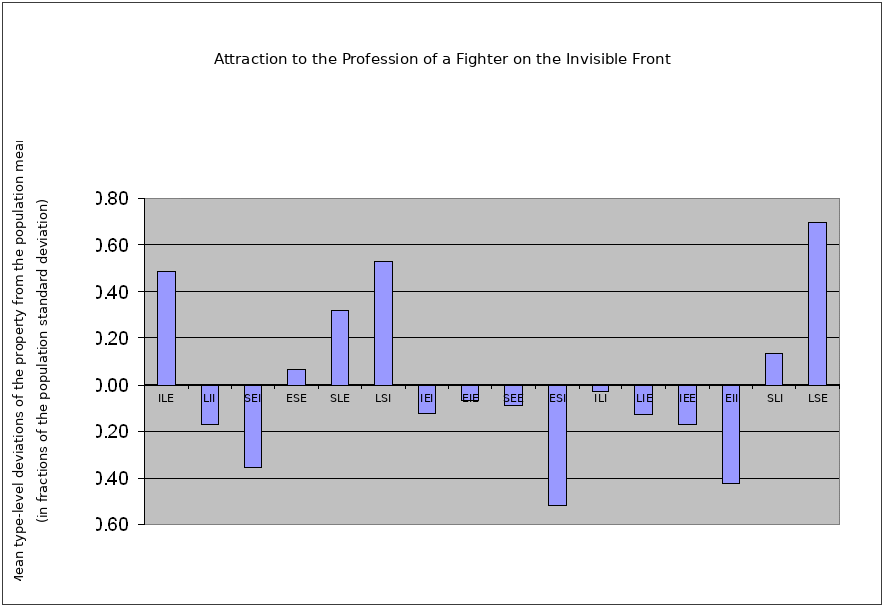
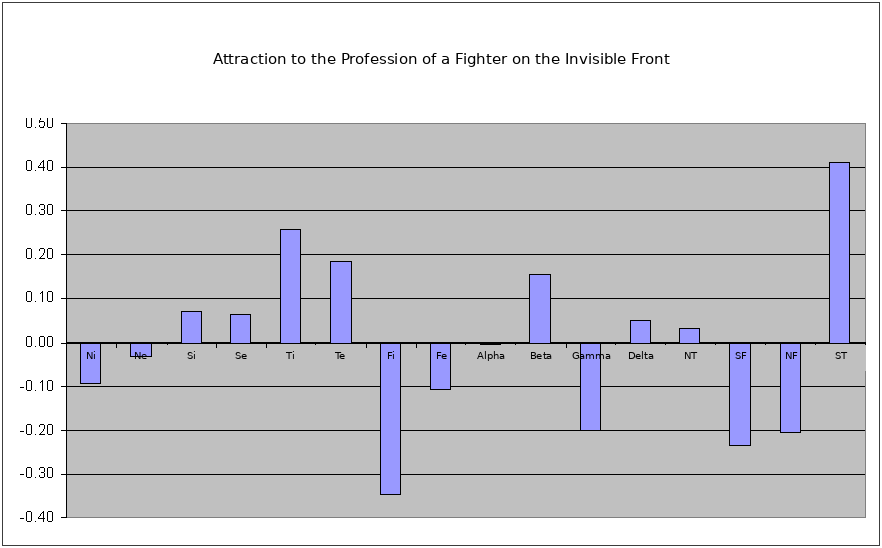
Cluster No. 24: “Attraction to the Profession of a Fighter on the Invisible Front”
The cluster consists of 3 rated statements; on average, 430 respondents participated in the rating of each one. A total of 1,290 responses from more than 900 respondents were used to construct the diagram.
Cluster No. 25: “Likes Having Servants”
The cluster consists of 5 rated statements; on average, 540 respondents participated in the rating of each one. A total of 2,700 responses from more than 1,500 respondents were used to construct the diagram.
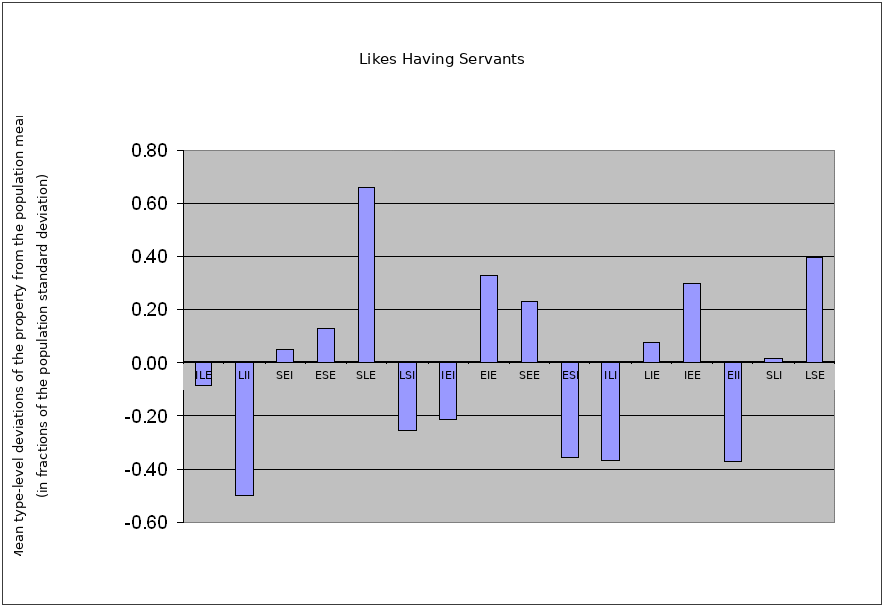
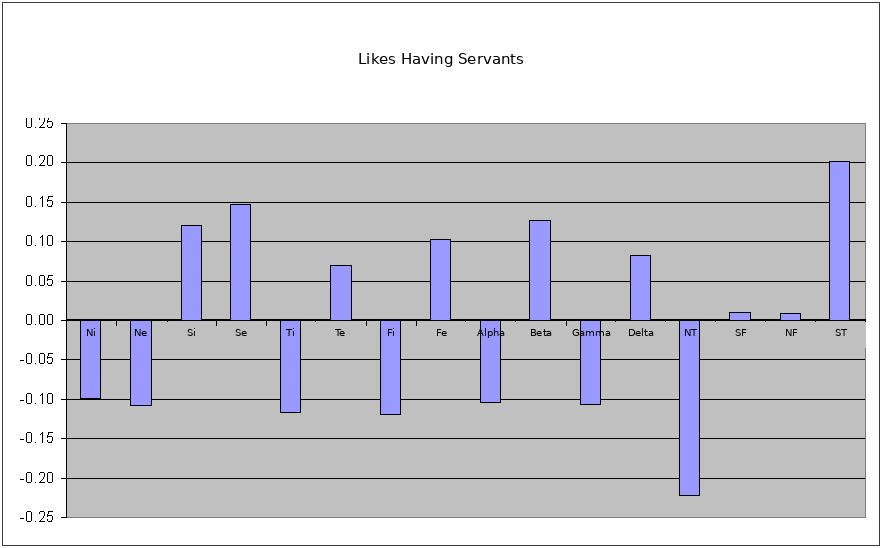
The cluster took into account AGREEMENT with the following opinions:
Likes being served by many people;
If I were rich, I would like to have many servants in my home;
Likes to make exacting use of restaurant and household services, including summoning their representatives to the home;
Is calmly indifferent or even positive about constantly being surrounded by people who stare at him and witness his life.
Cluster No. 26: “Negative, Maliciously Hostile Attitude Toward People”
The cluster consists of 42 rated statements; on average, 470 respondents participated in the rating of each one. A total of 19,740 responses from more than 4,500 respondents were used to construct the diagram.
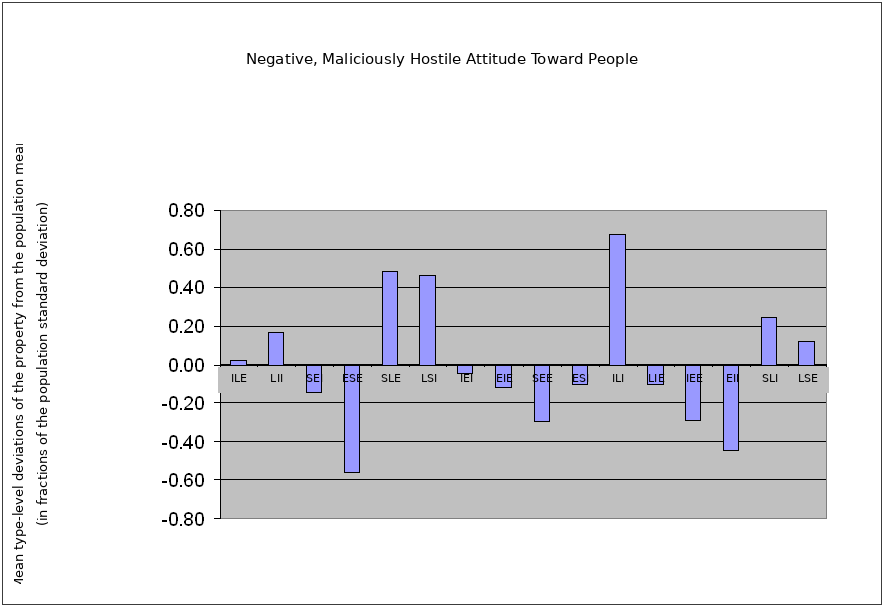
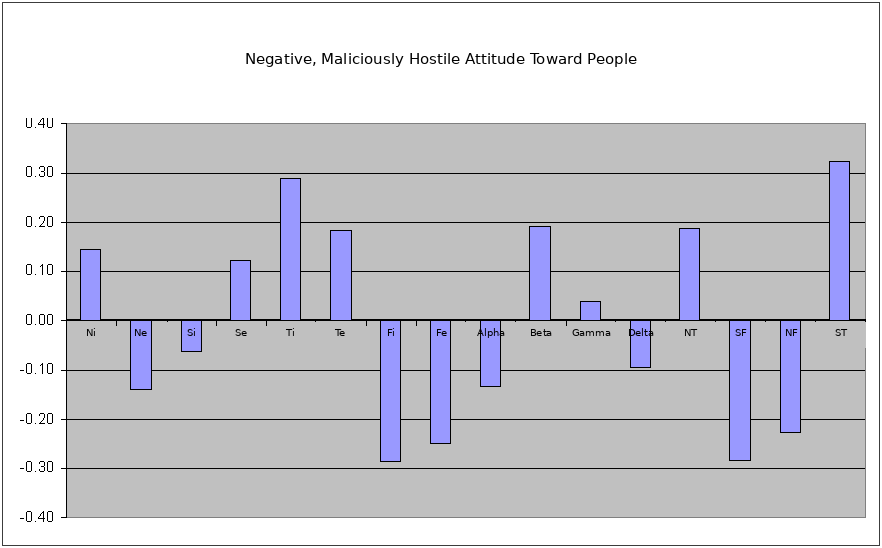
The cluster took into account AGREEMENT with the following opinions:
I am distrustful and suspicious of people;
Many people deserve to be treated like shit;
There is biliousness in my character;
My facial expression is more often dissatisfied;
I would like the work of a censor or controller;
I am indifferent to other people’s pain;
Individual notes of sadism sometimes break through in my behavior;
I am regarded as an evil person;
My gaze is cold; a shade of suspicion or condemnation can be read in it;
I do not like people;
People are shit; I often feel like killing myself or all of them;
I am always prepared for the possibility of betrayal by people;
My favorite color is black.
I have more enemies than friends;
Most people are scum;
I do not like children;
I do not believe in universal human brotherhood or devoted friendship;
I am not inclined to help people;
I do not want to improve other people’s mood;
I dislike most of my acquaintances;
I like noticing how people around me deviate from their own norms of morality and ethics;
The manners of people around me often irritate me;
People are sometimes so disgusting that I feel an urge to do something nasty to them;
The good mood of people around me often irritates rather than pleases me;
etc.
Cluster No. 27: “Donor of Negative, Malicious, Painful Emotions - First, Often Experiences Dissatisfaction (Frustration) and Malice; Second, Subconsciously Even Strives to Experience Malicious and Dissatisfied Feelings”
The cluster consists of 18 rated statements; on average, 525 respondents participated in the rating of each one. A total of 9,450 responses from more than 2,500 respondents were used to construct the diagram.
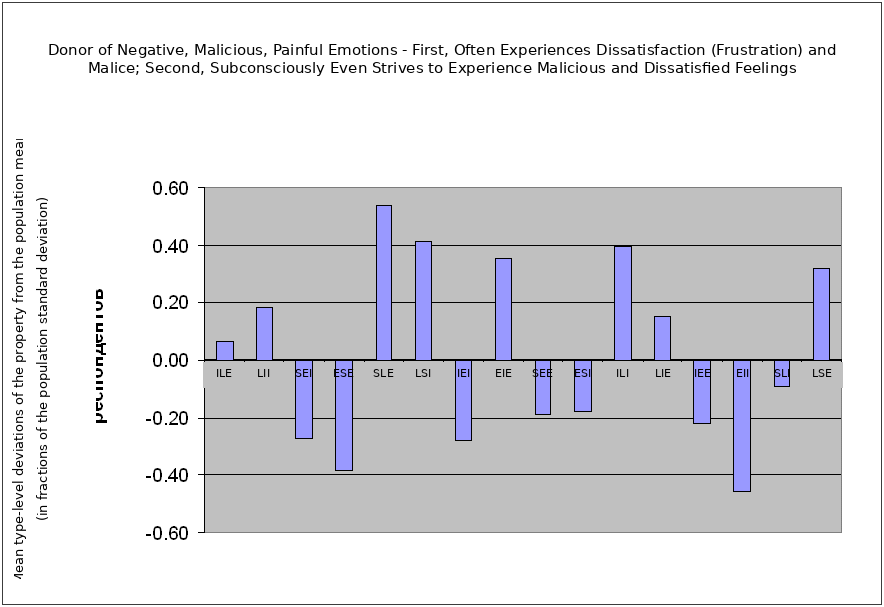
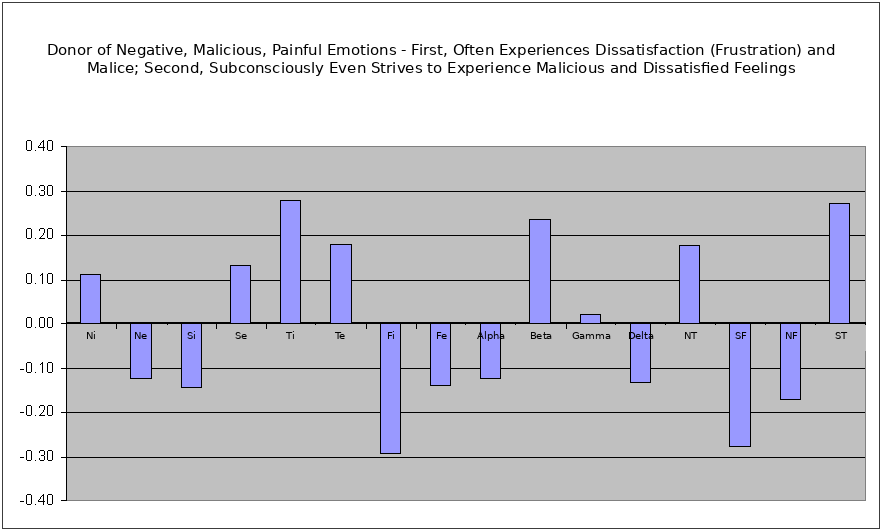
The cluster took into account AGREEMENT with the following opinions:
As a rule, I see negative rather than positive prospects in an object;
Sometimes in my mind I devise executions for enemies;
I can be cruel to those close to me;
I experience anger more often than joy and merriment;
There are people toward whom I feel intense malice;
I know how to be evil;
I often have a maliciously melancholic mood accompanied by looking for someone on whom I could take out my anger;
Sometimes it is more pleasant to do something bad to someone than something good for someone;
I have a terrible character;
I often look for enemies and then punish them;
I often fixate on hostility coming from people;
I want to hurl my bitterness and anger into this rotten world;
I am drawn to bad news;
I certainly do not belong among good-natured people who are satisfied with life;
I more often find minuses than pluses in things;
I am not a warm, gentle, conciliatory person.
Cluster No. 28: “Often Has an Irritable, Malicious, Bad Mood in Which It Is Easy to Lose One’s Temper”
The cluster consists of 5 rated statements; on average, 305 respondents participated in the rating of each one. A total of 1,525 responses from more than 900 respondents were used to construct the diagram.
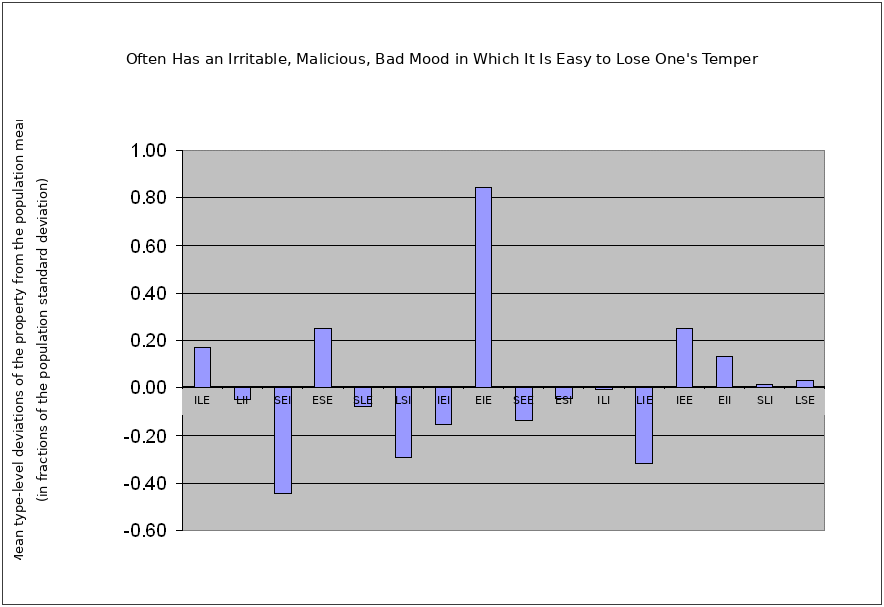
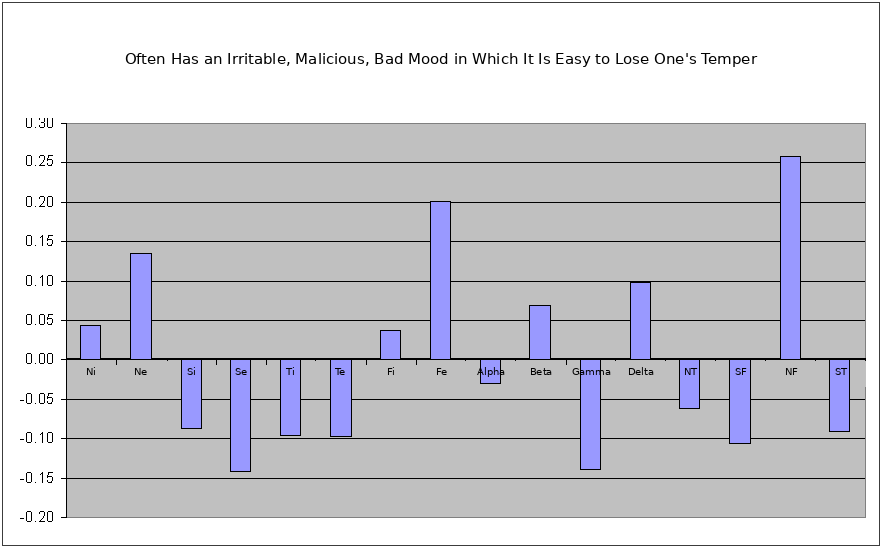
The cluster took into account AGREEMENT with the following opinions:
It is easy to make me irritated and put me in a bad mood;
I have episodes of hysterical laughter or crying that I cannot stop immediately;
I often react disproportionately strongly — as though everything is ready to make me lose my temper;
Several times a week I have a prolonged bad, malicious mood that I want to take out on someone;
Cluster No. 29: “Love of Power, Need for Power, Domination, and Complete Subordination of Those Around Oneself”
The cluster consists of 27 rated statements; on average, 565 respondents participated in the rating of each one. A total of 15,255 responses from more than 4,500 respondents were used to construct the diagram.
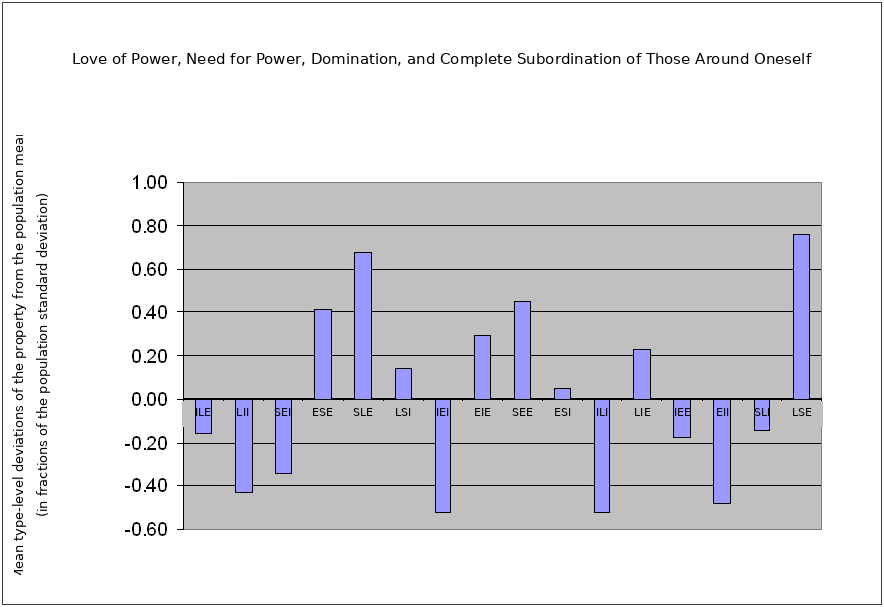
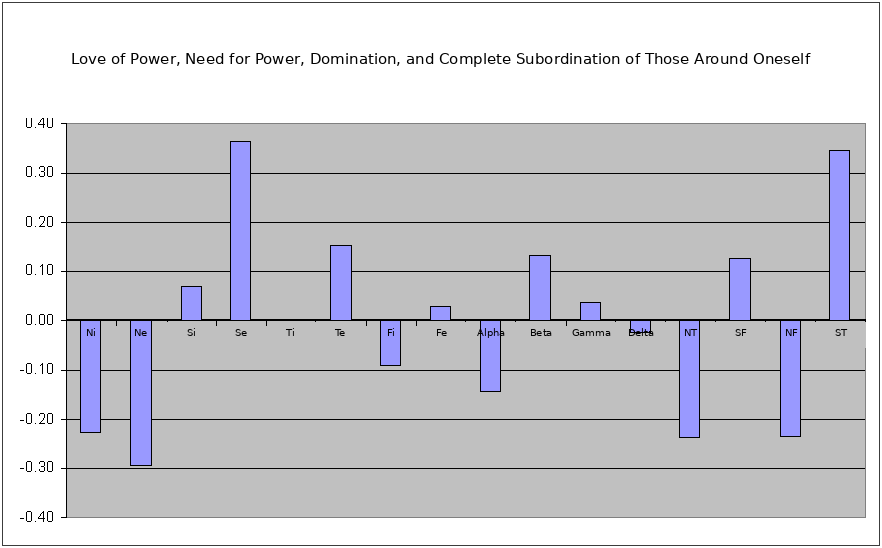
The cluster took into account AGREEMENT with the following opinions:
I get pleasure from having the right to give orders;
I feel a calling to be a master;
I would like to be an arbiter of human destinies;
Between power and independent activity, I will choose power;
I always strive to lead a cohesive group that would obey me completely;
My drive for a career is stronger than other people’s;
I like and know how to manage people harshly;
People around me readily and gladly submit to me;
I like to bring people completely under my influence;
I feel uncomfortable without subordinates;
I like it when people depend on me and feel indebted to me;
The status of the position I hold is very important to me;
I have an authoritarian character that demands complete submission from those around me;
I get great pleasure when I manage to break someone’s resistance;
Since my youth I have aimed to occupy an important place in society;
I am jealous; I need to possess my partner completely, dominating them;
I like and know how to establish acquaintances with important and influential people;
At times I restrict the freedom of family members;
Power is not needed for something; it is pleasant in itself;
In love I have always preferred to be the conqueror rather than the conquered;
It is better to be a big fish in a small lake than a medium-sized fish in a large sea;
I always take care to increase my status.
Cluster No. 30: “Dividing People into ‘Our Own’ and ‘Outsiders,’ Commitment to Team-Based Groupism and the Principle ‘Whoever Is Not with Us Is Against Us’”
The cluster consists of 5 rated statements; on average, 790 respondents participated in the rating of each one. A total of 3,950 responses from more than 2,000 respondents were used to construct the diagram.
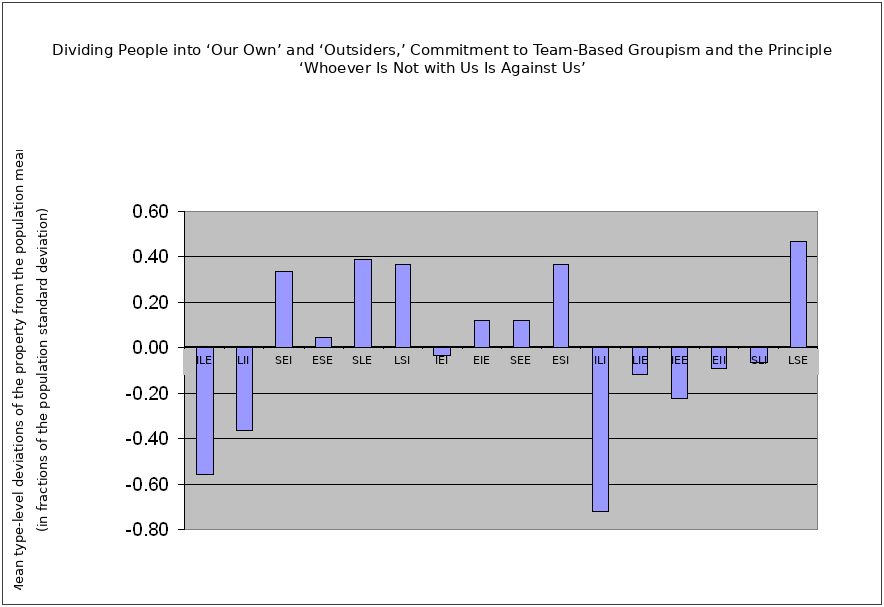
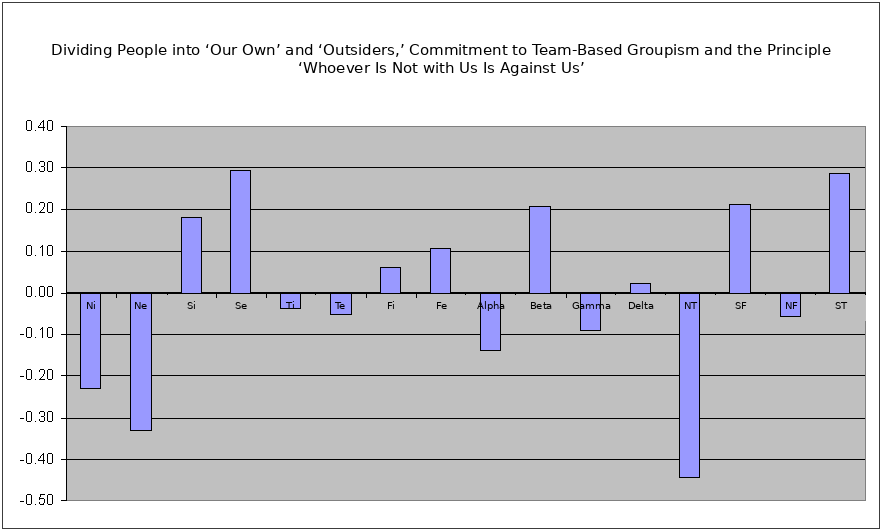
The cluster took into account AGREEMENT with the following opinions:
Whoever is not with us is against us;
I am surprised by those who try to live in friendship “with both our side and yours” - no, make up your mind, and if you are with them — then you are against us;
Personal loyalty is more important than talents and convictions;
I am a team person — for me there are always our own people and outsiders;
If you do not belong to a group of people bonded by common loyalty to a leader, you will achieve nothing in life.
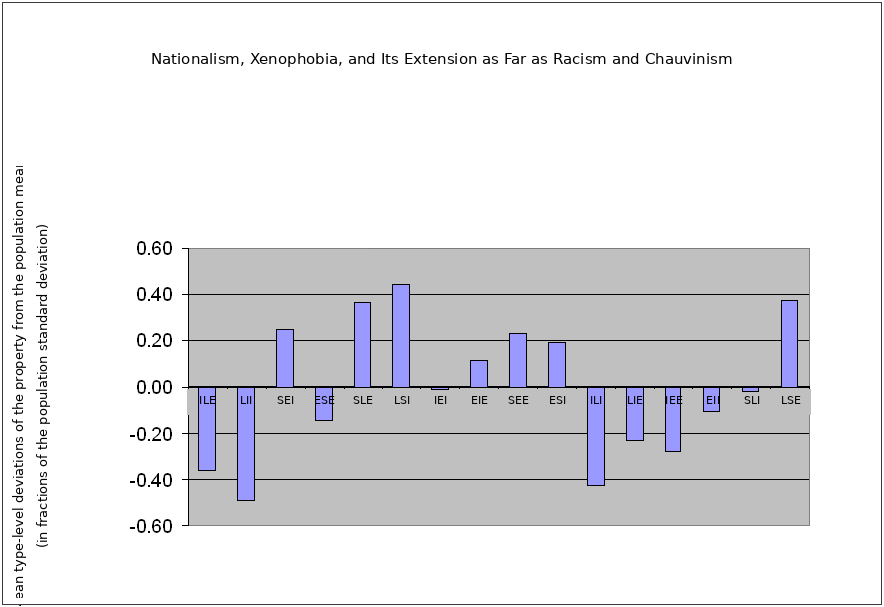
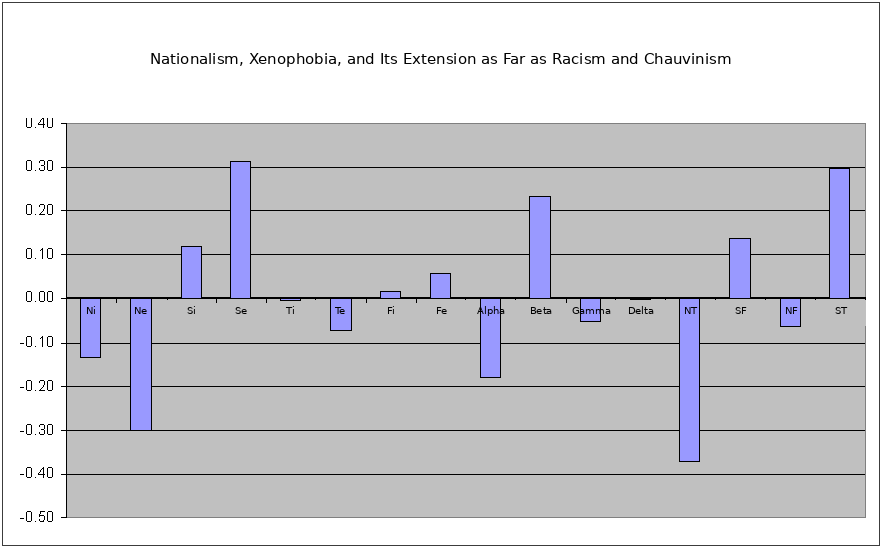
Cluster No. 31: “Nationalism, Xenophobia, and Its Extension as Far as Racism and Chauvinism”
The cluster consists of 26 rated statements; on average, 470 respondents participated in the rating of each one. A total of 12,220 responses from more than 4,500 respondents were used to construct the diagram.
The cluster took into account AGREEMENT with the following opinions:
Most people of foreign ethnic origin ought to live in their own historical homeland rather than among us;
The most dangerous people for the state are those who contaminate the national soil with the weeds of cosmopolitanism;
Immigrants cannot and should not have equal social rights with native inhabitants;
Internationalism is always either deception or stupidity;
A person who does not think about their nationality is always a dangerous degenerate;
Foreigners must not be allowed to criticize one’s own state;
Sympathy for a country that competes with my homeland is already betrayal;
To be a patriot means to defend one’s country from any critical attacks;
There are peoples who wish harm upon my nation;
Representatives of small non-titular peoples should not be represented in culture, science, and politics beyond their percentage share of the country’s total population;
It is better to be a nationalist than an internationalist;
Some nationalities are deeply unpleasant to me;
I would prefer to live exclusively among people of my own nationality;
Outside their own people, any person is nothing;
Stateless persons should not have the right to scholarships at our universities;
There is a dangerous conspiracy by the intellectual elite of one small nationality against all humanity;
The inhabitants of other countries are, for the most part, worse than us;
There is little of particular value for us to learn from other peoples;
etc.
Let us analyze the socionic causes contributing to the emergence of xenophobia. First of all, the illustrations presented clearly show that Cluster No. 30, “Dividing People into ‘Our Own’ and ‘Outsiders,’ Commitment to Team-Based Groupism and the Principle ‘Whoever Is Not with Us Is Against Us,’” and Cluster No. 31 (xenophobia and nationalism proper) have very similar socionic profiles, which also indicates substantial commonality in the causes underlying them. Of all socionic functions, xenophobia is promoted first and foremost by high Se, followed by Si and Fe. Conversely, high Ne counteracts xenophobia. How can this be explained? In our view, the phenomenon of xenophobia has five or six principal causal components. We shall characterize them in order of their expected decreasing role.
The first factor influencing the degree of xenophobia is the width of the range of variation in the compared characteristics within which a person becomes prepared to identify themself with other people. As is known, the width of the range within which a subject places an equality sign between any two perceived objects, including when comparing themself with other people, is much greater among intuitive types than among sensing types (see our work http://www.newsocionicsmodel.narod.ru/structure_intuit.html/ ). The largest contribution to greater range width, which is equivalent to low selectivity of the comparison and identification apparatus, is made by intuition of possibilities, Ne. People with high Ne perceive even objects with very remote similarity as similar and close, which, among other things, leads them to perceive a much broader circle of unrelated people as “their own” than sensing types do.
The second factor is associated with a different hierarchy of the set of traits by which other people are identified with oneself. Owing to the characteristics of their concrete-visual perception, sensing types attach greater importance to external similarity when establishing an equality sign between people, whereas intuitive types pay much more attention to the inner spiritual world of another person when making comparisons and identifications. In addition to the obvious connection with the Intuition-Sensing dichotomy, this difference is also partly determined by the subject’s intellectual resources and nonsocionic cultural and educational status. Therefore, intuitive types and, to some extent, logical types, as well as any people with higher intellectual status, are more inclined to recognize other people as equal to themselves when those people have the same spiritual interests and values, regardless of their language and facial features; sensing types and, to some extent, ethical types, as well as people with low intellectual and cultural status, are much more oriented toward formal external similarity: that is, facial features, skin color, language, the nationality entry in a passport, or formally declared affiliation with some organization or religious denomination.
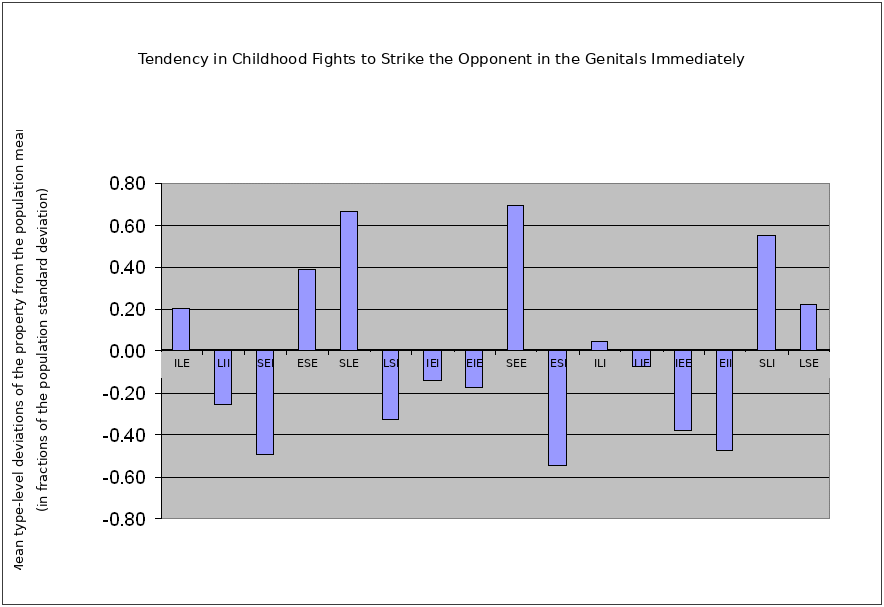
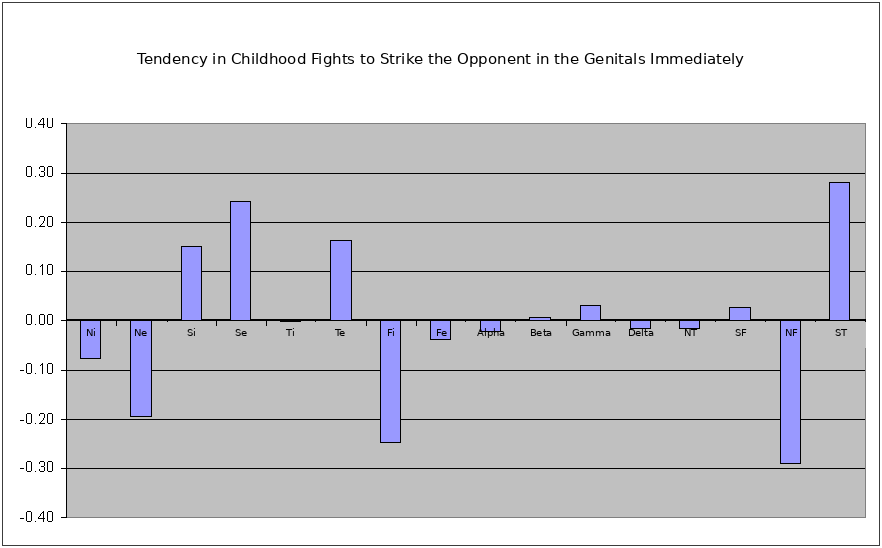
The third factor is associated with the strength of the “basic instinct,” which strives for the maximum propagation of one’s own genes and suppression of the propagation of other people’s genes. One side of the “basic instinct” is personal sexual aggression; the other side of the same coin — an implicitly intensified drive toward the genocide of everything alien and competing. It is well known that this factor, which contributes considerably to xenophobia and racism, is usually more strongly expressed the more strongly the subject’s force sensing, Se, is expressed (the magnitude of sexual libido is equally associated with Se and Fe, but Se is its most aggressive component). It is no coincidence that the tendency, in childhood fights, to strike an opponent in the genitals immediately is most strongly expressed in the two sociotypes with program Se. The “basic instinct” factor is not the only factor forming xenophobia — otherwise SEE (on average for the type) would have a greater tendency toward racism than LSI does on average, which, as we see, is not the case. Incidentally, the third factor under consideration can sometimes also manifest nonsocionically, outside any connection with force sensing — for example, it was presumably substantially elevated in Hitler (EIE) because of his sexual inhibitions and the consequently distorted, hypercompensated sexual instinct, pathologically sharpened within the framework of his conceptual personal attitudes and directed exclusively toward the collective gene of the nation rather than toward the expression of his own genes. Of course, Hitler’s high Fe and Se elevated above type norms also in themselves contributed to xenophobia caused by the “basic instinct,” but a different circumstance played the main role here. A normally developed sexual instinct follows rather the path of propagating one’s own genes than aggression against alien genes. In Hitler, the routes for direct realization of the sexual instinct were blocked — as is known, he did not sleep with women and from a certain point regarded himself as the “bridegroom of the entire nation.” In this case, the route of aggression against alien genes was precisely the one that remained open for realization of the basic instinct. Apparently, in persons with high Se and Fe, the greater the subject’s sexual inhibition and dissatisfaction, the more xenophobia should also be expected in them.
The fourth factor of predisposition to xenophobia is associated with a developed group herd instinct. The socionic function most strongly linked to this instinct is Fe (originally Fe itself arose from the exchange of alarm emotional signals indicating danger among individuals within one group). Te, by contrast, is the function least connected with the group instinct; moreover, it is opportunistic with respect to Fe. In fact, this factor increases xenophobia as such relatively weakly; rather, it is associated with manifestation of the group instinct in its pure form, that is, with dividing people into “our own” and “outsiders,” commitment to team-based groupism, and the principle “whoever is not with us is against us.” It influences the formation of xenophobia only to the extent that the “herd instinct” participates in it. But, for example, Hitler’s xenophobia was to a large extent caused precisely by this factor (and partly also by the pathologically elevated third factor, as well as the fifth and sixth factors discussed below).
Finally, the fifth factor of xenophobia is value-motivational and is determined by the division of the socion into clubs bonded by shared values, which, in descending order of the average level of xenophobia within them, are arranged as follows: ST-SF-NF-NT. Because the greatest difference is between ST and NT, this generally results in the “Aristocrats” of the socion having a somewhat higher overall level of xenophobia than the “Democrats.” The causal essence of this factor is that the higher a person’s “managerial” motivations are relative to “scientific,” research motivations, the higher the potential for xenophobia. This should be understandable: science recognizes neither nationalities nor borders, whereas management, by contrast, demands the erection of additional boundaries. Science and cognition unite; management is interested in dividing people and, especially, in “marking” the contingent under its control, separating it from the rest of the world’s population. The more strongly a given socionic type expresses love of power, the more intensely this factor operates. It is primarily because of this factor that xenophobia is substantially expressed in the LSE type. But because motives of genocide are not built into this factor, xenophobia in the LSE sociotype manifests rather as patriotism and great-power orientation, sometimes as a tendency toward national insularity, rather than as interethnic hatred (which in its tendency is most strongly linked to the level of Se). Although closely connected with socionic clubs, this factor can nevertheless also manifest independently of them, individually, in connection with a person’s profession. For example, in Hitler personally (owing to the specific managerial tasks he set himself), it was also elevated substantially above average, although in the Humanitarian club, to which Hitler belonged, it is overall slightly below the population mean.
One could add one more, sixth factor to the five listed above — while remembering, however, that it is much weaker than the preceding ones and has only a small influence on the level of xenophobia. This factor is associated with Rationality-Irrationality. Among Rational types (on average and all else being equal), xenophobia tends to be slightly higher because Rational types, owing to their tendency to fix evaluations, are also more inclined to “attach labels,” including national ones.
Taken together, all these factors produce the specific socionic profile of a certain averaged “xenophobia” shown in the illustrations for Cluster No. 31.
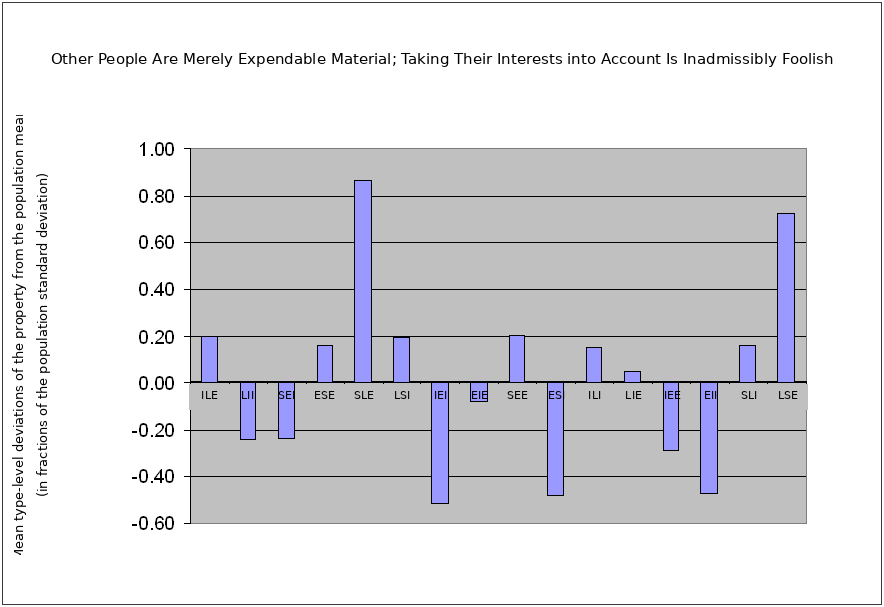
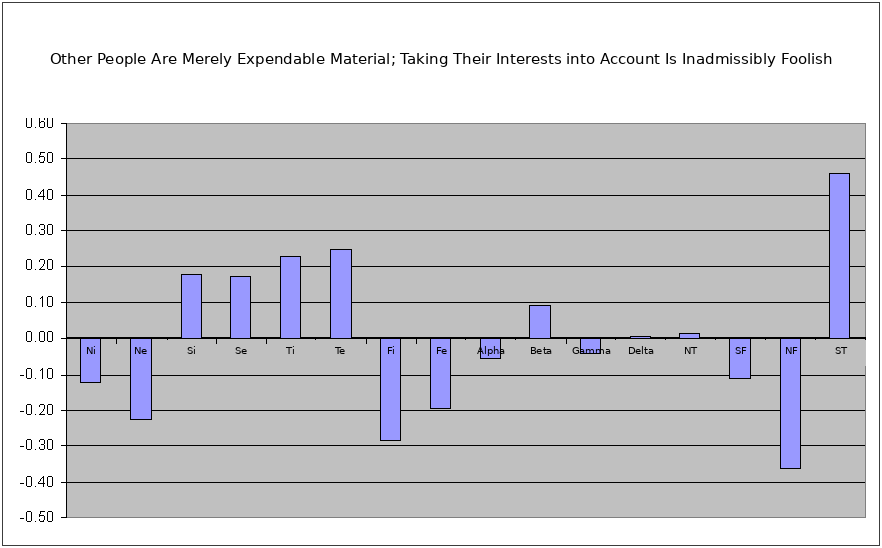
Cluster No. 32: “Other People Are Merely Expendable Material; Taking Their Interests into Account Is Inadmissibly Foolish”
The cluster consists of 11 rated statements; on average, 515 respondents participated in the rating of each one. A total of 5,665 responses from more than 2,500 respondents were used to construct the diagram.
The cluster took into account AGREEMENT with the following opinions:
I regard and use human material as a means in the struggle for power;
If necessary, I will go toward my goal even over other people’s heads;
If another person has money and is trusting, it is simply a sin not to make them share the money;
I am capable of moving toward a goal while completely trampling other people’s interests;
I believe that in certain situations it is necessary to step over other people in order to reach the required place;
All means are good for achieving what is desired;
My internal logical argument never yields to another person’s request or tears;
The cluster took into account DISAGREEMENT with the following opinions:
Every individual person is an entire world worthy of respect;
Another person’s inner world of memory and imagination is no less important than the large real world;
I am often embarrassed to use useful connections I have established in my own interests.
Cluster No. 33: “He Is Drawn to the Role of a Boss Who Goes ‘Belly First’”
The cluster consists of 6 rated statements; on average, 560 respondents participated in the rating of each one. A total of 3,360 responses from more than 1,500 respondents were used to construct the diagram.
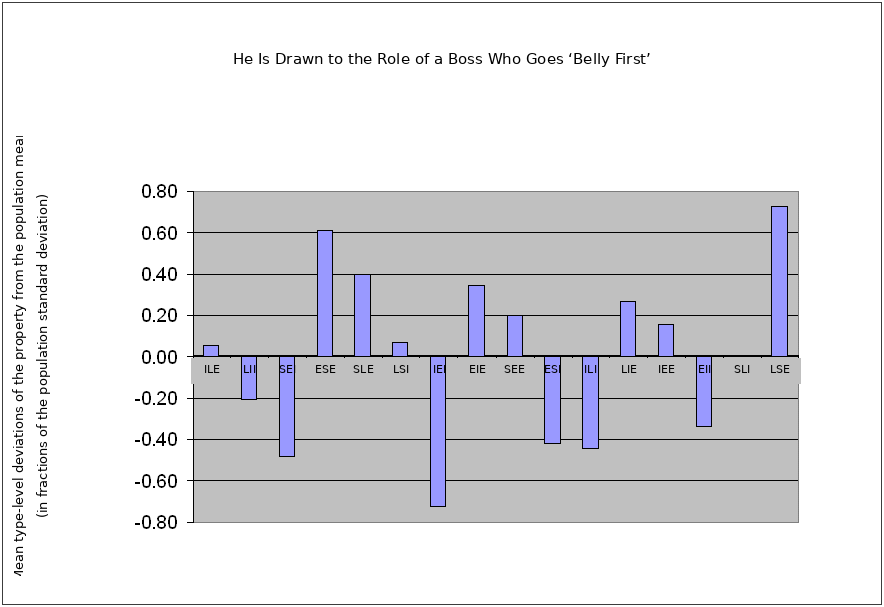
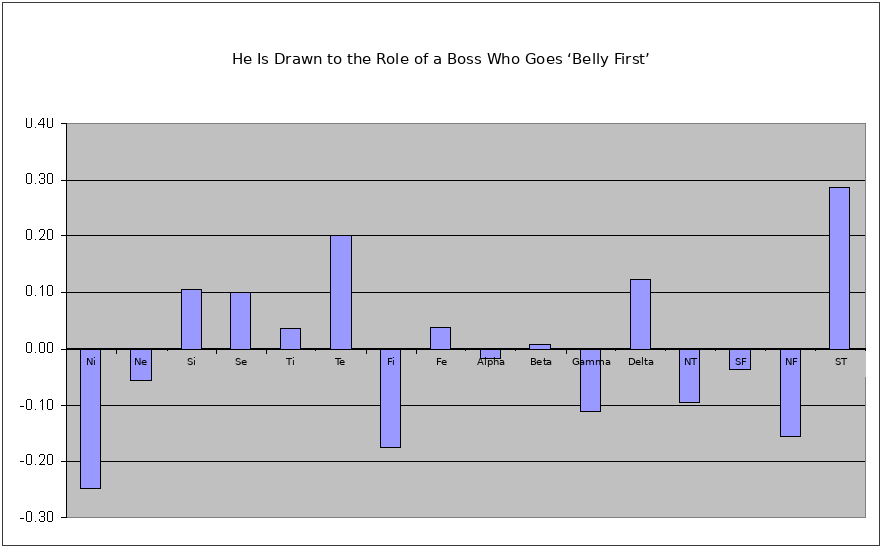
The cluster took into account AGREEMENT with the following opinions (all of them turn out to be closely correlated with one another):
If I were to write books, they would be about myself, not about someone else;
I am often intolerant of other points of view;
I always behave like a person vested with power and authority;
When speaking before people, I always speak loudly;
I am ambitious and self-confident, cannot tolerate criticism or irony, and usually become sincerely angry if people argue and wrangle with me;
By temperament, I would be suited to being the director of a company or factory.
Cluster No. 34: “Greed for Money, Self-Interest”
The cluster consists of 23 rated statements; on average, 400 respondents participated in the rating of each one. A total of 8,120 responses from more than 3,000 respondents were used to construct the diagram.
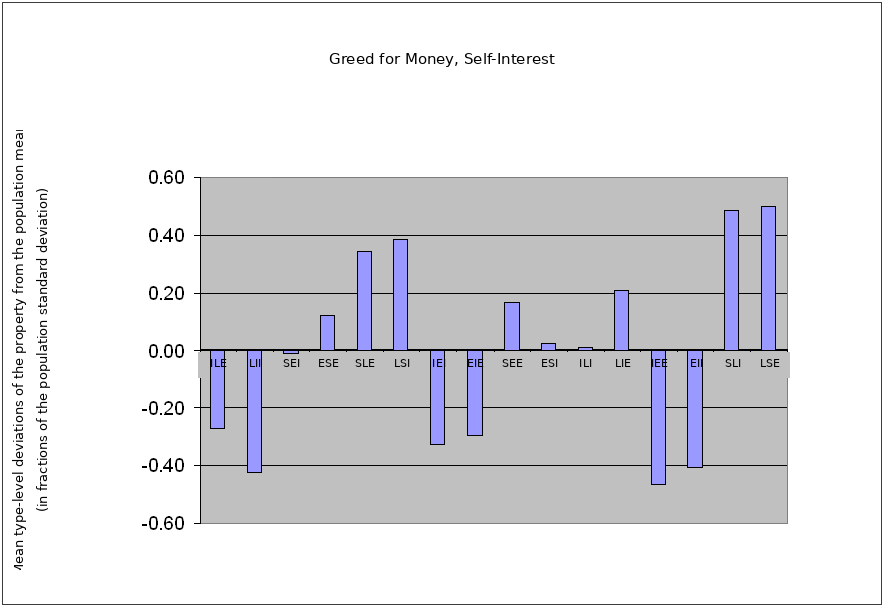
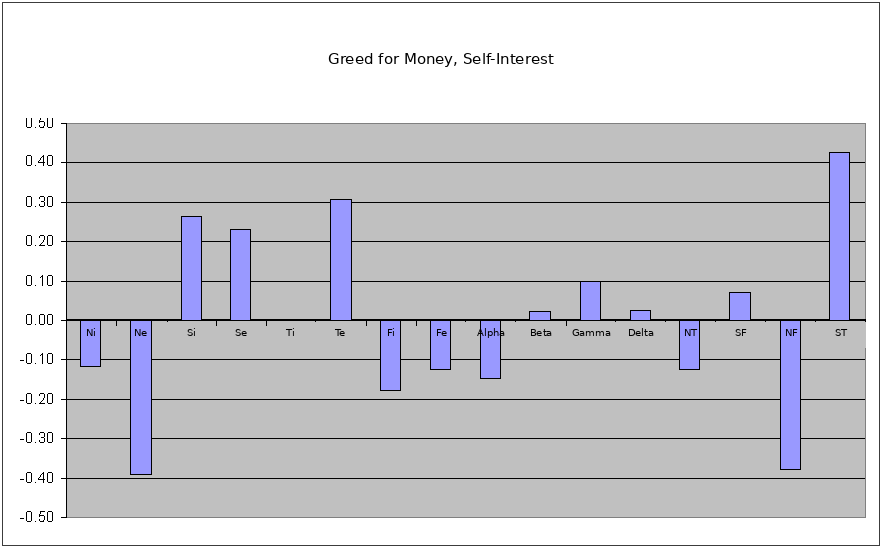
The cluster took into account AGREEMENT with the following opinions:
I am often impatiently greedy for money that seems obtainable quickly and easily;
It is better to have a reputation as a fool than as a pauper;
I like thinking through and discussing plans for enrichment and the possible financial advantages and disadvantages of various undertakings;
I blame and reproach myself if it turns out that I slightly overpaid for a product;
Monetary reward plays a decisive role in my interest in work;
I am better than others at saving money;
Sometimes greed lets me down — I have that weakness;
I am rather stingy and greatly dislike parting with money;
Poorly paid work is automatically of no interest to me;
I would certainly try to conceal carefully from others any information from which one could try to make good money;
Parting with money is already a sign of weakness;
I try not to pay for work done and to “squeeze” money whenever there is an opportunity;
A threat to my money is more frightening than a threat to my faith;
I know how and like to bargain at the market, driving down the price;
Stinginess is characteristic of me;
For the sake of money, I sometimes exploit subordinates;
Money is the key to everything;
I always weigh the benefits and losses of purchasing a product, fearing unnecessary expenditure;
It is better to sacrifice tomorrow’s opportunities than today’s money;
Money is not only a means, but also a pleasant end in itself.
Cluster No. 35: “Susceptibility to Thieves’ Morality (Guided by Current Personal Benefit and Common Sense, Often Cynical, Rather than by Laws and Principles; Indifferent to Other People’s Opinions; Tends to Be Guided by the Morality of Thieves and to Live ‘by the Code’ Rather than by Laws)”
The cluster consists of 32 rated statements; on average, 700 respondents participated in the rating of each one. A total of 22,460 responses from more than 4,500 respondents were used to construct the diagram.
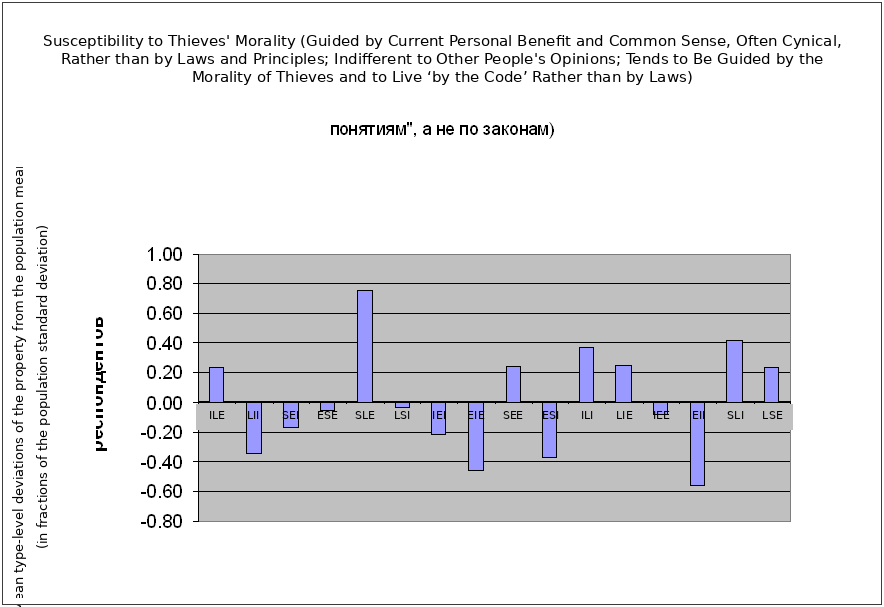
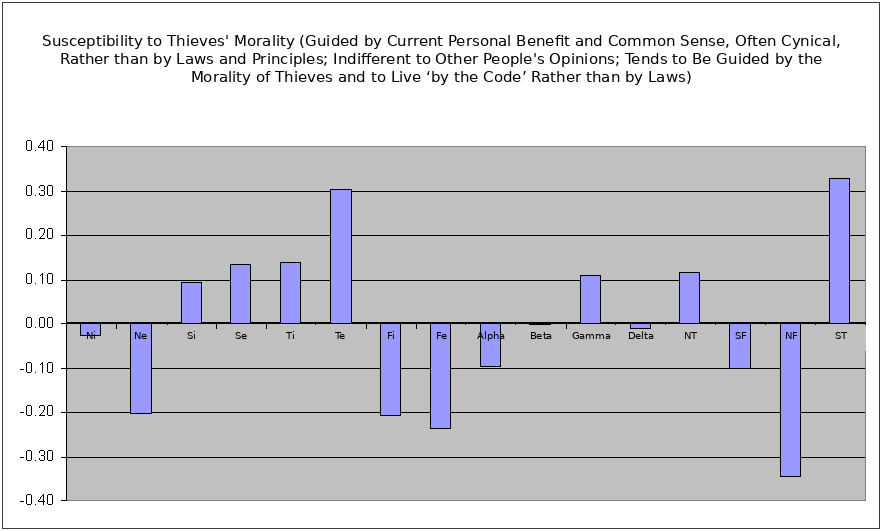
The cluster took into account AGREEMENT with the following opinions (all of them turn out to be fairly closely correlated with one another):
The one who should answer for it is not the one who is guilty, but the one who got caught;
I can sometimes take what belongs to someone else if I really want something;
First things should be good and comfortable for me; concern for others comes only afterward;
The ability to pretend and cunning are what intelligence is;
I do not dwell on mistakes and failures and easily throw them out of my head;
Relations between people interest me only from the standpoint of how and when they can be used to my own advantage;
I know how to be unceremonious;
Other people’s impudence and boorishness neither offend nor shock me;
If a well-off person is stupid and trusting, one should make them share their money;
I am not squeamish; I will readily pick up even a snake if I am sure it will not bite me;
On a dare, I would readily walk barefoot over hot coals;
I like songs in the genre of “prison chanson”;
I communicate mainly with people who are useful for my career;
Forgetting about myself while helping someone — that is not at all something that can be said about me;
A ruler-governor should care exclusively about the interests of the person who appointed him, not about the interests of the country to which he was appointed;
Sometimes, deliberately and out of boredom, I say hurtful things to people — to throw them off balance;
I despise people concerned with universal justice;
People who fall for swindlers’ tricks are themselves to blame — because they are suckers;
I never feel guilt for any of my actions whatsoever;
Only what is near me matters; what is far away from me is no longer important;
I would gladly make the acquaintance of some interesting crooks;
“If they give, take; if they beat you, run” - a wise proverb;
“If you haven’t been caught, you’re not a thief” - a wise proverb;
“There is no defense against a crowbar” - also a wise proverb;
Healthy egocentrism is characteristic of me;
Everyone should care first and foremost about themselves, not about others;
Benefit and everyday common sense are more important than any laws.
The cluster took into account DISAGREEMENT with the following opinions:
I readily feel sympathy for people;
I often perceive the problems even of a stranger as my own;
I feel uncomfortable if someone in a group has a poor opinion of me;
I am vulnerable to remarks made by those around me;
I always tense up internally if I have to run across a road in dense traffic;
I often sacrifice my time or comfort in order to do another person a service without expecting anything in return;
When making decisions, I always involuntarily consider beforehand whether they might harm the interests of society, humanity, and other people;
I worry if I failed to foresee everything and let those around me down;
After examinations, my thoughts continued returning to the completed ordeal for a long time;
I am sensitive both to offenses and to punishments.
Let us note and recall that, owing to the existence of subtypes within a type (as well as nonsocionic factors), far from every SLE is even potentially a thief as a tendency, and, for example, not every EIE or SEI, conversely, shuns corruption and theft. The subtype is of primary importance. The properties of a specific real person can be represented most accurately as a weighted sum of the properties of all 16 types without exception, where for each sociotype, one of the full set of 16, that person has their own weight coefficient. This is what creates a specific subtype. Thus, an ILE whose profile is simultaneously elevated at the LII, EII, and ESI peaks, that is, with reduced Extraversion and Irrationality and additionally with Fi strengthened relative to the type norm, will have a potential tendency toward “thieves’ morality” below the population mean, whereas an EIE with strengthened Se and Te — conversely, will most likely have potential susceptibility to criminal morality above the population mean. In addition, behavior is naturally influenced by the factor of inculcated values, not only by temperament predisposing a person to manifestations of a particular property. This further increases within-type dispersion. For example, within the SLE type group, the dispersion in the magnitude of the analyzed property (the half-width of the within-type distribution), for all the reasons indicated, ultimately proves fairly large and amounts to about 0.9 population standard deviations, whereas the difference between the group mean of the property under consideration (for the SLE type) and the population mean is only 0.75 standard deviations. Thus, as a simple statistical calculation based on the percentiles of a Gaussian distribution shows, about 20% of all SLEs will have an individual “susceptibility to thieves’ morality” score not above but, on the contrary, below the population mean. Exactly the same qualifications should be borne in mind with respect to all the other clusters described in the present article. More precise information on the percentage of representatives of a type whose individual score on any property has the opposite sign (relative to the population mean) from the mean value of that property for all representatives of that type can be found in Table 1 at the end of the article.
Cluster No. 36: “Arrogance, Disrespect for Another Person’s Individuality, a Contemptuous ‘Top-Down’ View of People, the Need to Establish One’s Superiority over Them - Including by Inflicting Harm on Them and Morally ‘Putting Them Down’ (‘I Feel Good If Others Feel Bad’)”
The cluster consists of 41 rated statements; on average, 490 respondents participated in the rating of each one. A total of 20,090 responses from more than 4,500 respondents were used to construct the diagram.
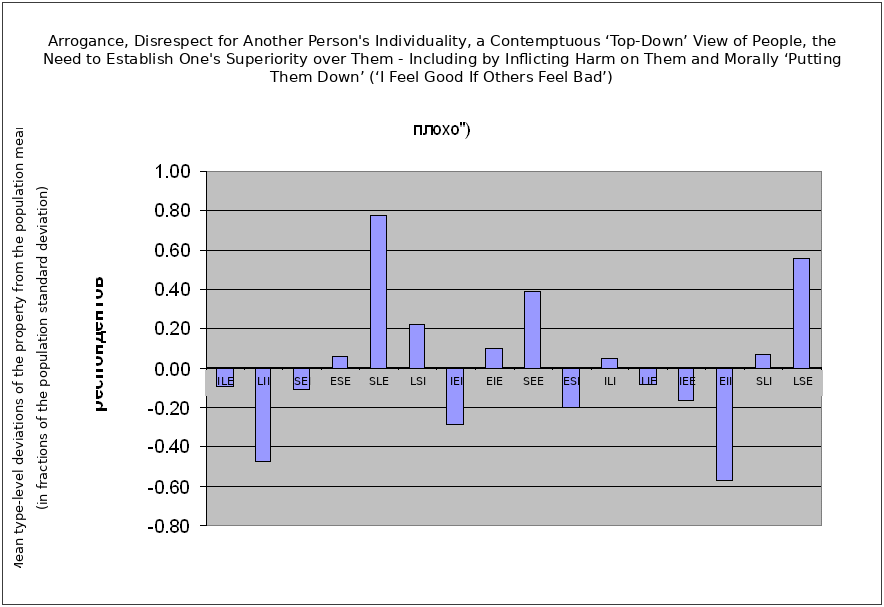
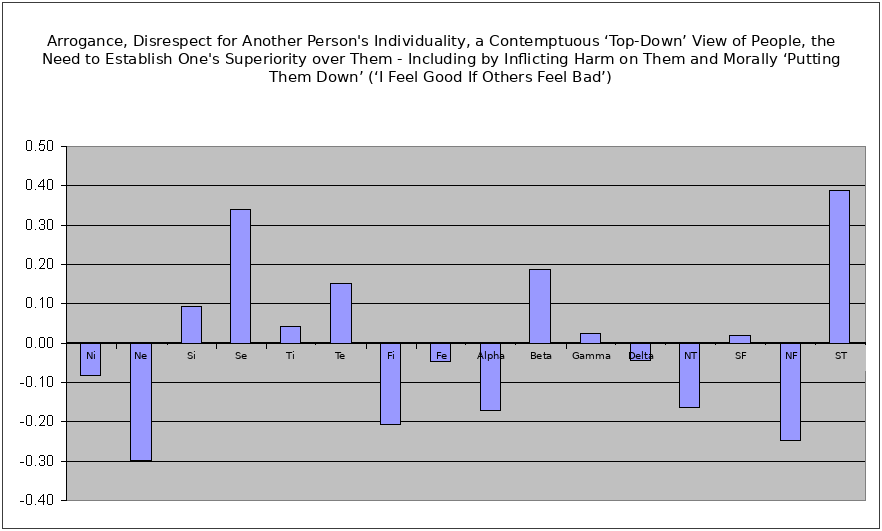
The cluster took into account AGREEMENT with the following opinions:
I like looking down on people;
I often make sarcastic remarks about other people;
I know how to regard human material solely as a means in the struggle for power;
I know how to put worthless weaklings in their place;
I like hurting certain people, bringing them to emotional distress and tears;
I know how to “strip” an opponent with my gaze;
I get pleasure from tormenting certain people around me;
The world is divided into plebeians and aristocrats, and that is magnificent;
I step over other people to reach the place I need to get to;
I often want other people to be stupider than I am and to know less than I do;
I know how to trample other people’s interests in passing while moving somewhere;
I know how to feel contempt;
I often demonstrate to people their dependent position in relation to me and their insignificance;
It is pleasant to feel like an expensive painting in a golden frame on the wall and look down from there at everyone with contempt: “as if to say, what freaks you all are!”;
If I were rich, I would like to keep many servants in my home;
Arrogance is characteristic of my personality;
I often deliberately spoil another person’s mood — so that they suffer and know their place;
The cluster took into account DISAGREEMENT with the following opinions:
Other people’s freedom and independence are as dear to me as my own;
I have sincere respect for “little” people;
I feel energetically drained when people close to me quarrel around me;
It is difficult for me to refuse a person’s request;
Every individual person is an entire world that is no less important than the world of a large country;
I sometimes experience injustice toward other people even more strongly than injustice toward myself;
Praise in education is usually a more powerful incentive than reprimand;
I respect the intrinsic worth of every person;
I believe in an originally good and honest human nature;
What I value above all is the ability to respect my own and other people’s human freedom;
I have almost always been ready to help any stranger;
I possess a heightened sense of justice;
I treat with contempt cultures in which offending the weak is considered a virtue;
The inner spiritual world of a person of the opposite sex is more important to me than their external appearance;
I would prefer to live in a world where there is no division into masters and slaves, aristocrats and plebeians;
I would find it repugnant to live in luxury at the expense of others while creating nothing independently;
I regard most people around me with goodwill and warmth;
I am more of an altruist;
I am ashamed of manifestations of negative feelings;
etc.
Cluster No. 37: “Anti-Intellectualism (Skeptical or Negative Attitude Toward Science, Scientists, Mass Education, Freedom of Scientific Information, and a Tendency to Create Conditions That Inhibit Scientific Activity)”
The cluster consists of 24 rated statements; on average, 685 respondents participated in the rating of each one. A total of 16,440 responses from more than 4,500 respondents were used to construct the diagram.
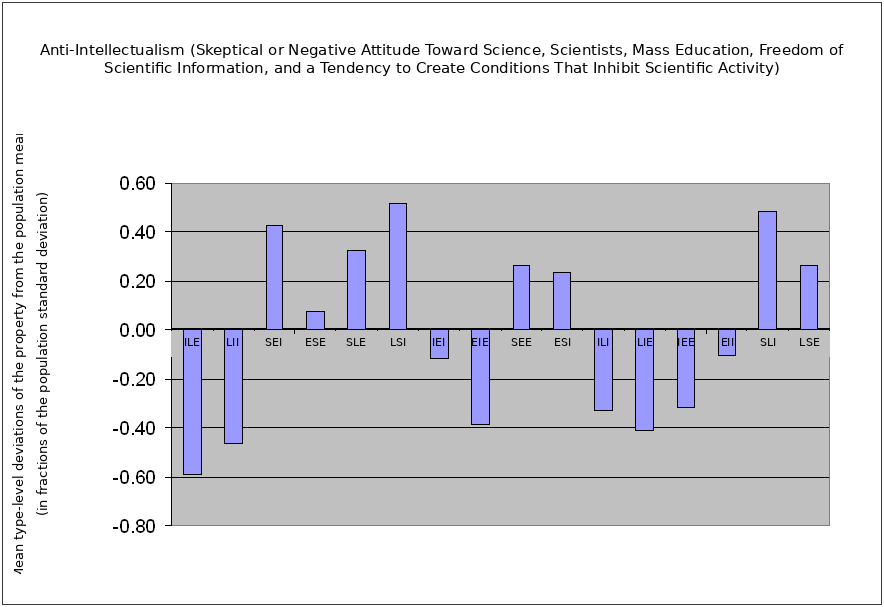
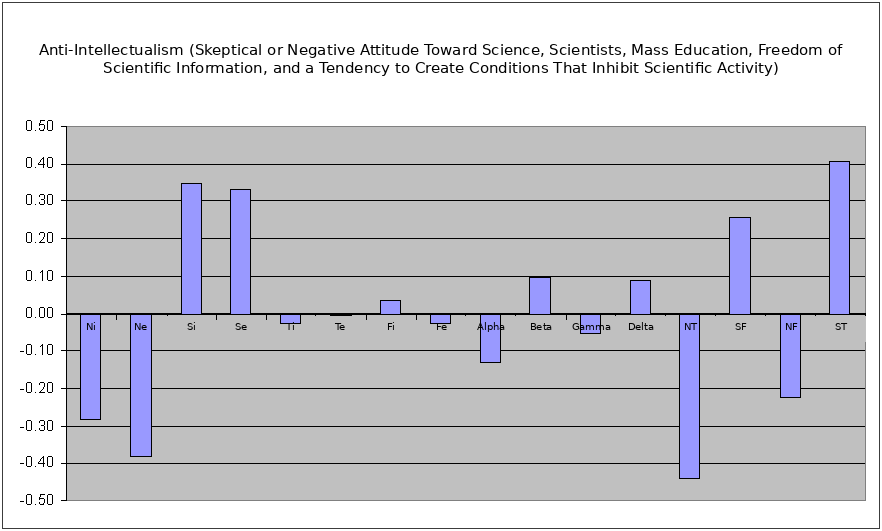
The cluster took into account AGREEMENT with the following opinions:
People in society have too much education — more than they need for their work and more than public utility requires;
Lone individuals in science are most often unpredictable and therefore dangerous and harmful;
The police should have higher funding priorities than science;
People who like to demonstrate their erudition irritate me;
The military is more necessary to society and the state than scientists are;
In the role of a minister, I would prefer a general rather than an intellectual;
I want religious rules and traditions to be strictly observed in society;
It is better accidentally to suppress something innovative than to permit turmoil;
Leaving descendants a beautiful, comfortable house is more valuable than leaving them a pile of books one has written containing various discoveries;
The general public should know only what it is supposed to know;
Social tranquility is more important than truth;
An important scientific discovery must under no circumstances leave the boundaries of its native country;
It would be good if other people knew less than I do and were stupider than I am;
People should receive strictly rationed information depending on their position in society;
Raising the educational level of the majority of people is an unnecessary and harmful undertaking;
All kinds of innovators, fantasists, and dreamers are unlikely to evoke my respect;
etc.
Cluster No. 38: “In Politics, the ‘Right’ Are More Appealing than the ‘Left’ (in the European Sense of These Terms))”
The cluster consists of 32 rated statements; on average, 480 respondents participated in the rating of each one. A total of 15,360 responses from more than 4,500 respondents were used to construct the diagram.
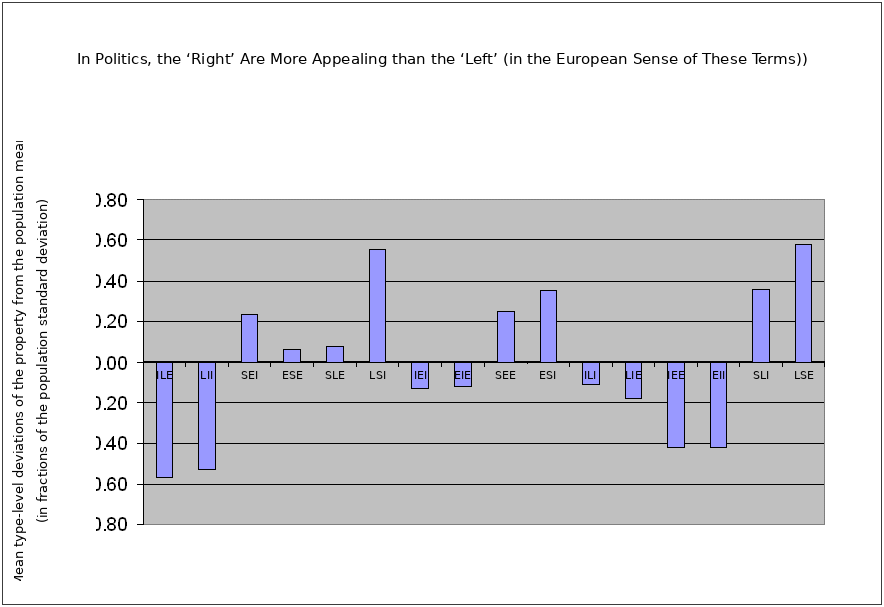
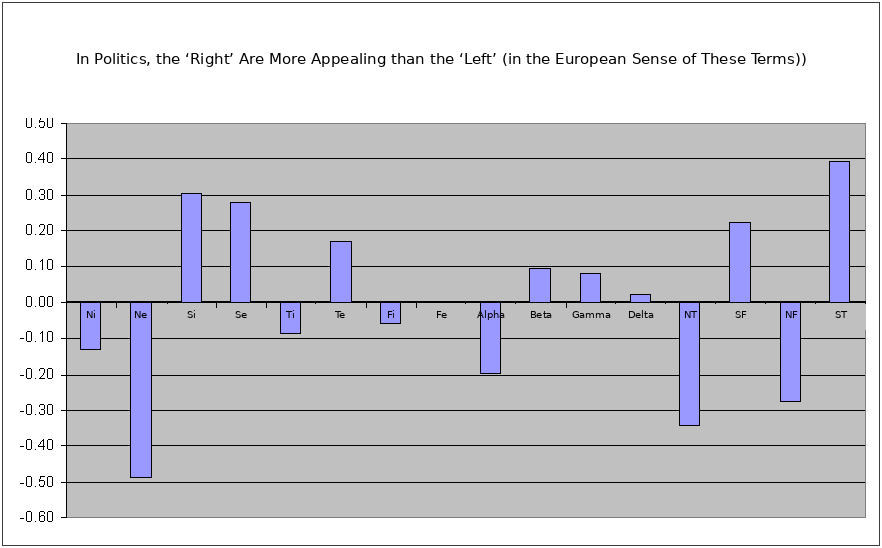
The cluster took into account AGREEMENT with the following opinions:
I sympathize with the “right” more than with the “left”;
My principal values are prosperity, practicality, and maintenance of traditions;
I zealously defend my personal space;
If control by society is weakened, everyone will steal;
I support a form of state authority that would be strong-handed authority;
I treat enthusiasts and clever people with irony and rely on common sense, material interest, and healthy conservatism;
Society should be divided into plebeians and aristocrats, and this is right; fantasies about equality continually do more harm than good;
I am opposed to foreigners and stateless persons having the right to scholarships at our universities;
I like strict discipline and subordination at work;
People should be motivated to perform high-quality work by strictness, not softness;
I do not particularly trust people — I am often afraid that I will be taken advantage of if I am not cautious;
The cluster took into account DISAGREEMENT with the following opinions:
If the rights of “newcomers” are curtailed, this may lead to dangerous chauvinism or even further;
Criminal punishments should be made more lenient rather than harsher;
I am an internationalist;
I am more indifferent to money than many other people;
As a child I often dreamed of passionate heroic deeds in the name of my country or humanity;
I believe that the people can govern themselves without tsars, leaders, and masters;
Not every activity should be oriented toward efficiency, direct utility, and benefit - “art for art’s sake” has a right to exist and to receive support;
I share the values of liberty, equality, and fraternity;
I hate selfish indifference to common interests in people;
Things and money are not ends in themselves for me, but merely means;
I support social justice; through its policies, the state should limit material inequality among members of society;
etc.
It is noteworthy that the greater part of the “confrontation” between the “right” and the “left,” in the socionic sense, runs along the Sensing-Intuition axis. All intuitive types without exception, including intuitive types of the second and fourth quadras, turn out in their integrated views to be slightly closer to the European “left” than to the “right.” It is also clear that, given the semantic content of the cluster, Zyuganov’s supporters in Russia can be classified as “left” only to a tremendous degree conditionally — by most parameters they are closer to the “right” in the European sense of the term. Of all political forces close to power, the ones closest to the “left” in Russia are the supporters of A Just Russia and, perhaps, to some extent President Medvedev with his “modernization” program.
Cluster No. 39: “Likes Flattery; Likes Being Surrounded by Flatterers”
The cluster consists of 3 rated statements; on average, 330 respondents participated in the rating of each one. A total of 1,000 responses from more than 700 respondents were used to construct the diagram.
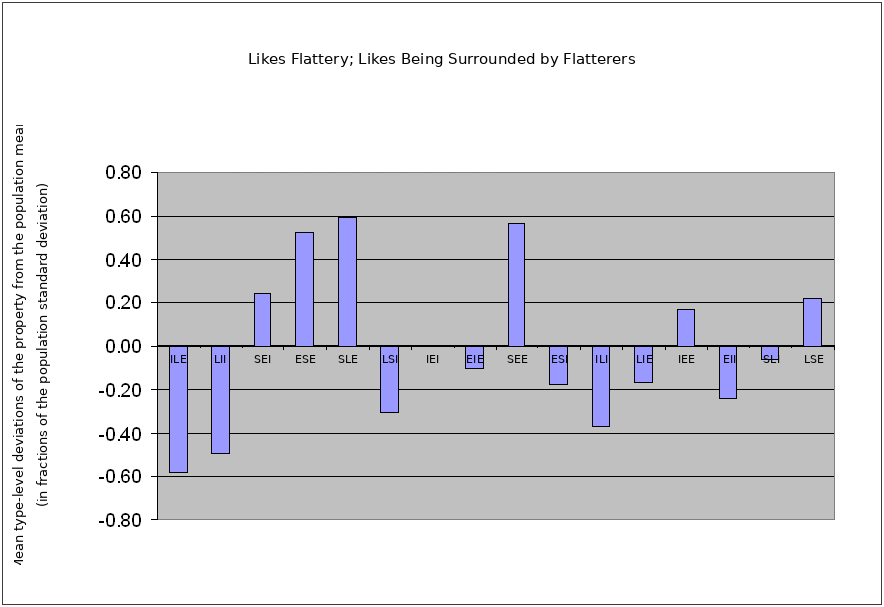
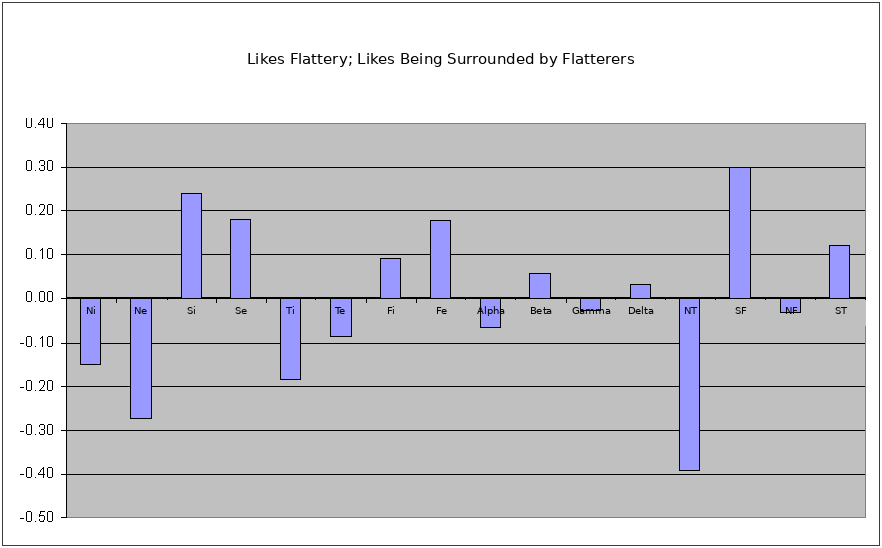
The cluster took into account AGREEMENT with the following opinions:
I like it when people flatter me skillfully;
I get pleasure from listening even to insincere praise;
Flattery and compliments pleasantly excite my imagination.
Cluster No. 40: “Tendency in Childhood Fights to Strike the Opponent in the Genitals Immediately”
The cluster consists of 1 rated statement, in the rating of which 230 respondents participated (for LSE, ESE, and LIE, the results are approximate because of the small number surveyed in the corresponding type groups — no more than 6 people).
.
Cluster No. 41: “Defense of Information Openness and Freedom of Speech”
The cluster consists of 9 rated statements; on average, 500 respondents participated in the rating of each one. A total of 4,500 responses from more than 2,000 respondents were used to construct the diagram.
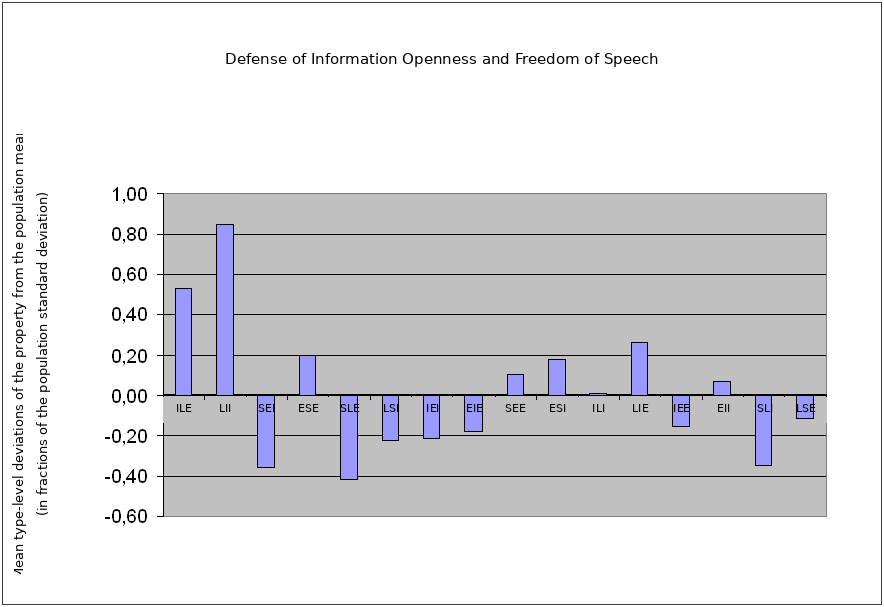
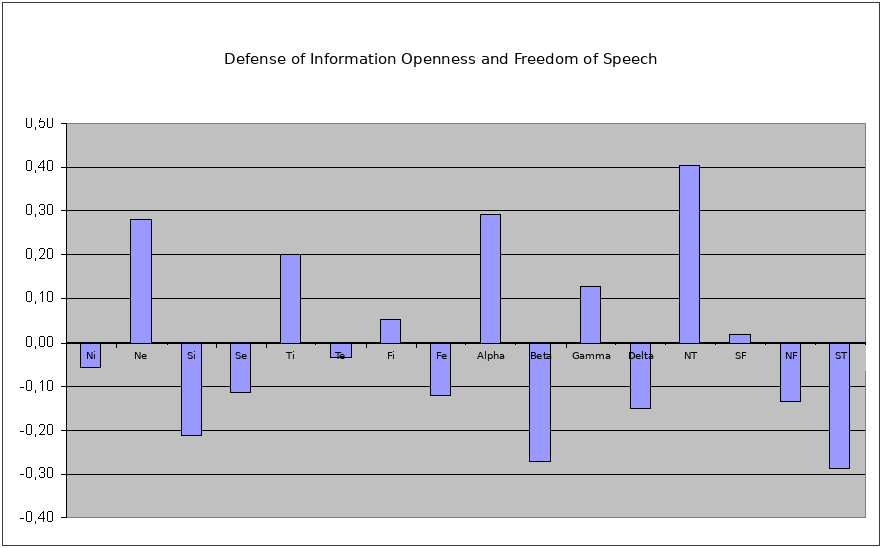
The cluster took into account AGREEMENT with the following opinions:
Concealing important events from the public is always ultimately bad;
The fuller freedom of speech is, the better; I have always defended it and will continue to defend it;
If it were up to me, I would prohibit all untruth and all concealed secrets in the world;
All contradictions in public life should be exposed and ruthlessly shown to the public;
Sometimes all lies and secrecy make me sick;
If I were President, I would expand openness and reduce the lists of information classified as state secrets;
Seeking truth, searching for truth, and defending truth against falsehood are an important component of my life;
Any truth is always better than absolutely any lie;
I disagree that the general public should know only what the authorities prescribe for it.
Cluster No. 42: “High Self-Regard with No Interest in the Opinions of Those Around Oneself”
The cluster consists of 7 rated statements; on average, 430 respondents participated in the rating of each one. A total of 3,010 responses from more than 1,500 respondents were used to construct the diagram.
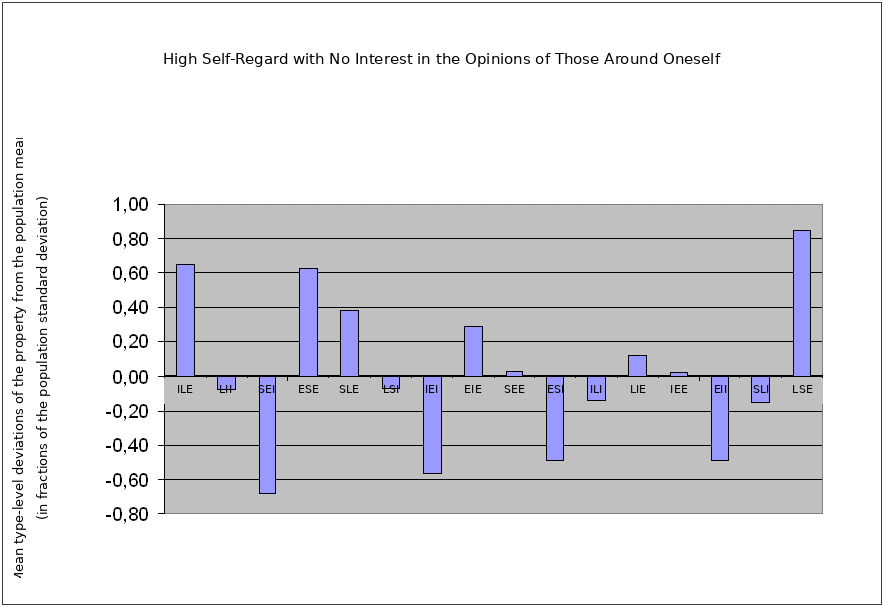
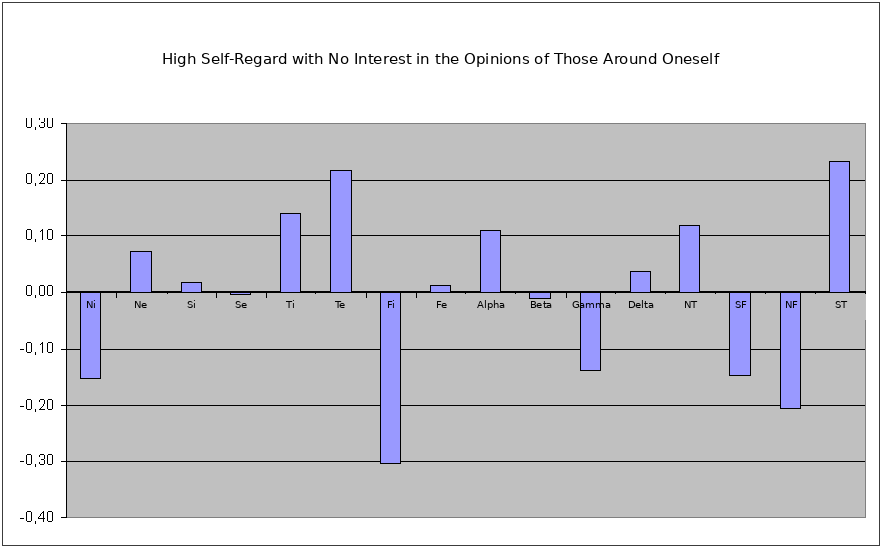
The cluster took into account AGREEMENT with the following opinions:
Expressing my own opinion is more habitual and easier for me than listening to someone else’s;
I often call mediocre people mediocre without embarrassment;
I can do practically everything and know how to do everything;
I cannot manage to live without quarrels and conflicts with anyone;
I do not accept criticism directed at me and try to rid myself of people who question the expediency of my actions and decisions;
The cluster took into account DISAGREEMENT with the following opinion:
- I speak cautiously, without imposing my opinion, trying not to come into conflict with my interlocutor.
Cluster No. 43: “Altruism (as the Opposite of Egoism)”
The cluster consists of 34 rated statements; on average, 540 respondents participated in the rating of each one. A total of 18,360 responses from more than 4,500 respondents were used to construct the diagram.
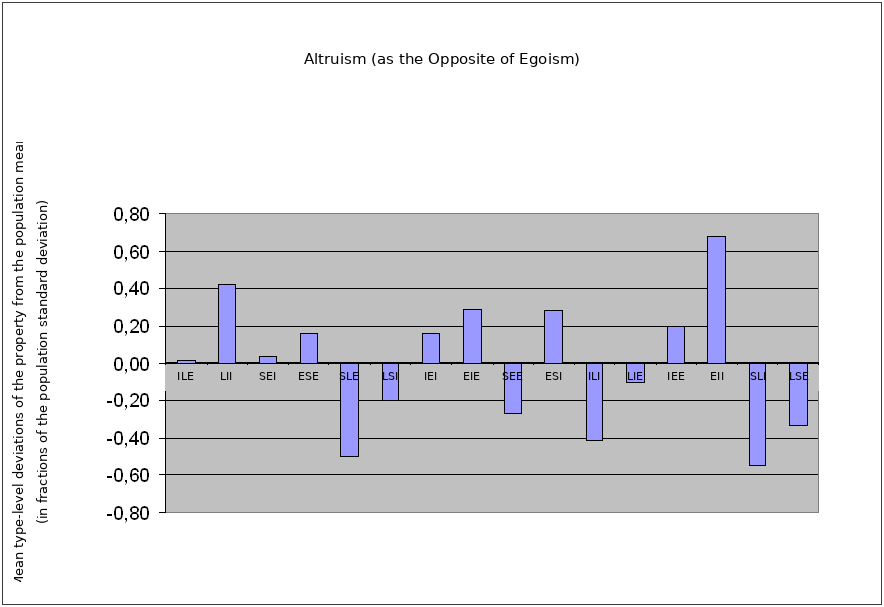
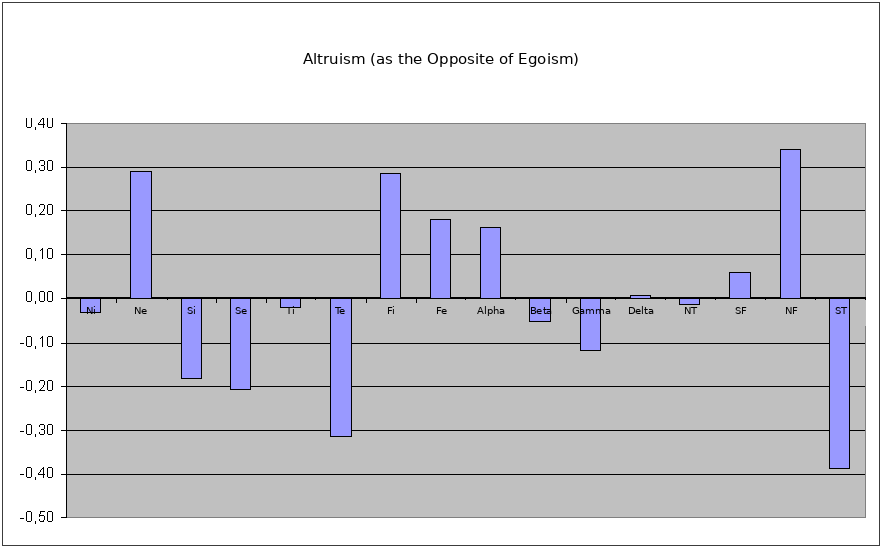
The cluster took into account AGREEMENT with the following opinions:
I hate egoism and indifference to common interests in people;
I always want to bring people who lag behind me up to my level;
I can imagine sacrificing myself in the name of some sacred idea;
I think more about other people’s moods than about my own;
I like supporting people’s talents;
I often perceive the problems even of a stranger as my own;
I often sacrifice my comfort or time in order to do another person a service without expecting anything in return;
In my thoughts I rarely concern myself with personal problems, more often with other people’s or global problems;
To feel comfortable, I absolutely need to know that my activity is needed by society;
My life is dedicated to the common collective good;
In this life I work for other people, and I am satisfied with that;
I often experience injustice toward other people more strongly than injustice toward myself;
When making decisions, I assess whether they may harm the interests of humanity, society, and other people;
I am more of an altruist than an egoist; etc.
The cluster took into account DISAGREEMENT with the following opinions:
People close to me often accuse me of egoism;
One should be honest only with one’s own people;
My feelings are often egocentric;
I often overlook and fail to take into account the interests of people connected with me;
Personal interests are more important than any group interests;
First things should be comfortable and pleasant for me; concern for others comes afterward;
Personal welfare is more important to me than the common welfare;
It would be good to take everything I own with me to the grave;
I have little respect for people concerned with universal justice;
I will never do something for someone while forgetting about myself;
I often rebuff those who want to benefit at my expense;
If someone is being restricted in some way and it does not directly affect me, I do not care about it;
Think about yourself first, then about others;
I take to heart only what concerns my personal needs and interests; etc.
Cluster No. 44: “Empathy, Capacity for Empathic Concern”
The cluster consists of 25 rated statements; on average, 425 respondents participated in the rating of each one. A total of 10,625 responses from more than 4,000 respondents were used to construct the diagram.
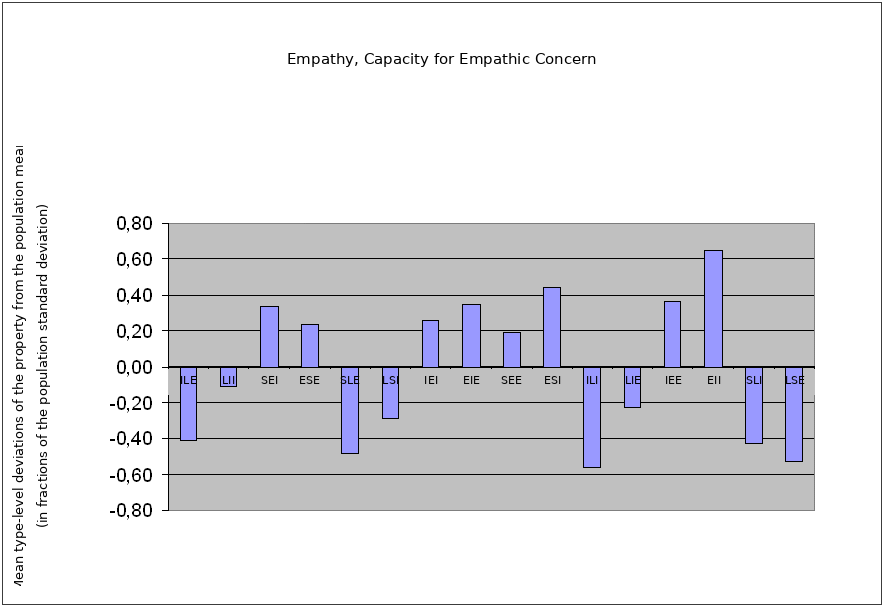
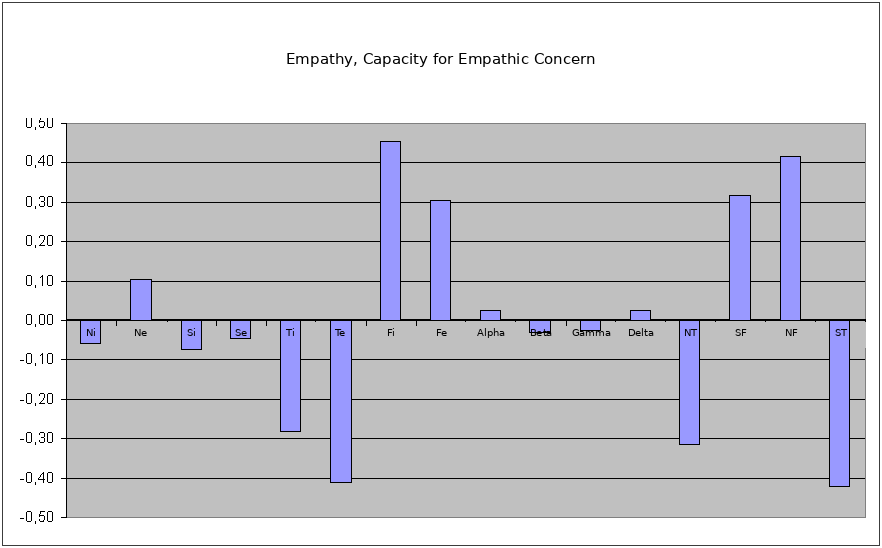
The cluster took into account AGREEMENT with the following opinions:
At times I break rules in order to help another person;
I lose my composure if I feel that those around me are oppressed;
The fate of homeless children concerns me almost as much as the fate of my own children;
I help and give sympathy to everyone near me who needs it;
Sometimes I act quite differently from how I wanted because I give in to other people’s requests;
I cannot bear the sight of physical suffering;
I am often guided by a feeling of pity;
I like humanistic film melodramas;
I need relations of love and peace among my friends;
If I come to feel sympathy for someone, it will be stronger for me than business interest;
If a film character finds themself in an awkward situation, I often experience it almost as my own embarrassment; I do not even want to look at the screen;
I cannot calmly endure other people’s tears;
etc.
Cluster No. 45: “Honesty in the Sense of Respect for Other People’s Property”
The cluster consists of 11 rated statements; on average, 445 respondents participated in the rating of each one. A total of 4,895 responses from more than 2,500 respondents were used to construct the diagram.
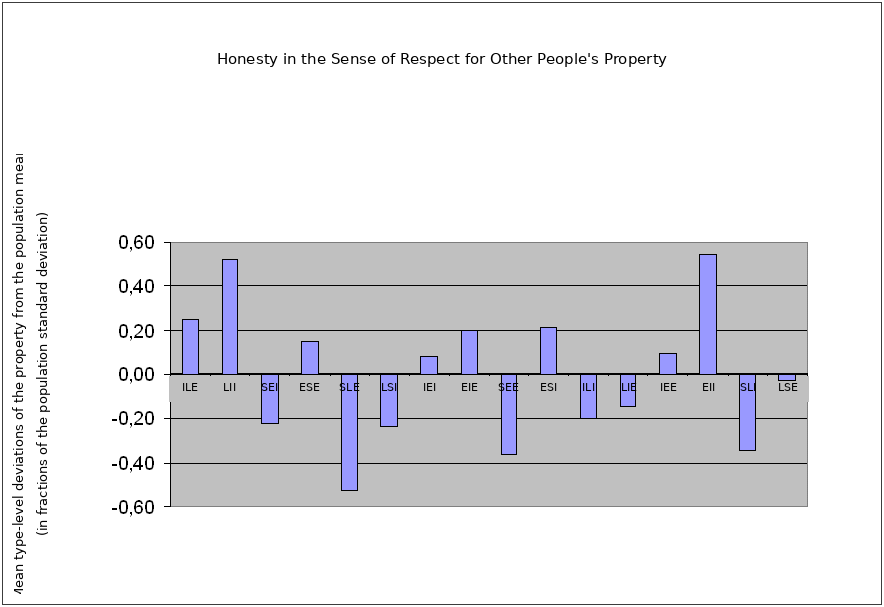
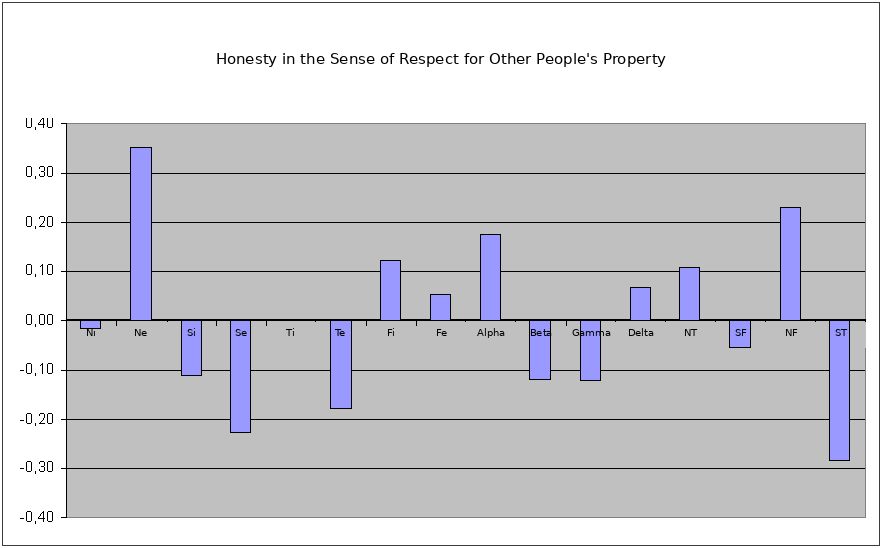
The cluster took into account AGREEMENT with the following opinion:
- If I found a wallet containing a substantial sum of money and someone else’s documents, I would try to find the owner.
The cluster took into account DISAGREEMENT with the following opinions:
I live by the rule “The bold get the spoils”;
After deceiving someone, I will never admit to the deception;
I can take what belongs to someone else if I really want something;
I feel pleasure when I manage to get something done at someone else’s expense;
The stupid and weak should share their money with the intelligent and strong;
Everyone will steal if control is weakened;
An intelligent person is intelligent precisely because they should deceive fools;
If I find a very expensive and unique item that I do not need (for example, a unique medical prosthesis), from that moment on it will nevertheless be my item;
I live by the principle: “If they give, take; if they beat you, run”;
Everyone is a thief at heart if the amount is large and there is no risk of being caught.
Table 1. Expected Percentage of Representatives of a Sociotype Whose Value of a Property Is Above or Below the Population Mean (reference table calculated according to the rules of the normal distribution under the empirically verified assumption that the standard deviation of the within-type distribution of the magnitude of most socionically related properties is approximately 0.9 of the population standard deviation):
| Type-average expression of the psychological property - the average, across all representatives of the type, excess of the property value over the population level in units of the population standard deviation (half-width of the population dispersion) | Expected percentage of representatives of the type with a property value above the population level | Expected percentage of representatives of the type with a property value below the population level |
|---|---|---|
| 1.8 | 98.8 | 1.2 |
| 1.6 | 97.7 | 2.3 |
| 1.4 | 96 | 4 |
| 1.2 | 93.3 | 6.7 |
| 1 | 89.4 | 10.6 |
| 0.9 | 87 | 13 |
| 0.8 | 84.1 | 15.9 |
| 0.7 | 80.9 | 19.1 |
| 0.6 | 77.3 | 22.7 |
| 0.5 | 73.4 | 26.6 |
| 0.4 | 69.1 | 30.9 |
| 0.3 | 64.6 | 35.4 |
| 0.2 | 59.9 | 40.1 |
| 0.1 | 55 | 45 |
| 0 | 50 | 50 |
| -0.1 | 45 | 55 |
| -0.2 | 40.1 | 59.9 |
| -0.3 | 35.4 | 64.6 |
| -0.4 | 30.9 | 69.1 |
| -0.5 | 26.6 | 73.4 |
| -0.6 | 22.7 | 77.3 |
| -0.7 | 19.1 | 80.9 |
| -0.8 | 15.9 | 84.1 |
| -0.9 | 13 | 87 |
| -1 | 10.6 | 89.4 |
| -1.2 | 6.7 | 93.3 |
| -1.4 | 4 | 96 |
| -1.6 | 2.3 | 97.7 |
| -1.8 | 1.2 | 98.8 |
Discussion and Conclusions
As can be seen above, both club values and quadra values participate in the formation of the traits of the “authoritarian personality,” but the role of club values nevertheless proves somewhat greater overall. However, the main conclusion from the experimental material obtained is that the greatest part of the differences between types in the properties considered above (including the characteristic properties of the “authoritarian personality”) reduces to the opposition between the socionic functions Ne and Se. The magnitudes of the Fi and Te functions play a smaller, but still noticeable, role. The other functions appear to play a less noticeable role in the formation of ideological and political value orientations.
Each of us has Se in our psyche. All functions are present in everyone; the only question is which of them is relatively stronger than the other functions. Se is responsible in the psyche first and foremost for egocentric aggression; the ultimate purpose of this function is the egocentric expansion of one’s own biological genes — hence, incidentally, the extremely close connection of Se not only with aggression but also with the basic instinct, with sex. In essence, Se is the most “animal” and rudimentary function of the psyche among all eight, at least under the conditions of modern civilization. It can also easily prove the most dangerous of all mental functions to those around a person — like any armed soldier among people engaged in peaceful labor — but only if that soldier recognizes no limits and his superiors have lost control over him. Se is aimed both at expanding one’s own genes and at preventing and destroying the genes of a male or female rival, and all of this is directly projected onto the sexual sphere. SLE Genghis Khan said that “it is not enough to be the very first; all the others must also die.” And one thirteen-year-old SEE adolescent known to us explained his motives to us in this way — with childlike frankness - when explaining why, while roughhousing and fighting, he deliberately aims his blows at his opponent’s genitals: “So that he won’t have children.” Sexual expansion and the destruction of other people’s genes — these are the principal instruments built into Se at the biological level; in earlier times, it existed for their sake. Whether this is good or bad, we consider it a scientific truth.
If Se is not restrained by civilized consciousness, it can very easily become directed toward genocide against “those who are not ours,” and this is confirmed by many contemporary examples. Thus, when “Se types” — usually organized ultranationalists or football fans — take part in their typical and not uncommon demonstrations in defense of war criminals subjected to judicial prosecution, they are defending neither law nor justice, and still less national or great-power interests. Another motive is plainly visible. They are merely defending, consciously or more often subconsciously, the personal and group right to kill with impunity, their primordial biological right to genocide against “those who are not ours.” Thus, in modern society Se should not remain without the control of civilized consciousness — both control by the individual’s other mental functions and control by society.
How does Se differ from the other extraverted functions? Te increases efficiency; Fe not only arouses, but also entertains and informs, warning the group of danger; Ne opens new scientific territories. Se, by contrast, helps one orient oneself, move skillfully, and aim accurately in the real, long-divided sensory world, while clearly keeping in mind its ultimate goal: to take away, suppress, and kill. There is no need to be ashamed of this; every animal has a corresponding mental mechanism, otherwise it would be unable to feed, compete, or survive. At one time this mechanism was the most important one for humans as well, and not so long ago — even in the times of Yermak and Stepan Razin. However, land has now been definitively assigned to established states, while wars of conquest and colonial wars have become impossible in the age of nuclear weapons and economic globalization. Therefore, uncontrolled Se, once it reaches the highest level of leadership, often turns aggression inward against society itself, divides its citizens into “ours” and “not ours,” and generates violence, banditry, deception, corporate raiding, and corruption. All of this is especially pronounced against a logical background, because the logical pole reduces sensitivity to emotional signals of other people’s suffering and pain. Crimes against the person, and any crimes involving violence, likewise as a rule have elevated Se in the perpetrator as their basis. Most swindlers are also carriers of high Se. For example, a marriage swindler nicknamed the “Ural Casanova,” detained in Yekaterinburg in 2011, who preyed on trusting women from the Humanitarian club and even deprived them of their apartments, turned out to be SLE by psychotype. There are also many representatives of the SEE type among swindlers.
If intuition of possibilities, Ne, directs a person’s values toward cooperation and collaboration (opportunities discovered and found must be used by other representatives of the species, otherwise they are lost absolutely for everyone in vain and provide no evolutionary advantages to the species as a whole), then force sensing, Se, orients its possessor’s values toward individual competition for resources that have already been discovered and are available (and behind it, correspondingly, stands not interspecific but intraspecific selection). Hence the egoism of Se, its love of power, its aggressiveness, and its exceptional competitiveness. Being oriented toward “fighting” and taking away other people’s resources as a universal method of solving problems, Se naturally also turns out to be linked with reduced pain sensitivity, rapid blood clotting, and rapid wound healing. All these correlations have likewise been reliably demonstrated by us in experiments (they are not the subject of special consideration in the present work). Se is a purely egocentric function, unlike the altruistic Ne and Fi. Systems of behavioral restrictions “drummed in” through upbringing find their natural reinforcement in Ne and Fi; by contrast, the Se function only calls any behavioral restraints into question and continually subjects them to revision in favor of a more egocentric line of behavior. Therefore, in comparison with other types, the aggression of a force-sensing type is controlled and limited to a greater extent not by a value system of self-restraints, social norms, and mutual obligations instilled through upbringing, but by fear of punishment (that is, a situational egocentric motive). This, incidentally, is also the source of the completely sincere conviction among many Beta sensing types that all other people too are restrained from crimes only by fear of punishment, and therefore - the more fear there is in society, the better it will ultimately be for everyone (it is precisely Beta sensing types who answer “yes” far more often to questions about the importance of fear for maintaining order in society).
What, then, happens if, against the background of an elevated love of power (for which Se is also responsible, as a function that ensures its owner’s dominance in the world and society by “forceful methods”), fear of punishment and condemnation by society suddenly disappears? Here lies the greatest danger of any dictatorship. The logical chain is as follows. Se naturally strives to maximize the power of its owner. The maximum possible power is dictatorship. At certain brief moments a dictatorship may even be useful to society — for example, in wartime or when emerging from a deep economic crisis, but only temporarily. However, when the time comes to abolish the dictatorship, ordinary citizens face a trap. If Se has “settled itself” at the summit of the dictatorship, especially Beta Se (because of its separation not only from altruistic Ne but also from altruistic Fi), then naturally it has no desire whatsoever to relinquish absolute power. While social institutions are strong, even this person’s Se, that of the dictator, is to some extent controlled by society. But the greater the power, the less control there is over it. At some point, freed from fear of punishment or censure, Se (especially against a logical background) moves to usurp power once it has fallen into its hands, stopping at nothing to achieve this goal. It is precisely for this reason that people from Beta most often end up at the head of dictatorships, but necessarily Beta types with especially strong Se.
Are we entitled to see a social danger of this kind coming from force sensing? Why not? Excuse me, but when an Se type leaves the profession of pilot, driver, or even artist and goes into politics because power draws them with irresistible force, and for its sake they are prepared to deceive and kill, then the danger is real, and people should be informed about it so as not to become victims. From some carriers of Se, including in Beta, such danger is not very great because they have culture, friends, upbringing, and sufficient internal control protected by these “anchors”; from others, however, the danger may be very great. What is to be done? One should simply always remain vigilant, understanding which mental functions of a politician one is dealing with. Otherwise one may be cruelly deceived, losing freedom both for oneself and for one’s country. It is clear that most people will never know socionics, but it would do no harm for the elite to have some understanding of its laws.
Let us note that it is usually impossible to convince an Se-oriented “authoritarian personality,” even one very far removed from real power, of the personal benefit to them of quite different, nonauthoritarian social values. The reason is that people of this disposition see in everything only interpersonal, or at best intergroup, competitive struggle, while talk of “public interests” and especially of “liberty, equality, and fraternity” is perceived either as foolish romantic naivety or, worse still — as deliberate deception and cynical manipulation and speculation. “Today it is you, tomorrow it is me. Seize the lucky moment; let the loser cry. Any other person is worse than me simply because they are not me” - this is their credo in life, and admonitions about good, evil, and social benefit cannot break through it. It must therefore be acknowledged that the love of executioners and shepherds-butcher-tormentors among many representatives of the human race is not a misunderstanding imposed from above, but quite conscious. In particular, ordinary people of this disposition are often quite sincere when, with malice in their voice toward everything incomprehensible and dissimilar, they openly suppose that human-rights advocates participate in actions defending someone else’s interests only because someone has paid for their activity. Judging others by themselves, they are convinced that every person is intent only on stealing and refrains from stealing only out of fear; it is therefore all the more difficult for them to imagine that, without personal self-interested motivation, they themselves might stand up for someone else’s interests.
Unfortunately, modern totalitarian threats are further aggravated by the fact that, when in a crowd, the animal psyche of an uneducated human mass still appeals, just as in ancient times, to biological and primitive rudimentary instincts, entirely independently of the psychotypes of the people making up that mass — including choosing a leader by the criterion of his authoritarianism and ferocity. Thus Hitler, a connoisseur of the archaic dark sides of the human soul, could write in his book with some degree of truth: “Cruelty convinces people that their destiny is to live in fear, and the crowd wants this.” Let this be so, and let even the formation of a crowd from a mass of people be inevitable because of the mass’s limited intellectual potential; nevertheless, a herd can still be managed in different ways, and what matters is the direction in which its bosses drive it. The psychotype of the shepherd-bosses therefore becomes all the more important. Se and Fe — the most rudimentary functions of the psyche. Se is associated with aggression, Fe — with the group instinct. Both are linked both with the egocentric sexual instinct and with xenophobia. Every dictatorship revolves precisely around them, and first and foremost around Se, reproducing the model of an ape troop at the state level. In “Beta,” these two functions dominant within it often become not only a means but also the ultimate purpose of power. The combination of the biological animal values of Se and Fe with the norm-setting role of Ti, with the populist pseudo-democracy of the grassroots dominant in society, and with the technological capabilities of modern civilization can, with especially high probability, produce the most vile egocentric totalitarianism.
Fascism will be reincarnated more and more often in the modern world, each time becoming more sophisticated in its mimicry, more long-lasting, and better armed with cynical means of suppressing individual freedoms, unless society begins to treat even the potential emergence of such an explosive mixture of conditions for the birth of dictatorship as it would a binary poison gas, any experiments with which can be conducted only in a fume hood.
Any excess is undesirable. But whereas an excess of most mental functions may harm the person themself, making them one-sided and poorly adapted to society, one-sided hyperdevelopment of Se is already sociopathy, which may pose a danger to others, primarily through its cruelty and impulsive, poorly controlled aggression. Parents’ genes in fact play an extremely small role in determining the type of children (if they have anything to do with it at all). In the most common dual marriages, the connection with the parents’ type surely disappears. In all statistical studies known to us of the types of children and their parents within families, beginning with the work of E. S. Filatova, it turned out that even when both parents are identical types (by psychotype), the children’s type is formed in a practically independent and random manner. Perhaps the matter lies in a broad polygenic and therefore, in practice, random mechanism of inheritance. But the key to formation of a psychotype may also lie to a considerable extent in the conditions under which the fetus develops during pregnancy. Thus, when pregnant women smoke, children with pronounced aggressive sociopathy, that is, with especially, pathologically elevated Se, are born much more often (by several times). This is quite explicable — for the same reason, adult intuitive types smoke reliably more and more often than sensing types; with tobacco they stimulate their sensory system. The mechanisms of Se are connected with the cholinergic system of brain neurons, and nicotine in the mother’s body, penetrating the fetal brain, sensitizes these neurons and, apparently, causes their accelerated growth. Hence, probably, the future aggressive psychopathy in the children. It is possible that contact with organophosphate insecticides widespread in modern civilization may have a similar effect. So I ask: does society need children with artificially elevated aggressiveness to develop on a mass scale as a result of such natal and early postnatal factors? Hitler and Mussolini might perhaps have said that this was good and that every country needed it, but I think — no. These are not the times, and these are not the social needs.
As a scientist, the author of course understands that each psychotype has its own values, and therefore it would be absurd to try to persuade people of an obviously authoritarian disposition that, from the standpoint of some abstract morality, their views of an “ideal society” are supposedly worse than those of other people. They are neither better nor worse; they are different. Some people find Cinderella and Pierrot more appealing, others — the Stepmother from the fairy tale and Karabas-Barabas. However, the point is that in addition to morality there are certain values that are genuinely universal for all people and can be used as a basis for comparing the “effectiveness” for society of particular views — though only on the condition that those views become dominant. First and foremost, these are the economy and the rates of scientific and technological progress. The principle of maximally economical use of nonrenewable resources, ecology, and personal safety can also be regarded as universal criteria. By all these criteria, authoritarian models of society lose to nonauthoritarian ones. Therefore, I would call on “authoritarian personalities” as well to be more cautious in elections and not to give preference to their obvious identical types. After all, a Humanitarian too will prefer to have their teeth treated by an LSI dentist rather than by their identical-type Humanitarian counterpart (because, all else being equal, after dental treatment by an IEI doctor, the teeth are highly likely to be less attractive, and the fillings and teeth placed will fall out sooner). So too in politics — rule by authoritarian personalities is fraught with war, corruption, state lies, crime, poverty, lack of rights, devastation, and revolution. It is equally fraught with these consequences for everyone. And only if you are a masochist can you, regardless of your type, support the political careers of authoritarian personalities with full logical justification (as they advance into power, your teeth will fall out sooner).
July 2011
© V. L. Talanov 2011
Many other works by V. L. Talanov can be found at the following websites: