Socionics: The Semantic Content of Its Basic Concepts
Contents:
- Part 1. Functions
- Part 2. Dichotomies (“Reinin traits”)
- Part 3. Socionic Functions and Sociotypes as Survival Strategies
- Appendices
- 1. Average values of socionic functions for actual representatives of different types
- 2. Comparison of the semantic content of functions in socionics and MBTI
- 3. Recommendations for type diagnosticians - probability of trait inversion
- 4. 60 important personality characteristics and character accentuations in the socionic coordinate system
- 5. Values of socionic dyads (the author’s concept)
Part 1. Functions
Important: in some socionics schools, function signs are used to give functions a particular shade of meaning - in connection with the influence of third Reinin traits (“process-result” or “positivism-negativism”). We completely reject this approach. We use signs for functions (as for dichotomies) in a purely mathematical sense: plus denotes an excess of a function (its inertness in strength and valued status), minus - a shortage, a deficit (inertness in weakness and non-valued status).
The types for which this position of the function is typical are given in parentheses.
1-4) Functions of biological survival (“irrational”)
Irrational functions exist in all animal species, including non-social ones; they correspond to different strategies for obtaining food and avoiding dangers (herbivorous, predatory, parasitic, etc.); at the intraspecific level, they reflect the age-related developmental stages of individuals typical of all living things (since individuals of the same species often follow different strategies at different stages)
Ne (“black intuition”) = imagining freedom / alternatives
+Ne (ILE, IEE)
- “Childlikeness” (the curious-child character type) - retaining in adulthood personality characteristics typical of childhood, sometimes even including certain reflexes link
- Curiosity, attraction to everything new
- Innovativeness (usually the first to try something new)
- Searching for alternative possibilities (an option once chosen as the “main route” quickly becomes tiresome)
- Breadth of associations
- Constantly and chaotically running through options in the imagination - “racing thoughts,” “flight of ideas” (hence often - problems concentrating attention)
- Love of games
- Creativity (synthesizing new ideas by combining elements of old ones differently)
- Word creation (inventing names for new phenomena and reworking the meanings of old words)
- Love of freedom and willingness to grant freedom
- Intolerance of routine, monotony, and strict discipline
- A tendency to underestimate the dangers and threats contained in the new and unknown
−Ne (LSI, ESI)
- Strictness, seriousness, and “respectability” (the patriarch character type, the eldest and most experienced member of the community, guarding its property)
- Orientation toward one’s own past experience and distrust of new things from others that conflict with it
- Conservatism of habits
- Tolerance of routine - the ability to maintain a goal over a long period without being distracted by interference
- Dislike of unexpected events, a choice in favor of stability and rigid order
- Dislike of multiple alternatives, a preference for unambiguity and completion
- A tendency to introduce prohibitions and increase punishments for behavior that deviates from the sole option considered permissible
- A tendency to suppress the self-organization of people and systems under one’s control (justified by considerations of safety, but in fact signifying fear of losing personal control, fear of the uncontrollable diversity of the surrounding world)
- Preservation of the established order and a cult of security - perceiving the external world as hostile and harmful by default, as something from which one must physically fence oneself off and informationally isolate the people under one’s control - children, subordinates, etc.
Ni (“white intuition”) = imagining damage / crisis
+Ni (IEI, ILI)
- A set of personality characteristics that increase the ability of an initially physically weak subject to adapt to an aggressive environment
- Adaptation to coexistence with subjects of superior strength (who compel reality to obey their will), including and above all - the capacity to derive pleasure from one’s subordinate, dependent position, that is, masochism
- Observing ongoing changes in the environment and in people and waiting for a moment of crisis when one can benefit from the fruits of others’ efforts without making one’s own (proximity to a dominant individual who concentrates resources makes it possible to encounter such situations more often)
- Fantasies of the deformation, destruction, and transformation of surrounding reality and of changes in oneself under the pressure of external forces and the passage of time in general (may be accompanied by experiences of derealization and depersonalization)
- Cultivating ideas of one’s own damaged condition (including for manipulative-deceptive and provocative purposes)
- A tendency toward evasiveness, ambiguity, and deceitfulness (so as to be able to escape direct aggression by dominant individuals)
- Denial of the existence of eternal truths (“everything flows, everything changes”; “whoever imposes their will makes the rules, and we must adapt”)
- A generally rather depressive background mood, frequent thoughts about the meaninglessness of events and one’s own actions
−Ni (ESE, LSE)
- A parasitic life stance is uncharacteristic - prefers to make efforts and spend one’s own time on the desired reorganization of the surrounding world rather than wait for someone else to do it
- Denial of the possibility of crisis - tends to adhere in detail to all deadlines and quantities planned in advance, sometimes failing to notice how newly emerging circumstances sometimes turn such activity into a meaningless waste of time
- A desire to care regularly for surrounding things and provide sensory care for loved ones (derives pleasure from the routine of life)
- A desire to ensure an abundance of resources around oneself (“a home overflowing with plenty”)
- A sense of health, uplift, and security - in oneself and in the surrounding environment
- Love of life and absence of fantasies of self-destruction (does not like to think about aging, death, chronic diseases, or catastrophic changes in society)
- Does not experience derealization or depersonalization - a feeling of “strangeness” about what is happening
- Feelings of involvement in real life and of society’s support for one’s actions; feelings of rejection and existential loneliness are uncharacteristic
Se (“black sensing”) = sensing power / dominance
+Se (SLE, SEE)
- Strength of offensive (territorial) aggression, aka “the ability to push one’s way through” - effective at breaching others’ boundaries through manipulation and force
- A desire to obtain everything one wants first, immediately, and in large quantities, regardless of other people’s wishes (“I take what I want”); this applies especially to sex
- A desire to be above rules that are binding on others
- Dominance of one’s desires over life’s circumstances - at times, the strength of desire can even suppress the instinct of self-preservation
- A tendency toward self-satisfaction and inflated self-esteem
- A consumerist approach to the environment and people (“others must serve my needs and interests”)
- A desire for superior status and positioning oneself from the outset as a boss, leader, or dominant individual
- Persistence in obtaining what one wants (“pushiness”)
- Contempt for “weaklings” (all those who suppress aggression in themselves)
- Weak self-criticism and intolerance of objections
- Ease of resorting to physical violence
- Often - thieves’ values
- At the physical level, Se correlates with working-memory capacity, reaction speed, increased muscle tone, dexterity and agility of movement, and other characteristics that provide an advantage in a fight without rules
−Se (LII, EII)
- Voluntary self-restraint in material consumption and encouraging others to do the same - to reduce the overall competitiveness (aggressiveness) of the social environment
- An altruistic desire to preserve opportunities for future life and for other people as well
- Cultivated intellectual and moral refinement - disapproves of an aggressive, animal-like model of society dominated by alpha individuals, advocating that society should be led by those most capable of creating the common good, rather than those most skilled at suppressing others
- Neither knows how nor wishes to “pressure” others through force and threats, preferring instead to appeal to reason and conscience
- Honesty and non-acquisitiveness, no tendency toward theft or self-serving lies
- Self-criticism, the ability to acknowledge one’s mistakes
- Indecisiveness
- Weakness of the basic instinct - often looks and feels asexual, does not evoke instinctive sexual attraction in potential partners
- A tendency toward shyness and low self-esteem
- The evolutionary meaning of −Se - a reliance not on necessarily achieving personal victory and personal reproduction “here and now,” but on indirectly promoting the long-term development and reproduction of one’s community as a whole, that is, on weak tendencies that manifest through statistical effects over a long span and ultimately outweigh any voluntarism (for further details, see “Simpson’s paradox”)
Si (“white sensing”) = sensing comfort / homeostasis
+Si (SEI, SLI)
- Striving for pleasant bodily sensations and avoiding unpleasant ones as the dominant motive for activity
- High sensitivity in perceiving immediate reality (well-developed smell and touch, detailed tactile sensations)
- The ability to adjust one’s physical well-being (thereby restoring bodily homeostasis) through proper food preparation, massage, timely medication, choosing comfortable clothing and the optimal position of the body in space, etc.
- The ability to arrange a comfortable, harmonious, healthy environment for oneself with minimal means and effort
- Focus on the present moment, unwillingness and inability to think about the future
- Avoidance of crisis situations that disturb the equilibrium of one’s familiar living environment
- More often a conformist-conciliatory position in conflicts - seeking to avoid any excessive, unnecessary violence
- At the physical level, Si correlates with general bodily and mental relaxation, smoothness of movement, and well-developed fine motor skills of the body (especially the fingers)
- There is a hypothesis that Si as an integrated set of characteristics originated from the grooming strategy (cleaning one’s own and others’ fur) in monkeys link
−Si (EIE, LIE)
- Readiness to leave one’s comfort zone and take others out of theirs
- Background tension (physical and mental)
- A constant sense of inner discomfort and dissatisfaction with what has been achieved, spurring active efforts
- Avoidance of relaxing tactile contact
- Seeking out and provoking states of crisis in order, through personal overexertion and the ability to foresee, to “ride the crisis” and turn events to one’s advantage
- Orientation toward the future and a clear view of prospects
- Pursuit of distant goals
- Advocates accelerating the pace of events, forcing developments, even to the point where the system one leads “runs out of control” and “comes apart at the seams,” but nevertheless does not descend into catastrophe under one’s leadership (tends to derive pleasure from this)
5-8) Functions of deliberative control (“rational”)
The emergence of rational functions in nature is associated with the emergence of care for offspring and the organization of society around the need to perform the associated actions regularly over a long period; these functions reflect the division of individuals into professional providers and those in direct contact with offspring and other individuals in the nest or group, and of populations/species into gregarious ones (migrating across extensive wastelands in search of resources) and family-based/solitary ones (seeking not to move far from a resource deposit they have found)
Ti (“white logic”) = calculating law / rights
+Ti (LII, LSI)
- Constructing an integrated, logically consistent model of the world and seeking to fit the entire world, including other people’s personalities, into a single scheme
- Thinking within the chosen paradigm (and, often - “blindness” to everything it does not take into account)
- Systematizing and cataloguing material to increase overall control over it
- Mapping, typification, and schematization (generalized typical patterns are considered instead of the unique characteristics of objects and personalities)
- Analyticity
- Impartiality
- Uncompromisingness
- Weak cognitive empathy - does not know how to initiate personal relationships or influence people through informal connections, does not like gossiping or discussing anyone’s private life
- Prefers to solve all problems using the formal channels and rules of the system with which one identifies and which one develops
−Ti (SEE, IEE)
- Mosaic thinking and personality (the individual lacks a unified, internally consistent image of the world; instead, there are numerous fragmentary notions-”memes” borrowed from different sources and used according to the situation)
- Ease of interpersonal contact - the ability to switch easily between people, quickly adapting to the interlocutor’s way of thinking
- Social manipulativeness - the ability to bypass formal rules and “find the key” to the right people, telling each precisely what they want to hear at that particular moment (appears as flattery and charm “especially for you”)
- Superficiality - the ability to seduce without becoming emotionally involved or attached to the other person
- A tendency toward ethical play and relationships based on it (“ludus”)
- Often - inconsistency and lack of forethought in actions (which, however, is not critical as long as such a person remains in their natural environment of informal groups with constantly changing membership)
Te (“black logic”) = calculating benefit / business
+Te (LIE, LSE)
- A desire to channel all activity in a productive direction (yielding usefulness, benefit, profit)
- A desire to modify processes in the external world technologically in order to increase the amount of useful work performed within them
- An orientation toward maximizing efficiency in any undertaking, eliminating everything non-functional and decorative
- Utilitarianism (neither does nor values anything that would not be useful)
- Well-developed financial thinking (seeks to maximize earnings, is interested in finance and investment more often than the average person)
- Well-developed time management (avoids unproductive pastimes)
- Professional specialization (advocates increased specialization in society; trusts well-paid professionals more than amateurs)
- Business initiative and energy in building businesses and production
- Workaholism - tends to escape into work from problems of a personal nature
−Te (SEI, IEI)
- Love of idleness
- Capriciousness and dependence on mood
- Artistic decorativeness - a desire to create and preserve beauty as the main motive for activity
- Rejection of commercial interest as the dominant motive
- Receptivity and sensitivity to prevailing moods
- The ability to manage the mood of those around oneself unobtrusively, relaxing people and restoring their psychological strength
- Seeking support and protection from a group or a strong individual
Fi (“white ethics”) = inducing an attitude
+Fi (ESI, EII)
- Moral and ethical evaluation of people according to their inner motives, values, and experiences (read by the Fi subject from nuances of outward behavior), regardless of the objective effect these people’s actions have on reality
- Well-developed feelings of shame and guilt - frequently experiences them oneself, but is also capable of inducing them in close others, thereby implicitly “educating” them (i.e., controlling their behavior, suppressing aggression and other affects)
- An orientation toward building deep and lasting personal relationships with selected people (for whom the Fi subject seeks to act as a “savior of souls”)
- A preference for non-publicness, privacy, and an intimate setting in communication - an unwillingness to “air one’s dirty laundry in public”
- Frequent use of confidential tones of voice
- Typically, a positive evaluation of politeness, tact, and observance of the etiquette of communication accepted in the given environment (i.e., the ability to conceal and leave unspoken the contradictions within the system of social relationships maintained by the subject), and condemnation of nonconformism and radical and frank statements (anything capable of destroying this system)
−Fi (ILE, SLE)
- Disregard for the individual stylistic component of communication, resulting in tactlessness, unceremoniousness, harshness, and impudence
- Grasps the objective state of affairs better and faster than others, without being taken in by omissions and political correctness
- A tendency toward early emancipation
- Bold experimentation (no fear of offending or insulting someone through one’s actions)
- Often - radicalism and a revolutionary disposition
- The potential of a pioneer
Fe (“black ethics”) = inducing attraction
+Fe (ESE, EIE)
- Expressive behavior (encouraging people to care, inspiring and motivating them to surpass themselves in their actions)
- Emotional excessiveness of reactions
- Involvement in public social life - a desire to associate with those public actors and social movements that currently evoke the strongest response and attraction among the masses (regardless of whether the activity of these actors and movements is beneficial to the society in question)
- Striving toward the ideal of beauty and attractiveness prevailing in society
- Working with fashion - following, studying, and shaping it
- Creating emotional superstimuli that attract the masses, thereby synchronizing people’s moods and intentions
- Esoteric thinking (uncritically reproducing images considered beautiful from the perspective of the mass observer)
- Often - musical talent
−Fe (ILI, SLI)
- Concealing one’s identity, motives, and means of earning money
- Individualism as non-involvement and an “it is none of my business” stance
- Acting out of synchronization with other people’s lives
- Indifference
- Unemotionality
- Well-developed critical thinking - the ability to analyze events dispassionately and soberly
- Sees better than others what needs to be done to keep something working properly with minimal resources and effort
9-12) Functions of positioning the individual in society (“questimic-declatimic”)
Higher functions that become actualized at the intraspecific level only in the most developed species (those forming complex personalized communities whose individuals possess well-developed individuality and self-awareness); these functions reflect the balance between the interests of the collective and the individual, and between tradition, which favors autochthonous populations, and the desire of newcomers to change the organization of society so that their interests are also taken into account.
Qi (“white questimity”) = separation of individuality
+Qi (LII, ESI)
- A desire for independence
- Defense of personal freedom and justice
- Protection of personal space (the zone of privacy) from intrusion by outside agents
- Moral disgust and a desire to preserve moral purity
- Distancing oneself from society as a source of lies and vices
- Unconditional priority of personal principles over the behavioral orientations prevailing in society
- An orientation toward defending individual rights (not only one’s own but also, on the basis of one’s understanding of justice, those of others, sometimes even unfriendly others) in conflict with collective opinion
- As a tendency - low stress tolerance in situations of social contact and increased susceptibility to seasonal diseases typical of the given society (untrained immunity - a consequence of physical distancing from the majority)
−Qi (SLE, IEE)
- Herd instinct
- Collectivism in the sense of rejecting the division of things, ideas, etc. into “one’s own” and “others’” (has no need for this division, since one creates nothing unique that would be worth protecting from borrowing by others, whereas in such a situation it is easier to borrow and appropriate original things created by someone else)
- Patriotism and nationalism
- Any propaganda (overwhelming people with talk in an attempt to prove that the actions of the authorities serve the common good)
- Uniting the group through mutual complicity by participation in collective activity whose content is morally dubious or criminal from a legal standpoint (corruption schemes; mobbing - collective harassment of outsiders / “white crows”; war)
Qe = (“black questimity”) = separation of nobility
+Qe (EIE, LSE)
- Disgust toward the inferior, alien, physically dirty, and diseased (everything contact with which could transmit an infection that turns a person into a declassed outcast in the given society)
- Disgust toward low-quality resources, a desire to work only with high-quality ones
- Elitism - a desire to feel oneself a member of a hereditary “club of the chosen” (a noble lineage, professional dynasty, etc.)
- A desire to surround oneself exclusively with things that are refined, glamorous, branded, etc. (there is also a connection with +Se)
- A strong feeling of envy
- Irritation at discomfort
- Feelings of indignation and anger when needs are frustrated
−Qe (SEI, ILI)
- Acceptance of everything (acknowledges the existence of everything in the world, sees usefulness and meaning even in what the majority consider filth or rubbish)
- Tolerance of human peculiarities, vices, and any bodily dirt
- Willingness to perform dirty tasks (in both the physical and moral senses) that others will not undertake for fear of becoming a pariah, an “untouchable”
- The ability to survive even “at the bottom” of society, or, as a collaborator, balancing between several societies, adapting a little to all of them while belonging to none
Di (“white declatimity”) = acceptance of submission
+Di (LSI, EII)
- Belief in fate and predetermination; submissively following fate - when all that remains is to carry out what someone above has ordained; to some extent, indifference toward one’s own fate
- Patience
- Endurance of deprivation
- Collectivism in the sense of following the opinion of the majority
- A tendency toward unquestioning obedience to authorities recognized in one’s society, especially if their opinion is presented as that of the majority
- Places faith and subordination above personal intellect
- Willingness and even a desire to be like everyone else - a “gray mouse,” in no way standing out from the general herd, a “cog” in the machine of a totalitarian state
- Political conservatism - the principal custodians of society’s “bonds”
−Di (ILE, SEE)
- Nonconformism
- Impatience, unwillingness to wait long for what one wants
- Willfulness
- Protest activity - actions contrary to the majority
- Denial of predetermination - believes everyone is the master of their own fate
- Individualism as pronounced personal distinctiveness
- Readiness to seek and use any opportunities to obtain what one wants, including opportunities outside the system, not prescribed anywhere, or even explicitly rejected and condemned by the majority
- Reformist potential - a desire to refute, overturn, and destroy the existing system of authorities, to release resources unjustly held within it
De (“black declatimity”) = acceptance of cooperation
+De (ESE, LIE)
- Individual activity that probes others for shared interests and opportunities to cooperate as equals, overcoming any social and estate-based “partitions,” national, linguistic, and cultural boundaries
- “Omnivorousness” in willingness to exchange resources / services and form situational alliances with people - regardless of partners’ personal characteristics, views, and values
- A good understanding of one’s own and others’ needs
- Readiness to become involved in the mainstream and to involve other people in one’s undertaking
- Good abilities to operate in a multitasking mode link
- Often - optimism, extending to “overconfident bravado”
−De (IEI, SLI)
- Detachment
- Lack of initiative
- Doubts about one’s own essence
- Frequent uncertainty about what to undertake
- A tendency toward procrastination
- Seeking special paths and carrying out original work in the hope of obtaining privileges for one’s unique mastery - so as to live without encountering unpleasant situations and people
Part 2. Dichotomies (“Reinin Traits”):
The actual semantic content of the dichotomies (given below) is based on analysis of statistics from Talanov’s large questionnaires.
Dichotomies determining the strength of functions:

| Code | Dichotomies | ILE | LII | SEI | ESE | SLE | LSI | IEI | EIE | SEE | ESI | ILI | LIE | IEE | EII | SLI | LSE | Functions | Meaning |
|---|---|---|---|---|---|---|---|---|---|---|---|---|---|---|---|---|---|---|---|
| Knowledge | Knowledge | Nature | Nature | Force | Force | Art | Art | Property | Property | Business | Business | Culture | Culture | Production | Production | ||||
| a | + logic / − ethics | + | + | − | − | + | + | − | − | − | − | + | + | − | − | + | + | Ti, Te / Fi, Fe | formal logic / cognitive empathy |
| b | + intuition / − sensing | + | + | − | − | − | − | + | + | − | − | + | + | + | + | − | − | Ne, Ni / Se, Si | imagination / sensation |
| c | + questimity / − declatimity | + | + | − | − | − | − | + | + | + | + | − | − | − | − | + | + | Qi, Qe / Di, De | divergence / convergence |
a “logic — ethics”:
| logic | ethics |
|---|---|
| A well-developed ability to abstract from the subjective component when working with information - from the personal attitude that arises, sympathy/antipathy toward the author-source of information (more characteristic of Ti), and from any current features of one’s emotional state, whether caused by the source or incidental and extraneous (more characteristic of Te) | Well-developed empathy: cognitive (the ability to penetrate another person’s individuality, to read the subjective component in the flow of information - more characteristic of Fi) and affective (the ability to read another person’s current emotional state and synchronize oneself with it - more characteristic of Fe) |
| Orientation toward interaction with the objective world (prefers to obtain resources by changing objective reality) | Orientation toward interaction with other people (prefers to obtain resources from other people in exchange for motivating them and helping them adapt to society) |
| Development of technologies of abstraction (formal logic, systems of rules and algorithms) | Development of technologies of empathic involvement (kinesthetic-bodily and imagery-based-humanistic) |
| Abilities in complex logical-mathematical calculations according to formal criteria | Abilities in inducing (and self-inducing) feelings and informal relationships |
| Thinking relies on objective facts of reality and measurements whose results are the same for all observers | Thinking relies on the opinions of people and/or a collective considered authoritative by the subject |
| Inability to empathize, treating people as means to an end, cold indifference to others’ suffering (decisiveness reinforces this characteristic) - moderate correlation with psychopathic personality traits | High capacity for sympathy and compassion (judiciousness reinforces this characteristic) - strong correlation with the Big5 “agreeableness” factor |
| Frankness, a preference for obtaining what one wants through productive work rather than intrigue (judiciousness reinforces this characteristic) | The talent of an ethical manipulator - the ability to exploit others’ weaknesses and vulnerabilities, to coax and provoke them into activity without directly becoming involved in conflict oneself (decisiveness reinforces this characteristic) |
| An extreme manifestation of the logic pole is schizoid personality disorder | Histrionic and dependent personality disorders link, as well as sensitivity as a personality characteristic, contain traits of the ethics pole |
| [Hypothesis] As a result of programming by logical thinking, the neural structure of the frontal lobes of a “logical” brain is organized to a greater extent into isolated chains along which signals travel directionally and lead to a specific result reproducible from one occasion to the next (that is, the functioning of such a brain more closely resembles that of a computer) | The “ethical” brain, by contrast, has a looser structure of neural connections, allowing excitation to spread diffusely through it and encompass entire regions of the brain (which is typical of affective behavior) |
| The difference between men and women on this trait reaches almost one sigma of the normal distribution of the trait’s magnitude in the population (the largest among all traits) link - which is equivalent to approximately 2/3 of men having more pronounced logical traits, and about 2/3 of women having more pronounced ethical traits. | |
| A high testosterone level contributes to the logic pole (and also to strengthening the Se function) | High levels of estrogens and oxytocin in the CNS contribute to the ethics pole (and also to strengthening the Si function) |
b “intuition — sensing”:
| intuition | sensing |
|---|---|
| Broader filters between the subconscious and consciousness (which allow more signals into consciousness — sometimes enabling advance detection of something useful or dangerous, but also containing more perceptual errors) | Narrower perceptual filters (allowing more detailed and accurate identification of typical environmental signals important for survival here and now) |
| Well-developed fantasy - imagining the improbable, remote, and “unprecedented” | Focus on the reality formed by experience, inability to reach into the distant future through imagination and perceive alternative pictures of the world |
| Abstractness of thinking | Concreteness of thinking |
| Prefers theory to practice | Prefers practice to theory |
| Sensory sensations are vague and difficult for consciousness to verify | Detailed sensory sensations readily accessible to consciousness |
| Better orientation in the space of meanings and ideas | Better orientation in physical space |
| Pays little attention to everyday domestic life, feels indifference or even aversion toward domestic matters | Practical household management, domesticity, the ability to make oneself comfortable in one’s immediate surroundings |
| More focused on the hidden abilities, essence, and possible future purpose of people and objects | More focused on appearance and health/state of care - of oneself, other people, and objects |
| More successful in working with information - requiring creativity (more Ne) and a talent for foresight (more Ni) | More successful in working with material resources and objects, requiring well-developed fine motor skills (more Si) and overall coordination of bodily movements (more Se) |
| A desire to develop biosocial “software” (the brain’s internal psychic reality, formatted using formal and informal language) | A desire to develop biosocial “hardware” (the physical body and other material instruments for influencing reality) |
| The intuition pole correlates with schizothymia link; an extreme manifestation – schizotypal personality disorder link | The sensing pole correlates with increased acetylcholine activity in the CNS (markers of which include strength of immunity, muscular strength, good hydration of mucous membranes, etc.) link |
c “questimity — declatimity”:
| questimity | declatimity |
|---|---|
| A lower threshold of irritation - consequently, a greater number of environmental signals evoke a reaction from the individual as threats to their agency, integrity, and self-preservation | A higher threshold of irritation |
| High selectivity - a narrower range of what is personally acceptable (everything beyond this range causes irritation/disgust and is thus rejected, while what remains within it forms the core of the personality) | Indiscriminateness, “omnivorousness” - a broader range of what is personally acceptable (creating more opportunities for uniting with other individuals) |
| Irritation at discomfort caused by others | Tolerance of discomfort |
| Disgust toward others’ physical dirt | Willingness to work with the products of others’ vital activity - no fear of contracting bacterial diseases typical of the given society; subconsciously ready to be infected |
| Fear of harm to one’s body (fears pain, bodily injuries, poisoning, diseases) link | When necessary, can ignore the likelihood of physical harm, is not afraid of the sight of others’ or one’s own mutilations (the behavior of a warrior, a nurse in war or in a hospice, etc.) |
| Aversion to deformities, a desire for refined beauty | Tolerance or even a pronounced interest in ugliness, examining and collecting it link |
| Disgust toward “moral dirt,” unwillingness to “soil oneself” by participating in morally dubious undertakings | Willingness to engage in morally dirty activities - no fear of becoming involved in mutual complicity; subconsciously ready to lose one’s independence from society |
| Fear of humiliation, “losing face,” “losing oneself” | Humility, fatalism |
| Protection of one’s personal uniqueness and talents, contempt for mediocrity | A sense of being an “ordinary person,” part of the masses (only through participation in whose life does one’s personal life acquire its full meaning and value) |
| A negative attitude toward the mainstream and “bonds” - what is generally accepted evokes protest | What is generally accepted evokes a desire to imitate |
| Creation of original works - does not tolerate others’ interference in one’s work | Acceptance of what belongs to others and willingness to work with it further, to copy and adapt according to already existing schemes |
| Advocates individual justice | Tends to sacrifice individual justice, justifying this to oneself by collective goals |
| Questimity carries the forces of social divergence and stratification - interpersonal (Qi) and intergroup (Qe) repulsion, distancing, unwillingness to join, and separation | Declatimity represents the force of social convergence - intragroup (Di) and intergroup (De) attraction, erasure of boundaries, unification, and merging |
| Questimity is closely associated with the active functioning of the brain’s insular cortex, to which many contemporary studies attribute roles in maintaining the organism’s homeostasis link | The declatimity pole is characterized to a considerable extent by increased vasopressin activity in the central nervous system link |
| A more developed instinct of self-preservation (judiciousness reinforces this characteristic) | A more developed herd instinct (aristocracy reinforces this characteristic) |
Types of thinking:
- Logic + intuition = probabilistic-analytical, scientific-research thinking (the aim - changing conceptions of the objective world by studying it and developing and applying new technologies);
- Ethics + intuition = abstract-imagistic, artistic-humanistic thinking (the aim - changing people’s inner spiritual state, mood, and views by influencing them through artistic images);
- Logic + sensing = object-instrumental, practical thinking (the aim - changing the world of objects by performing mechanical work - creating and destroying material objects);
- Ethics + sensing = visual-kinesthetic, everyday-domestic thinking (the aim - changing people’s physical condition by providing them with material resources - food, clothing, housing, etc., as well as services involving tactile contact).
Any thinking can also take divergent and convergent forms.
Divergent thinking means searching for new knowledge and ways of self-expression, technologies of production and seduction. For divergent thinking, the concept of authorship is central: driven by a desire for self-expression, the author assumes all the risks, creating something apart from and contrary to the mainstream, without knowing for certain in advance whether society will have a demand for it.
Convergent thinking means using standards and technologies that have already been developed and have demonstrated that they are in demand. For convergent thinking, what matters is not being original, but copying, adapting, and reproducing what is already present in the “common pool” of society’s achievements faster and better than competitors.
- Divergent probabilistic-analytical thinking is possessed by the sociotypes of KNOWLEDGE - ILE, the creator of new knowledge, and LII, the custodian of existing knowledge. Driven by a desire for truth, these types form a universal scientific picture of the world through competition among the original concepts of independent thinkers.
- Convergent probabilistic-analytical thinking is possessed by the sociotypes of BUSINESS - LIE, the creator of new business, and ILI, the custodian of existing business. Driven by a desire for gain, these types form and maintain society’s market unity (in which the value of everything is determined exclusively by market mechanisms and expressed in a universal monetary equivalent).
- Divergent object-instrumental thinking is possessed by the sociotypes of PRODUCTION - LSE, the creator of new production, and SLI, the custodian of existing production. Driven by a desire for usefulness, these types form an ergonomically perfect habitat through competition among technologies developed by independent craftspeople.
- Convergent object-instrumental thinking is possessed by the sociotypes of FORCE - SLE, the creator of new force, and LSI, the custodian of existing force. Driven by a desire for power, these types form society’s state unity (in which the right to use violence is alienated from the individual and belongs exclusively to the coercive military-police stratum).
- Divergent abstract-imagistic thinking is possessed by the sociotypes of ART - EIE, the creator of new art, and IEI, the custodian of existing art. These types form high art through competition among the original plots and works of independent artists.
- Convergent abstract-imagistic thinking is possessed by the sociotypes of CULTURE - IEE, the creator of new culture, and EII, the custodian of existing culture. These types form society’s cultural-linguistic unity (in which people undergo psychotherapy to reduce their aggressiveness).
- Divergent visual-kinesthetic thinking is possessed by the sociotypes of PROPERTY - SEE, the creator of new property, and ESI, the custodian of existing property. These types form reputational evaluations of particular people’s appearance and behavior (directly influencing their right to dispose of particular property) through competition among independent evaluators-moral authorities.
- Convergent visual-kinesthetic thinking is possessed by the sociotypes of NATURE - ESE, the creator of new nature, and SEI, the custodian of existing nature. These types form the unity of the population’s outward appearance by forming and maintaining its average value (mode) - conceptions of the most attractive appearance and behavior (with attractive defined as that which contributes maximally to the survival of the population as a whole).
Dichotomies determining which functions a person values and thus determining their quadra affiliation:

| Code | Dichotomies | ILE | LII | SEI | ESE | SLE | LSI | IEI | EIE | SEE | ESI | ILI | LIE | IEE | EII | SLI | LSE | Functions | Meaning |
|---|---|---|---|---|---|---|---|---|---|---|---|---|---|---|---|---|---|---|---|
| Alpha quadra | Alpha quadra | Alpha quadra | Alpha quadra | Beta quadra | Beta quadra | Beta quadra | Beta quadra | Gamma quadra | Gamma quadra | Gamma quadra | Gamma quadra | Delta quadra | Delta quadra | Delta quadra | Delta quadra | ||||
| ac | + judiciousness / − decisiveness | + | + | + | + | − | − | − | − | − | − | − | − | + | + | + | + | Ne, Si / Se, Ni | peacefulness / competition |
| bc | + merriness / − seriousness | + | + | + | + | + | + | + | + | − | − | − | − | − | − | − | − | Ti, Fe / Fi, Te | universal meanings / private goals |
| ab | + democracy / − aristocracy | + | + | + | + | − | − | − | − | + | + | + | + | − | − | − | − | Qi, De / Di, Qe | liberalism / paternalism |
ac “judiciousness — decisiveness” (the designation “values of peripheral — central quadras” is also used):
| judiciousness | decisiveness |
|---|---|
| The idea that the social norm is for people not to want to harm one another | The idea that the social norm is for people to readily harm one another whenever the opportunity arises |
| Kindness, peacefulness, and cooperativeness - derives pleasure from helping others and/or not causing harm where alternatives are possible | Malevolence, an orientation toward rivalry, opposition of interests - derives pleasure from causing harm through one’s actions or inaction (justifying this by considerations of revenge or weakening a possible future rival) |
| Altruism and selflessness | Egoism and self-serving motives |
| A desire for equality (reducing unjust inequality) | A desire for superiority, seizing and retaining a privileged position |
| Delegating control over resources (observable result: the social environment around the subject becomes saturated with freely available resources) | Acquisitiveness and usurpation (observable result: a shortage of freely available resources arises in the social environment around the subject) |
| Support for the weak | Attraction to strength, contempt for weakness in oneself and others |
| A child-parent element (care for a weak partner) in close relationships | A sadomasochistic element (a struggle between predator and prey) in close relationships |
| Extending considerable trust to people, sincerity, often - naivety | Distrust, suspiciousness (paranoid tendencies), a tendency toward manipulation, often - treachery |
| Willingness to grant freedom, remove prohibitions and restrictions | A desire to establish boundaries and prohibitions, increase punishments |
| Readiness to make concessions, relax requirements, and moderate one’s appetites to achieve peace | Escalation of conflicts, a desire to win at any cost |
| Relaxation | Increasing the pace and intensity of activity, even to the point of balancing on the verge of overexertion and critical injuries |
| Avoids violence, feels aversion to all forms of coercion, violence, and intimidation | Takes an active interest in violence, readily resorts to violence when the occasion arises (physical and/or psychological, aka gaslighting) |
| Better adapted to a low-aggression environment and creates it through one’s actions | Better adapted to a high-aggression environment and creates it through one’s actions |
| Psychologically corresponds to the extremes of age (childhood and old age), when the individual is insufficiently competitive and prefers to cooperate with someone | Psychologically corresponds to the central ages (youth and maturity), when the individual reaches the optimal condition for fighting for their interests |
| ”Judicious” individuals tend to have lower stress tolerance and a stronger instinct of self-preservation (the latter also depends on other traits, primarily questimity) | “Decisive” individuals are characterized by a high level of endorphin release in response to stress, which in some cases can lead to deliberately seeking out and provoking stressors (endorphin dependence) link |
| Extreme manifestations of the decisive pole correlate with traits of the “dark triad” (Machiavellianism link, antisocial psychopathy link, narcissism link) | |
| “Judicious” people in power usually govern by lawful, “transparent” methods, seeking to create better, more comfortable, and freer living conditions for the majority (to the extent permitted by their managerial abilities and understanding of the situation and people’s aspirations); they do not particularly cling to power or fight for it themselves, more often entering power as compromise figures in the struggle between rival “decisive” clans and leaving in accordance with legal procedures and the wishes of public opinion | ”Decisive” people, having obtained power, focus on retaining it and suppressing possible competitors; to this end, they provoke social crises to place people in a state of constant stress (so that they have no material or psychological resources left to resist their rule); they govern by intensifying fears and hostility (“divide and rule”), combining economic coercion of the masses to work for them, disorienting deception (political technologies), and direct military-police violence. |
| ”Judicious” populations are those following a “herbivorous” survival strategy (seeking and processing dispersed resources at a low level of processing) | “Decisive” populations are those following a “predatory-parasitic” survival strategy (fighting to seize and retain highly processed resources that concentrate considerable energy and others’ labor) |
bc “merriness — seriousness” (also: “subjectivism — objectivism,” “values of ascending — descending quadras”):
| merriness | seriousness |
|---|---|
| The idea that the social norm is for people to recognize their participation in what is happening in the global world and sympathize with like-minded people - all those who share the same ideological picture of the universe; as a result, society acquires the capacity for project-based governance, allowing it to break out of the rut of inertial development and give a consolidated response to external challenges (as an integrated superorganism) | The idea that the social norm is for people to live by deeply private goals - family and professional goals, individually securing resources for them and sympathizing exclusively with those with whom they enter mutually beneficial close relationships; as a result, society develops spontaneously and inertially (as an ecosystem), realizing the most probable trajectory of its development |
| Attraction to the first causes of Being, the all-encompassing, universal meanings contained in them, and the most intense existential experiences they evoke | A desire for a specialized, private state, terminal for one’s life course, of well-organized domestic life, work, and cultural leisure, making it possible to avoid intense experiences and the need to become aware of anything |
| Stimulation of affective behavior (individual and mass). Affect can take the forms of insight (the joy of understanding), parental instinct (an acute sense of involvement in the fate of one’s offspring, a desire to protect them at any cost), rage and sadistic intoxication with violence in the struggle against a mortal enemy, and religious awe when confronted with a superior entity that evokes existential fear | Restraint of affective behavior - avoiding, suppressing, and devaluing strong emotions in oneself and others, declaring them consequences of “ill breeding,” “immaturity,” “savagery,” and “primitiveness” |
| A tendency toward passionate absorption in a single undertaking | A tendency toward multitasking |
| In art: a “high style,” emotionally involving the audience in the hero’s life course and allowing them to feel their participation in great events (epic, drama; proper names elevated to higher concepts, to names of God) | A “low style,” detachedly recounting certain characters in everyday domestic situations (situational comedy, fable, anecdote; proper names brought down to everyday life - neighborhood nicknames and sobriquets) |
| Paradigmatic-holistic thinking, constructed around a system of axiomatic principles and providing an integrated understanding of what reality looks like (should look like) | Algorithmic-mosaic thinking, using a set of known facts to achieve a chosen goal faster and more easily within already existing reality |
| Increasing passionarity (according to L. N. Gumilyov): civilizing activity, society’s ascent from a state of original, prehistoric disunity and absence of a unified development plan to the heights of its High Culture and statehood | Decreasing passionarity: being civilized and descending into a posthistorical state (in the modern world, this corresponds to the end of the era of modernity with its universal meanings and the transition to the “information bubbles” and simulacra of postmodernism) |
| “Young souls”: psychologically corresponds to earlier ages (childhood, youth), when the individual learns universal knowledge (Ti) and becomes involved in global social life (Fe) | “Old souls”: psychologically corresponds to later ages (maturity, old age), when the individual focuses on a chosen profession (Te) and private relationships with close others (Fi) |
| “Merry” populations are those with an extensive mode of subsistence, migrating in large groups across wastelands in search of resource sources | ”Serious” populations are those with an intensive mode of subsistence, living alone or in small sedentary groups near the resource they cultivate |
ab “democracy — aristocracy” (also: “egalitarianism — elitism”):
| democracy | aristocracy |
|---|---|
| Liberalism: the idea that the social norm is the primacy of the individual’s interests, i.e., when people themselves determine individually what they value and how they should behave, while all social institutions (including the state as such) are merely representative bodies facilitating resource exchange and the resolution of interpersonal conflicts of interest | Paternalism: the idea that the social norm is the primacy of the interests of a traditionally established institution of inequality (the state), i.e., when people, in exchange for provision for their basic needs, recognize the right of institutions (the state) to impose their values and behavioral models on them (to “shepherd” them as subjects) |
| Primacy of individual abilities | Loyalty to collective tradition and the “marks of quality” it awards (titles, awards, etc.) |
| Meritocracy - the position that movement between social groups should be as free as possible and determined exclusively by the individual’s talents | Dynastic continuity, caste organization, and nationalism - the position that boundaries between social groups are justified and necessary, and that such boundaries should be preserved and reinforced |
| Tolerance of outsiders and the alien, cosmopolitanism | Disgust and/or fear toward outsiders and everything alien, xenophobia (may take the form of conspiracy theories) |
| Promotion of globalization and free trade | A struggle to preserve local cultural and occupational distinctiveness, protectionism toward one’s own |
| Progressivism: orientation toward society’s future, locating one’s ideals in the future; a desire to discard atavisms of the collective past, above all - obsolete estate-class and other social “partitions” | Conservatism: orientation toward society’s past, idealization of the past; defensive aggression directed at any associations and forms of relationships that are non-traditional for the given society |
| Psychologically corresponds to ages for which the development of individual abilities is central: childhood (in play) and maturity (in work) | Psychologically corresponds to ages for which the issue of passing on an inheritance is central: youth (the struggle to obtain an inheritance) and old age (the choice of heirs) |
| Behavior aims at maximum adequacy to objective reality (the separateness of the human body as the basis of private property, biological species norms as the basis of universal human values) | Ritualization of behavior (its following the subjective reality formed by the culture of the given society); an increased risk of falling into collective delusional thinking |
| ”Democratic” populations are those without an established ecological niche, but which, through their ability to adapt across a broader range of environmental properties and their individuals’ lack of built-in restrictions on activity (including mental activity), can diffuse into others’ exosocial systems, restructuring their traditional pyramids of ecological interrelationships (which, ultimately, usually increases the overall productivity and stability of ecotopes) | “Aristocratic” populations are those that have occupied a particular ecosocial niche for a long time and during this period developed mechanisms of collective resistance to competitors arriving from outside (established systems of symbiosis - mutual assistance among “one’s own” through informal channels and/or readiness of low-ranking individuals to sacrifice themselves in the struggle against “outsiders”) |
Quadras:
Peaceful [left-]liberal universalists = Alpha.
The first quadra represents the interests of humanity as a whole (cleansing human nature of errors of past development and restoring its capacity for new development). It promotes childhood values of knowledge acquisition and development (revealing the true nature of all that exists and selflessly conveying it to other people - for the continued reproduction of intelligent life in the global future).
Highly competitive patriotic universalists = Beta.
The second quadra represents the interests of state hierarchies acting under the banners of collective “egregores” (religions or ideologies that sacralize the institution of power). It promotes the romantic-force-oriented values of adolescent groups (the forcible seizure of living space and resources, inspired by an ideology of group existential superiority).
Highly competitive [right-]liberal specialists = Gamma.
The third quadra represents the egoistic interests of separate individuals. It promotes pragmatic adult values (accumulation of personal wealth and cultivation of a personal reputation legitimizing it through participation in market exchange and the advertising-political manipulations that accompany it).
Peaceful patriarchal specialists = Delta.
The fourth quadra represents the interests of small social groups united by traditionally established kinship and professional ties. It promotes conformist elderly values (psychotherapy and fostering tolerance to create a comfortable and ergonomic living environment conducive to preserving the customary way of life).
Dichotomies shaping temperament:

| Code | Dichotomies | ILE | LII | SEI | ESE | SLE | LSI | IEI | EIE | SEE | ESI | ILI | LIE | IEE | EII | SLI | LSE | Functions | Meaning |
|---|---|---|---|---|---|---|---|---|---|---|---|---|---|---|---|---|---|---|---|
| x | + extraversion / − introversion | + | − | − | + | + | − | − | + | + | − | − | + | + | − | − | + | Ne, Se, Fe, Te, Qe, De / Ni, Si, Ti, Fi, Qi, Di | excitation / inhibition |
| abcx | + irrationality / − rationality | + | − | + | − | + | − | + | − | + | − | + | − | + | − | + | − | Ne, Ni, Se, Si / Ti, Te, Fi, Fe | spontaneity / control |
| abc | + statics / − dynamics | + | + | − | − | + | + | − | − | + | + | − | − | + | + | − | − | Ne, Se, Ti, Fi, Qi, Di / Ni, Si, Fe, Te, Qe, De | will / adaptation |
x “extraversion — introversion”:
| extraversion | introversion |
|---|---|
| Excess of energy (hyperthymia) | Lack of energy (dysthymia) |
| Predominance of excitatory reactions in higher nervous activity | Predominance of inhibitory reactions in higher nervous activity |
| Sanguine and choleric temperaments | Phlegmatic and melancholic temperaments |
| Activity, initiative | Passivity, waiting for others’ initiative |
| A desire to explore and change the surrounding world | A desire to preserve what has already been achieved, maintaining order and harmonizing it |
| Sociability | Social withdrawal, a tendency toward agoraphobia and/or social phobia |
| Expressiveness (a loud voice, broad gestures, etc.) | Inexpressiveness |
| A fast pace of speech and activity | A slow pace of speech and activity |
| Greater quantity in work, reliance on quantity | Greater quality in work, reliance on quality |
| Breadth and superficiality of interests | Depth and narrowness of interests |
| Love of risk | Avoidance of risk |
| A tendency toward inflated self-esteem (overconfidence, self-admiration) | A tendency toward low self-esteem (lack of confidence in oneself and one’s ability to change the situation) |
| A tendency to fight actively for one’s interests and impose one’s own rules of the game | A tendency toward conformism, accepting generally accepted rules of the game as preset constraints on one’s activity |
abcx “irrationality — rationality”:
| irrationality | rationality |
|---|---|
| Impulsiveness, a desire to cast off any control | Self-control and self-discipline |
| Improvisation | Planning, including long-term planning |
| Love of surprises | Preference for expected events |
| Unpredictability (to oneself, and among decisive and obstinate individuals - deliberate unpredictability to others as well) | Predictability (primarily to oneself, and among judicious and yielding individuals - to others as well) |
| A tendency toward recklessness | Deliberative calculation of the situation many steps ahead, tediousness |
| Spontaneity, naturalness, freely uninhibited behavior | Overregulation, rigidity, artificial “mechanisticness” of behavior |
| Unwillingness to think about the future, an indifferent attitude | Excessive concern about the future, one’s own and others’ |
| Laziness, delaying deadlines in tasks in which one has no interest | Starts what one has undertaken on time and sees it through to completion |
| Unwillingness to control others, a tendency toward permissiveness | A desire to control the environment and people, more often advocates restricting others’ rights and freedoms |
| Seeks sources of pleasant sensations and impressions, avoiding unpleasant social “burdens” | Lives by a sense of duty toward oneself and/or other people (the trait is presumed to have developed from care for offspring) |
| A deficit of frontal neocortical activity (for various reasons) | High activity of the frontal lobes of the neocortex is characteristic link |
| The unstable type of personality accentuation carries traits of the irrational pole | An extreme manifestation of the rational pole is anankastic (obsessive-compulsive) personality disorder link |
abc “statics — dynamics”:
| statics | dynamics |
|---|---|
| The focus of attention - on abilities: unchanging properties of objects and subjects, immanently inherent in them, the extent to which these properties correspond/do not correspond to environmental properties | The focus of attention - on needs: the internal metabolism of objects and subjects and its changes resulting from the exchange of matter and information with the external environment |
| Perceives reality as a cross-section perpendicular to the time axis: a multitude of separate potentials (of force, intellect, reputation, and culture) forming a “configuration of forces” - deforming the surrounding space so that everything within it, depending on its nature and distance, acquires a certain acceleration of development in one direction or another | Perceives reality as a cross-section along the time axis: “flows of resources” (energy, food, money, the resource of collective attention) through which everything in the world is connected, originates from someone, and, depending on its nature, is useful/harmful for consumption by someone else |
| The presence of an inner “core” of personality (values-beliefs that are unchanging and independent of the current environment) | Susceptibility to external influences, passing fashions, and conditions in the political marketplace |
| Self-sufficiency | Dependence on the evaluations and opinions of others |
| Defends what one considers true | Indifferent to truths (and even - sometimes - denies the existence of any “eternal values,” any timeless categories) |
| A bearer of the volitional principle - personal or collective, advancing principled positions and thereby overcoming environmental influence | A master of adaptation, skillfully adapting to another’s will currently dominant in the environment and serving its interests |
| A custodian of one’s quadra’s values; more often continues to defend them even in a society of another quadra | More responsible for interquadra contacts and the symbiosis of needs; in a society of another quadra, more easily and willingly joins the majority, adopting its values |
Temperaments:
Extraversion + irrationality + statics = “flexible-maneuvering.”
Through the activity of this temperament, everything new (both good and bad) emerges from chaos.
Introversion + rationality + statics = “balanced-stable.”
Through the principled nature of this temperament, stable structures can be kept in order over long periods.
Extraversion + rationality + dynamics = “linear-assertive.”
Any regular social activity is sustained by the energy of this temperament.
Introversion + irrationality + dynamics = “receptive-adaptive.”
Through this temperament’s desire to conserve energy, any activity unnecessary for survival gradually slows and comes to nothing.
Less important dichotomies
Determining the inert/contact positions of functions (theoretically, they have the same values at both extremes of function strength, ”+” and ”−”):
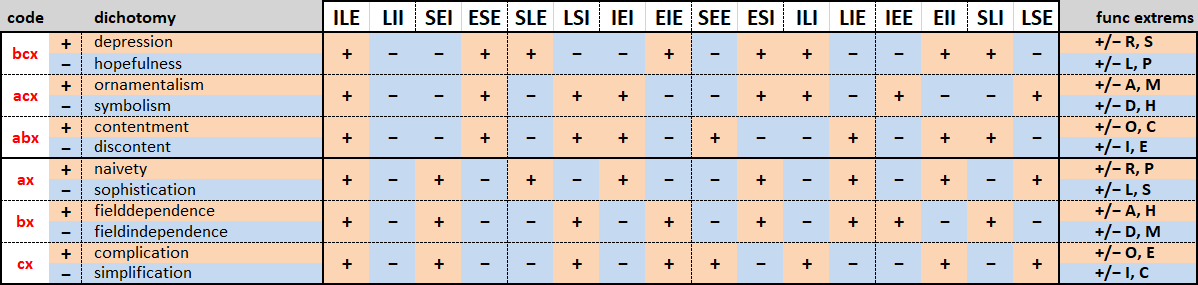
| Code | Dichotomies | ILE | LII | SEI | ESE | SLE | LSI | IEI | EIE | SEE | ESI | ILI | LIE | IEE | EII | SLI | LSE | Extremes | Meaning |
|---|---|---|---|---|---|---|---|---|---|---|---|---|---|---|---|---|---|---|---|
| bcx | + constructivism / − emotivism | + | − | − | + | + | − | − | + | − | + | + | − | − | + | + | − | +/− Fi, Fe / +/− Ti, Te | depression / optimism |
| acx | + tactics / − strategy | + | − | − | + | − | + | + | − | − | + | + | − | + | − | − | + | +/− Ne, Ni / +/− Se, Si | detailing / symbolization |
| abx | + positivism / − negativism | + | − | − | + | − | + | + | − | + | − | − | + | − | + | + | − | +/− Di, De / +/− Qi, Qe | benevolence / skepticism |
| ax | + yielding / − obstinacy | + | − | + | − | + | − | + | − | − | + | − | + | − | + | − | + | +/− Fi, Te / +/− Ti, Fe | naivety? / sophistication? |
| bx | + carelessness / − foresight | + | − | + | − | − | + | − | + | − | + | − | + | + | − | + | − | +/− Ne, Si / +/− Se, Ni | field dependence? / field independence? |
| cx | + process / − result | + | − | + | − | − | + | − | + | + | − | + | − | − | + | − | + | +/− Di, Qe / +/− Qi, De | cognitive complexification / cognitive simplification |
abx “positivism — negativism”:
| positivism | negativism |
|---|---|
| Attention is more focused on the merits of any material, object, or subject | Attention is more focused on shortcomings |
| Benevolent faith | Skepticism |
| Satisfaction with what is available | Dissatisfaction |
bcx “constructivism — emotivism”:
| constructivism | emotivism |
|---|---|
| Emotional fixation | Emotional mobility and play |
| ”Mental preoccupation” | Serenity |
| Inner torment | A light attitude toward life |
| A tendency toward self-blame and self-injury | |
| A sense of hopelessness, depressiveness | Full of hope |
acx “tactics — strategy”:
| tactics | strategy |
|---|---|
| ”Ornamentalism”: lack of control over imagination (producing excessive detail in the picture of events) | “Symbolism”: lack of control over sensory sensations (producing a clear differentiation of what is desired from the background and its fixation as a simple, compelling symbolic image) |
| Delving into details | Grasping the essence |
| Sublimation of desires into social games | Dominance of the primary drive (toward a hedonistic goal among sensing types or an ascetic one among intuitive types) |
cx “process — result” (also: “right — left” dyads):
| process | result |
|---|---|
| Cognitive complexification | Cognitive simplification |
| Interest in systems with numerous rules and intricate internal interrelationships | A desire to encompass all diversity within a small number of simple rules |
| Neuroticism (neurosis as a consequence of “complexes” - excessive mental complexification of the image of the world and oneself) | |
| Politicization - interest in complex aspects of the organization of human society (there is a correlation with merriness) | Political indifference |
| [Hypothesis] Among “right” types, dyad and quadra values tend to make a greater contribution to personality characteristics; therefore, a suitable organization of the social environment is more important for the survival of “right” types (which explains their interest in politics as a mechanism for changing the properties of this environment) | Among “left” types, individual traits tend to make a greater contribution to personality characteristics => achieving dual complementarity, having a partner who provides support in weak aspects, is more important for the survival of “left” types |
ax “yielding — obstinacy”:
| yielding | obstinacy |
|---|---|
| The idea that one lives in a simple reality (“what I see is what exists”) | The idea that one lives in a complex, multifaceted reality (“the first impression is mistaken,” “nothing is as it seems”) |
| More aggressive in reality | More aggressive in one’s imagination |
| Shows one’s real self | Hides one’s true face behind social masks (a “theatrical”/“intelligence-service” style of behavior) |
| Naivety, directness in communication (there is a correlation with judiciousness) | Sophistication, a tendency toward sophistry (there is a correlation with decisiveness) |
bx “carelessness — foresight”:
| carelessness | foresight |
|---|---|
| Delegation of control to social structures | Desires personal control over the situation |
| Likes a predictable environment | Ready for a radical change of environment if one decides on it oneself |
For the last three dichotomies, the semantic core is not yet entirely clear; at present, these are only hypotheses (albeit largely supported by statistics), and research continues.
Part 3. Socionic Functions and Sociotypes as Survival Strategies
Survival strategies can be divided into “static” and “dynamic” ones. “Static” strategies determine the method of selection of the genotype and its cultural envelope; they shape the characteristics of individuals in the population during selection. “Dynamic” strategies determine the way resources are obtained in interaction with the environment; they shape the characteristics of the ecotope in which the population exists.
Static functions as methods of evolutionary selection of individuals
Se: Genetic selection. Those individuals survive and reproduce whose genetics create a biological body better suited to the tasks of survival. The share of the genetic factor in the contribution to behavior increases - behavior becomes more instinctive, genetically determined. Because only relatively simple behavioral models can be encoded in the genotype, the behavioral norm narrows, requirements for the precision of behavioral reproduction become stricter, and intraspecific diversity decreases. As a consequence - more intense intraspecific competition and more aggressive territorial behavior. A shorter childhood is also typical (a rapid transition to independently obtaining food and reproducing).
Ne: “Selection of brains” (memes, images of the world). Those individuals survive and reproduce whose brain architecture allows them to form an image of the world more adequate to surrounding reality. The share of the genetic factor in the contribution to behavior decreases, while the contribution of linguistic culture increases (interpersonal learning through external speech and self-learning through inner speech). Because the brain’s synapses allow much more information to be stored than the genotype does, behavioral variability increases, behavioral norms broaden, and intraspecific diversity increases. As a consequence - weakening of intraspecific competition and territorial aggression. Also, because programming the brain requires time, childhood lengthens, and the population gradually shifts toward the retention and fixation of juvenile traits in its individuals - neoteny.
Ti: Natural selection (directed by the properties of the external environment). Those individuals survive and reproduce whose appearance, perception of the world, and behavior are more adequate to the objective reality common to all - the actual landscape in which action takes place (even if such appearance, perception of the world, and behavior reduce the individual’s social and reproductive success).
Fi: Sexual selection (directed by factors of random genetic and cultural changes and the stylization of behavior that follows from them). Those individuals survive and reproduce whose appearance, perception of the world, and behavior contribute more to the individual’s social and ultimately reproductive success within their local population (even if such appearance, perception of the world, and behavior are harmful to the survival of the individual and the population as a whole in the objective world).
Qi: Directional selection (a progressive factor of evolution). Work toward cleansing the genotype of mutations harmful to the survival of the individual and their offspring, and consciousness of harmful memes (the latter implies a positive correlation of Qi with high individual intelligence). The future of the species is determined by the genetics and culture of the most viable individuals, who become the founders of new genetic or cultural lineages. Because each separate individual gains the opportunity to exert a strong influence on the future of the species, Qi corresponds to individualism at the worldview level.
Di: Stabilizing selection (a conservative factor of evolution). The future of the species is determined by already existing collective genetic and cultural norms. Suppression of genetic and cultural renewal, accumulation in the population of genes (“genetic junk”) and memes (rituals) that have become useless for survival but have turned into species markers. Di correlates negatively with the value of intelligence (high individual intelligence among members of a population is harmful to the literal reproduction of the population’s tradition).
Ne+Qi+Ti (Alpha statics):
Relaxing requirements for precision in reproducing one’s behavioral strategy in the landscape (interest in strange ideas and actions) => increased probability of discovering new ecological niches and survival strategies => escaping into new niches from competitive pressure within the original one => allopatric separation into a new population with new characteristics => directional natural selection
Se+Di+Ti (Beta statics):
Tightening requirements for conformity of one’s behavioral strategy in the landscape to the population norm => all individuals in the population do the same thing and share one ecological niche => intensification of competition within this niche => stabilizing natural selection
Se+Qi+Fi (Gamma statics):
Tightening requirements for precision in reproducing mating and other social rituals => minor stylistic details of behavior generated by genetic and cultural drift become increasingly important in choosing and retaining a mate => sympatric separation of this population from the original one => directional sexual selection
Ne+Di+Fi (Delta statics):
Relaxing requirements for conformity of mating and other social rituals to the population norm (tolerance of “strange” individuals) => communication and genetic exchange between different populations of the species increase => differences between populations of the species are erased, and the populations approach the averaged species norm => stabilizing sexual selection
Dynamic functions as methods of transforming the habitat
Ni: Bringing the ecotope into crisis (opening ecological chains; a finite resource being expended; linear time that accelerates as the resource is depleted); reproduction is more successful during crises of ecotopes, because there are then more resources that have accidentally fallen out of circulation (out of the destroyed ecosystem), which Ni is best at finding first.
Si: Bringing the ecotope into homeostasis (closing ecological chains; a resource potentially infinite in its dynamic cycle; cyclical time); reproduction is more successful in stable (climax) ecotopes - those in which the individual can focus on the quality of resource processing without thinking about the possibility of its sudden depletion.
Fe: The dying out of a highly specialized economic order and a universal return to a natural ecosystem - to an archaic mode of subsistence and social organization; a society organized by Fe is built around dependence on the forces of nature and the irrational fears and hopes associated with this; its very organization follows biological nature, adapting to the basic instincts of the majority in their primary forms (undistorted by specialization).
Te: Development of instrumental technologies and, in the process, the formation of artificial ecotopes - highly specialized economies tied to the richest deposits of a particular resource; within Te economies, the original natural environment is largely replaced by a monoculture and a technosphere specializing in its processing; this also applies to the psyche of individuals, in which natural emotional reactions are suppressed and behavior is modified in the interest of better adaptation to a particular workplace.
De: Omnivorousness in resource selection; expansion of the ecological conditions suitable for survival; integration into others’ ecotopes (cosmopolitan species, “weeds”).
Qe: Selectivity in resource choice; narrowing of the ecological conditions suitable for survival; dependence on the native ecological pyramid, outside which survival is impossible (often leads to endemism); defensive aggression toward all outsiders is characteristic (as potentially capable of destroying familiar ecological connections, without which the viability of the Qe possessor integrated into them declines sharply).
Integrated type-specific survival strategies
ILE (= +Ne−Fi−Di) an innovative strategy (associated with weakening the filters of reality perception), relying on the discovery of new ecological niches not yet occupied by anyone and the spread of the original species into them; if successful, the species becomes a universal cosmopolitan with weakly genetically determined behavior; subsequently, a new progressive clade of species may arise from its subpopulations (allopatric speciation)
LII (= −Se+Ti+Qi) a strategy of intellectualizing the individual (renunciation of intraspecific competition, especially in sexual selection, to avoid the development and fixation of the cognitive distortions associated with it); reliance on the global progress of intelligent life - the strategy reproduces itself through weak statistical effects associated with the objectively better survival of more intelligent populations and species over long periods
SEI (= +Si−Te−Qe) a symbiotic strategy (maintaining the homeostasis of as broad an ecosystem as possible through tolerant mutual satisfaction of the needs of all its participants)
ESE (= −Ni+Fe+De) a swarm-intelligence strategy (following fashion to form a group within which all members’ consumption is synchronized and individual survival risks are reduced through mutual assistance)
SLE (= +Se−Fi−Qi) a strategy of intensifying natural selection (a desire to seize the top of the ecological pyramid, to become an absolute predator)
LSI (= −Ne+Ti+Di) a strategy of intensifying stabilizing selection (a desire to suppress all alternative behavioral strategies within the population, and to eliminate newly emerging groups and species capable of influencing the population’s already established structure of ecological connections; if the strategy succeeds, the species becomes fixed in its ecological niche, its genotype and phenotype are “frozen,” and against the background of an environment that continues to evolve the species gradually acquires relict characteristics)
IEI (= +Ni−Te−De) a strategy of “attractive parasitism” (instilling in a strong host inspiring illusions that implicitly control its behavior, encouraging the host to keep the parasite close, protect it, and care for it)
EIE (= −Si+Fe+Qe) a strategy of destabilizing provocations (expressively influencing the group’s opinion to consolidate it and intensify its struggle against the elite’s problems and enemies)
SEE (= +Se−Ti−Di) a strategy of intensifying sexual selection (development of “Machiavellian tricks” - “showy” behavior with elements of cunning and deception to raise one’s personal status and, ultimately, reproductive success)
ESI (= −Ne+Fi+Qi) a strategy of increasing sexual selectivity (development of “morality” - mechanisms preventing uncontrolled random mating in favor of controlled mating, tending more toward close inbreeding; the aim - reproductive isolation of the population, bringing harmful recessive mutations into the phenotype and, together with the elimination/expulsion of unsuccessful individuals, purging them from the population genome; if successful, the strategy provokes genetic drift and leads to sympatric speciation)
ILI (= +Ni−Fe−Qe) a “solitary scavenger” strategy (using disorienting deception in combination with searching for and tracking others’ misfortune, so as to be the first to exploit resources that have fallen out of circulation in a situation of universal disunity and distrust)
LIE (= −Si+Te+De) a strategy of escalating interpersonal competition (stimulating intraspecific personal effectiveness through a race among equals to create something useful from newly discovered deposits of resources that as yet “belong to no one”)
IEE (= +Ne−Ti−Qi) a disorderly-friendly strategy (associated with broadening conceptions of social behavioral norms - which leads to interpopulation communication and, ultimately, the emergence of a cultural-linguistic superstructure over instinctive, genetically specified behavior)
EII (= −Se+Fi+Di) a eusociality strategy (altruistic intragroup mutual assistance and tolerance, weakening selection pressure on the individual and increasing phenotypic intraspecific diversity, which makes the population a more complex and, therefore, more stable system)
SLI (= +Si−Fe−De) a peaceful-avoidant strategy (withdrawal to the deep periphery and occupation of a specialized ecological niche for which there are no other contenders)
LSE (= −Ni+Te+Qe) a highly productive strategy of habitat transformation (creating and maintaining through one’s own labor an artificial biotope that more stably reproduces the resources necessary for the survival of the given population)
Appendix 1. Average Values of Socionic Functions for Actual Representatives of Different Types
(The figures show the relative deviation of function values from the population mean, averaged across all people in whom the given type is leading)
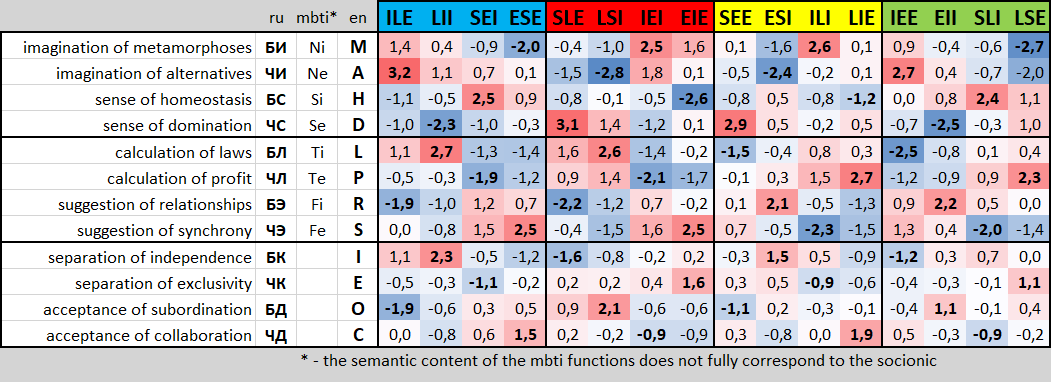
| ILE | LII | SEI | ESE | SLE | LSI | IEI | EIE | SEE | ESI | ILI | LIE | IEE | EII | SLI | LSE | ||
|---|---|---|---|---|---|---|---|---|---|---|---|---|---|---|---|---|---|
| Imagining crisis | Ni | 1.4 | 0.4 | -0.9 | -2.0 | -0.4 | -1.0 | 2.5 | 1.6 | 0.1 | -1.6 | 2.6 | 0.1 | 0.9 | -0.4 | -0.6 | -2.7 |
| Imagining freedom | Ne | 3.2 | 1.1 | 0.7 | 0.1 | -1.5 | -2.8 | 1.8 | 0.1 | -0.5 | -2.4 | -0.2 | 0.1 | 2.7 | 0.4 | -0.7 | -2.0 |
| Sensing comfort | Si | -1.1 | -0.5 | 2.5 | 0.9 | -0.8 | -0.1 | -0.5 | -2.6 | -0.8 | 0.5 | -0.8 | -1.2 | 0.0 | 0.8 | 2.4 | 1.1 |
| Sensing power | Se | -1.0 | -2.3 | -1.0 | -0.3 | 3.1 | 1.4 | -1.2 | 0.1 | 2.9 | 0.5 | -0.2 | 0.5 | -0.7 | -2.5 | -0.3 | 1.0 |
| Calculating law | Ti | 1.1 | 2.7 | -1.3 | -1.4 | 1.6 | 2.6 | -1.4 | -0.2 | -1.5 | -0.4 | 0.8 | 0.3 | -2.5 | -0.8 | 0.1 | 0.4 |
| Calculating benefit | Te | -0.5 | -0.3 | -1.9 | -1.2 | 0.9 | 1.4 | -2.1 | -1.7 | -0.1 | 0.3 | 1.5 | 2.7 | -1.2 | -0.9 | 0.9 | 2.3 |
| Inducing an attitude | Fi | -1.9 | -1.0 | 1.2 | 0.7 | -2.2 | -1.2 | 0.7 | -0.2 | 0.1 | 2.1 | -0.5 | -1.3 | 0.9 | 2.2 | 0.5 | 0.0 |
| Inducing attraction | Fe | 0.0 | -0.8 | 1.5 | 2.5 | -0.4 | -1.5 | 1.6 | 2.5 | 0.7 | -0.5 | -2.3 | -1.5 | 1.3 | 0.4 | -2.0 | -1.4 |
| Separation of individuality | Qi | 1.1 | 2.3 | -0.5 | -1.2 | -1.6 | -0.8 | -0.2 | 0.2 | -0.3 | 1.5 | 0.5 | -0.9 | -1.2 | 0.3 | 0.7 | 0.0 |
| Separation of nobility | Qe | -0.5 | -0.3 | -1.1 | -0.2 | 0.2 | 0.2 | 0.4 | 1.6 | 0.3 | 0.5 | -0.9 | -0.6 | -0.4 | -0.3 | -0.1 | 1.1 |
| Acceptance of submission | Di | -1.9 | -0.6 | 0.3 | 0.5 | 0.9 | 2.1 | -0.6 | -0.6 | -1.1 | 0.2 | -0.3 | -0.1 | -0.4 | 1.1 | -0.1 | 0.4 |
| Acceptance of cooperation | De | 0.0 | -0.8 | 0.6 | 1.5 | 0.2 | -0.2 | -0.9 | -0.9 | 0.3 | -0.8 | 0.0 | 1.9 | 0.5 | -0.3 | -0.9 | -0.2 |
Appendix 2. Comparison of the Semantic Content of Functions in Socionics and MBTI
| MBTI functions | Socionic functions | Semantic overlap | ||
|---|---|---|---|---|
| Ne | A flow of ideas; running through numerous possible futures in one’s mind | Ne | Imagining new possibilities; “childlikeness” - love of novelty and attraction to freedom | Moderate |
| Ni | Insight - extracting information from the subconscious, creating a feeling of “illumination” | Ni | Imagining future crises leading to changes in the familiar world and oneself; passivity of an egoistic kind (self-absorbed contemplation + unwillingness to make efforts to help anyone in the external world); strong correlation with masochism | Low. According to statistics from socionic questionnaires, insight occurs more often among those with strong Ne than Ni |
| Se | Fullness of sensations here and now; hedonism | Se | A desire for dominance and usurpation of the best resources (the behavior of “alpha individuals”); strong correlation with proactive aggressiveness and sadism | Low. Se has more in common with combined socionic sensing, with a somewhat irrational inclination, than with Se proper |
| Si | Memory of sensations, traditionalism, caution | Si | Comfort and relaxation; living here and now; maintaining homeostasis and preventing crises | Low. Si has more in common with the creative form of Se, i.e., a deficit of Ne, than with Si proper |
| Fe | Sociability and social involvement, adherence to collective values | Fe | The same as Fe + an excellent understanding of the ideal of attractiveness (fashion), management of the dramatic passions of the masses - poets, performers, prophets | High (but not 100%). Communicativeness pertains even slightly more to the creative form of Fi (i.e., a deficit of Ti) than to the program form of Fe |
| Fi | Empathy based on personal emotional experience and personal values | Fi | Management of personal relationships based on an excellent understanding of the personality characteristics of close others | High |
| Te | Objective thinking; performing work to change the external world | Te | The same as Te + professional specialization leading to utilitarianism (striving for usefulness and gain as the main motive for activity) | High (but not 100%) |
| Ti | Analysis and mental modeling of reality | Ti | The same as Ti + obstinacy caused by principled adherence to the chosen ideological paradigm | High (but not 100%) |
Appendix 3. Recommendations for Type Diagnosticians - Probability of Trait Inversion
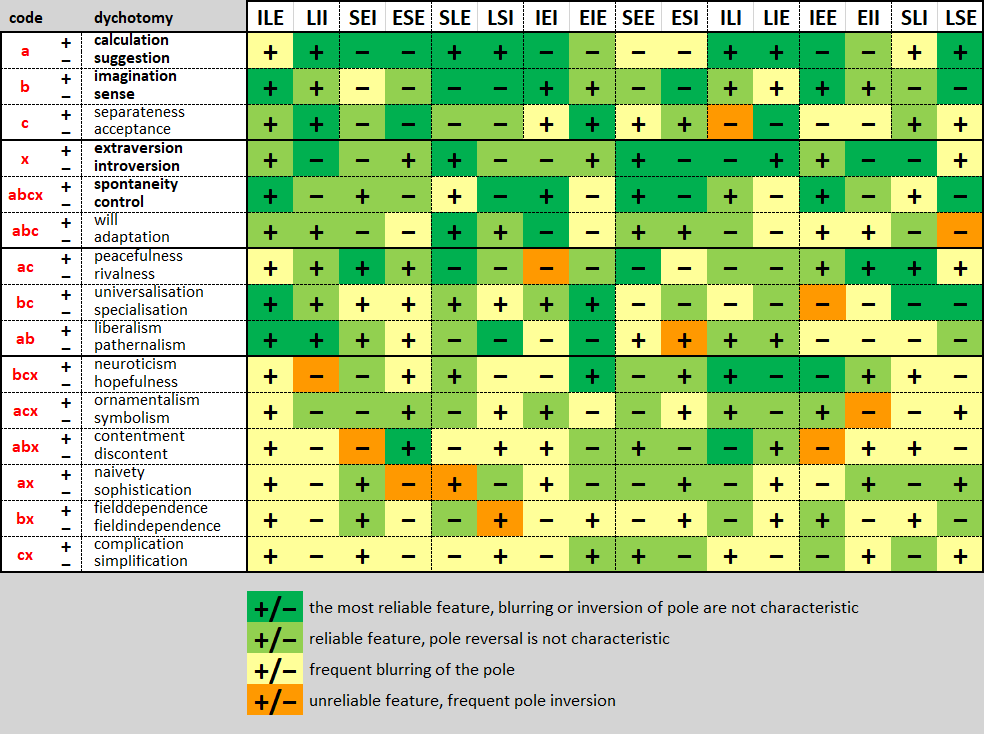
| Code | Dichotomies | ILE | LII | SEI | ESE | SLE | LSI | IEI | EIE | SEE | ESI | ILI | LIE | IEE | EII | SLI | LSE |
|---|---|---|---|---|---|---|---|---|---|---|---|---|---|---|---|---|---|
| a | + logic / − ethics | + (pale yellow) | + (green) | − (green) | − (green) | + (green) | + (green) | − (green) | − (light green) | − (pale yellow) | − (pale yellow) | + (green) | + (green) | − (green) | − (light green) | + (pale yellow) | + (green) |
| b | + intuition / − sensing | + (green) | + (light green) | − (pale yellow) | − (light green) | − (green) | − (green) | + (green) | + (light green) | − (light green) | − (green) | + (light green) | + (pale yellow) | + (green) | + (light green) | − (light green) | − (green) |
| c | + questimity / − declatimity | + (light green) | + (green) | − (light green) | − (green) | − (light green) | − (light green) | + (pale yellow) | + (green) | + (pale yellow) | + (light green) | − (orange) | − (green) | − (pale yellow) | − (pale yellow) | + (light green) | + (pale yellow) |
| x | + extraversion / − introversion | + (light green) | − (green) | − (light green) | + (light green) | + (green) | − (light green) | − (light green) | + (light green) | + (green) | − (green) | − (green) | + (green) | + (light green) | − (green) | − (green) | + (pale yellow) |
| abcx | + irrationality / − rationality | + (green) | − (light green) | + (light green) | − (light green) | + (pale yellow) | − (green) | + (green) | − (pale yellow) | + (green) | − (green) | + (light green) | − (pale yellow) | + (green) | − (light green) | + (pale yellow) | − (green) |
| abc | + statics / − dynamics | + (light green) | + (light green) | − (light green) | − (pale yellow) | + (green) | + (light green) | − (green) | − (pale yellow) | + (light green) | + (light green) | − (light green) | − (pale yellow) | + (pale yellow) | + (pale yellow) | − (light green) | − (orange) |
| ac | + judiciousness / − decisiveness | + (pale yellow) | + (light green) | + (green) | + (light green) | − (green) | − (light green) | − (orange) | − (light green) | − (green) | − (pale yellow) | − (light green) | − (light green) | + (light green) | + (green) | + (green) | + (pale yellow) |
| bc | + merriness / − seriousness | + (green) | + (light green) | + (pale yellow) | + (pale yellow) | + (light green) | + (pale yellow) | + (light green) | + (green) | − (pale yellow) | − (light green) | − (pale yellow) | − (light green) | − (orange) | − (pale yellow) | − (green) | − (green) |
| ab | + democracy / − aristocracy | + (green) | + (green) | + (light green) | + (pale yellow) | − (light green) | − (green) | − (pale yellow) | − (green) | + (pale yellow) | + (orange) | + (light green) | + (light green) | − (pale yellow) | − (pale yellow) | − (pale yellow) | − (light green) |
| bcx | + constructivism / − emotivism | + (pale yellow) | − (orange) | − (light green) | + (pale yellow) | + (light green) | − (pale yellow) | − (pale yellow) | + (green) | − (light green) | + (light green) | + (green) | − (green) | − (green) | + (light green) | + (pale yellow) | − (pale yellow) |
| acx | + tactics / − strategy | + (pale yellow) | − (light green) | − (light green) | + (light green) | − (light green) | + (pale yellow) | + (light green) | − (pale yellow) | − (light green) | + (pale yellow) | + (light green) | − (light green) | + (light green) | − (orange) | − (pale yellow) | + (pale yellow) |
| abx | + positivism / − negativism | + (pale yellow) | − (pale yellow) | − (orange) | + (green) | − (pale yellow) | + (pale yellow) | + (pale yellow) | − (light green) | + (light green) | − (light green) | − (green) | + (light green) | − (orange) | + (pale yellow) | + (pale yellow) | − (pale yellow) |
| ax | + yielding / − obstinacy | + (pale yellow) | − (pale yellow) | + (light green) | − (orange) | + (orange) | − (light green) | + (pale yellow) | − (light green) | − (light green) | + (light green) | − (light green) | + (pale yellow) | − (pale yellow) | + (light green) | − (light green) | + (light green) |
| bx | + carelessness / − foresight | + (pale yellow) | − (pale yellow) | + (light green) | − (pale yellow) | − (light green) | + (orange) | − (pale yellow) | + (pale yellow) | − (pale yellow) | + (pale yellow) | − (light green) | + (pale yellow) | + (light green) | − (pale yellow) | + (pale yellow) | − (light green) |
| cx | + process / − result | + (pale yellow) | − (pale yellow) | + (pale yellow) | − (pale yellow) | − (pale yellow) | + (pale yellow) | − (pale yellow) | + (light green) | + (light green) | − (light green) | + (pale yellow) | − (pale yellow) | − (light green) | + (pale yellow) | − (light green) | + (pale yellow) |
Recommendations for type diagnosis
| +/− (green) | The most reliable trait; blurring or inversion of the pole is uncharacteristic |
| +/− (light green) | A reliable trait; inversion of the pole is uncharacteristic |
| +/− (pale yellow) | Frequent blurring or slight inversion of the pole |
| +/− (orange) | An unreliable trait; pronounced inversion of the pole is possible |
Appendix 4. Various Important Personality Characteristics and Character Accentuations in the Socionic Coordinate System
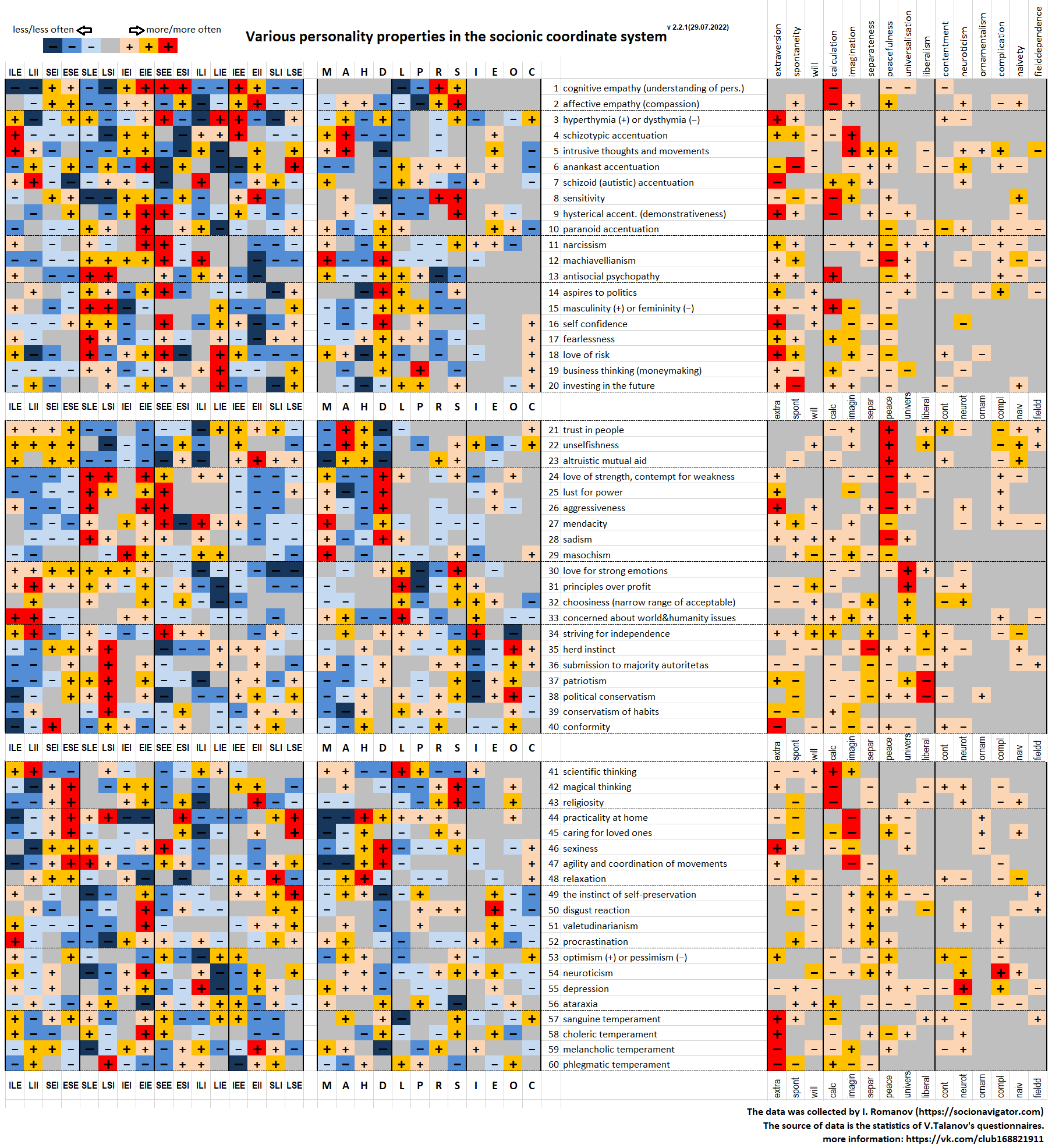
Socionic Associations of Personality Characteristics and Accentuations
v 2.2.1(29.07.2022)
| Less / less often ← | → More / more often | |||||
|---|---|---|---|---|---|---|
| − (dark blue) | − (blue) | − (light blue) | gray | + (peach) | + (yellow) | + (red) |
| ILE | LII | SEI | ESE | SLE | LSI | IEI | EIE | SEE | ESI | ILI | LIE | IEE | EII | SLI | LSE | ||
|---|---|---|---|---|---|---|---|---|---|---|---|---|---|---|---|---|---|
| 1 | Cognitive empathy (understanding people) | − (dark blue) | − (dark blue) | + (yellow) | + (peach) | − (blue) | − (dark blue) | + (yellow) | + (red) | + (red) | + (red) | − (blue) | − (blue) | + (red) | + (yellow) | − (blue) | − (blue) |
| 2 | Affective empathy (empathic sharing) | − (light blue) | + (yellow) | + (yellow) | − (blue) | − (blue) | + (peach) | + (peach) | − (blue) | + (yellow) | − (dark blue) | − (light blue) | + (yellow) | + (red) | − (light blue) | − (light blue) | |
| 3 | Hyperthymia (+) - dysthymia (−) | + (yellow) | − (dark blue) | − (light blue) | + (yellow) | + (yellow) | − (blue) | − (light blue) | + (peach) | + (red) | − (blue) | − (dark blue) | + (red) | + (red) | − (blue) | − (dark blue) | + (peach) |
| 4 | Schizotypy | + (red) | − (light blue) | − (light blue) | − (light blue) | − (light blue) | − (dark blue) | + (yellow) | + (yellow) | − (dark blue) | + (peach) | + (peach) | + (red) | − (light blue) | − (light blue) | ||
| 5 | OCD (obsessive thoughts and movements) | + (red) | + (peach) | − (blue) | − (blue) | − (blue) | + (yellow) | + (yellow) | − (blue) | − (dark blue) | + (yellow) | − (dark blue) | + (yellow) | + (yellow) | |||
| 6 | OCPD (ritualization) | − (blue) | + (yellow) | − (light blue) | + (yellow) | − (blue) | + (yellow) | − (blue) | + (red) | − (dark blue) | + (yellow) | − (dark blue) | − (dark blue) | + (yellow) | + (red) | ||
| 7 | Schizoid traits (autistic traits) | + (peach) | + (red) | − (light blue) | − (dark blue) | − (light blue) | + (peach) | + (peach) | − (light blue) | − (dark blue) | + (red) | − (blue) | + (peach) | + (yellow) | − (light blue) | ||
| 8 | Sensitivity | − (light blue) | + (yellow) | + (peach) | − (dark blue) | − (dark blue) | + (yellow) | + (yellow) | − (blue) | + (yellow) | − (blue) | + (peach) | + (red) | − (blue) | |||
| 9 | Histrionic traits (demonstrativeness) | − (blue) | + (yellow) | − (blue) | + (yellow) | + (red) | + (red) | − (light blue) | − (blue) | − (light blue) | + (yellow) | − (light blue) | − (blue) | − (light blue) | |||
| 10 | Paranoid traits | − (blue) | − (light blue) | − (light blue) | + (yellow) | + (peach) | + (red) | + (peach) | + (yellow) | − (dark blue) | − (light blue) | − (light blue) | + (peach) | ||||
| 11 | Narcissism | + (peach) | − (light blue) | + (peach) | − (light blue) | + (red) | + (red) | − (light blue) | − (blue) | − (blue) | − (light blue) | ||||||
| 12 | Machiavellianism | − (blue) | − (blue) | − (light blue) | − (light blue) | + (yellow) | + (yellow) | + (yellow) | + (yellow) | + (red) | − (light blue) | + (red) | − (dark blue) | − (blue) | − (blue) | ||
| 13 | Antisocial psychopathy | + (peach) | − (blue) | − (blue) | + (red) | + (red) | + (peach) | − (blue) | + (yellow) | + (peach) | − (blue) | − (dark blue) | |||||
| 14 | Aspires to politics | + (peach) | − (light blue) | + (yellow) | + (peach) | − (blue) | + (yellow) | + (red) | − (blue) | − (light blue) | − (light blue) | − (dark blue) | + (peach) | ||||
| 15 | Masculinity (+) - femininity (−) | + (peach) | − (blue) | − (light blue) | + (red) | + (red) | − (dark blue) | − (light blue) | + (yellow) | − (blue) | − (blue) | + (yellow) | |||||
| 16 | Self-confidence | − (light blue) | − (light blue) | − (light blue) | + (peach) | + (yellow) | + (yellow) | − (blue) | + (red) | − (blue) | + (yellow) | + (peach) | − (dark blue) | − (blue) | + (peach) | ||
| 17 | Fearlessness | + (peach) | − (light blue) | + (red) | + (peach) | − (blue) | − (light blue) | + (peach) | − (light blue) | + (peach) | − (light blue) | − (dark blue) | + (peach) | + (peach) | |||
| 18 | Love of risk | + (yellow) | − (dark blue) | − (blue) | + (red) | − (blue) | + (peach) | + (yellow) | + (red) | − (dark blue) | + (red) | + (yellow) | − (blue) | − (blue) | − (blue) | ||
| 19 | Financial talent | − (light blue) | − (light blue) | − (light blue) | − (light blue) | + (peach) | + (peach) | − (blue) | − (light blue) | + (peach) | + (peach) | + (red) | − (light blue) | − (light blue) | + (yellow) | ||
| 20 | Invests in the future | − (light blue) | + (yellow) | − (blue) | + (peach) | − (light blue) | + (yellow) | − (blue) | + (peach) | + (red) | − (blue) | − (dark blue) | + (yellow) | ||||
| 21 | Trust in people | + (peach) | + (peach) | + (peach) | + (yellow) | − (blue) | − (blue) | − (blue) | − (light blue) | − (light blue) | − (dark blue) | + (yellow) | + (yellow) | + (peach) | + (yellow) | − (light blue) | |
| 22 | Selflessness | + (yellow) | + (yellow) | + (yellow) | + (yellow) | − (dark blue) | − (light blue) | − (blue) | − (blue) | + (yellow) | − (blue) | + (yellow) | − (blue) | ||||
| 23 | Altruistic mutual assistance | + (yellow) | + (yellow) | + (yellow) | − (blue) | − (blue) | − (light blue) | − (blue) | − (dark blue) | + (peach) | − (dark blue) | + (peach) | + (red) | + (peach) | + (peach) | ||
| 24 | Love of strength, contempt for weakness | − (blue) | − (blue) | − (blue) | − (light blue) | + (red) | + (red) | + (red) | + (yellow) | + (peach) | + (peach) | − (light blue) | − (blue) | − (blue) | − (light blue) | ||
| 25 | Love of power | − (blue) | − (blue) | − (light blue) | − (light blue) | + (red) | + (yellow) | + (yellow) | + (red) | − (light blue) | − (blue) | − (blue) | + (peach) | ||||
| 26 | Aggressiveness | + (peach) | − (blue) | − (blue) | − (light blue) | + (red) | + (red) | + (red) | − (light blue) | − (blue) | − (blue) | ||||||
| 27 | Deceitfulness | − (blue) | − (light blue) | − (blue) | + (peach) | + (yellow) | + (peach) | + (red) | − (dark blue) | + (red) | + (peach) | + (peach) | − (blue) | − (light blue) | − (light blue) | ||
| 28 | Sadism | − (light blue) | − (light blue) | − (light blue) | + (red) | + (peach) | + (peach) | + (peach) | + (peach) | − (light blue) | − (blue) | − (light blue) | − (light blue) | ||||
| 29 | Masochism | − (light blue) | − (blue) | − (light blue) | + (red) | + (yellow) | − (light blue) | − (light blue) | + (yellow) | + (yellow) | − (light blue) | − (blue) | |||||
| 30 | Love of strong emotions | + (peach) | + (peach) | + (yellow) | + (yellow) | + (yellow) | + (yellow) | + (yellow) | + (peach) | − (light blue) | − (dark blue) | − (light blue) | − (light blue) | − (blue) | − (dark blue) | − (dark blue) | |
| 31 | Principles are more important than gain | + (peach) | + (red) | + (peach) | + (peach) | + (yellow) | + (peach) | − (light blue) | + (yellow) | − (light blue) | + (peach) | − (blue) | − (dark blue) | − (light blue) | − (blue) | − (blue) | |
| 32 | Selectivity | + (yellow) | + (peach) | + (yellow) | − (light blue) | + (yellow) | − (light blue) | − (dark blue) | − (blue) | ||||||||
| 33 | Concern for the fate of the world and humanity | + (red) | + (red) | − (light blue) | − (light blue) | + (peach) | + (peach) | − (light blue) | − (light blue) | − (light blue) | − (light blue) | − (blue) | |||||
| 34 | Desire for independence | + (yellow) | + (red) | − (blue) | − (light blue) | + (peach) | − (light blue) | − (blue) | − (light blue) | + (red) | + (peach) | + (peach) | − (blue) | + (peach) | − (light blue) | ||
| 35 | Herd instinct | − (light blue) | − (blue) | + (yellow) | + (yellow) | + (peach) | + (red) | − (dark blue) | − (blue) | − (blue) | + (peach) | + (peach) | + (peach) | − (light blue) | |||
| 36 | Submission to the authorities of the majority | − (blue) | − (blue) | + (peach) | + (red) | + (peach) | − (light blue) | + (peach) | + (peach) | − (blue) | |||||||
| 37 | Patriotism | − (blue) | − (blue) | − (light blue) | + (yellow) | + (yellow) | + (red) | + (yellow) | − (light blue) | − (light blue) | − (dark blue) | + (peach) | + (peach) | − (blue) | + (peach) | ||
| 38 | Political conservatism | − (dark blue) | − (light blue) | + (yellow) | + (peach) | + (red) | + (peach) | − (dark blue) | − (blue) | − (blue) | + (peach) | + (yellow) | − (light blue) | + (yellow) | |||
| 39 | Conservatism of habits | − (blue) | + (peach) | − (light blue) | + (red) | − (light blue) | − (light blue) | − (light blue) | + (yellow) | − (light blue) | − (blue) | + (peach) | + (peach) | + (peach) | |||
| 40 | Conformism | − (dark blue) | − (light blue) | + (red) | − (blue) | + (yellow) | + (peach) | − (blue) | − (light blue) | + (peach) | − (light blue) | − (light blue) | + (peach) | + (yellow) | |||
| 41 | Scientific thinking | + (yellow) | + (red) | − (blue) | − (blue) | + (peach) | − (light blue) | − (blue) | − (light blue) | + (yellow) | + (peach) | − (light blue) | |||||
| 42 | Magical thinking | − (light blue) | − (dark blue) | + (peach) | + (red) | − (blue) | + (yellow) | + (yellow) | − (blue) | − (blue) | + (yellow) | + (yellow) | − (blue) | ||||
| 43 | Religiosity | − (blue) | − (blue) | + (peach) | + (red) | + (peach) | + (yellow) | − (blue) | + (yellow) | − (dark blue) | + (red) | − (blue) | − (light blue) | ||||
| 44 | Practicality in everyday life | − (dark blue) | − (light blue) | + (peach) | + (red) | + (peach) | + (red) | − (dark blue) | − (dark blue) | + (red) | − (blue) | − (blue) | − (blue) | + (yellow) | + (red) | ||
| 45 | Care for loved ones | − (blue) | − (light blue) | + (peach) | + (red) | − (light blue) | − (light blue) | − (light blue) | + (yellow) | − (dark blue) | − (light blue) | + (peach) | + (red) | ||||
| 46 | Sexual amorousness | − (dark blue) | + (yellow) | + (yellow) | + (yellow) | − (light blue) | − (light blue) | + (peach) | + (red) | − (light blue) | − (blue) | − (blue) | |||||
| 47 | Dexterity and coordination of movements | − (dark blue) | − (blue) | + (peach) | + (red) | + (red) | + (peach) | − (blue) | − (blue) | + (yellow) | + (peach) | − (blue) | − (light blue) | − (light blue) | − (blue) | + (peach) | + (yellow) |
| 48 | Relaxation | + (peach) | + (yellow) | + (yellow) | − (light blue) | + (peach) | − (dark blue) | − (dark blue) | − (light blue) | + (yellow) | − (light blue) | + (red) | − (blue) | ||||
| 49 | Instinct of self-preservation | + (peach) | − (light blue) | − (dark blue) | − (blue) | + (yellow) | − (blue) | − (light blue) | − (light blue) | + (peach) | + (peach) | + (yellow) | + (red) | ||||
| 50 | Disgust reaction | + (peach) | − (blue) | − (blue) | − (light blue) | + (red) | − (blue) | + (peach) | − (light blue) | − (light blue) | + (yellow) | + (yellow) | |||||
| 51 | Anxious suspiciousness | + (yellow) | − (light blue) | − (light blue) | − (light blue) | − (blue) | − (blue) | + (red) | − (light blue) | − (light blue) | + (peach) | + (peach) | + (yellow) | ||||
| 52 | Procrastination | + (red) | − (light blue) | − (blue) | − (blue) | − (dark blue) | + (yellow) | + (peach) | + (peach) | − (light blue) | + (peach) | − (light blue) | − (light blue) | + (yellow) | + (peach) | ||
| 53 | Optimism | + (peach) | − (light blue) | + (yellow) | − (light blue) | − (blue) | + (yellow) | − (blue) | − (dark blue) | + (yellow) | + (yellow) | ||||||
| 54 | Neuroticism | + (yellow) | − (light blue) | + (peach) | − (dark blue) | − (blue) | + (peach) | + (red) | − (light blue) | + (peach) | − (dark blue) | − (blue) | + (yellow) | + (yellow) | |||
| 55 | Depressiveness | + (peach) | − (light blue) | + (peach) | − (blue) | + (peach) | + (yellow) | − (blue) | − (light blue) | + (red) | − (dark blue) | − (blue) | + (yellow) | + (peach) | |||
| 56 | Equanimity (ataraxia) | − (light blue) | + (peach) | − (light blue) | − (blue) | + (peach) | + (yellow) | − (dark blue) | + (peach) | − (light blue) | + (peach) | + (yellow) | + (yellow) | − (blue) | + (peach) | − (light blue) | |
| 57 | Sanguine temperament | + (yellow) | − (blue) | + (peach) | + (yellow) | + (peach) | − (blue) | + (peach) | + (yellow) | − (blue) | − (blue) | + (yellow) | + (yellow) | − (blue) | − (blue) | ||
| 58 | Choleric temperament | + (yellow) | − (blue) | − (blue) | + (yellow) | − (light blue) | + (red) | + (yellow) | − (light blue) | − (blue) | − (blue) | ||||||
| 59 | Melancholic temperament | − (light blue) | + (yellow) | + (yellow) | − (light blue) | − (dark blue) | − (light blue) | + (yellow) | + (peach) | − (blue) | + (peach) | + (yellow) | − (blue) | − (light blue) | + (red) | + (peach) | − (blue) |
| 60 | Phlegmatic temperament | − (blue) | + (yellow) | − (light blue) | + (red) | − (light blue) | − (blue) | − (blue) | + (peach) | + (peach) | − (dark blue) | + (peach) | + (yellow) |
| Ni | Ne | Si | Se | Ti | Te | Fi | Fe | Qi | Qe | Di | De | ||
|---|---|---|---|---|---|---|---|---|---|---|---|---|---|
| 1 | Cognitive empathy (understanding people) | − (dark blue) | − (blue) | + (red) | + (yellow) | ||||||||
| 2 | Affective empathy (empathic sharing) | − (light blue) | + (peach) | + (peach) | − (blue) | − (light blue) | − (dark blue) | + (yellow) | + (red) | ||||
| 3 | Hyperthymia (+) - dysthymia (−) | − (light blue) | + (yellow) | − (blue) | + (yellow) | − (blue) | − (light blue) | + (yellow) | − (blue) | − (light blue) | + (yellow) | ||
| 4 | Schizotypy | + (yellow) | + (red) | − (blue) | − (blue) | − (blue) | − (light blue) | + (peach) | |||||
| 5 | OCD (obsessive thoughts and movements) | + (peach) | + (red) | − (dark blue) | − (light blue) | + (yellow) | − (blue) | ||||||
| 6 | OCPD (ritualization) | − (blue) | − (blue) | − (blue) | + (yellow) | + (peach) | + (peach) | + (peach) | + (peach) | − (blue) | |||
| 7 | Schizoid traits (autistic traits) | + (yellow) | − (blue) | + (yellow) | + (peach) | − (light blue) | − (blue) | + (peach) | − (light blue) | ||||
| 8 | Sensitivity | + (peach) | − (dark blue) | − (blue) | − (blue) | + (red) | + (red) | ||||||
| 9 | Histrionic traits (demonstrativeness) | + (peach) | − (light blue) | + (peach) | − (blue) | − (blue) | + (red) | + (peach) | − (light blue) | ||||
| 10 | Paranoid traits | + (peach) | − (blue) | − (light blue) | + (yellow) | + (peach) | + (yellow) | + (peach) | − (blue) | ||||
| 11 | Narcissism | + (peach) | − (blue) | + (yellow) | − (light blue) | − (light blue) | + (yellow) | + (peach) | + (peach) | − (blue) | |||
| 12 | Machiavellianism | + (red) | − (blue) | − (blue) | + (red) | − (light blue) | − (light blue) | − (light blue) | − (light blue) | ||||
| 13 | Antisocial psychopathy | + (yellow) | − (light blue) | − (light blue) | + (yellow) | + (yellow) | + (peach) | − (dark blue) | − (blue) | ||||
| 14 | Aspires to politics | − (dark blue) | + (red) | + (yellow) | − (blue) | + (peach) | |||||||
| 15 | Masculinity (+) - femininity (−) | − (light blue) | − (blue) | − (light blue) | + (yellow) | + (yellow) | + (yellow) | − (blue) | − (blue) | ||||
| 16 | Self-confidence | − (light blue) | − (blue) | − (light blue) | + (red) | + (peach) | − (light blue) | + (peach) | |||||
| 17 | Fearlessness | − (light blue) | − (light blue) | + (peach) | + (yellow) | + (peach) | + (peach) | − (blue) | − (light blue) | + (peach) | |||
| 18 | Love of risk | + (yellow) | + (peach) | − (dark blue) | + (yellow) | − (blue) | − (blue) | − (light blue) | + (peach) | ||||
| 19 | Financial talent | − (blue) | + (yellow) | + (red) | − (blue) | + (peach) | |||||||
| 20 | Invests in the future | − (light blue) | − (dark blue) | − (light blue) | + (yellow) | + (yellow) | + (peach) | − (light blue) | + (peach) | ||||
| 21 | Trust in people | − (blue) | + (red) | + (yellow) | − (dark blue) | − (light blue) | + (peach) | ||||||
| 22 | Selflessness | − (blue) | + (red) | + (yellow) | − (blue) | − (blue) | + (peach) | + (yellow) | − (blue) | − (light blue) | + (yellow) | ||
| 23 | Altruistic mutual assistance | − (dark blue) | + (yellow) | + (yellow) | − (dark blue) | + (yellow) | + (peach) | − (light blue) | |||||
| 24 | Love of strength, contempt for weakness | + (yellow) | − (blue) | − (blue) | + (red) | + (peach) | − (light blue) | + (peach) | − (blue) | + (peach) | |||
| 25 | Love of power | + (peach) | − (dark blue) | − (blue) | + (red) | − (light blue) | + (peach) | ||||||
| 26 | Aggressiveness | + (peach) | − (light blue) | − (blue) | + (red) | − (light blue) | + (peach) | − (light blue) | |||||
| 27 | Deceitfulness | + (red) | − (blue) | + (yellow) | − (light blue) | − (light blue) | − (light blue) | − (light blue) | |||||
| 28 | Sadism | + (peach) | − (blue) | − (light blue) | + (red) | + (peach) | − (light blue) | − (light blue) | |||||
| 29 | Masochism | + (red) | − (blue) | − (light blue) | − (light blue) | + (peach) | − (blue) | + (peach) | |||||
| 30 | Love of strong emotions | − (light blue) | + (peach) | + (yellow) | − (dark blue) | − (blue) | + (red) | − (light blue) | |||||
| 31 | Principles are more important than gain | − (light blue) | + (red) | − (dark blue) | − (light blue) | + (yellow) | + (peach) | ||||||
| 32 | Selectivity | − (light blue) | − (light blue) | + (yellow) | − (blue) | + (yellow) | + (yellow) | + (peach) | − (blue) | ||||
| 33 | Concern for the fate of the world and humanity | + (peach) | + (yellow) | − (blue) | − (blue) | + (red) | − (light blue) | − (blue) | + (yellow) | − (light blue) | − (light blue) | ||
| 34 | Desire for independence | + (yellow) | + (peach) | + (peach) | + (peach) | − (light blue) | − (blue) | + (red) | − (dark blue) | ||||
| 35 | Herd instinct | − (light blue) | + (peach) | + (peach) | − (light blue) | − (light blue) | + (yellow) | − (dark blue) | − (light blue) | + (red) | + (peach) | ||
| 36 | Submission to the authorities of the majority | + (peach) | − (blue) | − (light blue) | + (peach) | + (peach) | + (peach) | − (blue) | − (light blue) | + (yellow) | + (peach) | ||
| 37 | Patriotism | − (blue) | − (blue) | − (light blue) | + (peach) | − (light blue) | + (yellow) | − (dark blue) | + (peach) | + (yellow) | |||
| 38 | Political conservatism | − (blue) | − (light blue) | + (peach) | + (peach) | − (light blue) | + (peach) | + (yellow) | − (dark blue) | + (peach) | + (red) | − (light blue) | |
| 39 | Conservatism of habits | − (blue) | − (dark blue) | + (peach) | + (yellow) | + (peach) | + (peach) | − (light blue) | + (peach) | − (light blue) | |||
| 40 | Conformism | − (light blue) | − (blue) | + (yellow) | − (light blue) | − (light blue) | + (yellow) | − (light blue) | − (light blue) | + (yellow) | |||
| 41 | Scientific thinking | + (peach) | + (peach) | − (blue) | − (blue) | + (red) | + (yellow) | − (blue) | − (blue) | + (peach) | |||
| 42 | Magical thinking | + (peach) | − (light blue) | − (blue) | − (blue) | + (peach) | + (red) | − (blue) | + (peach) | ||||
| 43 | Religiosity | − (light blue) | − (light blue) | − (light blue) | − (blue) | + (yellow) | + (red) | − (blue) | + (yellow) | ||||
| 44 | Practicality in everyday life | − (dark blue) | − (dark blue) | + (red) | + (yellow) | + (peach) | + (peach) | + (peach) | + (peach) | ||||
| 45 | Care for loved ones | − (dark blue) | − (light blue) | + (yellow) | − (light blue) | + (yellow) | + (peach) | ||||||
| 46 | Sexual amorousness | − (blue) | − (light blue) | + (yellow) | + (red) | − (blue) | − (light blue) | − (light blue) | + (yellow) | − (light blue) | − (light blue) | + (peach) | |
| 47 | Dexterity and coordination of movements | − (dark blue) | − (dark blue) | + (yellow) | + (red) | − (light blue) | − (light blue) | + (peach) | |||||
| 48 | Relaxation | − (light blue) | + (yellow) | + (red) | − (light blue) | − (light blue) | − (light blue) | − (light blue) | + (peach) | ||||
| 49 | Instinct of self-preservation | − (light blue) | + (yellow) | + (peach) | − (dark blue) | − (light blue) | + (yellow) | + (yellow) | − (light blue) | − (blue) | |||
| 50 | Disgust reaction | − (light blue) | − (blue) | + (peach) | + (peach) | + (peach) | + (red) | − (light blue) | − (blue) | ||||
| 51 | Anxious suspiciousness | + (peach) | − (blue) | + (peach) | + (yellow) | − (light blue) | − (light blue) | ||||||
| 52 | Procrastination | + (peach) | + (yellow) | − (light blue) | − (blue) | − (light blue) | − (light blue) | + (peach) | + (yellow) | − (blue) | − (light blue) | ||
| 53 | Optimism | − (blue) | + (yellow) | + (peach) | − (blue) | + (peach) | − (light blue) | + (yellow) | |||||
| 54 | Neuroticism | + (peach) | + (peach) | − (blue) | − (light blue) | − (light blue) | + (peach) | + (yellow) | + (peach) | + (yellow) | − (light blue) | − (light blue) | |
| 55 | Depressiveness | + (yellow) | + (peach) | + (peach) | − (blue) | − (light blue) | − (light blue) | + (peach) | − (light blue) | ||||
| 56 | Equanimity (ataraxia) | + (peach) | + (yellow) | + (yellow) | − (light blue) | − (dark blue) | − (light blue) | + (peach) | |||||
| 57 | Sanguine temperament | + (yellow) | + (peach) | − (dark blue) | + (yellow) | − (light blue) | − (light blue) | + (yellow) | |||||
| 58 | Choleric temperament | − (blue) | + (yellow) | − (light blue) | − (light blue) | + (yellow) | + (yellow) | − (blue) | |||||
| 59 | Melancholic temperament | + (yellow) | + (peach) | − (dark blue) | − (blue) | + (yellow) | + (peach) | − (light blue) | |||||
| 60 | Phlegmatic temperament | − (light blue) | − (blue) | + (peach) | + (yellow) | + (peach) | − (blue) | − (light blue) | + (yellow) |
| Extraversion | Irrationality | Statics | Logic | Intuition | Questimity | Judiciousness | Merriness | Democracy | Positivism | Constructivism | Tactics | Process | Yielding | Carelessness | ||
|---|---|---|---|---|---|---|---|---|---|---|---|---|---|---|---|---|
| 1 | Cognitive empathy (understanding people) | − (red) | − (peach) | − (peach) | − (peach) | |||||||||||
| 2 | Affective empathy (empathic sharing) | + (peach) | − (red) | + (peach) | + (yellow) | + (peach) | − (peach) | + (peach) | ||||||||
| 3 | Hyperthymia (+) - dysthymia (−) | + (red) | + (peach) | − (peach) | + (peach) | − (peach) | ||||||||||
| 4 | Schizotypy | + (yellow) | + (yellow) | − (peach) | − (peach) | + (red) | ||||||||||
| 5 | OCD (obsessive thoughts and movements) | − (peach) | + (red) | + (yellow) | + (yellow) | − (peach) | + (peach) | + (peach) | + (yellow) | − (yellow) | ||||||
| 6 | OCPD (ritualization) | − (yellow) | − (red) | − (peach) | − (peach) | + (peach) | + (peach) | − (peach) | − (peach) | + (yellow) | + (peach) | − (peach) | ||||
| 7 | Schizoid traits (autistic traits) | − (red) | + (yellow) | + (yellow) | + (peach) | + (peach) | ||||||||||
| 8 | Sensitivity | − (peach) | − (yellow) | − (peach) | − (red) | + (yellow) | + (peach) | + (yellow) | ||||||||
| 9 | Histrionic traits (demonstrativeness) | + (red) | + (peach) | − (red) | + (peach) | − (peach) | + (peach) | − (peach) | ||||||||
| 10 | Paranoid traits | − (yellow) | − (peach) | − (yellow) | + (peach) | + (peach) | − (peach) | − (peach) | ||||||||
| 11 | Narcissism | + (yellow) | + (peach) | − (peach) | + (peach) | + (peach) | − (yellow) | + (peach) | + (peach) | − (peach) | + (peach) | − (peach) | ||||
| 12 | Machiavellianism | + (peach) | + (yellow) | − (peach) | − (red) | + (peach) | − (peach) | + (peach) | − (yellow) | − (peach) | ||||||
| 13 | Antisocial psychopathy | + (peach) | + (peach) | + (red) | − (yellow) | + (peach) | + (peach) | − (peach) | ||||||||
| 14 | Aspires to politics | + (yellow) | + (peach) | − (peach) | + (peach) | − (peach) | − (peach) | + (yellow) | − (peach) | |||||||
| 15 | Masculinity (+) - femininity (−) | + (peach) | − (peach) | + (peach) | + (red) | − (yellow) | − (peach) | |||||||||
| 16 | Self-confidence | + (red) | + (peach) | − (yellow) | − (peach) | − (yellow) | − (yellow) | |||||||||
| 17 | Fearlessness | + (yellow) | + (peach) | + (yellow) | − (yellow) | − (peach) | ||||||||||
| 18 | Love of risk | + (red) | + (yellow) | + (yellow) | − (peach) | − (yellow) | + (peach) | − (peach) | ||||||||
| 19 | Financial talent | + (peach) | − (peach) | + (yellow) | − (peach) | − (peach) | − (peach) | − (yellow) | − (peach) | |||||||
| 20 | Invests in the future | + (peach) | − (red) | + (peach) | + (peach) | − (peach) | − (peach) | + (peach) | ||||||||
| 21 | Trust in people | − (peach) | + (peach) | + (red) | + (peach) | + (yellow) | − (peach) | − (yellow) | + (peach) | + (peach) | ||||||
| 22 | Selflessness | + (peach) | + (peach) | + (red) | + (yellow) | − (yellow) | + (yellow) | + (peach) | ||||||||
| 23 | Altruistic mutual assistance | − (peach) | − (peach) | + (red) | + (peach) | − (peach) | + (yellow) | |||||||||
| 24 | Love of strength, contempt for weakness | + (peach) | − (peach) | − (peach) | − (red) | + (peach) | − (peach) | + (peach) | − (peach) | |||||||
| 25 | Love of power | + (yellow) | − (yellow) | − (red) | − (peach) | + (peach) | ||||||||||
| 26 | Aggressiveness | + (red) | + (peach) | + (peach) | − (red) | + (peach) | + (peach) | + (peach) | ||||||||
| 27 | Deceitfulness | + (peach) | + (yellow) | − (peach) | + (peach) | − (yellow) | − (peach) | + (peach) | − (peach) | − (peach) | ||||||
| 28 | Sadism | + (peach) | + (peach) | + (peach) | + (peach) | − (peach) | − (red) | + (peach) | ||||||||
| 29 | Masochism | + (peach) | − (yellow) | − (peach) | + (yellow) | − (peach) | − (yellow) | |||||||||
| 30 | Love of strong emotions | − (peach) | − (peach) | − (peach) | + (red) | + (peach) | − (peach) | |||||||||
| 31 | Principles are more important than gain | − (peach) | − (peach) | + (yellow) | − (peach) | + (red) | − (peach) | + (peach) | ||||||||
| 32 | Selectivity | − (peach) | − (peach) | + (peach) | − (peach) | + (yellow) | + (yellow) | − (yellow) | + (yellow) | |||||||
| 33 | Concern for the fate of the world and humanity | + (peach) | + (peach) | + (yellow) | + (peach) | + (yellow) | + (peach) | − (peach) | ||||||||
| 34 | Desire for independence | + (peach) | + (peach) | + (yellow) | + (yellow) | + (yellow) | − (peach) | + (yellow) | − (peach) | − (peach) | − (yellow) | |||||
| 35 | Herd instinct | − (peach) | − (peach) | − (peach) | − (red) | + (peach) | + (peach) | − (yellow) | + (peach) | − (peach) | + (peach) | |||||
| 36 | Submission to the authorities of the majority | − (peach) | − (peach) | − (peach) | − (yellow) | − (peach) | − (peach) | + (peach) | − (peach) | + (peach) | ||||||
| 37 | Patriotism | + (yellow) | − (yellow) | − (peach) | − (peach) | − (yellow) | − (peach) | + (yellow) | − (red) | |||||||
| 38 | Political conservatism | − (yellow) | − (peach) | − (peach) | − (yellow) | + (peach) | + (peach) | − (red) | − (peach) | + (peach) | ||||||
| 39 | Conservatism of habits | − (yellow) | − (yellow) | + (peach) | − (yellow) | |||||||||||
| 40 | Conformism | − (red) | − (peach) | − (peach) | − (yellow) | − (peach) | + (peach) | − (peach) | + (peach) | − (peach) | ||||||
| 41 | Scientific thinking | − (peach) | − (peach) | + (peach) | + (red) | + (yellow) | ||||||||||
| 42 | Magical thinking | + (peach) | − (peach) | − (red) | − (peach) | − (peach) | + (peach) | + (peach) | − (peach) | |||||||
| 43 | Religiosity | − (yellow) | − (red) | − (peach) | + (peach) | − (peach) | + (peach) | − (peach) | + (peach) | |||||||
| 44 | Practicality in everyday life | − (peach) | − (yellow) | − (red) | + (peach) | − (peach) | + (peach) | |||||||||
| 45 | Care for loved ones | − (yellow) | − (yellow) | − (red) | + (yellow) | − (peach) | + (peach) | + (peach) | ||||||||
| 46 | Sexual amorousness | + (red) | + (peach) | − (peach) | − (yellow) | + (peach) | − (peach) | |||||||||
| 47 | Dexterity and coordination of movements | + (peach) | − (red) | − (peach) | − (peach) | |||||||||||
| 48 | Relaxation | − (peach) | + (yellow) | − (peach) | − (peach) | + (yellow) | + (peach) | − (peach) | − (peach) | − (yellow) | ||||||
| 49 | Instinct of self-preservation | − (peach) | − (peach) | + (peach) | + (yellow) | + (yellow) | − (peach) | − (peach) | + (peach) | |||||||
| 50 | Disgust reaction | − (yellow) | − (peach) | + (peach) | + (yellow) | + (peach) | − (yellow) | + (peach) | − (peach) | + (peach) | ||||||
| 51 | Anxious suspiciousness | − (peach) | + (peach) | + (yellow) | + (peach) | + (peach) | ||||||||||
| 52 | Procrastination | + (yellow) | − (peach) | + (peach) | + (yellow) | + (peach) | + (peach) | |||||||||
| 53 | Optimism | + (yellow) | − (peach) | − (peach) | + (yellow) | + (yellow) | − (yellow) | − (peach) | ||||||||
| 54 | Neuroticism | − (yellow) | − (peach) | + (peach) | + (yellow) | + (peach) | + (yellow) | + (red) | + (peach) | |||||||
| 55 | Depressiveness | − (peach) | + (peach) | − (peach) | + (peach) | + (peach) | − (peach) | − (peach) | + (red) | + (yellow) | − (peach) | |||||
| 56 | Equanimity (ataraxia) | + (peach) | + (peach) | + (yellow) | − (peach) | − (peach) | − (peach) | − (yellow) | − (peach) | − (peach) | ||||||
| 57 | Sanguine temperament | + (red) | + (peach) | − (yellow) | + (peach) | + (peach) | − (peach) | + (peach) | ||||||||
| 58 | Choleric temperament | + (red) | − (peach) | + (peach) | − (yellow) | + (peach) | + (peach) | |||||||||
| 59 | Melancholic temperament | − (red) | − (peach) | − (peach) | + (yellow) | + (peach) | − (peach) | + (peach) | ||||||||
| 60 | Phlegmatic temperament | − (red) | − (yellow) | + (yellow) | − (yellow) | − (peach) |
Table author: I. Romanov (https://socionavigator.com)
Data source: statistics from V. Talanov’s questionnaires
For more details, see: https://vk.com/club168821911
Appendix 5. Values of Socionic Dyads (the Author’s Concept)
| Pair | Thesis | Life motto | What all this actually means (positioning toward others, philosophy of life) |
|---|---|---|---|
| ILE+SEI | One’s own past is not valuable, not important | Free yourself from the burden of the past - from everything that prevents you from developing and being yourself | I am a child, beginning everything with a clean slate; I want to understand and experience everything myself |
| LII+ESE | Others’ future is valuable, important | Discover and convey the best to those who are still pure; remember your duty to future generations | You are children who need care and true knowledge to grow up and survive; I will help you - for the sake of this world’s future |
| SLE+IEI | Others’ future is not valuable, not important | Be strong, do not spare your opponent - this is right, because the best always wins | I am an adolescent demanding my place in the sun, and if you cannot hold on to yours - then this world will be better with me in its future, rather than with you |
| LSI+EIE | One’s own past is valuable, important | Remember who you are and where you come from, what values live within you, because their antiquity is evidence of your superiority and right to power | You are adolescents who do not yet understand how things work in this cruel world; I will teach you the values and rules of life accepted in my lineage (people), so that you continue its history as I see it |
| SEE+ILI | Others’ past is not valuable, not important | Take and do anything as long as you are allowed to - whoever cannot protect what is theirs has only themselves to blame for having learned poorly in the school of life | I am an adult who has seen much and now wishes to reap the fruits of my experience, so if your experience does not enable you to protect your property, you are unworthy of the past that gave it to you |
| ESI+LIE | One’s own future is valuable, important | Work and accumulate rather than squander; be faithful to your choice, because the longer-term your goals - the stronger your morality | You are adults who sometimes forget what you live for amid life’s vicissitudes, but through my example I will show you what a worthy future could look like for each of you - my future |
| IEE+SLI | One’s own future is not valuable, not important | Do not think about the future; live here and now and let others live | I am an old person; I now want to pass my affairs and concerns on to others, and from now on only rest and enjoy myself, taking pleasure in every remaining day |
| EII+LSE | Others’ past is valuable, important | Value the experience of those around you; remember your duty to those who raised you | You are old people, but you gave me everything, so I will gratefully care for you and your legacy, preserving it carefully |
copyleft: Ivan Romanov, Saint Petersburg, 4 July 2022 - 19 July 2023
The author permits free reproduction of information from this page provided that an active hyperlink to the source is included.