Some Personality Traits That Are Closely Related to the Logic-Ethics Dichotomy
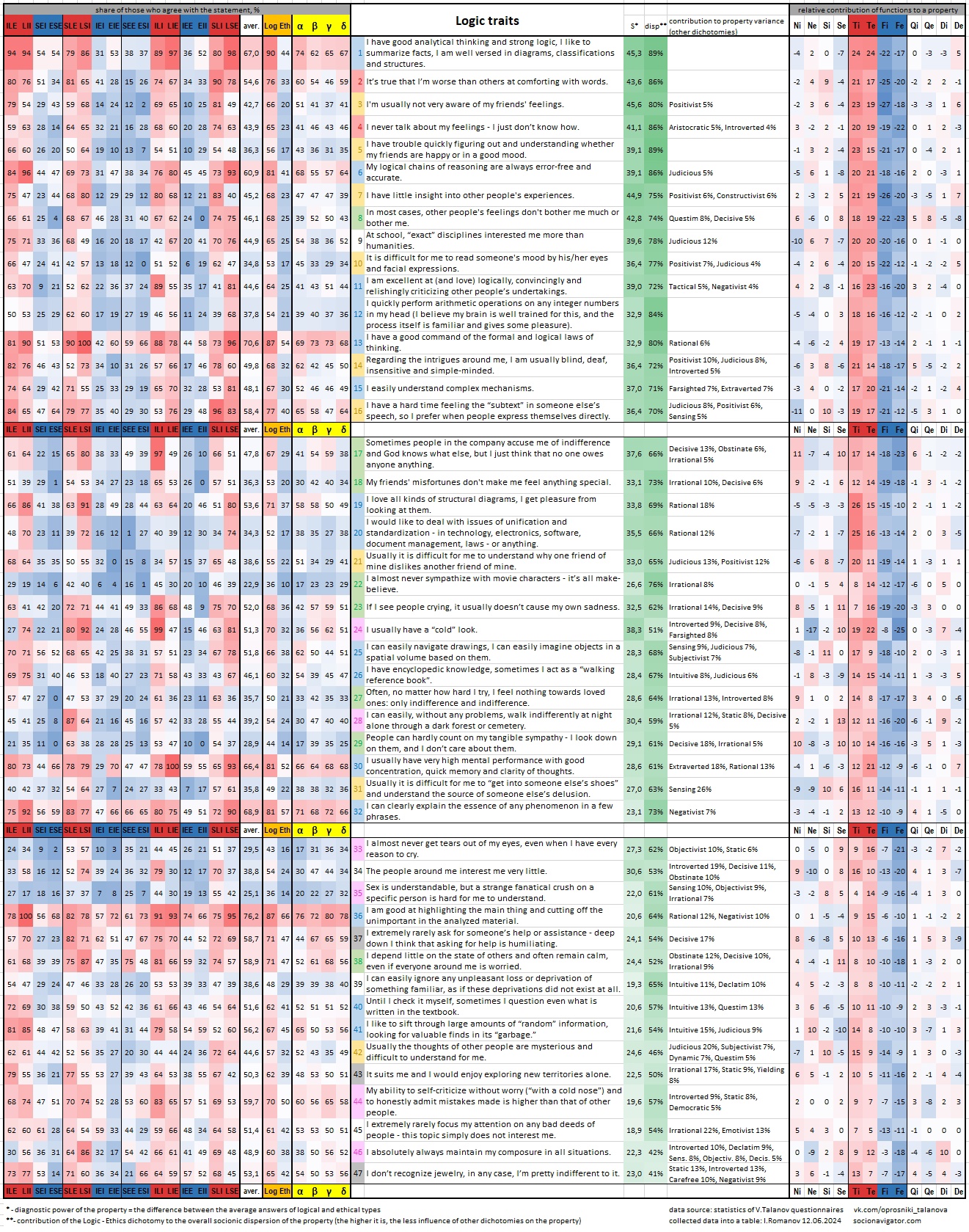

If for extraversion it is impossible to conduct a cluster analysis even on 100 properties (extraversion has many manifestations that cannot be divided into less than two or three dozen meaningful groups), everything is somewhat simpler with regard to ethics.
Based on 83 properties that clearly gravitate to this dichotomy, we managed to identify six semantic groups with their own peculiarities.
1. Cognitive empathy. It combines properties indicating the ability to make an abstract ethical analysis of another person - based on the nuances of their behavior, speech, and appearance. In addition to ethics proper, the following traits contribute to this property:
* negativism - allows you to better detect the oddities of another’s behavior and thus to see the differences between people,
* seriousness - gives a focus on someone else’s personality, rather than on typical elements of behavior.
* decisiveness - treating a vis-a-vis as a potential enemy requires discreet, unemotional study of their personality, and conversely, a discreet study of a vis-a-vis creates an atmosphere of distrust and hidden hostility.
The leaders in cognitive empathy in the socion are ESI and IEE, from the quadras - gamma; outsiders are SLI and ILE, from the quadras - alpha.
2. Ability to ethically influence people. In meaning, this cluster is closest to the previous one, but ethics is combined here with other attributes:
* declamity - necessary in any close communication, questims prefer to keep a distance with people.
* emotivism - flexible contact ethics is useful in a situation of finding an approach to different people.
The most skillful and effective in influencing people ethically is the SEE, the worst of all is the SLI and Alpha logicians.
3. Affective empathy. This includes the ability to empathize with someone else’s emotional state, to become emotionally infected with the emotions of another person or group. In addition to ethics, the main contributors to these properties are:
* rationality - as it positions a person relative to the group, it requires taking into account the state of other people, including emotional state, in one’s activity.
* judiciousness - because the very possibility of empathy in most cases (if we do not take into account deviations like sadomasochism) is impossible without a general benevolent attitude towards people in general, or at least towards the person who evokes emotional resonance in you.
The most developed affective empathy in socion is in ESE and EII, and the worst with the ability to empathize is the ILI. Judicious quadras generally outperform decisive quadras in this trait.
4. Internal emotionality of personality - subjective feeling of experiencing emotions in oneself, their strength and intensity. It can manifest itself externally through expressive behavior, which, however, is not controlled here rationally for communicative purposes, but in fact only has the purpose of drawing other people’s attention to oneself and one’s problems for consolation, support and involvement in solving problems. Among all the clusters examined, this is the one that, in our opinion, comes closest to what has been called the “first psychosophic emotion (1E)”. In addition to ethics, inner emotionality is enhanced by:
* cheerfulness - strong, coming from within, i.e. sincere, emotions are the main unifying stimulus for people.
* intuition - a rich imagination allows you to “wind up” emotions more strongly, living exciting moments again and again in different fictional situations and worlds.
According to statistics, the ethicists of the cheerful quadras, and especially the EIE, have the strongest inner emotionality, while the most internally calm and unemotional are the beta logicians and the owners of painful Fe. Of the quadras in general, alpha is the most emotional, while gamma is the least, which mirrors the distribution of ethical analysis abilities in the socion (cluster 1).
5. Logical abilities. Here we have included all statements, agreement with which indicates a high assessment by the individual of the level of his/her logical thinking, its clarity (noiselessness), infallibility and independence, as well as abilities for objective and unemotional criticism and self-criticism.
In addition to the pole of logic, logical ability is found to be enhanced by three other attributes:
* rationality - apparently, it allows you to better organize your thinking, make it more consistent and “book-like” logical.
* negativism - as in the case of cognitive empathy (ethical analysis), the ability to see defects in the material being analyzed, not to blindly trust what seems obvious, but to critically double-check everything is very important for the success of logical analysis.
* process - striving to use cognitively complex models strengthens logical abilities (it is mentioned here: https://vk.com/wall-168821911_75625).
Thus, LSE and LII have the most precise logical thinking in the socion, while IEI assess themselves most modestly here. Among the quadras, alpha is slightly ahead of the others, however, the difference is not significant.
6. The smallest cluster in terms of the number of properties and loosest in their composition. It was assembled around two properties: 37 and 43, which have in common the independence of the individual in terms of willingness to survive separately from others, without the help of the group. Interestingly, properties indicating reluctance to exchange gifts and signs of attention with others, and even to decorate oneself and others (i.e., to make people more attractive to each other) turned out to be close to this cluster.
In addition to logic, traits that contributed greatly to the generalized meaning of this group of properties were:
* statics - as the desire to solve one’s problems independently, and not by sharing resources with someone else.
* negativism - as a lack of sympathy to people, which leads to distancing oneself from society.
The leaders of this last cluster are SLE, ILI and LII, while its absolute outsider is ESE - the most social, oriented to constant maintenance of ties with the collective type.