Judiciousness-Decisiveness (Central-Peripheral Values)
Judiciousness-decisiveness is the fifth-strongest pair of traits in socionics, practically as important as irrationality-rationality (in some individuals, it may even rank 1st in terms of its “magnitude,” which is never the case for any other non-Jungian dichotomy). It is associated with the balance of functions: decisive Se and Ni versus judicious Si and Ne. This balance can provisionally be broken down into 4 components:
- Properties associated with the predominance of Ne over Ni: openness and straightforwardness in communication; openness as a leader (avoids the position of an “éminence grise”); avoidance of solitude (needs to have some people nearby at all times); a display of friendliness toward a broad range of people, a liking for lively, noisy gatherings and events, and an effort to create an atmosphere of friendship and trust within a group (rather than suspicion and disunity)
- Properties associated with the predominance of Si over Se: non-conflictuality; being slow to anger; moderation as a way of life (dislikes anything sharp, contrasting, or provocative); a preference for provisionally termed “herbivorous” strategies for obtaining resources for living (involving skillful processing of material and avoidance of conflict) over provisionally termed “predatory” ones (involving clashes with opponents of comparable strength in a struggle over material that has already been processed)
- Properties associated with the predominance of Si over Ni: values the present more than the past and future; is trusting and guileless; does not sense hostility in the surroundings or danger emanating from others (if these are present); has no inclination toward masochism, self-sacrifice, or provocative behavior; a well-developed parental instinct (wants to have many children and is prepared to provide for their physical care)
- Properties associated with the predominance of Ne over Se: engages in exploratory activity more often than territorial aggression; a weak possessive instinct and altruistic behavior (readily shares what they have - because they think there is always an opportunity to find more); the view that altruism is the norm and egoism a deviation (rather than vice versa), hence, among other things, the idea that encouragement is a more effective incentive than the threat of punishment; an open interest in other people’s differing views (rather than wary hostility) and tolerance of diversity in the surrounding world in general; respect for others’ freedom (does not want deliberately to restrict and/or exploit anyone); internationalism (does not divide people into “one’s own,” who are protected, and “outsiders,” who are oppressed); respect for ordinary people, including those who are weak and unable to stand up for themselves (since they too are capable of generating ideas and sharing them), but disrespect for the wealthy “powers that be” (who suppress Ne-related freedoms in order to perpetuate their dominance) (all of this is closely interconnected)
Among the other traits, the judiciousness pole has secondary associations with the poles of introversion, ethics, democracy, positivism, dynamics, tactics, yielding, and leftness. The most important associations are with introversion and ethics; because of these, judicious traits are often diagnosed in the IEI and ESI types, and decisive traits in LSE and ILE.
On possible objections concerning the semantic content of the judiciousness-decisiveness trait
Some critics of these conclusions (predominantly belonging, in terms of their sociotype, to the Gamma quadra) like to express the view that all people are egoists by nature, but that only some, the decisive, have the courage to admit this openly, whereas others, the judicious - wishing to establish a better reputation for themselves - are mistaken and mislead others by considering themselves supposedly altruistic, while essentially remaining just as egoistic. The following arguments are usually advanced in support of this position: even when performing good deeds and expecting no immediate reward for them, people nevertheless usually receive this reward subsequently - in the form of enhanced attractiveness and an improved professional and personal reputation in the eyes of others. Thus, being, for example, weaker by nature and unable to compete on equal terms with others, an individual may, for the sake of their own survival, choose a strategy of avoiding conflicts, peaceful conformism, and accommodation. By telling others about their “altruism” (which is not actually altruism but a forced form of behavioral egoism), they thereby achieve their aims by another, peaceful route. However, since, like all “normal” (read: decisive) individuals, they still dream deep down of winning in competition among the strong, but cannot, they also persuade themselves that they possess altruism - thereby “justifying” their weakness in their own eyes.
Let us set aside the fact that such reasoning in itself reveals the socionic nature of the people who use it as clearly as could be. But can it be said that they are at least partly correct in this reasoning? To examine this, let us try to understand how such traits as altruism and egoism, benevolence and hostility, arose in nature in the first place.
The agreeableness factor is one of the 5 main factors in the widely known Big-5 typology. And, as V. L. Talanov’s study showed, there is a close association between this factor and such socionic traits as judiciousness and ethics. But how can the contributions of these traits to benevolence be distinguished from one another?
People sometimes tend to confuse benevolence of an ethical kind, associated with empathic attachment to other people (usually relatives, friends…), with benevolence arising from belonging to the judiciousness pole. In the author’s opinion, the difference is as follows. The ethical component of benevolence is associated with the balance of rational functions, that is, altruistic acts here are always associated with specific relationships, as well as with emotions and moral and ethical attitudes instilled in a person by society. Ethical kindness is always relative and is determined by the nature of the current relationships between particular people. As relationships between people and the moral and ethical norms transmitted in society change, so does the individual’s level of ethical benevolence. Exactly the same applies to the degree of readiness to harm other people’s interests, which is associated instead with the balance of predominantly logical (but also rational) functions. This readiness is also relative and depends on the interests of the current undertakings in which the person is involved, as well as on logical considerations of a general nature.
By contrast, the level of benevolence-ill will, egoism-altruism, associated with the balance of a person’s judicious and decisive - that is, irrational - functions is not subject to conscious control. It is a background parameter of personality associated with its instinctive, animal (rather than social) component. And although it can be partly adjusted through the influence of the individual’s rational functions (and even then not permanently, but only until the governing judgments lose their force), it cannot be changed in its essence.
In the author’s opinion, the origin of the judiciousness-decisiveness trait is as follows: the more judicious human populations are those that historically formed on the periphery of large communities and survived by gathering dispersed resources over a large territory, as well as through cross-border exchange of ideas and goods with a low degree of processing (unprocessed raw materials). In such a situation, a strategy of cooperation between people is more advantageous. For there is no point in competing for resources if the surpluses that you personally can appropriate are small in comparison with the effort expended in the struggle, and also if they cannot subsequently be sold easily. It may be supposed that, over many generations, benevolent-altruistic traits became fixed in the genotype in such populations and became the “default” behavioral program - that is, one not subject to rational control.
Conversely, decisiveness as a trait arose and became established in those populations that historically occupied the most resource-productive landscapes and geographically central locations, and therefore, over time, concentrated within themselves large quantities of highly processed resources (i.e., with a large proportion of labor invested in them). In such a situation, the struggle for resources became fiercer, since it became possible to obtain goods many times more valuable and liquid per unit of effort expended. Accordingly, selection in such populations favored the establishment of qualities that made it possible to struggle more effectively with competitors over such goods - both individually and as members of various groupings. These may include heightened aggressiveness, a propensity for physical and verbal-psychological violence, a generally low level of empathy, heightened stress tolerance, foresight regarding dangers, ethical perceptiveness, and cunning (the specific content varies from type to type and is associated with which other traits, apart from decisiveness, are accentuated in the individual). Over time, here too, all these qualities gradually shifted from the domain of conscious control to that of unconscious, “automatic” enactment.
Thus, the author considers mistaken the view that all people are egoists, only more or less “disguised.” Proponents of this view tend to rationalize people’s every action excessively and to overestimate people’s capacity for conscious control over their inner nature. In reality, however, many personality qualities, including those associated with the level of benevolence and altruism, are innate and are expressed unconsciously, instinctively.
Depending on numerous environmental factors, natural selection favors better survival and reproduction of people who are more or less egoistic. For example, the following factors are very important:
- Judicious individuals are, on average, more fond of children (since willingness to invest in offspring is, essentially, a form of altruism);
- Decisive individuals usually achieve higher social status and greater access to resources; accordingly, men (above all) of decisive psychological types are more often successful in attracting female partners and leave more descendants;
- Decisive individuals are, on average, more aggressive; their way of life more often involves increased danger, and they therefore more often die or sustain critical injuries in various conflicts (again, this applies to men to a greater extent).
Because of the unique combination of these and other factors operating over a prolonged period (many generations), small reproductively isolated populations may differ markedly from one another in the mean value of the judiciousness-decisiveness trait (as of any other trait). And with regard to one such population, it is often quite possible to say that its members’ existing mean level of a particular trait, if it differs greatly from the worldwide level, is the most evolutionarily advantageous under those local conditions. But what interests us is by no means this mean level, but the individual characteristics of particular people resulting from natural genetic variability! Specifically, deviations in either direction from this population mean, which is provisionally optimal from the standpoint of survival and passing one’s genes on to descendants. In modern urban society, with its high level of genetic diversity, the trait values of particular individuals may be entirely random, completely detached from the conditions under which the selection that produced them occurred. In such a case, it is incorrect to say that a particular individual’s level of egoism-altruism, etc., is rationally determined even from the standpoint of the population as a whole (to say nothing of that individual).
In conclusion, I would note that, among the people who doubt the innateness of egoistic and altruistic personality traits and are known to the author to one degree or another, the numerical majority are precisely representatives of those types that are ambiverts with respect to judiciousness-decisiveness - i.e., in whom this trait is not pronounced. As practice shows, being an ambivert with respect to any particular trait (any trait at all) makes it much more difficult to understand its essence. The essence of a trait is felt most clearly when a person’s scores on it deviate as strongly as possible from the population norm - because, in that case, mutual understanding with the population as a whole inevitably becomes more difficult, and a sense of superiority over the majority arises, or, conversely, a sense of inadequacy (and often both at the same time, but in different domains).
If judiciousness-decisiveness is excluded from the calculation of the overall level of benevolence, that level becomes entirely determined by the balance of rational, reasoning functions. This is exactly what happens in ambiverts with respect to judiciousness-decisiveness - such people may quite sincerely feel that the egoism and altruism of those around them are determined by purely rational, socially conditioned factors. To overcome this cognitive distortion, the only thing I can recommend is to change one’s country of residence for a time and move somewhere where the historically established levels of judiciousness-decisiveness differ greatly from those of one’s native country. Somewhere with a different background level of this trait, a different “mentality.”
Conclusions
The semantic content of the decisiveness pole comes down to the desire and readiness to advance one’s egoistic interests while, without regret (often intentionally), harming the interests of others. Judiciousness, by contrast, is associated with an interested and benevolent attitude toward the world and other people, and a higher level of intragroup and intergroup altruism. In calculations of trait values based on a person’s overall level of benevolence or ill will, the component of benevolence or ill will that can be explained by consciously controlled, rational motives - considerations of utility, order, morality, and kinship ties - should be excluded. Manifestations of judiciousness-decisiveness include only the naturally given, general background level of benevolence, aggressiveness, and other competition-related personality qualities that is not subject to conscious control.
Addendum
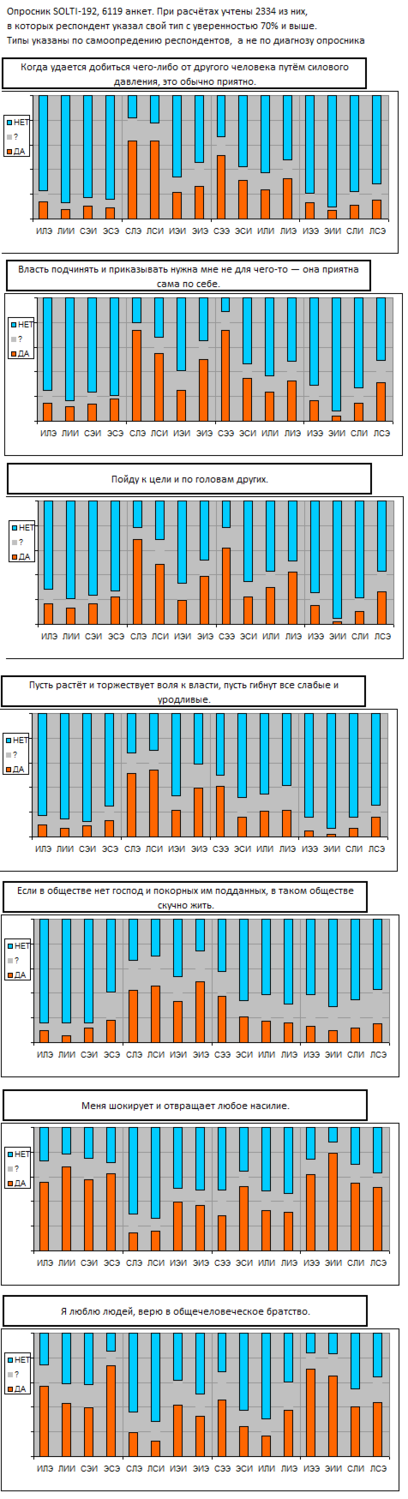
The image attached to the article shows the distribution of responses by representatives of the 16 socionic types (reported on the basis of self-diagnosis) to a series of questions whose meanings are closely associated with the judiciousness-decisiveness dichotomy. (The questionnaire used a 5-point scale to rate one’s agreement with the stated assertion; in the chart, respondents’ ratings of 4 and 5 are equated with “YES,” and ratings of 1 and 2 with “NO.”)
It is particularly worth emphasizing that many psychological attitudes closely associated with the decisiveness pole contain socially undesirable meanings, and even representatives of the decisive quadras acknowledge having them less often than average.
I also recommend materials from the VKontakte group “Talanov’s Questionnaires”:
- Psychological properties closely associated with the judiciousness-decisiveness trait
- Egoism – its socionic profiles
- Empathy for others’ pain (cluster No. 19 in the list of judiciousness-decisiveness properties)
- A cluster of the decisive pole - self-infatuation and self-admiration
- A property of the decisiveness pole: a disposition to appropriate everything and everyone (acquisitiveness)
- Socionic profiles of verbally provocative behavior
- Socionics: tracing sociopathy (an investigation in several posts) Part 1 – What psychopathies are, and sociopathy in particular; Part 2 – Assembling a socionic profile of sociopathy from clusters
Copileft: Ivan Romanov, Saint Petersburg, April 2019
The author permits free reproduction of the material from this page provided that a hyperlink to the source is included.