Is the Semantic Content of the So-Called Reinin Traits in Socionics Accidental?
The first descriptions of the meaning of the additional dichotomies belong to the pen of Aushra Augistinavichiute and were created by her, apparently, solely on the basis of empirical observations. Since at first there were no other descriptions, and owing to the authority of A.A., these descriptions were accepted by the socionic community and widely replicated - to the point that even today many consider them the only correct ones. However, later other descriptions also appeared - partly confirming A.A.’s point of view, and partly running counter to it. Different traits were affected to different degrees - thus positivism-negativism has survived to our days with minimal changes, whereas merriness-seriousness and questimity-declatimity received a completely different, deeper meaning little connected with the original one, and carelessness-foresight, on the contrary, was emasculated into a trait almost empty in semantic terms.
However, to all this there can always be objections from representatives of other socionic schools - why did you decide that your understanding of the Reinin traits is correct, and not ours, or, for example, Aushra’s?
And indeed, why? How can we check whether we understand the meaning of one or another trait correctly? Or are they all merely a convention, behind which nothing but the agreement of the majority stood or can stand? After all, the meanings of the dichotomies in the so-called Jung basis are in no way connected with each other. So why should the meanings of the additional traits be connected? Why, for example, do we attribute to a conventional ENTP also the set of personality features that are generalized in the description of the traits “judiciousness” and “positivism”, and not, on the contrary, “decisiveness” and “negativism”? Or, which is almost the same thing - why do we attribute to the pole of “decisiveness” the set of closely related personality features that we have now become accustomed to understand as “decisive”, and not the opposite, “judicious” set, or some third one altogether?
In fact, this is a very important question, the answer to which largely predetermines the future of socionics. If it is possible to prove that the system of RT (on which both the so-called duality and the quadra values rest) is non-random in terms of its semantic content, then such a proof will become a confirmation of the reality of the RT, and the value of socionics as a typology will increase manyfold.
However, if the scales of the weak RT turn out to be clogged with random sets of properties, there is always the temptation either to discard them altogether, branding them an “effect of self-suggestion”, or to argue endlessly about whose point of view is more kosher and authoritative in order to be recognized as “canonical”.
Fortunately, all this can be avoided. The solution lies in the very essence of the RT - namely, in how they were obtained. Few people pay attention to this, but the RT have one important difference from the basic foursome of dichotomies - the so-called “Jung basis”. All of them, as a mathematical category, were not introduced arbitrarily but were obtained by multiplying the poles of this original foursome, and also of each other.
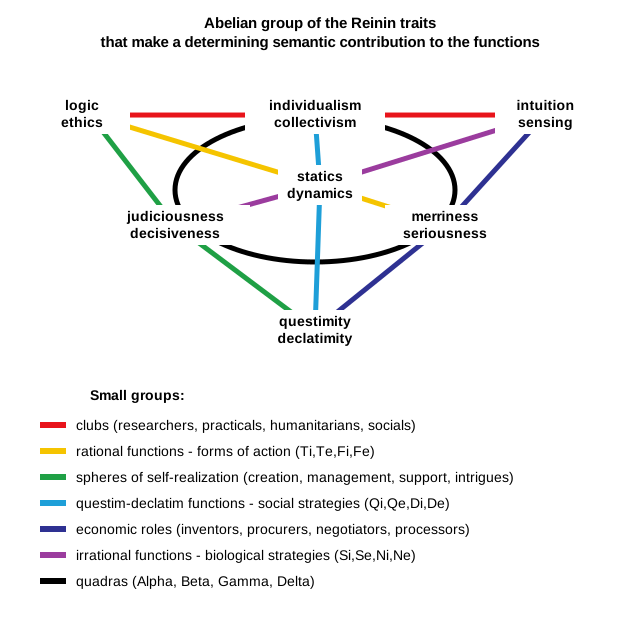
There are 35 so-called small groups - partitions of the socion into 4 groups of 4 types each - such that all types of one of these groups are on the common poles of some three RT, and differ from any other type by the poles of two RT out of these three. Such is the theory. Yes, in practice all this is not observed, and different RT can combine with each other in an absolutely arbitrary way. And besides extravert-rational-dynamics (an example of a small group with a “correct” linkage of the poles of the RT with each other), extravert-rational-statics, and introvert-rational-dynamics, etc. are also quite real. But still there is a theory, and if there is any sense in it, then the “correct” linkage should have an advantage over the “incorrect” one.
In order to link the RT logically with each other, it is necessary that all three RT in a small group possess significant, and at the same time sufficiently strong, semantic content. A number of weak RT that at the moment have no clear semantic core lead to the striking out of a number of small groups from the potential candidates for research. On the basis of going through many variants, the author settled on 7 RT that make a determining contribution to the functions considered in socionics. Namely, these include all the strong RT, excluding vertness and nality - the traits of the temperament group. All of them are linked with each other in 7 important small groups, among which three groups are purely functional, three combine functional and value traits (among them the so-called “interest clubs” - the strongest small group of socionics, but the other two, although less known, are also very important), and, finally, the last one consists only of value RT - the quadras.
to be continued