Personality Traits Associated with the Merry-Serious Dichotomy
(Statistics from V. L. Talanov’s questionnaires + our reflections)
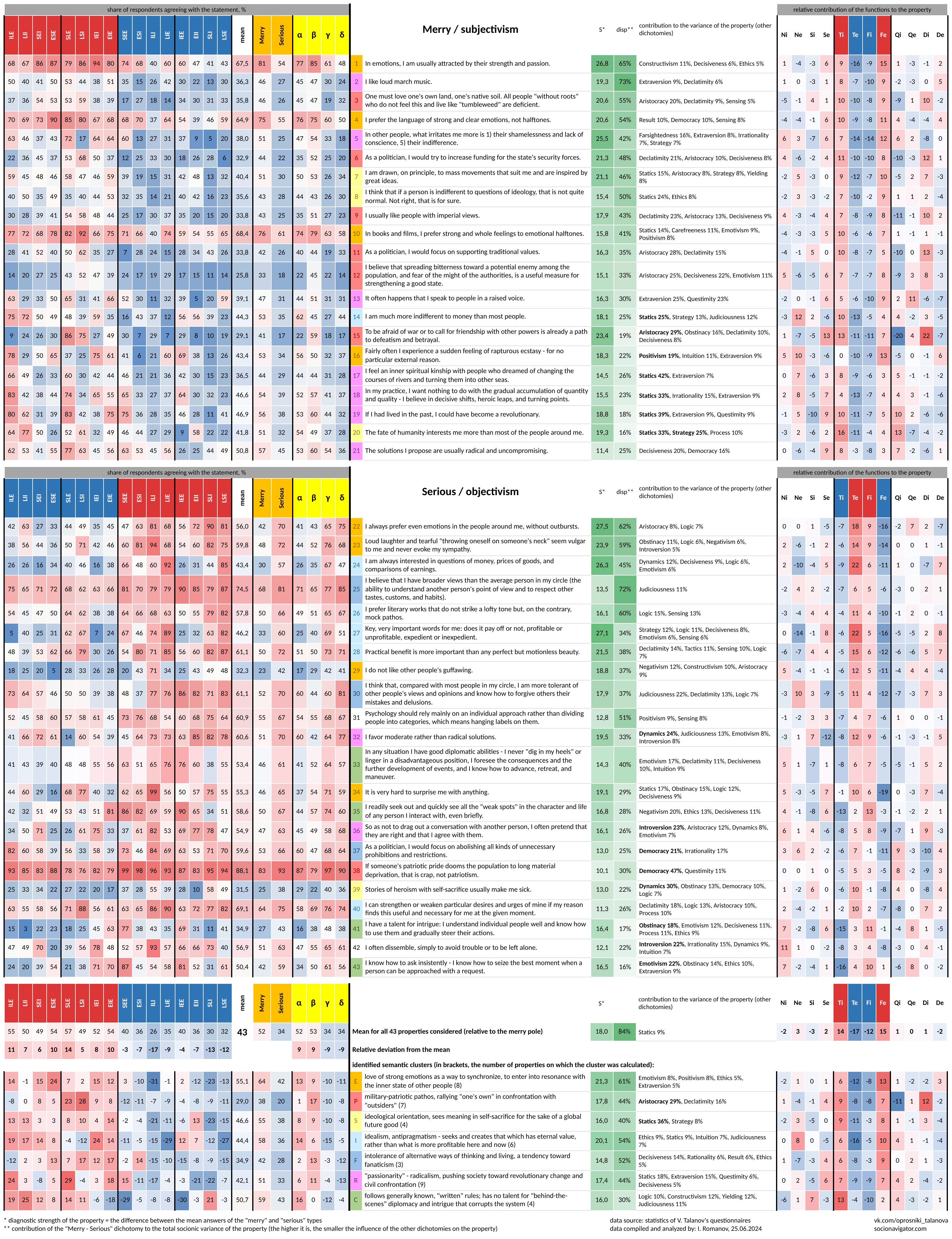
Using the available data (45 questions, of which 24 have a dominant contribution from this dichotomy), we were able to identify seven semantic clusters clearly tending toward this Reinin trait. However, none of these clusters can be called central, containing the core meaning of the dichotomy. In this respect, “merry-serious” differs both from the five strong dichotomies considered earlier and from a number of weaker ones.
The list of identified clusters, in descending order of their projection onto the trait axis (properties of the “merry” pole):
1. A love of strong emotions.
In addition to the attraction itself to strong, vivid emotions in other people, in reality, in art and cinema, this also includes properties associated with the strength of a person’s own emotional reaction to what is happening around them. Clearly, all these properties are reinforced both by greater trust in the authenticity of what is happening around them (if you perceive something as false, it will elicit neither liking nor an emotional response of your own) and by a desire to enter into emotional resonance with the people around them, to feel synchronized with them and to belong to the same group.
Both trustfulness and hypersociality fully characterize the ESE type, which leads here; the distrustful loner ILI also predictably occupies the other side.
Overall, a love of strong emotions is associated with the strength of the Fe function itself, as well as with its opposition to Te. The contribution of Ti here, however, is close to zero, which is why LII and LSI score substantially lower on this property, whereas SEE and IEE, which have relatively strong background Fe, stand out among the other “serious” types.
Since, in socionics, “merriness” was initially associated predominantly with the meanings of this cluster, it is not surprising that this feature was conspicuous in the earliest tests: types with leading Ti turned out to be “serious,” whereas those with Ti in the vulnerable position turned out to be “merry.”
2. Military-patriotic pathos.
As it turns out, confrontation with “outsiders” not only helps consolidate “one’s own” into a cohesive group (aristocracy + declatimity, Di), and not only intensifies intergroup competition (decisiveness, Se), but is also one of the most important motivating factors in the development of a global structure for governing society (Ti). In addition, war is perhaps the single strongest factor provoking emotions among masses of people, and these emotions are genuine and sincere (Fe), since they are associated with an existential threat to collective survival.
Within the socion, the military-patriotic theme is most frequently addressed and developed by the logical types of the second quadra, while their main fellow travelers here are the ethical types of both the second and first quadras. In rejecting the pathos of war and the defense of ancestral values, ILE more often aligns here with the descending quadras, whereas LII occupies a neutral position.
3. Ideological orientation - takes an interest in the global goals and tasks facing humanity, views the world through the prism of ideology, sees meaning in self-sacrifice for the sake of a global future good.
The cluster is identical to the opposition of Ti, Fe, and Ne on one side to Te, Si, and De on the other. Specifically, Ti provides the logical framework of any ideology, Fe sustains a sense of emotional unity with like-minded people near and far, and Ne lends global unity an idealistic, fantasy-like character. Te, by contrast, is interested in economics rather than ideology, while Si and De generally dislike complex topics that make one think.
At the poles of this property are the intuitive types of the first quadra, EIE, and EII, which joins the “merry” types, versus the extraverted logical types of the third and fourth quadras. In addition to merriness, the most important contributions to the cluster come from statics (since eternal values are at issue) and intuition (which allows one to view the world globally and as a whole); rationality also has an influence (as social responsibility toward the future).
4. Idealism, antipragmatism - seeks in the surrounding world that which has eternal value and universal beauty, rather than that which can be applied in practice here and now; creates more for the soul and at the heart’s bidding than for sale.
As with the preceding group of properties, the tone here is set by the opposition of Fe and Ne (with the contribution of Ne even greater than in the preceding cluster) to Te (primarily) and, in part, Se. At the poles of the property are IEI and ILE versus LIE and LSE; the ethical-intuitive types of the fourth quadra are on the side of the “merry” types here, whereas the logical-sensing types of the second quadra, in a mirror pattern, draw closer to the “serious” types. In addition to intuition and ethics, which are more inclined toward artistic expressiveness and less concerned with the practical application of their creations, judiciousness also makes some contribution to idealism, as a willingness to create without necessarily obtaining a return for oneself.
5. Intolerance of alternative ways of thinking and living, a tendency toward fanaticism in one’s views and, in extreme cases, a desire to act as an inquisitor, destroying dissent.
The meanings of this cluster are close to those of the second cluster; here, however, the issue is less a global confrontation between large groups of people than a personalized confrontation with specific people whose way of thinking and behavior differ from what the subject considers normal. The contribution of ethics therefore increases here, in its rational, leading, “guardian” form.
The “decisive” motive also manifests itself more strongly here (the desire to destroy personal enemies involves much more egoism and self-interest than the desire to join in destroying a collective enemy; in the second case, the motivation is, after all, also partly explained by a desire to protect and preserve “one’s own”).
In functional terms, Fe is primarily responsible for fanatical intolerance of dissent (it is precisely this function that produces fanatical frenzy); the contribution of Ti and Se is secondary here, while Ne (predictably, since this is the function that loves diversity) and Te (why eradicate something if it can be used?) are the most tolerant of alternatives.
Among the types, the second quadra is most inclined toward fanaticism in the struggle against dissent; it is specifically its rational dyad that usually takes the lead in seeking an internal enemy. Its initiatives are usually readily supported by both rational social types: ESI (despite its “seriousness,” the irritable intolerance of otherness inherent in vulnerable Ne makes itself felt) and ESE (despite its “judiciousness,” the declatimity- and Fe-related susceptibility to the group’s opinion inherent in the ethical types of the first quadra has an influence). The sociotypes most tolerant of alternative ways of thinking and living are IEE, LSE, ILI, and ILE.
6. “Passionarity” - radicalism, pushing society toward revolutionary change and civil confrontation.
In this cluster, merriness combines with extraversion, forming a pronounced choleric temperament with its characteristic irritable intolerance. The four psychological types in which this temperament most frequently manifests itself, SLE, ILE, EIE, and SEE, lead in destabilizing social peace and tranquility, while the introverts of the “serious” quadras do more than the others to calm the situation. Among the functions, the Fe+Se combination comes to the fore here, opposed by the peace-loving, conformist Fi, Si, and Di, and by Te, which dislikes abrupt changes (because they destroy established businesses).
7. Follows generally known, “written” rules; has no talent for “behind-the-scenes” diplomacy and intrigue.
The only cluster in which the contribution of structural logic to the “merry” properties comes to the fore, while the role of Fe remains neutral. Ti (which relies on universal standards) is opposed here by Fi (which, by contrast, tends to resolve problems privately). The opposition between Si (guilelessness and directness) and Ni (intrigue and things left unsaid) is also apparent.
Among the psychological types, all representatives of the first quadra prefer to play by generally accepted rules (because of their orientation toward the global common good), as do most logical-sensing types (because of the concreteness of their thinking and, consequently, their limited aptitude for subtle intrigue). The remaining types more often tend to resolve problems privately, circumventing generally accepted rules, especially SEE and IEE, which have creative Fi.
I. Y. Romanov (socionavigator.com) 24.06.2024 - 07.2026, CC BY-NC 4.0
All rights to the source data belong to Viktor Lvovich Talanov.
When publishing the data on third-party websites, an active hyperlink to socionavigator.com and vk.com/oprosniki_talanova is required.
”Merry-Serious”. Searching for the Core Meaning of the Dichotomy.
So, what unites all these disparate properties into a single whole? Does such a property exist, and if so, why is it so difficult to identify?
Before proceeding to describe the author’s current understanding of the nature of the merry-serious trait, let us briefly review earlier theories.
Previously, the following were proposed as a unifying property representing the quintessence of the “merry” pole:
1) A love of strong emotions, regardless of their nature (whether associated with the joy of unity, existential fears, the pathos of irreconcilable confrontation, or the possibility of continuing into the future through one’s children and like-minded people).
As we have already established, a love of strong emotions is much more characteristic of Fe than of Ti; the latter’s “merriness” manifests itself more in adherence to certain global orders than in emotional affects.
2) The surplus energy, the “passionarity” of “merry” functions and types, which prompts them to act “with energy to spare,” thereby warming and structuring not only their immediate surroundings but also the global social environment.
However, as is known today, surplus energy is primarily a property of extraversion. Yes, the meanings of extraversion and merriness can be distinguished if we posit that extraversion is associated with a person’s superior energy potential relative to the social environment (the extravert is a bearer of impulse, and the introvert of inertia), whereas merriness indicates the overall high energy level of the environment itself.
Moreover, this can even explain a certain correlation between extraversion and merriness, which is discernible, albeit only as a barely perceptible tendency.
But how, in that case, will “merriness” manifest itself at the individual level? As a love of an environment “with a higher energy level,” that is, a more emotionally intense one? But then we return to what was written above. Or as directing one’s activity from the outset toward an indefinitely large circle of people, toward emotional synchronization with this circle (for Fe) or synchronization in thought and activity through creating and imposing a system of universal standards (for Ti)? In that case, we move on to the next point.
3) Namely, “merriness” is indeed more closely associated with an interest in the global processes and phenomena of this world. A sense of involvement in the fate of one’s nation and humanity as a whole is more characteristic of the first two quadras, whereas the other two are more characterized by an interest in the world limited to family and narrowly professional processes and phenomena, a sense of involvement in the fate of those close to them combined with indifference to the fate of larger masses of people.
However, here we observe some overlap in meaning with the intuition-sensing dichotomy, since it is intuitive types, by virtue of their broader perceptual focus, who more often take an interest in global questions concerning the universe (which always seem too generalized and abstract to the average person), whereas sensing types focus on the reality they encounter in everyday practice (and for most people, excluding major politicians and businesspeople, all of this is a very narrow area within the larger world).
3a) This also includes the tendency for the creative work of “merry” types to favor a “high style”, that is, a universal language allowing one to expand one’s audience as much as possible, and for “serious” types to favor various jargons and dialects that allow them to “pick out” “their own” from the entire mass of humanity in the surrounding world, in order to convey information specifically to them alone.
4) “Merriness” is also often defined as subjectivism, that is, a desire to impose one’s values on the surrounding environment (literally: to be a subject), reshaping it according to one’s ideas of what is desirable, right, and necessary. At the other pole here, accordingly, is objectivism: the understanding that the world around you is an objective given within which you were formed, so that continuing to play your game according to the rules of this world is far more reliable and advantageous for you than inventing something of your own.
This interpretation accords well with the “age” hypothesis of the origin of quadra values, according to which the first two quadras (“merry”) are the quadras of people who are “young in spirit” and, consequently, full of ambitions to change the world to suit themselves, whereas the last two quadras (“serious”) correspond to older ages, when the individual seeks to consolidate what has been achieved and reap its fruits, which is why, to new generations, the individual increasingly begins to resemble an object within the world created by that individual and their generation.
However, let us be honest: this interpretation once again much more closely resembles the opposition between the poles of other functions:
- Active extraverts and passive introverts
- Intuitive types oriented toward an ideal not yet realized and sensing types well established in the real world
- Static types defending their principles and dynamic types adapting to the will of others
It also fits poorly with the fact that orientation toward the collective past or future is determined by the pole of the aristocracy-democracy dichotomy, which is orthogonal to merry-serious; consequently, in those quadras where merriness is combined with aristocracy (Beta) and seriousness with democracy (Gamma), none of the above will work at all.
Thus, of all the interpretations of merriness, this one perhaps appears the least convincing.
”Merry - Serious” as an Opposition between the Transpersonal and the Personal. Description of the Dichotomy (Including Its Characteristic Manifestations in Combinations with Other Traits).
| ”Merry” transpersonalism | ”Serious” personalism | |
|---|---|---|
| deriving the meaning of one’s existence beyond the personal “I” and elevating it to supra-personal being; building, supporting, and promoting institutions that help one’s transpersonal identity survive | denial of the existence of supra-personal being; the drive to develop personal identities, obtaining resources for this individually; using collective institutions to achieve one’s own or someone else’s personal goals | |
| logic | building a collective world order and a system of governing society | gaining time for the fastest and most economical achievement of goals |
| ethics | expressing and perceiving strong emotions in order to feel a deep resonance with one’s group | ethical manipulation to attract and retain particular partners |
| sensing | defending traditional values and social roles; self-sacrifice for the survival of one’s people | personal bodily self-preservation and personal genetic reproduction |
| intuition | the search for eternal global truths and distant prospects, communion with the absolute, utopian ideas | seeing the possible ways events may unfold; broad-mindedness - the ability to understand other people’s alternative values |
| extraversion | a collective forced march toward a great goal that promises vivid positive emotions | multitasking; frequent changes of goals and social contacts in order to maximize benefits |
| introversion | inertia in keeping a place in the system once chosen; unwillingness to change it merely for the sake of gain | keeping one’s distance from collective activity; the desire to live without attracting unnecessary attention |
| rationality | prolonged concentration on a single theme; formation of overvalued ideas | constantly checking one’s behavior against the requirements of the setting and the situation; personal control over one’s life |
| irrationality | the drive to throw off cultural frameworks and restrictions in order to realize one’s true natural essence | the ability to imitate cultural norms for the sake of personal gain and peace, without actually sharing them or believing in them |
| statics | perceiving one’s identity as supra-personal; readiness to defend it at the cost of self-sacrifice | the drive to separate one’s individual identity from any external influences |
| dynamics | the desire to merge with a superior will, up to the dissolution of one’s individual identity | readiness to submit to a superior will and change one’s identity for the sake of self-preservation and comfort |
| questimity | the drive to make one’s individual values universal; the position of a creator, shaman, prophet | the drive to protect one’s personal values from the pressure of the collective; individualism |
| declatimity | perceiving the collective values of one’s society as one’s own and bringing others up in their spirit | understanding the diverse individual values of others; the role of translator, intermediary, adapter |