The Meanings of the Eight "Classical" Functions of Socionics - Reverse Inference from the Meanings of Function Combinations
| Ti - values impersonality and objectivity in oneself and in others | Te - wants to be valuable according to the criterion of one’s objective, impersonal effectiveness and benefit | Fi - values the personal and subjective in oneself and in others | Fe - wants to be valuable according to the criterion of one’s personal subjective attractiveness | ||
|---|---|---|---|---|---|
| Considers everyone “one’s own”, and everything common | Ne | 🟩 Does not value what is personally one’s own, depersonalizes oneself, makes one’s position more detached and abstract | 🟨 Easily changes one’s position, borrows and adapts what belongs to others for one’s own use if it is objectively more advantageous than what one previously had | 🟩 Values what is personal to others, humanizes others, imbues them with humanity, and animates the world as a whole | 🟨 Selflessly gives away what is personally one’s own to make it more subjectively attractive and thereby common |
| Wants to be an unneeded “outsider” - so as not to be exploited or parasitized | Ni | 🟦 Perceives the general and objective better through distancing oneself from others and solitude | 🟥 Seeks to be unpleasant in order to avoid being parasitized by unprofitable ties and the objective losses associated with them | 🟦 Perceives the personal better because of the habit of concealing what is one’s own and the understanding that others likewise conceal other worlds within themselves | 🟥 Seeks to be harmful in order to avoid outsiders seeking advantage, an alliance with whom leads to a loss of subjective attractiveness |
| Considers others “outsiders”, and divides everything into one’s own and others’ | Se | 🟩 Does not value what is personal to others, depersonalizes and objectifies others, and therefore uses violence more readily | 🟨 Concentrates what belongs to others and what is common under one’s own power in the process of competition according to objective criteria | 🟩 Values what is personally one’s own, introduces concrete egoistic interest and personal control over those close to oneself everywhere | 🟥 Aggressively defends one’s personal subjectivity and attractiveness against any external attacks |
| Wants to be needed, loved and valued as “one of their own” - so that others will help | Si | 🟦 Perceives the general and objective better through concentration on one thing, a literal reading of the world | 🟥 Does what is objectively useful for others in order to be a needed and valued counterpart | 🟦 Perceives the personal and subjective better through closeness to others and following them closely | 🟥 Does what is subjectively pleasant for others in order to draw attention to oneself and one’s needs |
| 🟨 Four forms of extraverted activity | 🟦 Four forms of introverted energy conservation | 🟩 Four types of static values | 🟥 Four dynamic ways of satisfying needs |
|---|
| Logic = assessments of the impersonal according to objective criteria | Intuition = perceiving oneself as an outsider among one’s own |
| Ethics = assessments of the personal according to subjective criteria | Sensing = perceiving oneself as one of their own among outsiders |
| Merriness = assessments of the impersonal according to subjective criteria | Judiciousness = perceiving oneself as one of their own among one’s own |
| Seriousness = assessments of the personal according to objective criteria | Decisiveness = perceiving oneself as an outsider among outsiders |
view the English version of the table
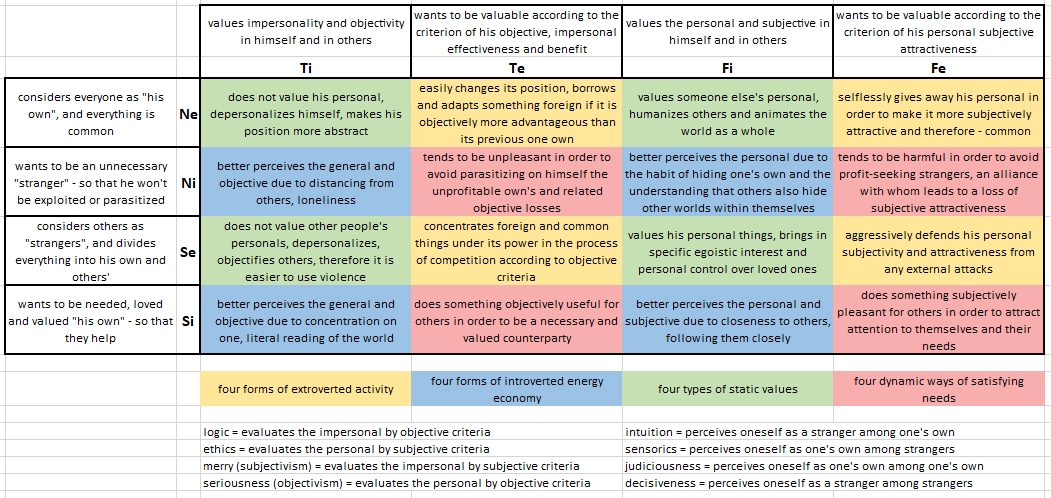
Considering the properties associated with combinations of functions may be useful, since people often identify a property that pertains to the combination of a given function with another function with the function itself, with its principal property; that is, instead of the central variant, they consider a semantic variant that, although important, is nevertheless peripheral.
Our task, however, is to identify the central meaning of each function by analyzing the entire spectrum of its meanings and finding what is common to all the statements within that spectrum. This is precisely what we have done. We have sought to remove, as far as possible, the parasitic influence of the meanings of the questimic-declatimic functions from the meanings of the eight classical functions of socionics.
In parallel, we were able to reconstruct the definitions of the main dichotomies associated with the functions (and, if desired, one can also try to derive quadra and club values from this table - we leave the latter to our readers).
The main information is in the attached images (including an English translation)! Below, in the text of the post, there are only free interpretations, vulgarized to create a vivid image!
Images of the functions (how to quickly understand what is what):
Dynamic aspects - sensations from the resource being consumed:
Fe - pleasant but harmful
Te - useful but unpleasant
Si - useful and pleasant
Ni - harmful and unpleasant
Static aspects - values:
Fi - one must make things better for a particular person - alternative: “one must act in accordance with the will of a particular person” [author’s note, 07.2026]
Ne - one must make things better for everyone - alternative: “one must act in accordance with the general will” [author’s note, 07.2026]
Se - one must obtain something from a particular person against that person’s will/desires
Ti - one must obtain something from everyone against their will/desires
Extraverted aspects - forms of activity:
Fe - protect what is valuable to you from the influences of others, and give it away to others in order thereby to make them your own
Te - borrow what belongs to others in order ultimately to accumulate more of what is objectively valuable for oneself and become the best according to external, common criteria
Se - accumulate for oneself what one considers valuable, and then protect it from the influence of what belongs to others in order to possess it exclusively
Ne - borrow what belongs to others, and then give it away to others in turn, so that ultimately everything objectively valuable becomes common
Introverted aspects - forms of energy conservation:
Ni - concealment and distancing (conservation through avoiding direct confrontations)
Si - revealing one’s nature and drawing closer (conservation through a symbiosis of needs)
Ti - revealing one’s nature and distancing (conservation through refraining from social games)
Fi - concealment and drawing closer (conservation through the use of shared infrastructure)