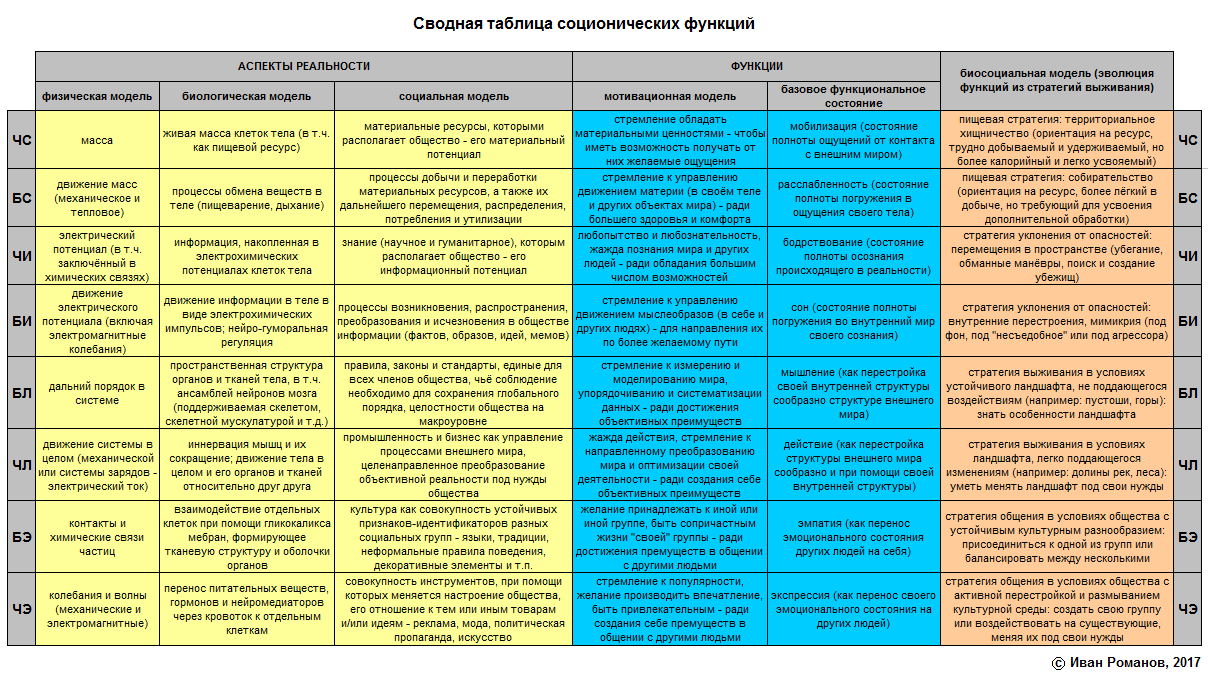
Socionic Functions - Description
Ethics - the function responsible for the ability to communicate, i.e., to interact with other people as subjects possessing an individuality that cannot be formalized.
Logic - the function responsible for the ability to interact with the objective world, in which uniform, formalizable laws common to everyone operate.
Sensing - the function responsible for the ability to obtain, process, and preserve the material resources necessary for the individual’s survival as a biological body.
Intuition - the function responsible for the ability to obtain, process, and preserve the information necessary for the individual’s survival as an informational entity.
Ethics
Properties common to all varieties of ethics:
- heightened emotionality - both internal (subjectively experienced) and outwardly expressed;
- attentiveness to nonverbal expressions of emotion;
- attentiveness to individual features of people’s speech - intonation, ways of constructing phrases, characteristic expressions;
- well-developed empathy; also the ability to “put oneself in another person’s place,” to “feel others from within”;
- preference for ethical motives over logical ones in decision-making;
- relatively reduced capacity for formal and impartial analysis (especially when there is a personal interest in a particular outcome);
- often - a lack of composure in emotionally provocative situations.
Varieties of ethics
| Classical name | Ethics of emotions (dynamic “black” ethics, Fe) | Ethics of emotions (dynamic “black” ethics, Fe) | Ethics of relations (static “white” ethics, Fi) | Ethics of relations (static “white” ethics, Fi) |
|---|---|---|---|---|
| Leading Fe | Creative Fe (the properties are primarily associated with a deficiency of Te) | Leading Fi | Creative Fi (the properties are primarily associated with a deficiency of Ti) | |
| Name in the 16-function system | Linear-assertive ethics (LA-E) | Receptive-adaptive ethics (RA-E) | Balanced-stable ethics (BS-E) | Flexible-maneuvering ethics (FM-E) |
| Function as a set of traits | Ethics, merriness, dynamics, extraversion, rationality | Ethics, merriness, dynamics, introversion, irrationality | Ethics, seriousness, statics, introversion, rationality | Ethics, seriousness, statics, extraversion, irrationality |
| Function as an average of the properties of types | ESE and EIE | SEI and IEI | ESI and EII | SEE and IEE |
| Key property | Transmission of one’s emotional arousal to a broad audience. The ability to “charge” others with a mood at a distance, even without personal contact. | Flexible emotional attunement to individual people; the ability to unobtrusively create a desired emotional image of a particular phenomenon or person. | An orientation toward strong emotional attachment to particular chosen people; the ability to be a faithful, reliable companion to those close to oneself. | The ability to manipulate relationships flexibly and without overburdening oneself with excessive sympathy, moving closer to the people one needs and distancing oneself as the situation requires. |
| Social role of the function | Spreading particular emotions through a group - for example, inspiring people to take certain actions, drawing everyone’s attention to particular problems. Ensures synchronization of activity, unity, and cohesion within the group. | Harmonizing the group’s emotional microclimate, smoothing out contradictions. Ensures the group’s “viscosity” - its ability to change its composition and relationship structure somewhat under the pressure of external influences without disintegrating completely. | Giving stability to intragroup ties. Ensures the group’s “strength,” its resistance to external loads without changes in the internal structure of relationships. | Introducing an element of play and a potential readiness for change into interpersonal ties. Ensures the group’s “elasticity,” its ability to resist ongoing changes by restoring the structure of relationships after an external influence. |
Properties most closely associated with the predominance of a particular function in the personality structure:[1]
LA-E (“leading” Fe)
- A tendency toward outward outpourings of emotion; expressiveness
- Rich, mobile facial expressions that strongly reflect emotions
- Openness and frankness in communication
- Verbosity
- Dislike of working alone; tolerance of other people’s interference in one’s work process
- Enjoys being the center of attention; prefers to have an audience to which to convey one’s own emotions; as a consequence - pays more attention to how people relate to oneself than to their relationships with one another
- Frequency of sensations of internal heat; dislike of cold, fear of cold; dislike of the color blue (which is probably associated with cold)
BS-E (“leading” Fi)
- Well-developed feelings of guilt and shame; a strong sense of conscience
- Suggestibility; dependence on society’s opinion
- Frequency of thoughts about spirituality, morality, and God
- A tendency to be led; submission to fate
- Attentiveness to minor ethical details in other people’s behavior
- Rigidity of the system of moral values; fidelity in marriage
- A predisposition to intrusive thoughts
- A tendency to worry in advance about possible troubles
- A tendency to become “stuck” on psychologically traumatic moments; difficulties repressing unpleasant memories
RA-E (“creative Fe,” “anti-Te”)
- Seeking protection and patronage
- Prefers to adapt to other people, to their moods, wishes, and interests (conformity); the ability to “charm” the people one needs when necessary
- A high level of tolerance for any opinion held by another person
- Attentiveness and sensitivity to other people’s opinions of oneself
- Avoids activities that require being a leader, making decisions, and taking responsibility for them; doubts one’s own competence and business capabilities
- Low levels of purposefulness, industriousness, and stress tolerance - prefers idleness and a relaxed existence
- A liking for long periods of sleep
- An interest in artistic creation and the field of design is characteristic
- An aesthetic preference for smooth, fluid forms (rather than sharp, clearly delineated ones)
- A liking for the color blue - as the color of peace, harmony, and inward-looking contemplation
FM-E (“creative Fi,” “anti-Ti”)
- Sociability - ease and lack of inhibition in initiating contact
- Flexibility in communication; the ability to give compliments and manage an interlocutor’s mood; a propensity and talent for ethical games
- Passionateness
- Frequency of changes of mood and relationships
- Inconsistency of thinking: dislikes organizing and working through fine logical details
- Preference for the quantity of what is done over its quality; carelessness in actions
- A tendency toward illogical behavior; frequently - a failure to understand the difference between what is desired and what is possible
- A tendency toward boasting and impulsive lying, toward shifting responsibility for one’s actions onto other people and external circumstances
- Low tolerance for monotonous activities
- Difficulties planning one’s time
Logic
Properties common to all varieties of logic:
- a relatively heightened capacity for formal and impartial analysis (even when there is a personal interest in a particular outcome);
- a high level of composure and self-control;
- reduced emotionality - both internal (subjectively experienced) and outwardly expressed;
- inability to enter another person’s inner world of experiences and understand their emotions;
- reduced capacity for empathy;
- preference for logical motives over ethical ones in decision-making;
- concentration of attention on factual information in an interlocutor’s speech and disregard for individual features of its presentation - intonation, ways of constructing phrases, characteristic expressions, etc.
Varieties of logic
| Classical name | Business logic (dynamic “black” logic, Te) | Business logic (dynamic “black” logic, Te) | Structural logic (static “white” logic, Ti) | Structural logic (static “white” logic, Ti) |
|---|---|---|---|---|
| Leading Te | Creative Te (the properties are primarily associated with a deficiency of Fe) | Leading Ti | Creative Ti (the properties are primarily associated with a deficiency of Fi) | |
| Name in the 16-function system | Linear-assertive logic (LA-L) | Receptive-adaptive logic (RA-L) | Balanced-stable logic (BS-L) | Flexible-maneuvering logic (FM-L) |
| Function as a set of traits | Logic, seriousness, dynamics, extraversion, rationality | Logic, seriousness, dynamics, introversion, irrationality | Logic, merriness, statics, introversion, rationality | Logic, merriness, statics, extraversion, irrationality |
| Function as an average of the properties of types | LSE and LIE | SLI and ILI | LSI and LII | SLE and ILE |
| Key property | The ability to maintain the direction and pace of work. Purposeful activity under objective conditions. | The ability to maintain the normal operation of systems by minimal means. Flexible adaptation to objective factors. | The ability to maintain the stability of a logical system. An orientation toward objectively optimal laws. | The capacity to discover, develop, and implement fundamentally new (and at the same time objectively optimal) laws. |
| Social role of the function | Maintaining the pace and direction of activity necessary for the group’s survival as a unified whole in the external environment. Ensuring the regular functioning of production chains: long-term planning, construction, resource extraction and processing. | Monitoring deviations in established production cycles: searching for hidden defects, potential problems, and other “peculiarities” in the functioning of equipment and technology. Ensuring the “running-in” of equipment and technology when brought into operation, as well as routine repairs and adaptation to changing operating conditions. | Maintaining the group’s optimal orientation relative to the objective conditions of the external world. Consolidating this orientation in a system of laws, rules, and standards - benchmarks. Monitoring compliance with these laws, rules, etc. | Activity under objectively new conditions - crisis management, work at the forefront of opening up some “untamed” environment. Irregular reconnaissance, establishing a new business, state-building. |
Properties most closely associated with the predominance of a particular function in the personality structure:[1]
LA-L (“leading” Te)
- Purposefulness; well-developed time management (including long-term planning of one’s life and career)
- Composure and energy
- Industriousness - becomes absorbed in any processes of purposefully changing the surrounding world, cannot conceive of oneself apart from one’s work, “hides” in work from personal problems
- A desire to remain informed about the current situation in its full scope and entirety
- A desire to invariably derive benefit from current activities
- A desire to increase the efficiency of the activity undertaken
- Prefers to solve problems immediately, as they arise
- Difficulties understanding “subtle” and implicit emotions, including those embodied in the aesthetics of music, painting, and design; an absence of inclination and ability for artistic creation
- Speaks the language of action - many verbs in speech
BS-L (“leading” Ti)
- A liking for classification and the search for typical exemplars
- Consistency of thinking
- An interest in formal logic
- Attention to fine logical details; thoroughness and perfectionism in working through material (may be perceived by others as tediousness)
- An absence of the desire to change anything in the surrounding world with one’s own hands - prefers to manage static structures rather than the dynamics of processes
- An emphasis on quality rather than quantity in one’s actions
- A negative attitude toward risk; preference for a small but more reliable and predictable profit
- Non-impulsive behavior
- Keeping one’s word; reliability in fulfilling commitments; places the team’s tasks above one’s own interests
- Difficulties understanding people; inability to establish informal contacts; always addresses people formally (a protective distance); inability to make jokes and intrigue others
RA-L (“creative Te,” “anti-Fe”)
- Secretiveness in communication; likes keeping people in the dark
- Taciturnity
- Prefers to live and work alone; likes peace and quiet - so that no one disturbs, agitates, or provokes oneself
- Indifference toward people; a lack of concern (“my hut is on the edge, I know nothing”)
- Does not tolerate interference in any of one’s activities
- Critical thinking and skepticism: can find defects in any available material
- Enthusiastic, idealistic emotions are uncharacteristic; a state of intense romantic infatuation is uncharacteristic
- Avoidance of useless activities and unnecessary expenditure of effort; slow, economical movements
- Prefers cats to dogs as companion animals (probably because their generally individualistic character resembles one’s own)
FM-L (“creative Ti,” “anti-Fi”)
- Independence of outlook and aspirations in life; low susceptibility to the opinion of the majority
- A positive attitude toward risk; enjoys participating in high-risk activities; a tendency toward radical, risky decisions
- An interest in situations and activities in which limits are determined by objective laws of nature rather than by society
- A well-developed ability to quickly find a way out of difficult situations involving an unusual combination of objective factors
- Inattention to the ethicality of behavior - both one’s own and that of others
- A predisposition to violating society’s laws, especially unwritten ones
- Feelings of guilt are uncharacteristic
- A liking for weapons
- High tolerance for noise in the surrounding environment
Sensing
Properties common to all varieties of sensing:
- life interests are concentrated in the material sphere and, predominantly, on material well-being “here and now”;
- a well-developed sense of ownership;
- thinking is more concrete and attentive to detail;
- dislike of speculative reasoning and a lack of understanding of fantasies that cannot be converted into material resources;
- decision-making is oriented toward highly probable information that is unambiguous and repeatedly confirmed (and a skeptical attitude toward low-probability trends);
- relatively good coordination of bodily movements (in introverts, to a greater extent, of fine motor movements; in extraverts, of the muscles of the limbs);
- stronger development of the instinctual sphere of personality, including the sexual instinct;
- the understanding of commonality and kinship with other people is more materialistic (outward resemblance, shared ancestors) than informational and spiritual (similarity of views).
Varieties of sensing
| Classical name | Volitional sensing (static “black” sensing, Se) | Volitional sensing (static “black” sensing, Se) | Sensing of sensations (dynamic “white” sensing, Si) | Sensing of sensations (dynamic “white” sensing, Si) |
|---|---|---|---|---|
| Leading Se | Creative Se (the properties are primarily associated with a deficiency of Ne) | Leading Si | Creative Si (the properties are primarily associated with a deficiency of Ni) | |
| Name in the 16-function system | Flexible-maneuvering sensing (FM-S) | Balanced-stable sensing (BS-S) | Receptive-adaptive sensing (RA-S) | Linear-assertive sensing (LA-S) |
| Function as a set of traits | Sensing, centrality, statics, extraversion, irrationality | Sensing, centrality, statics, introversion, rationality | Sensing, peripherality, dynamics, introversion, irrationality | Sensing, peripherality, dynamics, extraversion, rationality |
| Function as an average of the properties of types | SLE and SEE | LSI and ESI | SLI and SEI | LSE and ESE |
| Key property | The ability to concentrate material resources under one’s control, including pushing aside and suppressing competitors. | The ability to retain and preserve existing material resources in a competitive environment. | The ability to avoid situations of unnecessary strain and risk to health and life, achieving material well-being with minimal effort. | The ability to regularly maintain the functioning of everyday domestic life and other processes that ensure material well-being. |
| Social role of the function | Concentrating power and material resources under the control of society’s elite, increasing this elite’s chances of survival (and thereby the preservation of this part of society) under critical conditions. | Ensuring the preservation of material goods under conditions of competition, distributing them according to need and the status of members of society, and curbing abuses in these matters. | Ensuring the continued reproduction of material resources (especially food), flexibly adapting to the habitat and the living natural world that produces these resources. | Dealing with everyday material matters that are in principle unavoidable (managing material supplies, organizing social events). |
Properties most closely associated with the predominance of a particular function in the personality structure:[1]
FM-S (“leading” Se)
- High confidence in oneself, in one’s right to exploit other people, to receive material goods first, to possess the best, “high-status” property; a tendency to magnify oneself by belittling others
- A desire for situations of struggle and rivalry, for expanding one’s sphere of influence and power, for leadership and the imposition of one’s will
- The ability to push through obstacles; decisiveness
- A high capacity for rapid mobilization, including physical mobilization; a large short-term memory capacity
- The “language of strength” is more comprehensible and familiar than the “language of weakness”: the view that everything weak, unviable, and unable to stand up for itself should be eradicated and give way to what is stronger and more viable is typical
- The ability and inclination to control other people through deception and intimidation
- Ease of resorting to physical violence, including as an instrument for expanding material interests
- A liking for red as the color of high vital energy, arousal and physical action, struggle and leadership
RA-S (“leading” Si)
- An accommodating disposition; avoidance of conflict; a desire for a quiet, measured life
- A desire for convenience and comfort; the ability to secure one’s comfort and arrange one’s domestic life with minimal effort
- A focus on bodily sensations; the pursuit of pleasant sensations (primarily those associated with food consumption) and avoidance of unpleasant ones as the basis of behavior
- Bodily relaxation and smoothness of movement are characteristic
- A focus on the present moment; unwillingness to think about the future and about complex subjects
- An attraction to nature - enjoys tending to animals and plants; a liking for green as the color of the peaceful tranquility of living nature
BS-S (“creative Se,” “anti-Ne”)
- Conservatism; stability of views; distrust of the new and unusual; dislikes experimenting
- Consistency; highly predictable behavior - attends to one’s affairs on time and sees them through to completion
- Adherence to a fixed and rigid order in the surrounding material world; persistent and strict observance of discipline, with heightened demands on other people in this area as well
- Reliability in everyday domestic matters; thoroughness and tidiness at home and in the workplace
- High irritability; irritation at minor domestic matters, at any, even minor, departure of the surroundings from their customary state
- Constant monitoring of threats to one’s territory and property; a wary and distrustful attitude toward people who differ markedly in appearance, behavior, or views, as a potential threat
- A tendency to narrow the range of what is socially permissible and to make punishments for misconduct harsher; justification of society’s systematic violence against its members for “educational” purposes
LA-S (“creative Si,” “anti-Ni”)
- Energy; a liking for intense physical exertion and active work (immersion in work improves mood); a high capacity for work and industriousness
- Practicality; good household management
- Everyday optimism; love of life; feelings of one’s own uselessness and insignificance are uncharacteristic
- Prominence in society: introduces disturbances, puts forward various initiatives
- Reliability in fulfilling commitments and conscientiousness; strong organizational abilities
- Responsiveness to other people’s problems; readiness to provide tangible help; often takes responsibility on one’s own initiative
- Complete immersion in reality: an absence of interest in fantasies detached from reality, in self-scrutiny, in anything affected or morbid
- Inability to detach oneself from current reality and assess the fruitfulness of one’s efforts over the long term
Intuition
Properties common to all varieties of intuition:
- the individual’s interests are concentrated in the informational rather than the material part of reality;
- abstract entities (ideas, images) are valued more than material objects; what is potentially possible - more than what is already known and realized;
- in decision-making, priority is given to low-probability trends that do not yet have sufficient material confirmation;
- relatively more developed abstract thinking overall;
- weaker coordination of movements in the motor sphere, weaker sensing of one’s own body;
- a predisposition to perceptual deceptions (because perceptual filters are set less rigidly and “malfunction” more often);
- the instinctual sphere of personality is weakened; the sexual instinct is often repressed / sublimated to some degree;
- commonality with other people is sought predominantly at the level of ideas and worldviews, which more often leads to greater tolerance of outward cultural and racial differences.
Varieties of intuition
| Classical name | Intuition of possibilities (static “black” intuition, Ne) | Intuition of possibilities (static “black” intuition, Ne) | Intuition of time (dynamic “white” intuition, Ni) | Intuition of time (dynamic “white” intuition, Ni) |
|---|---|---|---|---|
| Leading Ne | Creative Ne (the properties are primarily associated with a deficiency of Se) | Leading Ni | Creative Ni (the properties are primarily associated with a deficiency of Si) | |
| Name in the 16-function system | Flexible-maneuvering intuition (FM-I) | Balanced-stable intuition (BS-I) | Receptive-adaptive intuition (RA-I) | Linear-assertive intuition (LA-I) |
| Function as a set of traits | Intuition, peripherality, statics, extraversion, irrationality | Intuition, peripherality, statics, introversion, rationality | Intuition, centrality, dynamics, introversion, irrationality | Intuition, centrality, dynamics, extraversion, rationality |
| Function as an average of the properties of types | ILE and IEE | LII and EII | ILI and IEI | LIE and EIE |
| Key property | The ability to perceive non-obvious information from the surrounding environment, including fundamentally new information. | The ability to preserve non-obvious information without distortion. | The ability to achieve inner harmony of consciousness by applying minimal effort to the external environment. | The ability to maintain a long-term course toward purposefully transforming reality and bringing it closer to the image in one’s consciousness. |
| Social role of the function | Actively seeking everything new and unusual in the surrounding environment, thereby expanding the field of possibilities. Society’s “sense organs.” | Ensuring the long-term preservation of information; combating the deliberate distortion and degradation of meanings. Society’s “memory.” | Sensitive perception of new and poorly predictable trends in the surrounding world; foreseeing future dangers and avoiding / preventing them at early stages. Society’s “pain receptors.” | Long-term strategic planning; purposefully constructing the desired future. Society’s “neurohumoral regulation.” |
Properties most closely associated with the predominance of a particular function in the personality structure:[1]
FM-I (“leading” Ne)
- Curiosity (discovering something new brings joy); a liking for surprises; dislike of completing tasks that have already become uninteresting
- A liking for variety in life, for experiments and innovations; intolerance of routine; a predisposition to changing activities and places of residence; a tendency to act unexpectedly
- Breadth of interests
- A rich imagination; the ability to find the unusual in the familiar; a tendency to think in paradoxes and to form caricature-like mental images; inventiveness, including word coinage
- Low general irritability
- Difficulties maintaining the sequence of bodily movements, including a tendency toward confused speech and unclear handwriting
- Democratic views and aspirations; internationalism
RA-I (“leading” Ni)
- Contemplativeness; absorption in oneself and one’s reveries, up to complete detachment from the real world
- Apathy and indifference toward everyday life; low industriousness
- Tolerance of and a liking for solitude: a frequent desire to be alone, avoidance of large groups of people, avoidance of activities requiring involvement in society’s life and other people’s problems
- A liking and aptitude for modeling a possible future in one’s imagination; the ability to anticipate the future from its subtle and unusual precursory signs and avoid undesirable developments
- A predisposition to errors and discontinuities in the perception of reality, including auditory and visual hallucinations, and to experiences of depersonalization
- A tendency toward a passive-dependent role in relationships with people; a tendency toward masochism
BS-I (“creative Ne,” “anti-Se”)
- Weakness of the selfish component of personal motivation - other people’s interests and wishes are perceived as more important and as taking priority
- Low self-esteem; modesty; shyness
- Unselfishness in one’s interests; a desire to improve the world; altruism; an absence of criminal tendencies
- Fear and avoidance of conflicts - anything involving confrontation through force; inability to exert volitional influence on people
- Intolerance of violence and self-serving lies
- Anxiety; a tendency toward doubts and fears (especially social ones); timidity; strong autonomic vascular reactions to fright
- Inertia and bewilderment in unforeseen situations; inability to engage quickly with a situation
- Absent-mindedness
- Motor clumsiness; a lack of aptitude for sports (especially team sports)
LA-I (“creative Ni,” “anti-Si”)
- Orientation toward the future; frequent thoughts about the future; the ability to change the future in the desired direction
- Long-term planning of creative activity; ambitious plans; a tendency to set “great goals”
- An interest in activities involving high risks, in “dangerous” people, in risky ventures and provocations, even to the point of self-sacrifice
- Aversion to domestic routine
- High tension; often - an exaggeratedly painful reaction to external stimuli and signals from one’s own body
- Heightened readiness for action and struggle; constant dissatisfaction with what has been achieved; outbursts of anger and irritation, of spasmodic activity, occur
Notes
[1] The sets of personality properties presented above, corresponding to particular socionic functions, are the result of the author’s analysis, creative reworking, and adaptation of research materials by V. L. Talanov and A. Khizhnyak, as well as other materials on socionics available online. The author does not guarantee that these sets will coincide, either in their entirety or in individual details, with the results of V. L. Talanov’s original research; although he does not deny that he used the materials listed below as the most reliable (in his view) factual sources in the field of socionics currently available online.
I would particularly emphasize that the author does not assert that all the properties from the sets for two functions will necessarily be found in the character of a particular person belonging, for example, to the ILE type (i.e., a type whose strongest functions are FM-I and FM-L). In fact, one can speak only of an increase in the probability of finding the corresponding properties as the corresponding function becomes stronger; however, a 100% probability in such matters is unattainable in principle.
See also:
- Advantages and disadvantages of socionic functions (summary table)
- Hypothetical evolution of socionic functions from biological to social (summary table)
Recommended materials from V. L. Talanov’s website:
- Validity of V. L. Talanov’s psychodiagnostic questionnaires in light of the empirically identified semantic content of the socionic functions of the psyche (2017) (download in docx format)
- A detailed study of the semantic clusters of white sensing (the socionic function Si, “sensing of sensations”) (2016)
- A detailed study of the semantic clusters of black sensing (the socionic function Se, “volitional sensing”) (2016)
- On the semantics of the 8 socionic functions in their leading and creative positions (2015)
- Everything unknown and little-known about the eight functions of the psyche. Part I: Calculation of functions, the quantitative value of all functions in the psychological type, the substantive content of functions (2012)
- The structure of the “intuitive-sensing” trait and its hypothetical cognitive mechanisms (2007)
© Ivan Romanov, Saint Petersburg, August 2017