Some Personality Traits That Are Closely Related to the Judiciousness-Decisiveness Dichotomy
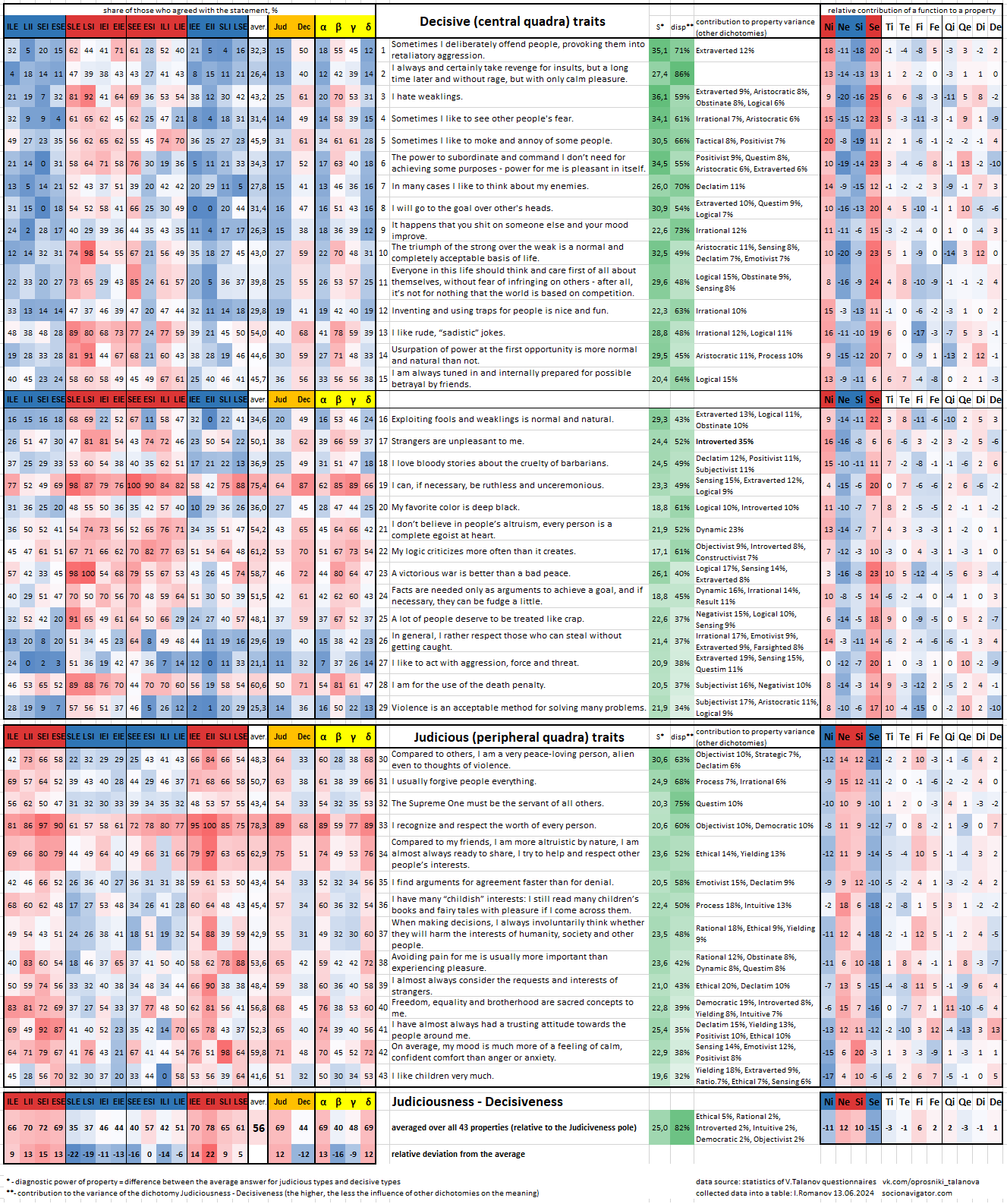
Judiciousness-decisiveness is the first of the dichotomies used in socionics, whose poles are not equal, and, in fact, one of them carries psychopathic personality traits. Why is this so? Just because someone decided so, based on the discordance and “politically incorrect” wording? Yes and no.
The fact that one of the poles of the dichotomy is more pathological than the other can be recognized by a number of indirect, but at the same time quite formalizable signs.
1. Questions on one pole of the dichotomy give generally higher profiles than questions on its other pole. That is, translating into everyday language, the formulations indicating the presence of a certain personality trait cause much stronger and more vivid emotions in people than its absence. And it doesn’t matter whether it is the emotion of lust or rejection, the main thing is that the absence of a property is usually perceived more indifferently. Like, yes, it happens, and it’s generally normal, so it’s not even worth focusing on this. BUT THIS…
2. The most diagnostically powerful questions (with the highest profiles) on this dichotomy have a clear shift in the average response. That is, the majority of people choose one option, which is essentially “more normal” because of this majority choice, while the minority chooses the second - which is why it becomes “less normal”. Even in those types that belong to the “less normal” pole a significant part of people do not recognize the existence of values of this pole, while in the types belonging to the opposite pole the share of “detractors” is much smaller.
3. When dividing society into type groups, one of the poles of the dichotomy - the “less normal” one - is most clearly manifested only in a smaller part of the types (within the limit of one or two), while the second, “more normal” pole is blurred and its manifestations are scattered over many types at once. That is, it is inherent in the very structure of the typology that the presence of a certain property is already enough to distinguish a group of people with it as special and separate, whereas its absence implies the emergence of other personality traits that are not related to this dichotomy at all, and the dispersion of attention on the variety of possible options.
As we see, for the pole of decisiveness all these properties are quite observed:
1. Questions on decisiveness generally have higher profiles (the value of the digits in column S) than questions on judiciousness;
2. The most “pure” (without semantic additions from other dichotomies) questions on judiciousness - decisiveness have the average of answers clearly shifted towards judiciousness;
3. Out of 16 types, only 5 or 6 are actually decisive, while the rational dyad of Gamma and, in some question collections, IEI, rather fall out of the decisive group into the neutral area.
In sum, what can we say about such dichotomies associated with psychopathic personality traits?
Their very existence tells us that the human population is not at all a blissful place where the needs of all can in principle be somehow taken into account, mutually satisfied and, as a result, anyone can live a personally happy life.
No, the population is clearly and steadily divided in some aspects into larger and smaller parts, and this, as far as we know from evolutionary biology, is only possible if there is an inequality of relations within the ecosystem.
In the case of judiciousness and decisiveness it is quite possible to say that among people there is always a group of conditionally “herbivores”, i.e. producers, who collect the resources scattered in the surrounding world and process them for a long time. And there is a group of conditional “predators” who are able to deftly take away from the majority and keep what this majority has laboriously collected and grown.
As in any ecosystem, the highest trophic level is always much less numerous than the lowest level - simply because energy is lost during the transition between levels, and if the predators become too numerous, they eat all the herbivores and then die out due to starvation. Everything is the same in human society, only human “predators” eat not bodies, but more and more time and the fruits of other people’s labor; and lives - only as a last resort (although, as you can see around, sometimes it comes… ).
The general cycle of development of societies in this regard is seen as wave-like/undulating. A certain catastrophe in one way or another frees society from a group of the most “decisive” psychopaths with their destructive ambitions for the common good. After that, the life of the layman gradually gets better, and due to the labor of individuals according to their “judicious” functions, the amount of free resources in society begins to grow. These resources are appropriated by the “decisive” and are gradually raked up into “heaps”, each of which has its own owner.
When the “heaps” become too large, the owners of the largest of them form their personal armies to defend their property. Gradually, one group seizes all power and becomes a monopoly over a certain territory.
The larger the territory seized, the higher the pyramid of power, the more difficult it is to get to its top, and the more likely it is that over time pronounced psychopaths will accumulate on this top (because others simply will not be able to get there and hold on). However, the more psychopathic the power is, the greater the risks it allows, and sooner or later it collapses the whole pyramid - either as a result of eating up the entire food base and thus losing opportunities for development, or simply the decapitation of the system, which has become over-centralized and therefore especially vulnerable to pinpoint effects on its governing center.
Ultimately, such emergence, ascent and destruction of pyramids concentrating property and power seems to be an endless and fundamentally irreversible process. Yes, it can be somewhat mitigated by the external environment, if it is too poor and does not produce enough resources (or technologies are not developed enough to extract them). In conditions of a poor environment, ecological pyramids are lower and smaller, and predators also become smaller and are not afraid to switch to omnivorousness on occasion. In human societies living in the harsh conditions of the far North, deserts or highlands, equality is more common at the everyday level.
So, perhaps, the exhaustion of “free” mineral deposits in the case of modern society will have a favorable effect on its future fate and will help to avoid self-extinction. But is this what we want - equality in poverty?
Is it possible to consciously, effectively, and most importantly, long-term, that is, not amenable to internal corruption, control over the distribution of resources in a relatively rich society? It is unknown. In nature, herbivores have never managed to negotiate and exterminate, or at least somehow limit the predators in their ecotope. Even if we take into account that in our case we are talking about representatives of the same species, and a social species at that, it is not a fact that the propensity of some people to “eat” other people’s time and fruits of labor has a simple opposition from those who are not inclined to it. Any hasty and seemingly simple decisions here can lead to the destruction of one pyramid of power, but the rapid construction of another on its ruins.
The gradual selection of societies in the absence of resource “freebies” can eventually change not only the culture, but even the genotype in the direction of greater “judiciousness”, but this is a long process, moreover, requiring significant political fragmentation / separation of sources of power. In the current conditions, all of this seems contrary to the prevailing trends and therefore unrealistic in the medium term.
What remains judicious in such conditions? Everything is the same as always: either the search for patronage, or withdrawal into inconspicuous peripheral spheres of activity, which do not bring in large revenues and therefore are not yet particularly bureaucratized and not planted with parasitic crooks, or the search and creation of new spheres of activity, which at first look “frivolous” and therefore do not attract the attention of those in power.